Who Can Guard Tessa? How Tessa Johnson’s 32-Point Night Revived a Gamecocks Rallying Cry
Nine months after LSU coach Kim Mulkey’s unforgettable sideline question became part of South Carolina basketball culture, Tessa Johnson supplied another emphatic response against UConn.
Women’s Showcase
Some basketball slogans are carefully planned by marketing departments. South Carolina’s most recognizable question about Tessa Johnson came from an opposing head coach trying to solve a defensive problem.
On November 24, 2026, Johnson scored a career-high 32 points as top-ranked South Carolina defeated No. 7 UConn 65–56 in the Basketball Hall of Fame Women’s Showcase at Mohegan Sun Arena in Uncasville, Connecticut.
The performance brought renewed attention to a phrase that had already become part of Gamecock Nation’s basketball vocabulary: “Who can guard Tessa?” Originally directed toward LSU players by Kim Mulkey in February, the question has evolved into an affectionate, competitive expression of confidence in South Carolina’s number 5.
Its return to the basketball conversation connects the latest performance with the established visual culture of the South Carolina Gamecocks collection and the wider NCAA fan community .
Three different graphic interpretations preserve this unusual journey from sideline frustration to team solidarity, childhood-photo humor and contemporary women’s basketball apparel.

Where Did Who Can Guard Tessa Come From?
The phrase originated during South Carolina’s February 14, 2026 game against LSU. Johnson made four early three-pointers, creating a significant defensive challenge for the Tigers.
During a timeout, LSU head coach Kim Mulkey asked her players who could guard Tessa. The moment was captured during the game and quickly became recognizable among South Carolina basketball supporters.
Johnson finished with 21 points as the Gamecocks defeated LSU 79–72. Reporting published by The State documented both Mulkey’s question and Johnson’s importance to South Carolina’s victory.
The question was originally a practical coaching instruction. Mulkey needed a defensive answer to Johnson’s perimeter scoring. Its later meaning emerged from the way South Carolina supporters interpreted the moment.
What began as an opponent’s attempt to organize a defense became a rhetorical expression of admiration for the player creating that problem.
How Chloe Kitts and a Childhood Photograph Turned the Quote Into a Shirt
The most memorable visual development occurred during South Carolina’s NCAA tournament campaign in March 2026.
On March 23, teammate Chloe Kitts appeared wearing a shirt that combined Mulkey’s question with a childhood photograph of Johnson. The image provided an unexpected contrast with the competitive basketball reputation behind the slogan.
Coverage by The State via Yahoo Sports documented how the phrase moved from a sideline exchange into the clothing worn by teammates and supporters.
Johnson also discussed the shirt during an NCAA tournament press conference in Sacramento. She explained that Kitts wore the graphic as a gesture of teammate support and recalled that her mother may have supplied the childhood image for a team-related activity.
The tournament press conference transcript provides Johnson’s own perspective on the graphic and the supportive relationship behind it.
The childhood portrait is therefore not simply an arbitrary visual addition to a basketball meme. It connects a public competitive moment with a more personal expression of teammate affection.
Kim Mulkey asks who can defend Tessa during LSU’s game against South Carolina. Johnson scores 21 points in a 79–72 victory.
Chloe Kitts wears a graphic pairing Johnson’s childhood photograph with the recognizable question during South Carolina’s tournament run.
Johnson scores 32 points as South Carolina defeats UConn, giving the established rallying cry a fresh basketball context.
Tessa Johnson Scores a Career-High 32 Points Against UConn
The November 24 matchup supplied an especially compelling reason for the phrase to return. Johnson accounted for 32 of South Carolina’s 65 points, nearly half of the team’s total offensive production.
The official Southeastern Conference game report credited Johnson with six rebounds alongside her career scoring mark. South Carolina’s Agot Makeer contributed another 12 points.
| Team | Q1 | Q2 | Q3 | Q4 | Final |
|---|---|---|---|---|---|
| South Carolina | 11 | 27 | 9 | 18 | 65 |
| UConn | 16 | 6 | 13 | 21 | 56 |
South Carolina’s decisive second quarter transformed the contest. After trailing by five points through the opening period, the Gamecocks outscored UConn 27–6 in the second.
Johnson finished 10-for-24 from the field, including three made three-pointers. She converted nine of her ten free-throw attempts. Those numbers demonstrate that the scoring performance was not dependent exclusively on perimeter shooting.
Her ability to contribute through different scoring situations became particularly valuable as South Carolina worked to preserve its lead. She also recorded three steals, adding defensive production to the career-high scoring night.
For the Gamecocks, it was a significant early-season victory against a nationally recognizable opponent. For Johnson, it supplied another documented performance behind a slogan that already carried considerable cultural meaning.
The team also celebrated Johnson’s performance through its official Instagram account, featuring her recognition following the victory.
Why Gamecock Nation Brought Back the Who Can Guard Tessa Meme
A memorable sports phrase becomes especially durable when subsequent performances provide new reasons to repeat it. Johnson’s November game against UConn illustrates that process.
The words were already familiar from the LSU matchup and the tournament clothing phenomenon. The new scoring milestone allowed supporters to revisit the same question without needing to invent an entirely different basketball slogan.
In the postgame discussion, multiple participants repeated the established Tessa question. Other comments praised her performance and discussed South Carolina’s defensive contribution to the victory.
The response was not confined to a general interest in basketball highlights. Supporters were explicitly reconnecting the career night with a phrase established during the preceding season.
These discussions demonstrate continued use of the slogan after the UConn performance. They do not establish that every graphic variation has achieved the same level of popularity or official status.
Three Who Can Guard Tessa Shirt Designs and the Stories Behind Them
Ellie Shirt’s three interpretations approach the same basketball phrase through different visual traditions. One emphasizes the recognizable childhood photograph. Another incorporates Johnson’s number 5 into a typographic basketball composition. The third simplifies the question into a collegiate rallying cry.
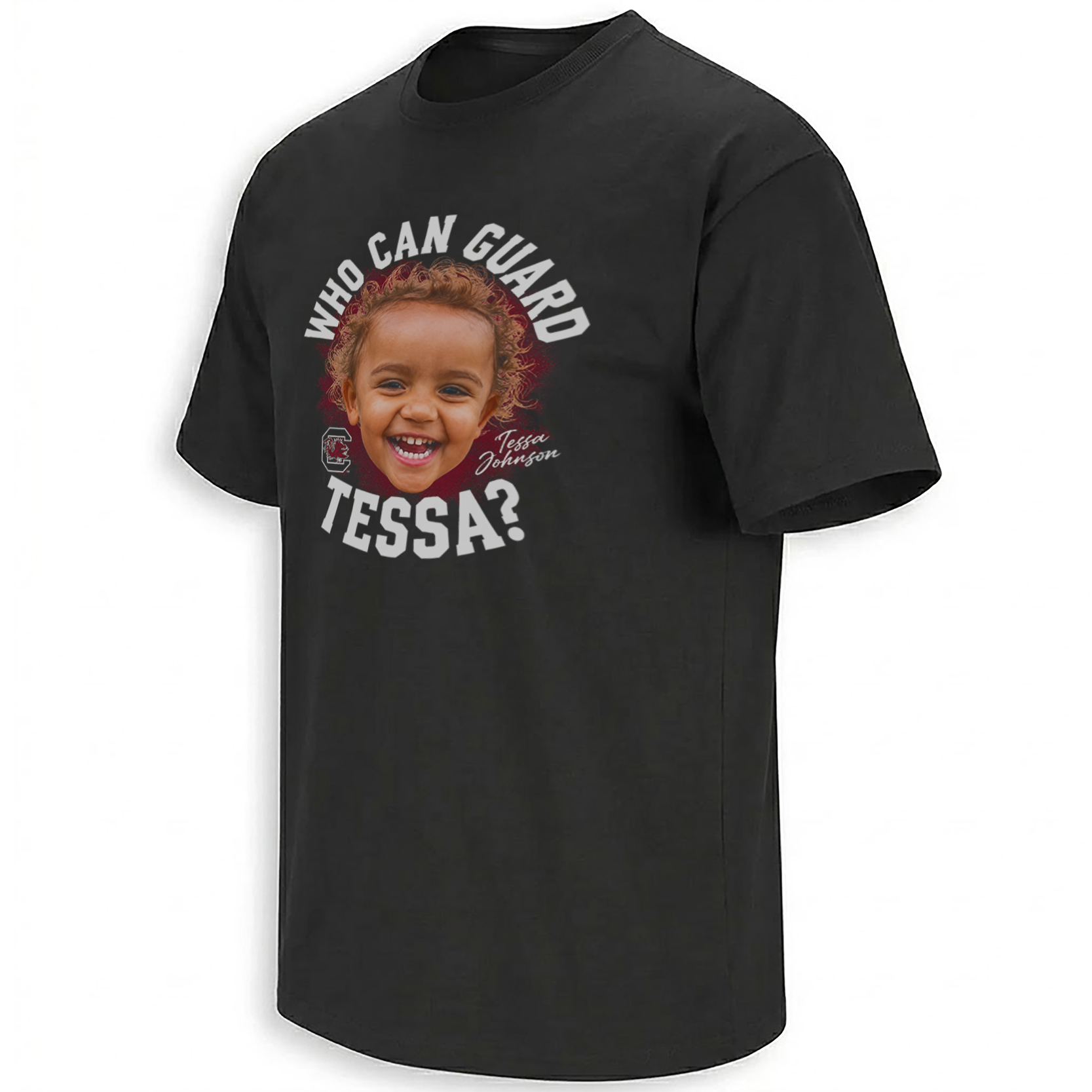
A nostalgic childhood-photo composition inspired by the graphic phenomenon associated with Chloe Kitts and South Carolina’s March 2026 tournament campaign. The portrait connects the competitive slogan with its affectionate teammate support story.
Explore the childhood photo design →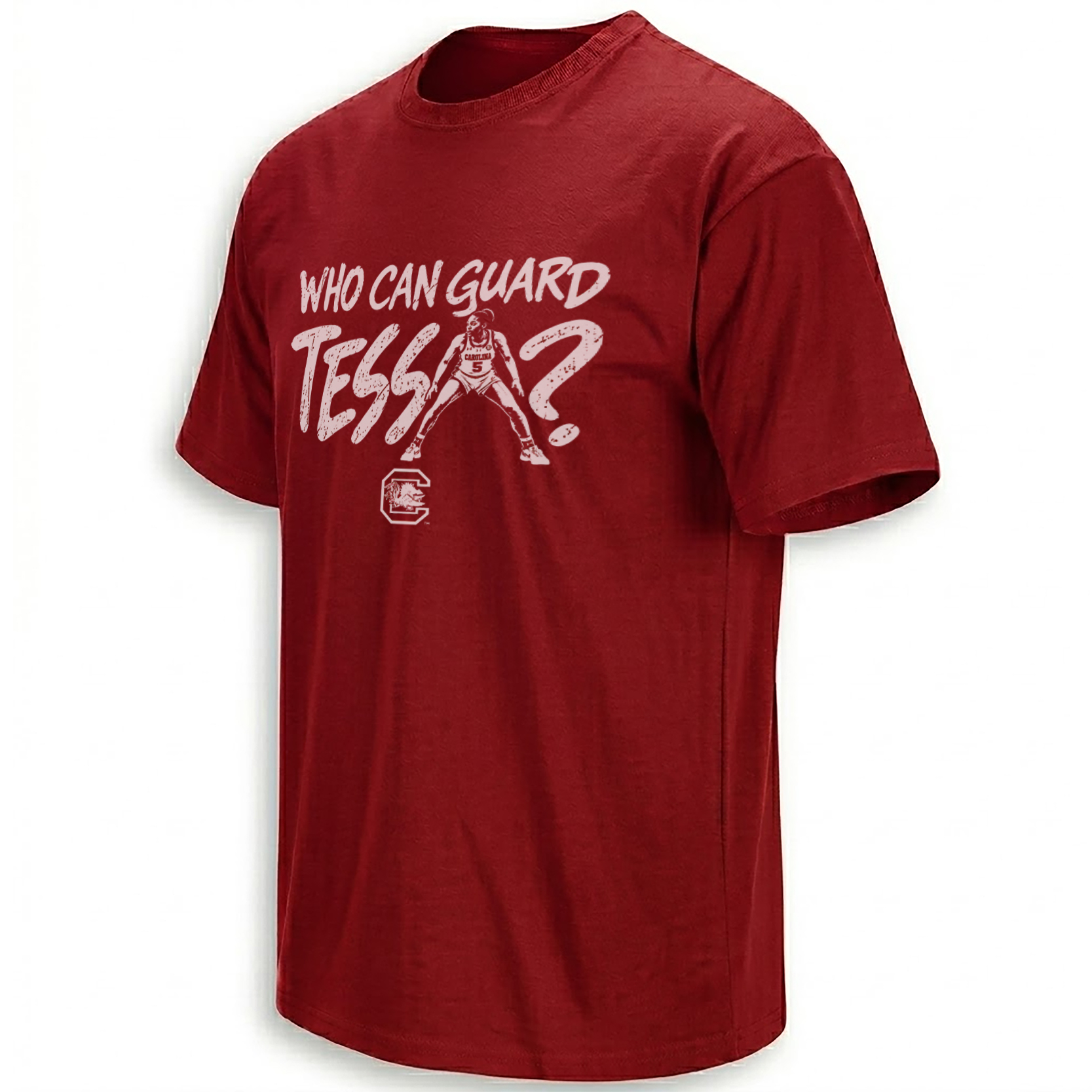
Distressed athletic lettering incorporates a number 5 basketball figure into Johnson’s name, connecting her on-court identity with the established fan phrase.
Explore the No. 5 design →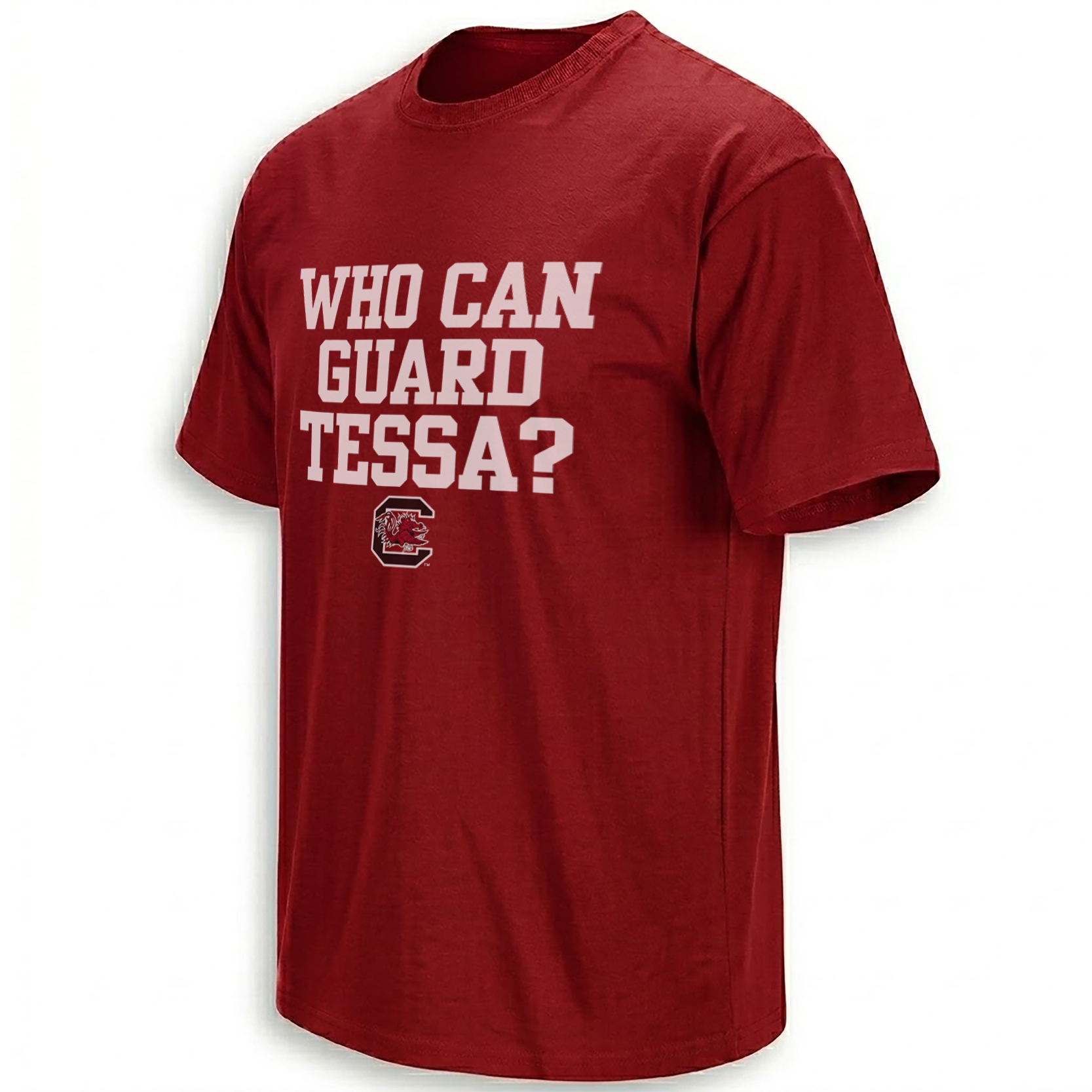
Bold white collegiate lettering, a garnet foundation and the recognizable South Carolina Block C create a direct slogan-centered graphic.
Explore the varsity design →How the Three Designs Interpret Tessa Johnson Differently
The childhood-photo version is the most directly connected to the documented March tournament phenomenon. Its emotional foundation is the combination of competitive confidence and the affectionate imagery associated with Johnson’s teammates.
The number 5 composition moves toward a more conventional athlete-centered basketball graphic. By integrating the player figure into the typography, it allows the visual identity and wording to become part of the same arrangement.
The varsity version removes most of the individual portrait emphasis. Its subject is the phrase itself, presented through visual conventions associated with collegiate basketball apparel.
The childhood portrait references the affectionate visual humor that emerged during the NCAA tournament.
Number 5 and the basketball figure emphasize Johnson’s recognizable on-court presence.
Varsity typography transforms the question into a direct expression of Gamecock basketball culture.
The different compositions demonstrate how the same cultural reference can support multiple visual interpretations without requiring a different origin story for each.
Why Number 5 Has Become Central to the Graphic Language
Johnson’s South Carolina jersey number provides a compact visual reference to her basketball identity. Supporters who recognize the number can connect the graphic with the player before reading the complete slogan.
Athletic typography serves a similar purpose. Broad letterforms, distressed surfaces and collegiate arrangements establish the visual context of basketball apparel.
Garnet and white connect the artwork to South Carolina, while the individual figure, childhood portrait or varsity lettering distinguishes each version.
For readers exploring other graphics connected to Johnson’s basketball career, the Tessa Johnson design archive gathers different visual interpretations of her recognizable Gamecocks identity.
From an Opponent’s Timeout to Gamecock Nation’s Shared Language
The Who Can Guard Tessa story illustrates the ability of basketball communities to transform ordinary competitive language into a lasting cultural reference.
Mulkey’s original question was addressed to her own players. Its reinterpretation belonged to South Carolina supporters, Johnson’s teammates and the wider women’s college basketball audience.
The childhood-photo shirt introduced a personal layer, while Johnson’s subsequent performances supplied new sporting context. Her November career night demonstrates why the phrase remains connected to actual basketball achievement rather than existing solely as internet humor.
Frequently Asked Questions
Who originally said Who Can Guard Tessa?
LSU head coach Kim Mulkey asked the question during a timeout in LSU’s game against South Carolina on February 14, 2026.
How many points did Tessa Johnson score against LSU when the quote originated?
Johnson scored 21 points, including four three-pointers, in South Carolina’s 79–72 victory over LSU on February 14, 2026.
Who wore the original Who Can Guard Tessa childhood photo shirt?
South Carolina teammate Chloe Kitts was photographed wearing the childhood-photo graphic on March 23, 2026, during the Gamecocks’ NCAA tournament campaign.
Why does the Who Can Guard Tessa shirt feature a childhood photograph?
The childhood portrait provides a humorous and affectionate contrast with Johnson’s competitive basketball reputation. Johnson described Kitts’ wearing of the graphic as a gesture of teammate support.
How many points did Tessa Johnson score against UConn in November 2026?
Johnson scored a career-high 32 points on November 24, 2026, helping South Carolina defeat UConn 65–56.
What were Tessa Johnson’s statistics against UConn?
Johnson recorded 32 points, six rebounds and three steals. She made 10 of 24 field-goal attempts, three three-pointers and nine of ten free throws.
What jersey number does Tessa Johnson wear?
Tessa Johnson wears number 5 for the South Carolina Gamecocks women’s basketball team.
What is the difference between the three Who Can Guard Tessa designs?
The first emphasizes Johnson’s childhood portrait, the second incorporates a number 5 basketball figure into the typography, and the third uses bold varsity lettering with South Carolina visual references.
Did the Who Can Guard Tessa meme begin during the UConn game?
No. The phrase originated during the February 2026 LSU game and became associated with shirts during the March tournament. Johnson’s November UConn performance renewed interest in the existing slogan.
Why is Who Can Guard Tessa important to Gamecock Nation?
The phrase connects Johnson’s competitive performances, teammate support and South Carolina’s basketball fan culture through a recognizable shared expression.
- Southeastern Conference — South Carolina defeats UConn , November 24, 2026.
- University of Connecticut Athletics — Official November 24 Game Center .
- ABC Columbia — Johnson’s career high lifts Gamecocks to win over UConn .
- The State — Raven Johnson and Tessa Johnson help South Carolina beat LSU , February 15, 2026.
- The State via Yahoo Sports — How a Kim Mulkey quote landed on South Carolina fans’ shirts .
- The State / AOL — How a Kim Mulkey comment turned into a viral T-shirt .
- NCAA Tournament Press Conference — Tessa Johnson discusses the childhood-photo shirt .
- South Carolina Women’s Basketball — Career-high scoring update .
- Gamecock Women’s Basketball — Postgame celebration .
- Reddit — South Carolina vs. UConn postgame discussion .
From the childhood-photo interpretation to the number 5 basketball graphic and the varsity slogan edition , three designs preserve different aspects of the same basketball story. Explore the South Carolina Gamecocks collection for other visual records of Gamecock Nation’s evolving basketball culture.
Who Can Guard Tessa? began with Kim Mulkey’s February 2026 sideline question, developed into a childhood-photo shirt phenomenon during South Carolina’s NCAA tournament campaign, and returned to the spotlight after Tessa Johnson’s career-high 32 points against UConn on November 24. Three graphic interpretations preserve the story through nostalgic portrait artwork, number 5 basketball imagery and garnet-and-white collegiate typography.