We On the Same Freakuency: When Joy Division’s Most Famous Signal Became a Relationship Meme
A phrase about two weird people matching each other, two embracing ape-like creatures and one of the most recognizable black-and-white images in music history should not fit together this cleanly. That incompatibility is exactly why the meme works.
“We on the same freakuency” belongs to a specific branch of internet romance: the moment two people realize they are not merely compatible, but compatible in some slightly embarrassing, overly specific or completely incomprehensible way.
The spelling does almost all of the verbal work. “Frequency” becomes “freakuency,” turning the normal idea of being on the same wavelength into an admission that both people are operating at the same level of weirdness.
Versions of the phrase were already circulating through meme and GIF culture in 2025. New iterations continued appearing in 2026 — cats, surreal images and relationship graphics — which makes the wording feel less like one fixed meme template and more like reusable internet language.
THE JOKE SAYS “WE MATCH.” THE IMAGE SAYS “OUR WEIRDNESS IS LITERALLY BENDING THE SIGNAL.”
The Joy Division Reference Is More Literal Than It Looks
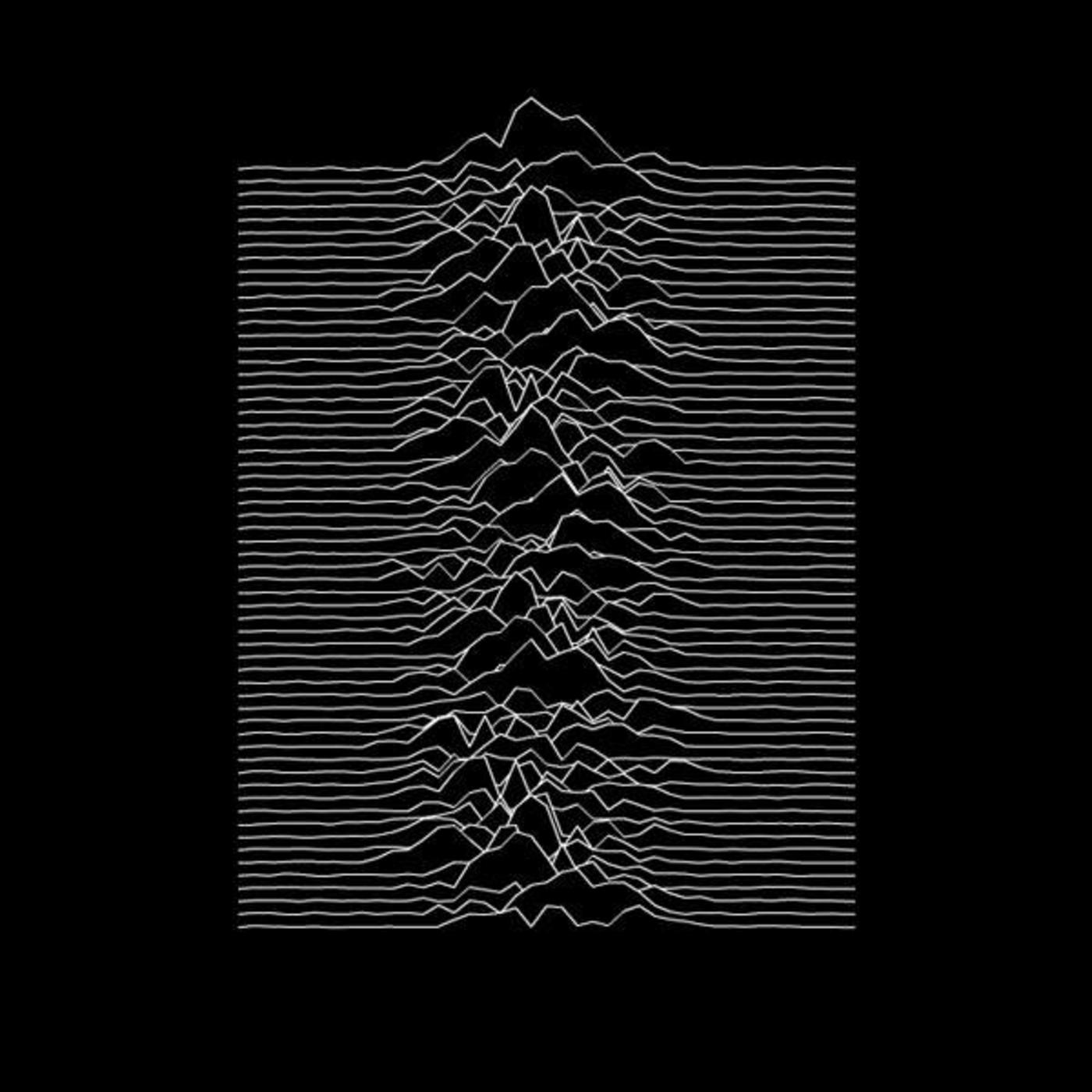
The central wave pattern immediately recalls Joy Division’s 1979 debut album, Unknown Pleasures. Peter Saville’s sleeve transformed a scientific image into one of music culture’s most enduring pieces of minimalist design.
The original stacked lines represent successive radio pulses from CP1919, the first pulsar discovered. The data image appeared in scientific sources before Bernard Sumner encountered it and brought it into the visual world of Joy Division.
That scientific origin accidentally makes “same freakuency” one of the smarter possible jokes to attach to the design. The album image already represents a signal. The meme is about two people sharing a signal.
Then the Internet Put Two Apes Inside the Signal
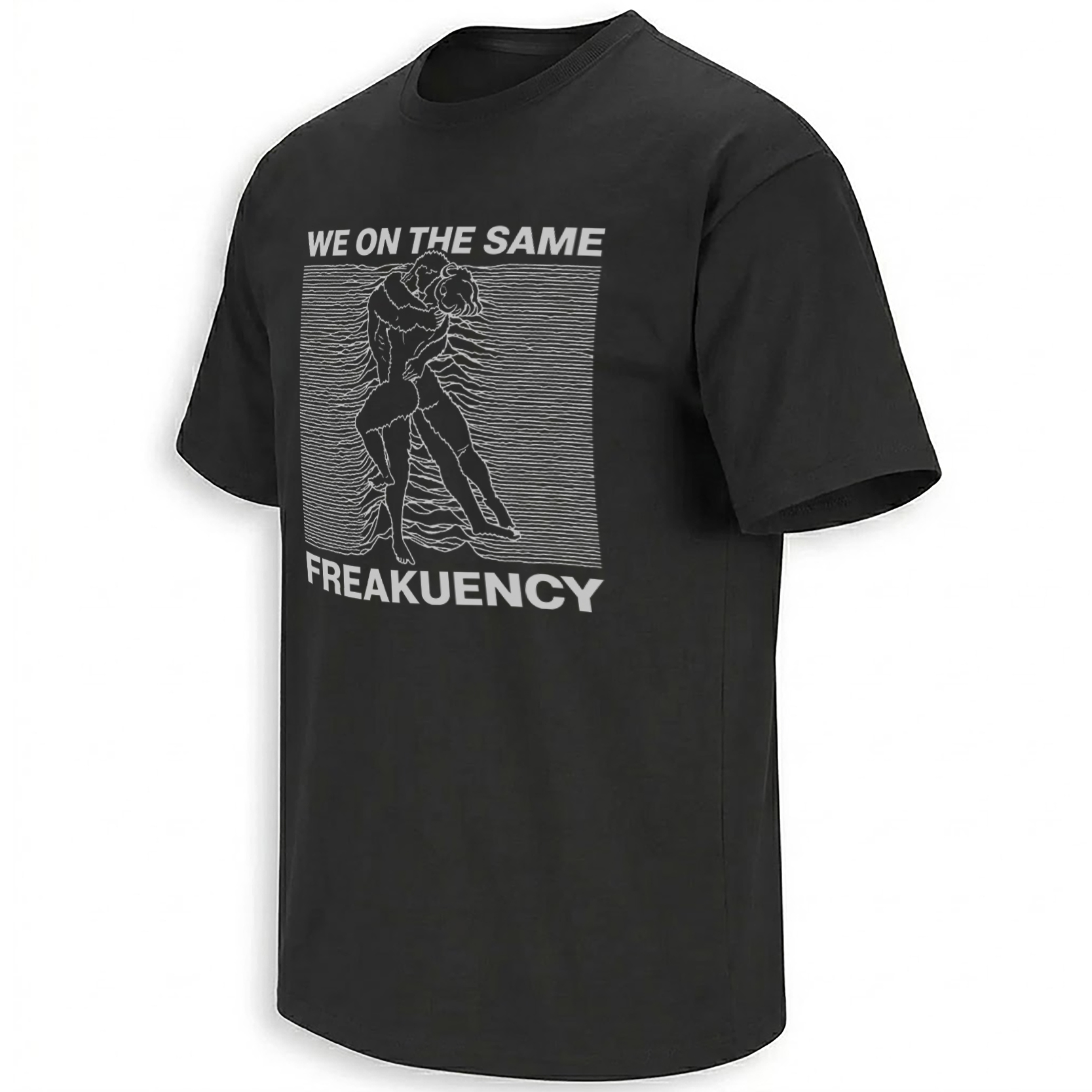
The Ellie Shirt design does not simply place meme text above the original waveform. It changes the center of the signal completely.
Two shaggy, ape-like humanoids hold each other in a close embrace. Horizontal white lines run across the black field, then bend and deform around the bodies as though the pair is physically interfering with the transmission.
That distortion provides the visual punchline. They are not just on the same frequency. Their freakuency is strong enough to change the frequency itself.
Using polished human romance photography would kill the joke. The creatures make the intimacy deliberately strange, allowing the design to sit somewhere between couple meme, cryptid humor, cursed internet image and post-punk parody.
Unknown Pleasures Became Bigger Than a Band Shirt
One reason the reference works so easily is that the waveform has escaped the boundaries of the original album. It has appeared on posters, tattoos, fashion, data visualizations and endless parodies in which the central pulse is replaced by mountains, skylines, fictional characters and other shapes.
That does not make every use a Joy Division shirt. In fact, the Freakuency graphic works specifically because it is not a normal band design. There is no Ian Curtis portrait, no track list and no giant “JOY DIVISION” wordmark.
Instead, it borrows the design language and lets the viewer decide how much of the reference they recognize. Someone can understand the weird-couple joke without knowing Unknown Pleasures. A Joy Division listener gets an additional layer.
Why “Same Freakuency” Works as Relationship Language
Internet relationship language increasingly rewards specificity over traditional romance. “Soulmate” is sincere but broad. “We share the same obscure joke nobody else understands” feels more personal.
That is the emotional engine underneath this meme. Two people can be on the same freakuency because they have identical bad humor, send each other bizarre images at 2 a.m., recognize the same hyper-specific references or simply make one another behave noticeably stranger.
The phrase therefore works equally well for romantic partners and friendships. It describes compatibility through shared oddness rather than conventional sweetness.
From Pulsar Data to Brainrot in One Graphic
There is something almost perfect about the cultural journey. Scientific radio data becomes an astronomy diagram. The diagram becomes a 1979 post-punk album sleeve. The album sleeve becomes a global design icon. Decades later, that icon becomes the visual scaffolding for two hairy meme creatures embracing under a misspelled relationship slogan.
That is not cultural decline. It is exactly how internet visual language behaves: recognizable symbols get detached, remixed and given completely new emotional jobs.
The design belongs naturally in Ellie Shirt’s Music collection because the visual reference remains rooted in Joy Division, while the Newest collection captures its internet-meme side. Readers following the specific musical reference can also browse Joy Division-related designs.
Frequently Asked Questions
What does “We On the Same Freakuency” mean?
It is a joke based on “being on the same frequency,” with “freakuency” suggesting two people share the same unusual humor, personality or romantic weirdness.
Why is “freakuency” misspelled?
The altered spelling combines “freak” and “frequency,” creating the central meme punchline.
Is the design inspired by Joy Division?
Yes. Its stacked white signal lines visually reference the famous Unknown Pleasures aesthetic.
What are the lines on the original Unknown Pleasures cover?
They derive from a scientific visualization showing successive radio pulses from pulsar CP1919.
Are the ape-like characters specific people?
No. The artwork presents them as anonymous surreal meme figures whose embrace represents two people operating on the same strange wavelength.
The We On the Same Freakuency design takes one of music culture’s most recognizable waveforms and gives it a completely new job: explaining what happens when two weird people find exactly the right weird person.
We On the Same Freakuency Shirt combines surreal couple humor, embracing ape-like figures and Joy Division-inspired Unknown Pleasures signal waves into a monochrome internet meme about two people sharing exactly the same weirdness.