The Sims Online and the “Be Somebody Else” Era
Before digital identity became a conversation about the metaverse, The Sims Online invited players into a virtual neighborhood where another version of themselves could have an entirely different life.
In December 2002, Electronic Arts took one of PC gaming’s most recognizable experiences and introduced a remarkable new possibility: the people living next door to your Sim could be actual people. The Sims Online was built around that simple but ambitious premise. The familiar life simulation had become a shared social world.
Its marketing condensed the experience into three unforgettable words: “Be Somebody. Else.” Even the punctuation was part of the joke. Instead of promising another adventure, another battle or another level, the campaign offered another identity.
Nearly twenty-four years after the game’s launch, that invitation still feels strikingly modern. Online avatars, virtual social spaces and curated digital personalities are everyday concepts now. The Sims Online explored their emotional appeal when meeting strangers through a computer-generated person still felt unusual.
A Virtual Neighborhood Before Social Media Took Over
The original Sims allowed players to build households, manage relationships, pursue careers and experiment with human behavior. Its appeal came from the freedom to observe or interfere with the rhythms of ordinary domestic life.
The Sims Online changed a crucial part of that formula. Players were no longer simply directing a household of simulated personalities. They could communicate with other human players, develop reputations, visit properties and participate in social activities inside a persistent online environment.
Electronic Arts announced the game’s release on December 17, 2002, presenting it as a multiplayer extension of the immensely popular Sims franchise. That timing matters. MySpace had not yet launched, Facebook was still in the future, and social networking had not become the default language of online life.
The idea of a virtual community was not entirely new, but The Sims Online offered a distinctive interpretation of it. Instead of fantasy warriors and monsters, its world revolved around familiar activities: socializing, decorating, earning money and becoming known by the people around you.
The Original Avatar Experience
For many players, the most memorable part of an online world begins before the first conversation. It starts with deciding what the character should look like, how they should dress and what impression they should make.
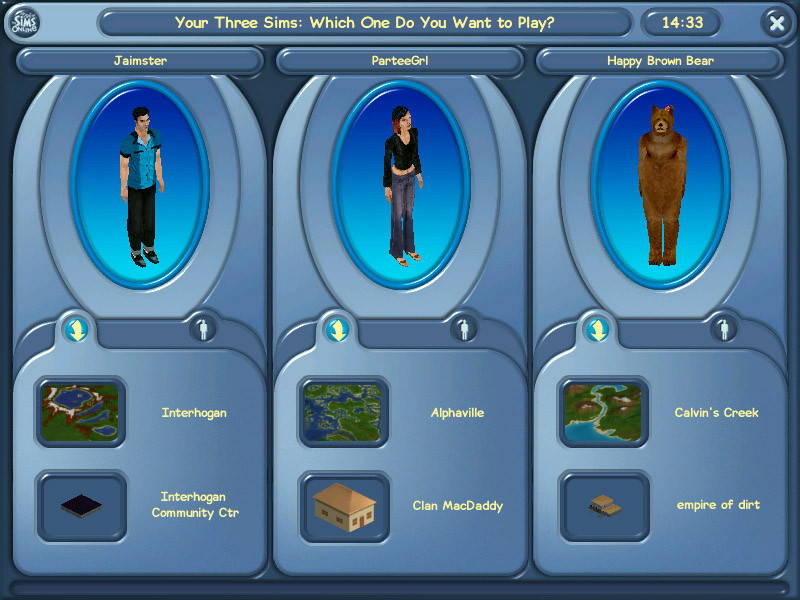
The character selection interface makes the game’s premise visible. Different Sims appear as potential selves, each with their own appearance and personality implied by the presentation. Choosing one is not quite like selecting a combat class or a sports roster. It is closer to deciding who you want to be at a virtual party.
That distinction is what gives early Sims imagery its lasting nostalgic appeal. The portraits, interface buttons, blue panels and expressive characters belong to a period when virtual worlds were imagined as exciting extensions of everyday life.
Why “Be Somebody. Else.” Was Such Effective Advertising
Most game slogans tell players what they can accomplish. This one suggested they could reconsider who they were. The period after “Somebody” interrupts the expected sentence and creates a deliberately awkward, memorable rhythm.
It also captures a contradiction at the center of online social life. Players might use their avatar to express their authentic personality, exaggerate one part of it or invent someone completely different. The game could accommodate all three approaches.
That was a compelling promise for a life simulator because identity was connected to almost every activity. The house you built, the friends you made and the role you played within your neighborhood all contributed to your virtual self.
Electronic Arts used the original “Be Somebody. Else.” campaign language in its December 17, 2002 launch announcement. Read the historical EA press release reproduced by SimsNetwork.
The Raglan Graphic as an Early-Internet Artifact
The Be Somebody Else Shirt draws directly on that era of online experimentation. Its visual center combines five weathered avatar portraits with The Sims Online branding and large distressed red lettering.
The graphic deliberately resembles an object recovered from the early 2000s rather than a newly polished gaming advertisement. The distressed finish gives the characters and typography the appearance of a print that has survived years of use.
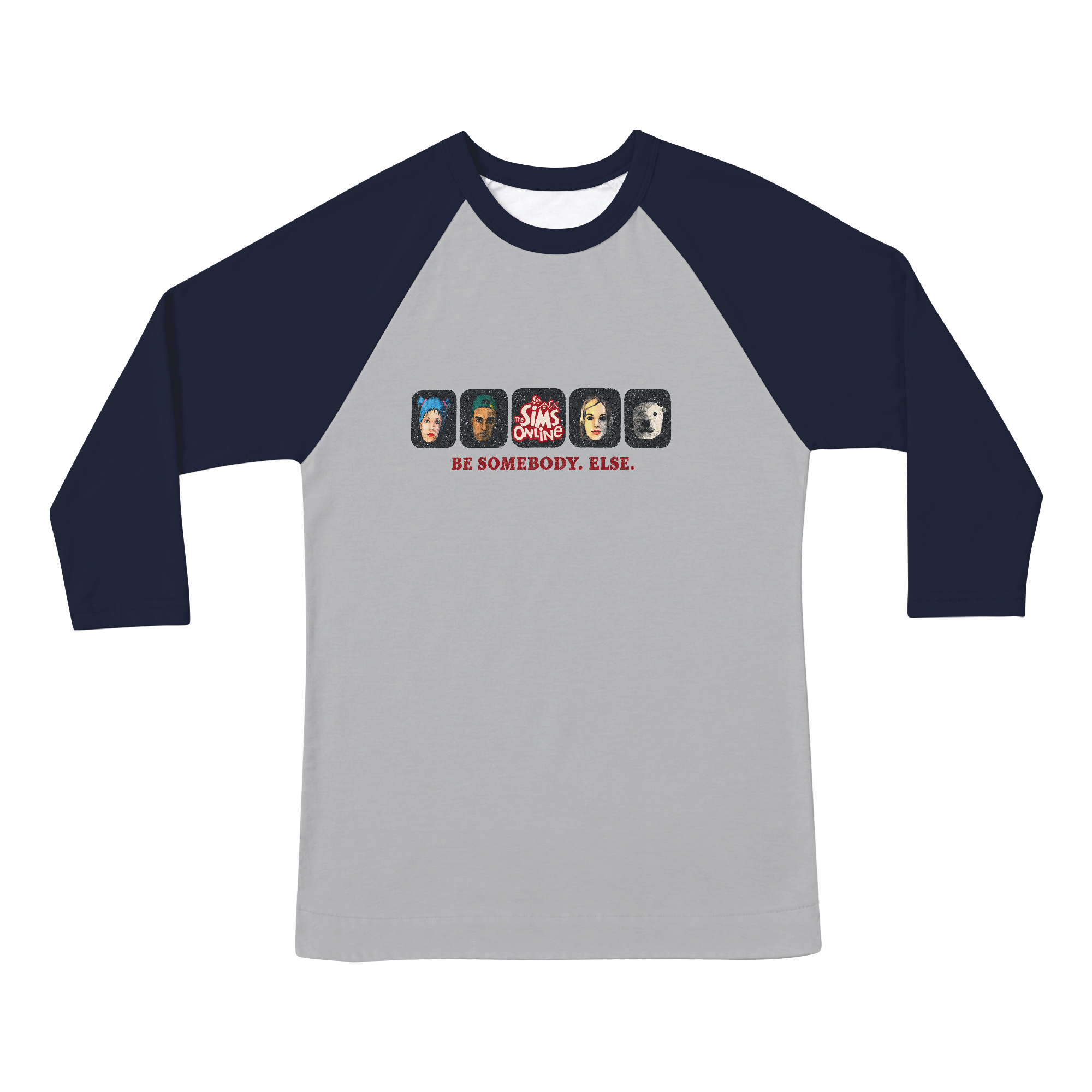
A visual callback to a specific moment when online characters represented possibility, experimentation and an emerging form of internet community.
Explore the archival graphic →The raglan format reinforces that nostalgic mood. Its casual, old-school silhouette feels appropriate to a design rooted in the age of boxed PC games, internet forums, expansion packs and computer-room gaming sessions.
Why a Closed Virtual World Still Matters
The Sims Online did not develop into the enduring commercial success its creators hoped for. The project was eventually reworked under the EA-Land name, and the service officially closed on August 1, 2008.
Yet an online world’s commercial lifespan does not fully describe its cultural meaning. Players may remember communities, friendships, experiments and unexpected encounters long after the software itself becomes inaccessible.
That is one reason abandoned multiplayer environments occupy such an unusual place in gaming nostalgia. A single-player game can often be revisited through an old disc or modern re-release. A multiplayer world depends on the presence of other people. When the official service disappears, part of its original social context disappears with it.
The remaining screenshots and promotional materials therefore serve as records of an earlier idea of internet life. The clothing, character portraits and clunky interface details are not visual flaws to be erased. They are evidence of the period itself.
From Sims Nostalgia to Modern Digital Identity
Today’s players switch between game characters, social profiles and virtual communities with little ceremony. The Sims Online belongs to an earlier moment when those possibilities were still being marketed as something extraordinary.
Seen through that history, “Be Somebody. Else.” sounds less like a forgotten slogan and more like an early statement about the fluidity of online identity. Its message has outlived the particular technology that first carried it.
The broader Game & Gamers collection offers another way to explore how gaming references, old interfaces, memorable characters and community nostalgia find their way into contemporary graphic culture.
Frequently Asked Questions
What does “Be Somebody. Else.” mean in The Sims Online?
It was an original Electronic Arts marketing slogan inviting players to create a different virtual identity and participate in a shared online life.
When was The Sims Online released?
Electronic Arts announced the game’s release on December 17, 2002.
When did The Sims Online shut down?
The official service, later called EA-Land, ended on August 1, 2008.
Why is The Sims Online remembered today?
Its multiplayer social experiment, distinctive early-2000s visual identity and focus on virtual relationships make it a notable chapter in online gaming history.
What inspired the Be Somebody Else Shirt?
The design references the game’s original slogan, retro avatars, classic branding and visual atmosphere of early online simulation gaming.
The original servers are gone, but the invitation remains. The Be Somebody Else graphic preserves a small piece of the era when another online life felt like a brand-new possibility.
The Sims Online Be Somebody Else Shirt revisits the 2002 virtual identity campaign with vintage avatar portraits, distressed typography and the nostalgic aesthetic of early multiplayer social gaming.