
The Big Misiorowski
A 6-foot-7 pitcher, a fastball living beyond 100 mph and a movie reference Milwaukee fans understood immediately: Jacob Misiorowski had become the Brewers’ version of The Dude.
“The Big Misiorowski” did not emerge from a generic nickname generator. It arrived at the intersection of Jacob Misiorowski’s towering frame, his shortened “Miz” identity and a cult film whose title was almost waiting for baseball to complete the joke.
On July 26, 2026, Misiorowski delivered the performance that made the reference feel especially timely. Facing Colorado at American Family Field, the Milwaukee right-hander retired the first 14 hitters, struck out the first seven batters of the game and accumulated 12 strikeouts before completing five innings.
The Brewers won 11–2. Misiorowski allowed one run on one hit, issued no walks and improved to 11–4. The result was impressive; the manner in which he produced it looked almost unreal.
A start that moved at Misiorowski speed
Misiorowski struck out seven consecutive Rockies to open the game. After a flyout interrupted the sequence, he struck out the next five hitters, giving him 12 strikeouts among the first 13 outs he recorded.
Colorado did not place a runner on base until Cole Carrigg hit an opposite-field home run with two outs in the fifth. Misiorowski then completed the inning without allowing the game to drift into a larger rally.
The final pitching line—five innings, one hit, one run, no walks and 12 strikeouts—does not fully communicate the experience of watching it. His fastball repeatedly crossed 100 mph, compressing each plate appearance into a reaction test.
The performance felt less like a conventional pitching sequence and more like watching pins disappear frame after frame.
The movie reference supplies the humor. Misiorowski’s fastball supplies the reason Milwaukee can say it with complete seriousness.
Why “The Big Misiorowski” connects to The Big Lebowski
The name is an unmistakable play on The Big Lebowski, the 1998 cult film centered on Jeff “The Dude” Lebowski. The artwork borrows from the movie’s instantly recognizable visual world while replacing its laid-back bowling protagonist with Milwaukee’s unusually intense flamethrower.
The joke works because the words already fit. Misiorowski is widely shortened to “Miz,” while his 6-foot-7 frame makes “Big” a literal description rather than empty promotional language.
There is also a productive contradiction. The Dude is associated with calmness and an unhurried approach to life. Misiorowski’s pitches arrive with almost no time to process them. One character abides; the other attacks the strike zone at triple-digit speed.
Misiorowski is not simply another hard thrower
Velocity is the first thing viewers notice, but the July 26 start demonstrated why his appeal extends beyond radar-gun numbers. Retiring 14 consecutive hitters required him to convert raw speed into strikes, put-away pitches and repeatable command.
That distinction matters. A pitcher can create viral clips by reaching 103 or 104 mph, yet a starting pitcher must return to the mound inning after inning and continue solving the same lineup. Misiorowski paired spectacle with structure: no walks, one hit and a dozen strikeouts.
The performance also arrived during a season in which Milwaukee was managing the workload of a young starter with postseason importance. That context makes the five-inning burst more meaningful. He did not need a complete game to dominate the afternoon; he created separation before the Brewers’ offense turned the result into a rout.
From prospect spectacle to Milwaukee character
When Misiorowski reached the Major Leagues in 2025, much of the conversation centered on novelty: the extreme velocity, the long frame and the immediate flashes of historic dominance.
By 2026, that framing had begun to change. He was no longer interesting only because he could throw harder than almost everyone else. He had become part of the personality of a contending Brewers team.
This is where a nickname-based design can document more than a player’s statistics. “The Big Misiorowski” shows the moment when Milwaukee’s ace became recognizable enough to support his own cultural shorthand. Fans no longer needed an explanation of who “Miz” was before understanding the punchline.
Why the design feels like a cultural timestamp
The strongest sports graphics connect multiple communities at once. A baseball fan sees the pitcher, uniform colors and No. 32. A movie fan recognizes the title construction and bowling-culture reference. A Brewers fan understands why this particular player is large enough—in stature, velocity and presence—to occupy the role.
The design therefore does not simply state that Misiorowski throws hard. It gives his rise a character: Milwaukee’s towering Dude, calmly existing at the center of a game that moves violently whenever the ball leaves his hand.
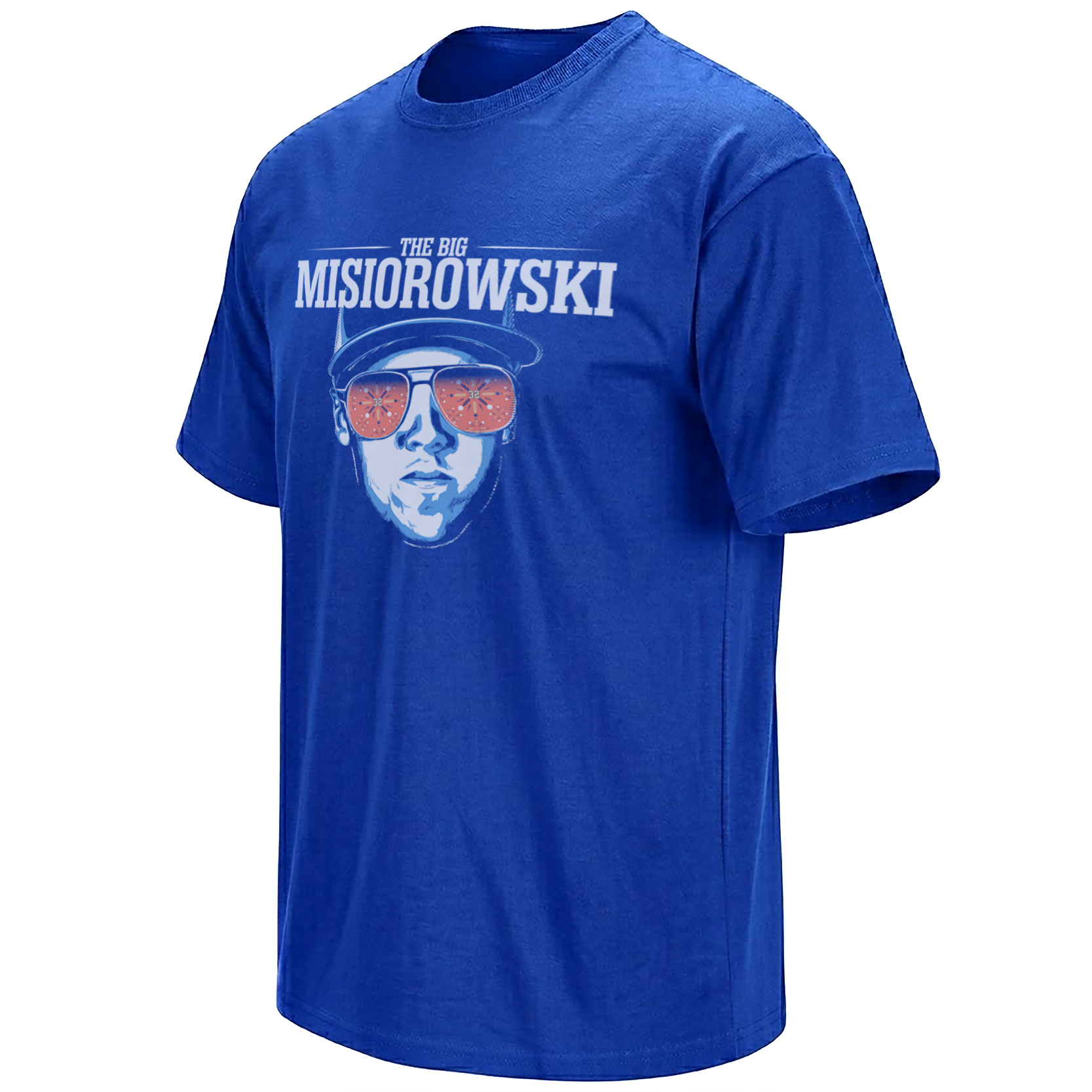
The Big Misiorowski Shirt
A movie-inflected portrait of the 6-foot-7 Milwaukee ace whose 100-mph arsenal turned a Sunday start into a 12-strikeout spectacle.
Milwaukee has found its Dude
Misiorowski’s July 26 performance supplied the perfect release point for the phrase. Seven consecutive strikeouts established the mood. Twelve strikeouts made it memorable. The one-hit pitching line gave the joke competitive substance.
“The Big Misiorowski” works because it feels discovered rather than manufactured. His name, body type, nickname and pitching personality align naturally with the reference.
It is both a movie parody and a baseball declaration: amid the velocity, expectations and noise surrounding Milwaukee’s young ace, the Miz abides.
Readers can discover more player-driven designs through the verified Milwaukee Brewers collection, explore the wider MLB collection, or browse the latest cultural releases in Newest.
Frequently Asked Questions
What does The Big Misiorowski mean?
The phrase combines Jacob Misiorowski’s surname with the title of the cult film The Big Lebowski. It also reflects the Brewers pitcher’s 6-foot-7 frame and “Miz” nickname.
Why is Jacob Misiorowski called the Miz?
Miz is a shortened form of Misiorowski that has become an easily recognizable nickname for the Milwaukee right-hander.
What happened in Misiorowski’s July 26 start?
He struck out 12 Rockies across five innings, retired the first 14 hitters and allowed only one hit and one run without issuing a walk in Milwaukee’s 11–2 victory.
How many consecutive strikeouts did Misiorowski record?
He struck out the first seven batters of the game. After recording a flyout, he struck out the next five hitters.
Where can fans find more Milwaukee Brewers designs?
Related apparel is available through Ellie Shirt’s verified Milwaukee Brewers and MLB collections.