
The Big Bang: When Nash, Amar’e and Marion Changed the Shape of Basketball
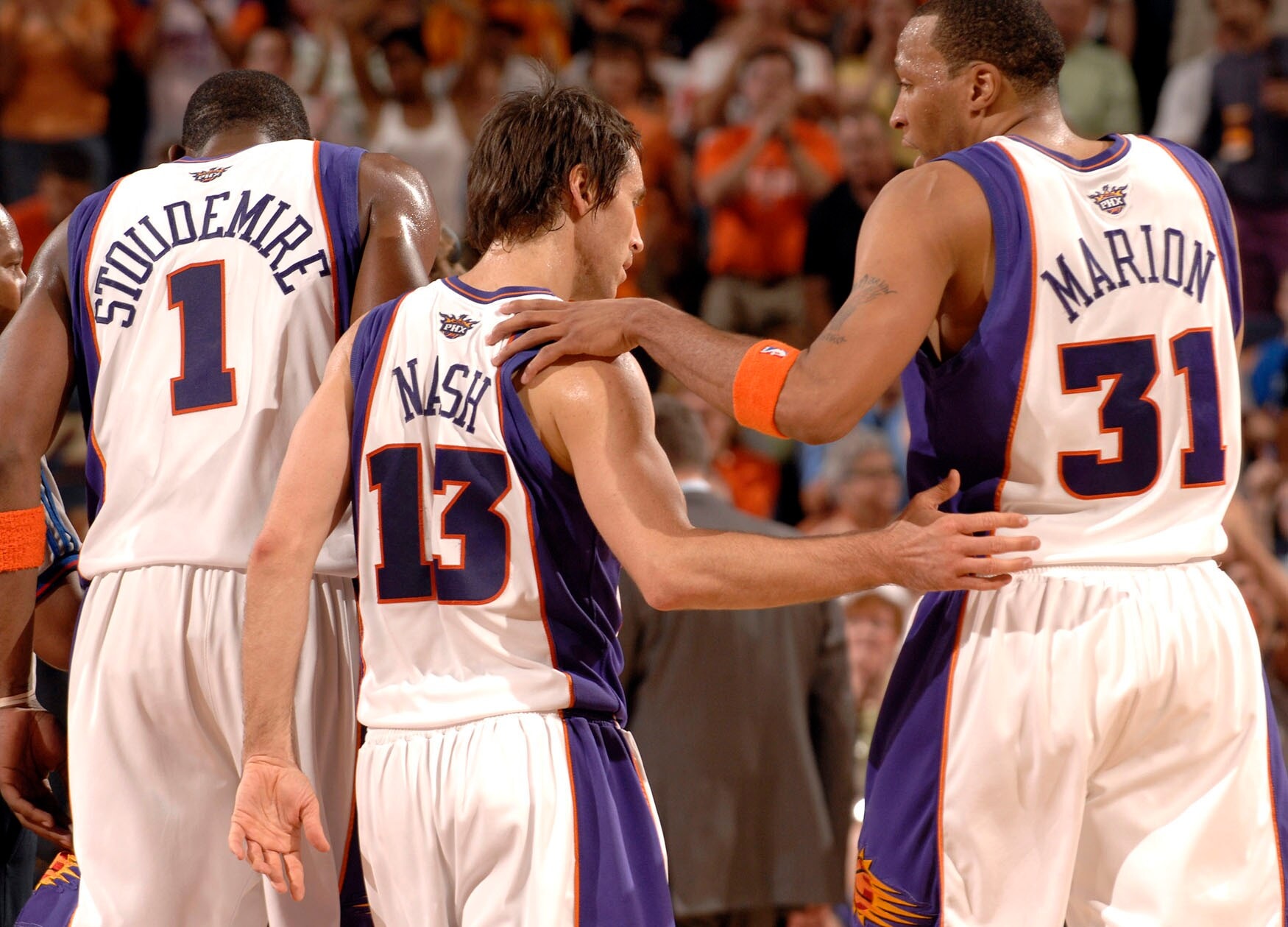
Steve Nash directing traffic, Amar’e Stoudemire exploding toward the rim and Shawn Marion filling every piece of space around them became one of the defining images of 2000s basketball. Phoenix never needed a championship banner for that era to matter. Its real legacy is visible every night the modern NBA decides that faster is better.
Some basketball teams become historically important because they win the final game of the season. Others matter because the rest of the league starts copying what they were doing before everyone understood why it worked.
The mid-2000s Phoenix Suns belong firmly in the second category. Under Mike D’Antoni, the “Seven Seconds or Less” system pushed pace, early offense and three-point volume in directions that now feel ordinary only because so much of modern basketball absorbed the lesson.
At the center of that transformation were three radically different players. Nash manipulated space with timing and passing. Stoudemire turned pick-and-roll possessions into violent vertical pressure. Marion did almost everything around them — rebound, defend, run, finish and cover positional gaps that allowed Phoenix to play faster without completely abandoning balance.
The “Big Bang” was not one play. It was the moment Phoenix discovered that speed, spacing and three incompatible-looking stars could create a basketball future before the rest of the league fully arrived there.
Why the trio still feels modern
Watch current NBA basketball long enough and the old Suns begin appearing everywhere. Early drag screens. Big men sprinting directly into pick-and-rolls. Shooters creating width before the defense is organized. Possessions beginning before the broadcast has finished discussing the last one.
Phoenix did not invent every component, but the Nash-era Suns arranged those ideas into a public spectacle. The pace itself became part of the identity.
Official Suns retrospectives still describe the 2000s as the “:07 Seconds or Less” era and credit those teams with helping normalize the fast pace and three-point emphasis that now define modern offense.

Steve Nash was the system’s clock
Nash’s genius was never simply that he passed well. He controlled when a possession felt calm and when it suddenly became urgent.
Phoenix could inbound the ball and arrive in a dangerous action before a defense had decided how it wanted to match up. Nash’s ability to see the second and third option made speed sustainable. Playing faster only works if decision-making keeps pace with the bodies moving around the floor.
That is why Nash remains the intellectual center of the trio. Stoudemire supplied force. Marion supplied flexibility. Nash made the timing coherent.
Amar’e made spacing dangerous vertically
Spacing is often discussed horizontally — shooters moving toward corners and wings to stretch defenders outward. Stoudemire attacked space vertically.
A Nash screen-and-roll could force two defenders into an impossible negotiation. Stay too high and Stoudemire had a path toward the rim. Drop too deeply and Nash gained room for the pull-up or a passing angle. Help from the weak side and Phoenix could move the ball toward an open shooter.
That threat made the offense feel explosive because the possession could change from routine setup to a dunk attempt almost instantly.
Shawn Marion was the reason the experiment stayed functional
Marion is the player most likely to be simplified when people remember those Suns. His unusual shooting form and “The Matrix” nickname are visually memorable, but his actual role was far more important.
Phoenix’s own historical coverage has argued that Seven Seconds or Less could not have worked without him. Marion rebounded, defended across positions, generated putbacks, ran the floor and frequently reached the offensive end before players traditionally assigned to his position.
That versatility allowed Phoenix to play with lineups that would have been fragile without a player capable of solving several problems at once.
Purple supplies the unmistakable Phoenix nostalgia, orange brings speed and impact, and warm sun tones make the layout feel closer to an old SLAM-era basketball cover than a contemporary minimalist team graphic. The trio should look like a cultural collision, not a roster list.
Why “The Big Bang” is a stronger phrase than “Big Three”
“Big Three” describes personnel. “The Big Bang” describes consequence.
Nash, Stoudemire and Marion were important not simply because three talented players occupied the same roster. Their combination accelerated a style of basketball whose logic became increasingly dominant years after their own Phoenix window closed.
That does not mean modern basketball comes from one team or three people. It means this particular Suns era became one of the clearest public demonstrations that pace, spacing and constant decision pressure could serve as an identity rather than an occasional tactic.
The Suns themselves still revisit this era
Phoenix has continued publishing official historical features and videos around the Seven Seconds or Less teams because the nostalgia remains unusually durable. It is not nostalgia for a championship parade. It is nostalgia for how watching those teams felt.
Three player searches, one shared memory
Because the graphic centers three specific Suns figures, each name creates a natural path deeper into the archive: Steve Nash designs, Amar’e Stoudemire designs and Shawn Marion designs.
The wider Phoenix Suns collection places that nostalgia beside other generations of Phoenix basketball, while the NBA collection shows how team eras eventually become part of a much larger visual history of league culture.
Frequently Asked Questions
Who are the three players featured in The Big Bang Shirt?
The design features Steve Nash, Amar’e Stoudemire and Shawn Marion, the core trio associated with the Phoenix Suns’ Seven Seconds or Less era.
What was Seven Seconds or Less?
Seven Seconds or Less was the nickname commonly associated with Mike D’Antoni’s fast-paced Phoenix Suns system, built around early offense, spacing, transition play and quick decisions.
Why was Shawn Marion so important to those Suns teams?
Marion’s versatility allowed him to rebound, defend multiple positions, run in transition and finish efficiently without requiring the offense to be built around him.
Why is the trio still relevant to modern NBA culture?
The Suns helped popularize a fast, spaced offensive style whose pace, pick-and-roll emphasis and three-point logic became increasingly common across the modern NBA.
What does “The Big Bang” mean in the design?
The phrase frames Nash, Stoudemire and Marion as a trio whose combined style helped create a major shift in how fans and teams understood fast offensive basketball.
The The Big Bang graphic preserves Nash, Stoudemire and Marion as a single cultural frame, while the Phoenix Suns archive connects that moment to the wider history of basketball in the Valley.
The Big Bang Shirt captures Steve Nash, Amar’e Stoudemire and Shawn Marion as the trio at the center of Phoenix Suns Seven Seconds or Less culture, blending early-2000s Suns nostalgia with the offensive revolution that helped shape modern basketball.