Time for Tubby Bye-Bye: How Teletubbies Became an ICE Raid Parody
A familiar children’s television farewell becomes a disturbing punchline when Teletubbies imagery meets American immigration enforcement, dark humor, and the internet’s increasingly surreal political culture.
One of the strangest political images of 2025 was not created by an anonymous meme account. It came from the White House itself.
On August 10, 2025, the official White House account published a video borrowing the visual universe of Teletubbies. Tom Homan, the Trump administration’s border adviser, appeared as the show’s smiling sun, delivering a message about immigration enforcement and deportation. The scene transformed an unmistakably gentle piece of children’s television into a vehicle for government messaging.
The video was covered by international news outlets, including Brazil’s Folha de S.Paulo, and later discussed in reporting about the administration’s unconventional social-media strategy. It was one real example of a broader phenomenon: familiar entertainment imagery becoming part of a deeply contested political conversation.
That collision gives the phrase “Time for Tubby Bye-Bye” an unexpected second life. In the fictional ICE raid parody, the peaceful farewell becomes an arrest scene. The joke depends on viewers remembering exactly how harmless the original words were supposed to sound.
The humor begins when the safest imaginary world on television suddenly looks like a place nobody can leave.
Editorial InterpretationWhen the White House Brought Teletubbies Into Immigration Messaging
The August 2025 White House video provides a documented intersection between Teletubbies and American immigration politics. It replaced the program’s familiar Sun Baby with Homan and placed the scene within border-enforcement imagery. The video addressed unauthorized immigration and the administration’s deportation policy.
The administration presented this type of messaging as a way to communicate its priorities through popular internet formats. Critics questioned the use of humor and entertainment imagery around an issue involving detention, deportation, and family separation. The disagreement showed how the same meme format could be read as effective political communication or as an uncomfortable trivialization of serious consequences.

The Original Political Post
The original White House social-media post is a useful primary source because it shows how children’s television imagery was actually introduced into official immigration messaging. It should not be confused with the later fictional ICE arrest drawings.
Why “Time for Tubby Bye-Bye” Works as Dark Political Humor
In the original Teletubbies program, the phrase announces the end of an episode. Tinky Winky, Dipsy, Laa-Laa, and Po respond to a narrator while the gentle, repetitive farewell unfolds. For viewers who grew up in the late 1990s and early 2000s, the words are immediately recognizable.
The parody changes their emotional meaning without changing the central phrase. Instead of ordinary goodbyes, tactical officers appear. The characters who once danced across colorful hills are restrained by agents associated with U.S. Immigration and Customs Enforcement, commonly called ICE.
This is a deliberately fictional scenario, not a report of an actual arrest. Its satire comes from a contrast that should not logically exist: preschool innocence and contemporary enforcement imagery. Depending on the viewer’s perspective, that contrast may register as criticism, uncomfortable comedy, or political provocation.
Two Visual Languages, One Surreal Farewell
The two TIME FOR TUBBY BYE-BYE designs approach the same fictional premise through different visual styles. One constructs an entire television landscape interrupted by a raid; the other removes the scenery and presents the confrontation as stark line art.
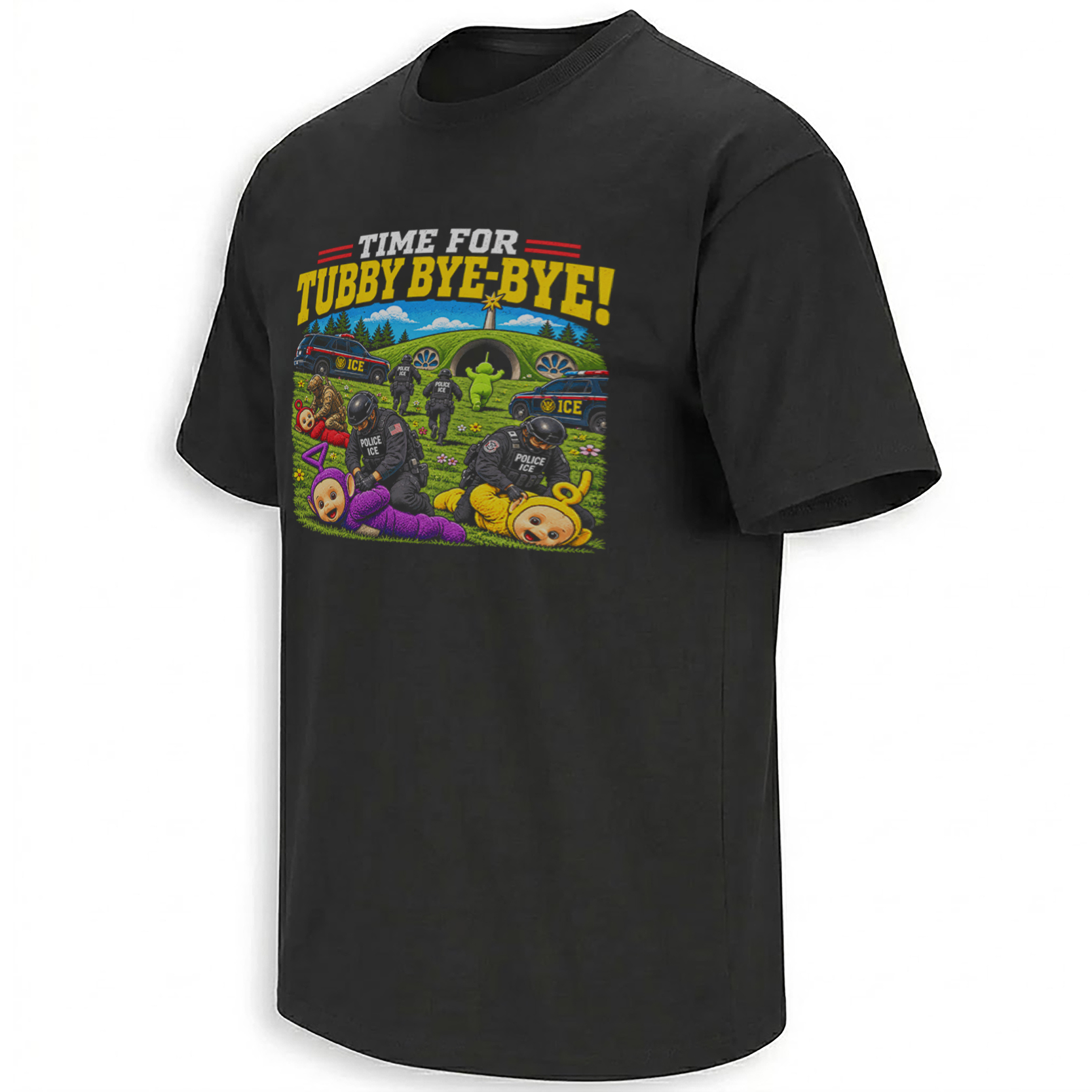
A chaotic reimagining of Tubbyland, with familiar characters, colorful scenery, ICE vehicles, and agents disrupting the original show’s peaceful atmosphere.
View the full scene →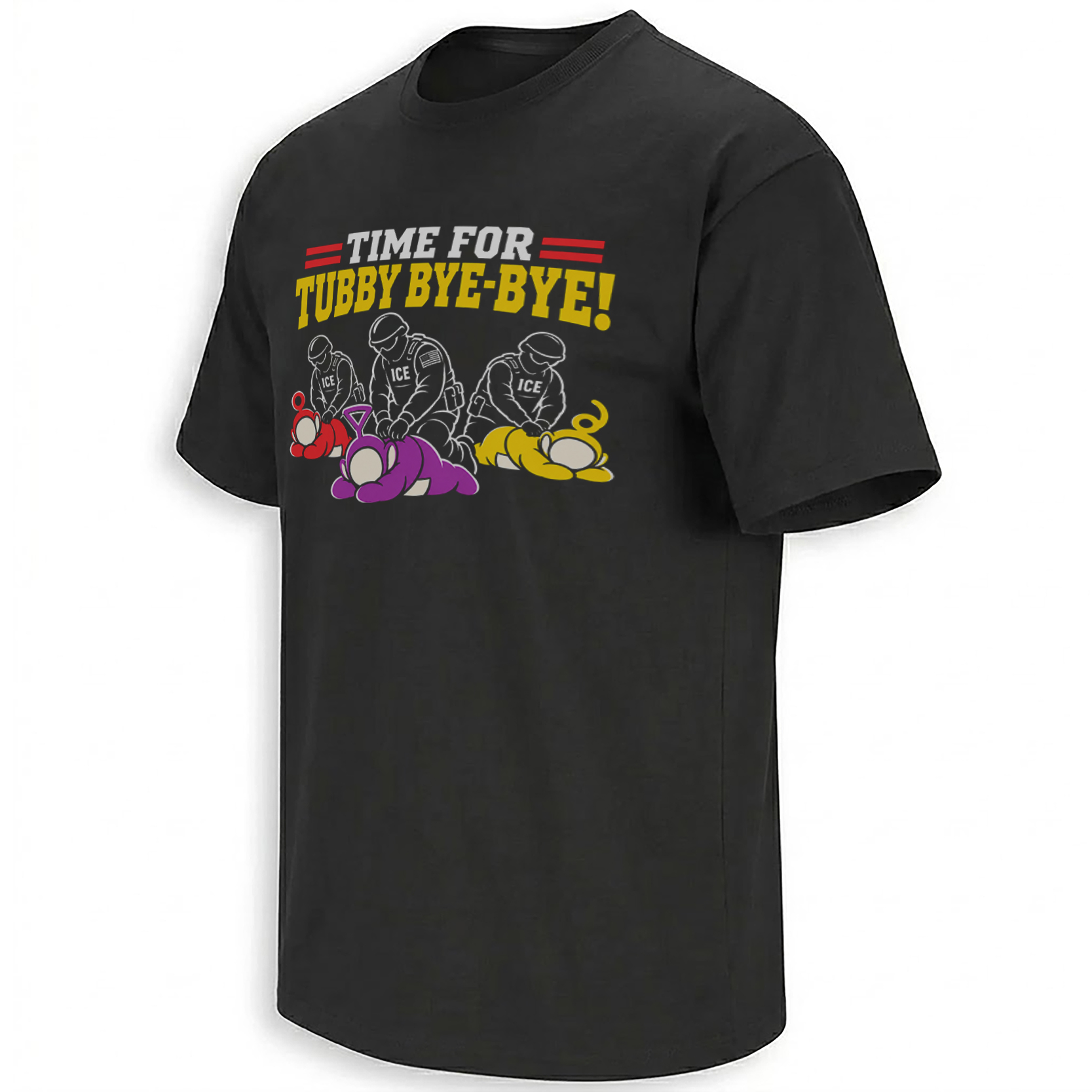
A stripped-down confrontation using bright character colors, pale tactical outlines, and a stark black foundation. The joke survives without the landscape.
Explore the line-art version →Both graphics depict imagined cartoon situations. Neither is evidence of an actual ICE operation involving Teletubbies performers or characters. A direct creative connection to the 2025 White House video has not been established.
The Visual Difference Between Nostalgia and Political Cartooning
The full-color edition preserves recognizable features of the television setting: bright sky, grassy hills, the domed home, and the familiar purple, green, yellow, and red characters. Tactical uniforms and ICE-marked vehicles disturb that atmosphere, making the illustration feel like an interrupted children’s episode.
The minimalist version instead emphasizes the bodies and their confrontation. Red Po, purple Tinky Winky, and yellow Laa-Laa appear beneath white-and-gray tactical figures. Dipsy is absent. Without hills or sunshine to soften the imagery, the composition resembles a compact political cartoon or underground protest graphic.
Both versions employ the same enormous yellow farewell lettering and use the slogan as an instantly recognizable cultural trigger. The first depends on visual storytelling; the second depends on blunt juxtaposition.
How Childhood Nostalgia Became a Language for Adult Internet Satire
Teletubbies is particularly adaptable to parody because its original world is simple, vivid, and visually distinctive. A grassy horizon, a smiling sun, a handful of colors, and a few repeated phrases are enough for recognition.
Adult internet humor often repurposes those instantly recognizable elements, introducing circumstances that clash with the audience’s childhood memory. The resulting image can communicate absurdity before the viewer reads a single explanatory sentence.
There is also a meaningful distinction between institutional use of a meme and satire directed at institutions. The White House’s 2025 video used Teletubbies imagery to communicate an enforcement message. These fictional graphics use enforcement imagery inside Teletubbies’ world to create an unsettling comic situation. That reversal is central to how the parody can be interpreted.
Political Graphics as a Cultural Archive
The TIME FOR TUBBY BYE-BYE designs belong to a larger visual culture in which politics, memes, and recognizable media characters repeatedly intersect. Their meaning depends on familiarity with both the children’s series and debates around immigration enforcement.
Ellie Shirt’s Anti-ICE collection gathers designs engaging with immigration enforcement through protest language, comedy, and satire. The broader Politics collection offers a wider view of how American political controversies are translated into visual commentary.
For readers exploring references to specific public figures, the site’s Tom Homan product search and Donald Trump product search provide additional ways to navigate related political imagery. Those searches are contextual references, not claims of direct involvement in these designs.
Frequently Asked Questions
What is the Time for Tubby Bye-Bye Teletubbies ICE raid meme?
It is a fictional political parody that places familiar Teletubbies characters in an imagined ICE enforcement scene, changing the show’s harmless goodbye into dark comedy.
Did ICE really arrest the Teletubbies?
No. The scenarios depicted in these graphics are fictional cartoon satire, not actual immigration-enforcement events.
Did the White House really post a Teletubbies immigration meme?
Yes. On August 10, 2025, the official White House account published a Teletubbies-themed video showing border adviser Tom Homan as the show’s sun.
What does Time for Tubby Bye-Bye mean?
The phrase comes from the ending of Teletubbies episodes, when the narrator announces that it is time for the characters to say goodbye. The parody changes that innocent meaning through an imagined arrest.
What is the difference between the two Teletubbies ICE shirts?
The ICE Raid Parody presents a detailed, colorful Tubbyland scene with vehicles and agents. The ICE Arrest Line Art edition focuses on three agents and three characters against a minimal black background.
Is the Time for Tubby Bye-Bye shirt connected to the White House video?
Both use Teletubbies imagery in an immigration-related context, but no direct creative or historical connection between the shirt artwork and the White House video has been verified.
The original Teletubbies farewell promised that another cheerful episode had come to an end. The ICE raid parody replaces that certainty with an absurd image shaped by modern political debate. The two Time for Tubby Bye-Bye interpretations preserve that collision in two distinct visual forms.
Time for Tubby Bye-Bye turns Teletubbies nostalgia into fictional ICE raid satire. Two contrasting graphic interpretations reflect how children’s TV imagery, political messaging, and internet humor intersect in contemporary culture.