
Sum Dum-Fuk: Trump and Kim Jong Un Are Back in the Same Headline
Donald Trump and Kim Jong Un have spent years occupying one of the strangest relationships in modern political media: threats, summits, personal praise, stalled negotiations and endless visual satire. In August 2026, that relationship returned to the news cycle again — making an intentionally crude Trump–Kim parody feel less like recycled 2019 imagery and more like a commentary on a story that has restarted.
Political satire often survives because the real world keeps giving old jokes new context.
Trump and Kim first became an unusually visual political pairing during Trump’s first presidency. Their 2018 Singapore summit and 2019 meetings created photographs unlike almost anything in contemporary U.S.–North Korea relations: an American president and North Korea’s leader repeatedly standing together for cameras after years of threats between their governments.
Negotiations eventually stalled. The imagery did not disappear.
Now the diplomacy itself is moving back toward the center of the conversation.
The joke is deliberately ridiculous. The reason it works politically is that the Trump–Kim relationship has repeatedly blurred the line between geopolitical drama and celebrity-style personal diplomacy.
The headline changed again on August 17
Trump told reporters that Kim had responded to his efforts to reopen communication. He did not explain how Kim responded or whether any meeting had been arranged.
That uncertainty matters. There is a major difference between an overture and a negotiated breakthrough.
Still, the statement was significant enough to put the two names together in international headlines again.
It followed Trump’s direction to reduce portions of U.S.–South Korea military exercises, a move he connected publicly to his view that North Korea had been respectful during his presidency and to his personal relationship with Kim.
South Korea publicly expressed hope that the relationship could eventually produce meaningful talks, while security analysts warned that reduced exercises could affect readiness and deterrence.
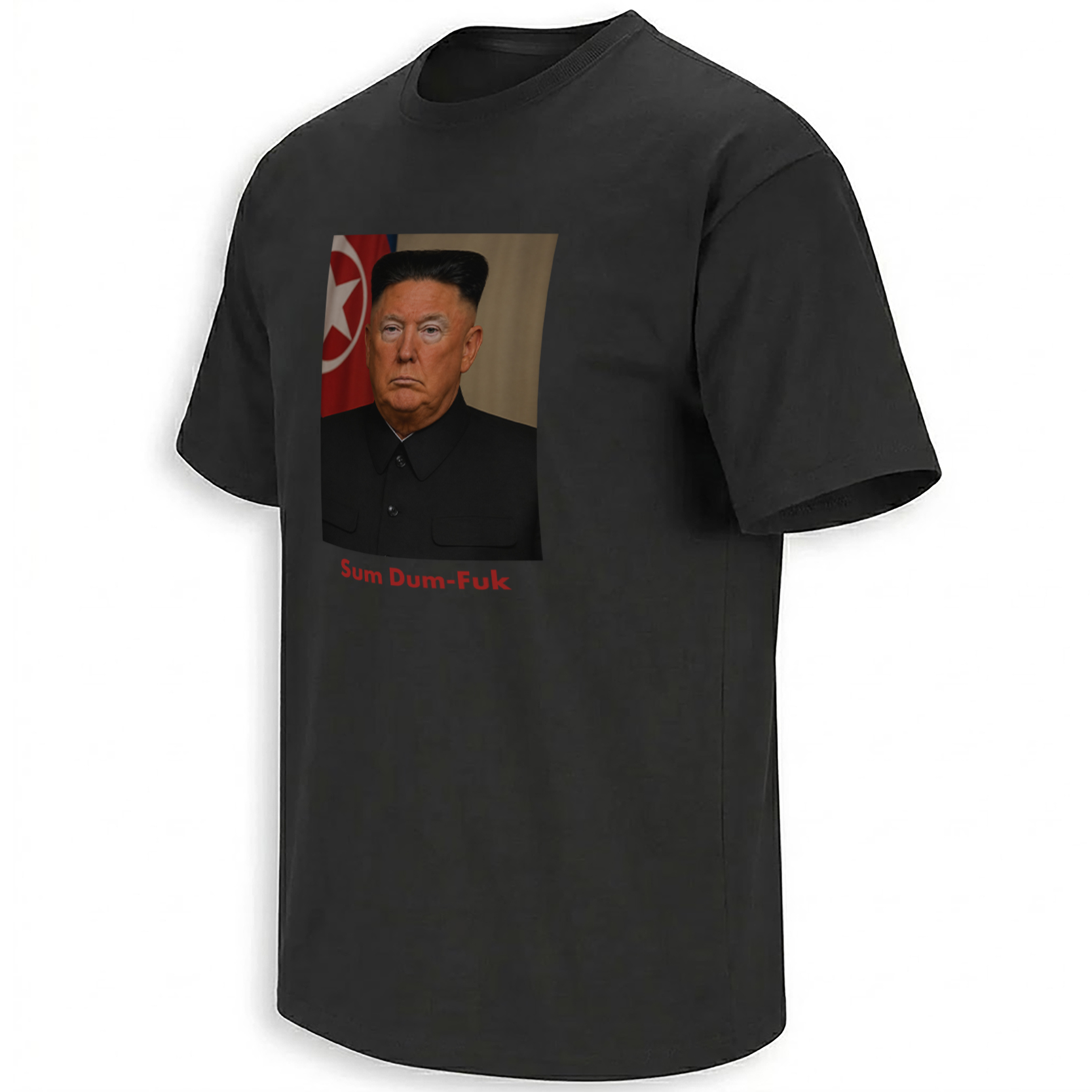
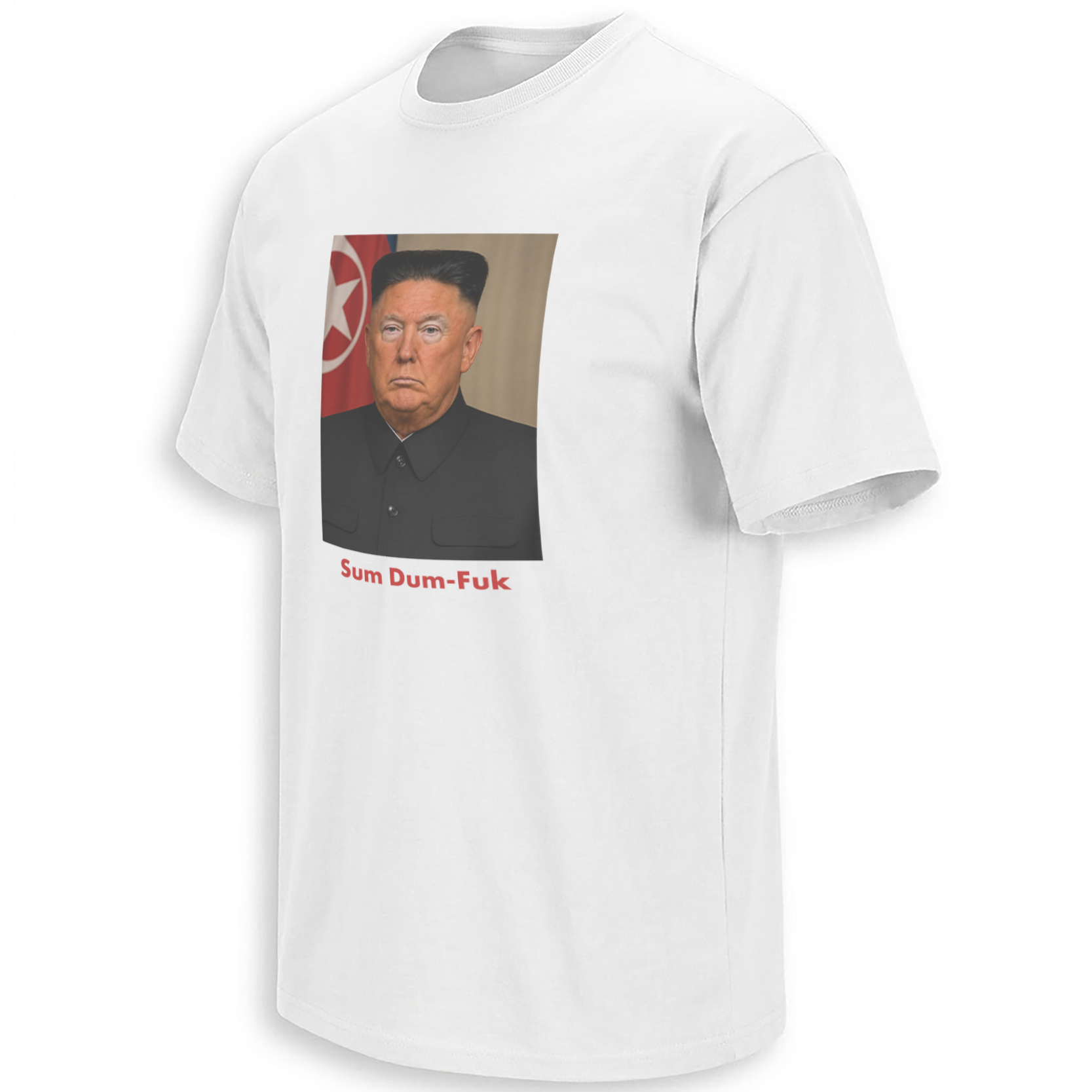
The real photographs are already stranger than most parody art
One reason Trump–Kim satire remains visually durable is that the original diplomatic photography already looks staged for cultural memory.
At Panmunjom in June 2019, Trump and Kim walked side by side near the military demarcation line after Trump briefly stepped into North Korea. The images became instantly recognizable worldwide.

What “Sum Dum-Fuk” actually means
“Sum Dum-Fuk” is not Korean and should not be presented as Korean writing or pronunciation. It is an English vulgar phrase — essentially “some dumb fuck” — altered to resemble a stereotyped East Asian-sounding personal name.
That distinction matters because the joke operates on two levels.
At the political level, it is an insult aimed at the figures in the image, particularly within an anti-Trump satire context.
At the linguistic level, the fake-name construction borrows an old racial caricature device that has often been used to imitate Asian names. Some readers will therefore understand the intended political insult while still finding the naming device itself crude or stereotyped.
A credible cultural article should explain both layers rather than pretending the phrase is a legitimate Korean translation.
The design works as deliberately lowbrow political parody. Its cultural context is Trump–Kim media spectacle, not Korean-language wordplay. Keeping that distinction explicit prevents the joke from being misrepresented as an authentic Korean phrase.
Trump’s relationship with Kim has always invited personality politics
The unusual feature of Trump-era North Korea diplomacy has been the amount of attention placed on the personal relationship between the two leaders.
Trump has repeatedly described Kim in personal terms, emphasizing respect and mutual understanding. During his first presidency, that relationship produced multiple high-profile summits and an exchange of letters.
Yet those meetings did not produce a lasting agreement eliminating North Korea’s nuclear arsenal, and talks eventually broke down.
The contrast gives satirists abundant material: highly dramatic personal chemistry presented against an unresolved strategic conflict.
2026 is not simply a replay of 2018
The current geopolitical environment is different.
North Korea has expanded its weapons capabilities and strengthened its relationship with Russia since the last Trump–Kim meeting. Analysts quoted by Reuters and AP have therefore cautioned that Kim may feel less urgency to return to negotiations than he did during Trump’s first presidency.
That makes a future meeting possible without making it inevitable.
It also makes the satire more pointed. The familiar photographs and personal-language diplomacy are returning, but the strategic environment around them has changed significantly.
Why the design belongs inside Anti-Trump rather than a neutral Korea collection
The supplied Anti-Trump collection is the natural internal destination because the graphic is structured as mockery rather than straightforward geopolitical imagery.
The design does not attempt to explain North Korean politics or celebrate a diplomatic relationship. It uses Trump and Kim as recognizable political characters inside a crude insult format.
That is also why the article should stay cultural rather than persuasive. Readers can interpret Trump’s outreach as unconventional diplomacy, a possible opening for talks, an unnecessary concession, or a combination of those depending on their political and security perspective.
The factual point is simpler: as of August 18, 2026, Trump is again publicly discussing direct engagement with Kim, and the old visual pairing has returned to current political culture.
Why black and white both work for this parody
The black mockup feels harsher and more poster-like. Faces and type sit inside a high-contrast field associated with protest graphics and political stickers.
The white version changes the reading. It feels closer to an editorial cartoon printed on paper, where the joke becomes the primary object rather than part of an aggressive dark layout.
Neither needs patriotic red-white-blue decoration. That would imply conventional campaign merchandise, while the point here is satire.
Frequently Asked Questions
Is “Sum Dum-Fuk” a Korean phrase?
No. It is not Korean. It is a vulgar English insult written as a fake East Asian-sounding name.
Who does the Sum Dum-Fuk design parody?
The graphic uses Donald Trump and North Korean leader Kim Jong Un as the central political figures.
Why is Trump–Kim satire timely again in August 2026?
Trump said on August 17 that Kim had responded to his renewed outreach, while the U.S. president also moved to reduce portions of joint military exercises with South Korea.
Have Trump and Kim met before?
Yes. They held high-profile meetings during Trump’s first presidency, including summits in 2018 and 2019 and a meeting at the Korean Demilitarized Zone in June 2019.
Does renewed outreach mean another Trump–Kim summit is confirmed?
No. Trump has said Kim responded to his outreach, but no new summit or diplomatic agreement had been confirmed as of August 18, 2026.
The Sum Dum-Fuk graphic captures the crude parody side of Trump–Kim media culture, while the Anti-Trump collection places it alongside other political satire and protest-oriented designs.
Sum Dum-Fuk Shirt uses Donald Trump and Kim Jong Un as a deliberately crude political parody just as U.S.–North Korea diplomacy returns to headlines in August 2026. The phrase is satirical English wordplay, not Korean, and sits naturally within anti-Trump political meme culture.