
Stop With the Excuses Stefon Diggs’ Sideline Rant & Jayden Daniels’ Clutch Comeback
A frustrated veteran receiver, a quarterback facing another impossible-looking finish and a stadium that briefly went dark. Washington’s Monday night victory over Cincinnati produced two contrasting expressions of the same competitive football culture: Stop With the Excuses and Raise Hail.
MONDAY NIGHT
The most memorable moments of Washington’s November 23 victory over Cincinnati did not all occur on the field. One began with Stefon Diggs expressing his frustration on the sideline. Another ended with Jayden Daniels engineering a last-minute scoring opportunity that turned a potential defeat into a 22–20 victory.
Three days before Thanksgiving, the Commanders gave their supporters a primetime game worth discussing long after the final whistle. Washington overcame early offensive struggles, a stadium lighting interruption and a late Cincinnati lead before rookie kicker Drew Stevens delivered the decisive points.
The two moments inspired contrasting pieces of football artwork within Ellie Shirt’s Washington Commanders collection. The Stop With the Excuses Shirt captures the intensity of Diggs’ sideline exchange, while the Raise Hail Jayden Daniels Shirt reflects the dramatic response that followed.
Together, they offer a visual record of an evening that moved from frustration to celebration, without reducing a complicated team victory to the actions of only two players.
The Excuses
Before Washington found its offensive rhythm, one of its veteran receivers made his frustration impossible for the television audience to ignore.
01 / The Viral Sideline Moment What Did Stefon Diggs Say During Monday Night Football?
Washington’s offense struggled throughout the opening portion of the game, punting on each of its first four possessions. During the second quarter, television cameras captured Stefon Diggs in an animated sideline exchange.
The footage circulated rapidly through sports reporting and social media. The Boston Globe’s November 25 coverage included a version of the statement about stopping the excuses, with profanity also attributed to Diggs.
The featured graphic removes the profanity and preserves the central message: Stop With the Excuses.
An important distinction remains. The broadcast footage did not conclusively establish the recipient of every remark. Reports differed over whether particular comments were directed toward Daniels, the offensive line or members of the coaching staff.
02 / Accountability or Frustration? Why the Stefon Diggs Rant Generated So Much Discussion
Sideline exchanges are especially compelling because they reveal a portion of professional football normally obscured by helmets, play calls and the movement of the game itself.
Some viewers interpreted Diggs’ comments as an example of veteran accountability. Others questioned whether publicly expressing frustration was the most constructive way to address Washington’s offensive difficulties.
Supporters sympathetic to Diggs viewed the exchange as an experienced player demanding a stronger collective response to an ineffective start.
Other viewers emphasized that a short television sequence cannot fully establish the conversation, its intended audience or the players’ relationships.
Both perspectives appeared within discussions among Washington supporters. A November 24 post in r/Commanders included a subtitled interpretation of the footage and generated further debate about the team’s offensive execution.
03 / The Coach’s Response Dan Quinn’s Reaction to Stefon Diggs’ Sideline Outburst
The discussion gained another dimension when Washington head coach Dan Quinn addressed the incident on November 24.
“I love his fire, I do.”Dan Quinn, discussing Stefon Diggs’ competitive intensity, as reported by ESPN and OutKick.
Quinn’s response placed the incident within a broader appreciation of Diggs’ competitive energy. It did not establish that every interpretation of the broadcast footage was accurate.
Nor does the sequence of events prove that the sideline exchange caused Washington’s subsequent offensive improvement.
What the game does establish is that the Commanders eventually found their rhythm. Their final possession of the first half produced a touchdown from Jacory Croskey-Merritt, reducing Cincinnati’s advantage to 10–7 before halftime.
When the game returned to Washington’s quarterback in the final minute, the conversation shifted from sideline frustration to execution under pressure.
04 / The Fourth-Quarter Comeback How Jayden Daniels Beat the Bengals With No Timeouts Remaining

Cincinnati regained the lead when Evan McPherson converted a 56-yard field goal with 46 seconds remaining in the fourth quarter.
Washington trailed 20–19 and had exhausted its timeouts. Following the ensuing kickoff, Daniels and the offense had 39 seconds to create a realistic scoring opportunity.
The decisive sequence involved two completions to rookie receiver Antonio Williams, covering a combined 64 yards.
Daniels finds Antonio Williams over the middle, advancing Washington toward midfield.
Williams secures another pass and advances to the Cincinnati 8-yard line.
Drew Stevens converts the field goal as time expires, securing a dramatic Washington victory.
The offense hurried into position and stopped the clock with four seconds remaining, allowing Stevens to attempt the winning kick.
The sequence was documented in both Washington’s official game recap and Cincinnati’s postgame report.
Watch the official Bengals vs. Commanders Week 11 highlights → Washington Commanders video archive. November 23, 2026. Includes the original game footage and decisive fourth-quarter plays.05 / The Numbers Behind the Comeback Jayden Daniels’ 344-Yard Monday Night Performance
Daniels finished the evening with 289 passing yards and 55 rushing yards, giving him 344 combined passing and rushing yards.
His performance also included a career-long 47-yard scramble and the decisive passes to Antonio Williams.
But the quarterback’s late-game production represented only one portion of Washington’s collective effort.
Williams finished with nine receptions for 122 yards. Stevens converted all five of his field goal attempts and supplied 16 of Washington’s 22 points.
The Commanders’ defense also made important contributions, preventing Cincinnati’s offense from establishing a decisive advantage and creating the conditions for Washington’s final response.
The sideline supplied the fire. The final drive supplied the answer.Editorial interpretation of the two contrasting moments, rather than a quotation attributed to a player or coach.
06 / A Night With Everything When the Stadium Lights Went Out but Washington Kept Fighting
The unusual Monday night atmosphere also included a temporary lighting interruption at Northwest Stadium during the third quarter.
The incident briefly stopped the game and added another unexpected image to an evening already filled with dramatic football moments.
As documented by People’s November 24 report, the interruption occurred while Washington’s offense was preparing for another play.
For supporters revisiting the game afterward, the combination of the sideline exchange, the blackout and the last-second victory gave the night a particularly memorable identity.
07 / Washington’s Rallying Cry What Does Raise Hail Mean to Commanders Fans?
Raise Hail was part of Washington’s football identity long before the November 2026 victory.
By 2024, the expression had become a prominent component of the franchise’s contemporary branding and supporter culture.
The Commanders released an official Raise Hail season trailer in 2024, while The Washington Post documented the slogan’s presence across team apparel, stadium decorations and social media communication.
Its effectiveness comes partly from the wordplay connecting Washington’s established football vocabulary with a contemporary rallying cry.
The phrase recalls the historical significance of Hail within Washington football culture while also suggesting the energy and noise associated with raising the atmosphere inside a football stadium.
Jayden Daniels’ ability to deliver in difficult late-game circumstances gives the expression another recognizable contemporary association.
08 / The Graphic Archive Stop With the Excuses and Raise Hail: Two Designs From One Game
The featured artworks approach the same evening through two distinct visual styles.
The first relies almost entirely on typography, preserving the verbal confrontation associated with Stefon Diggs. The second uses an illustrated quarterback and vintage script to express the celebratory atmosphere associated with Daniels.
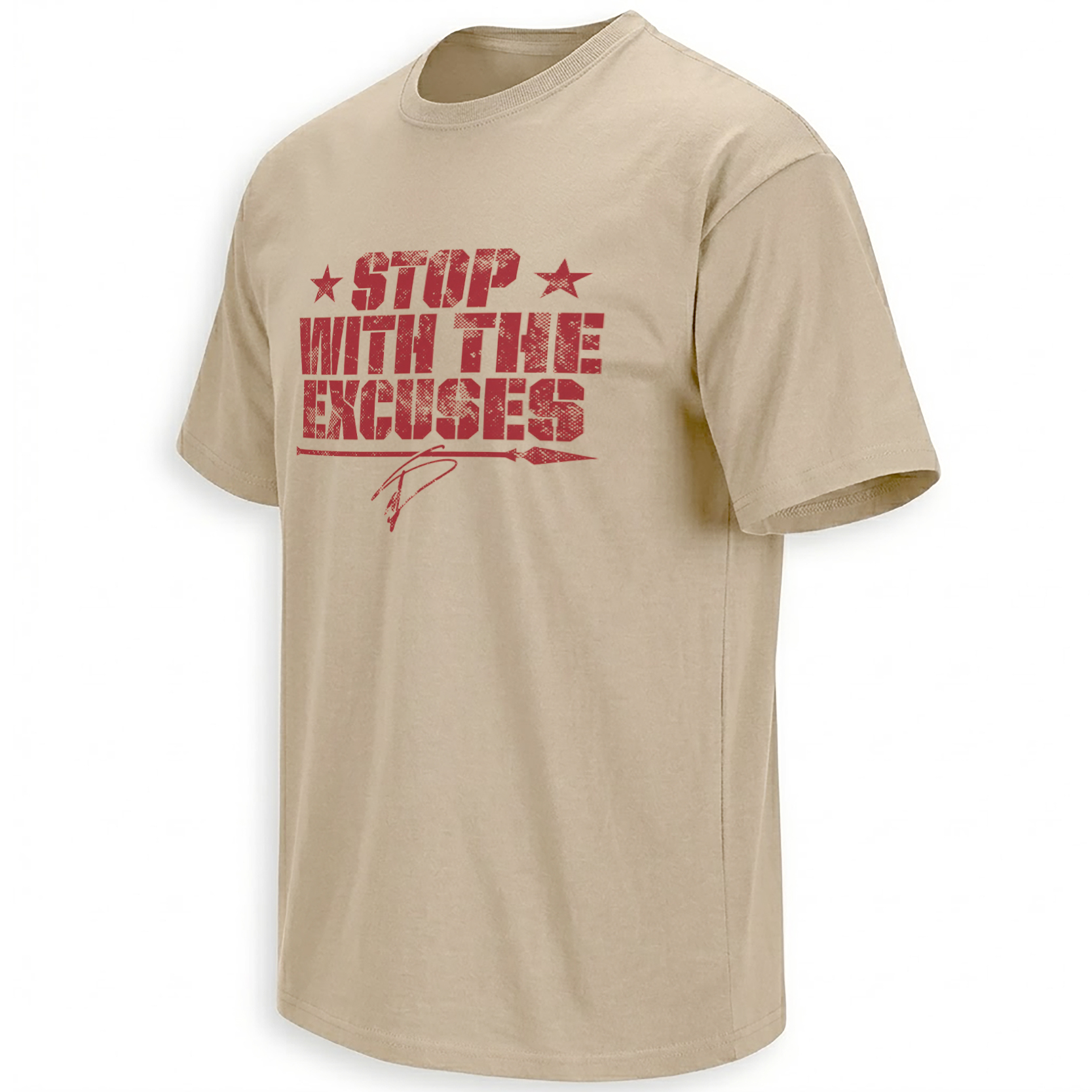
Distressed burgundy stencil lettering, flanking stars, a horizontal spear motif and signature-style artwork transform Diggs’ widely discussed sideline message into a direct typographic statement.
Examine the sideline design →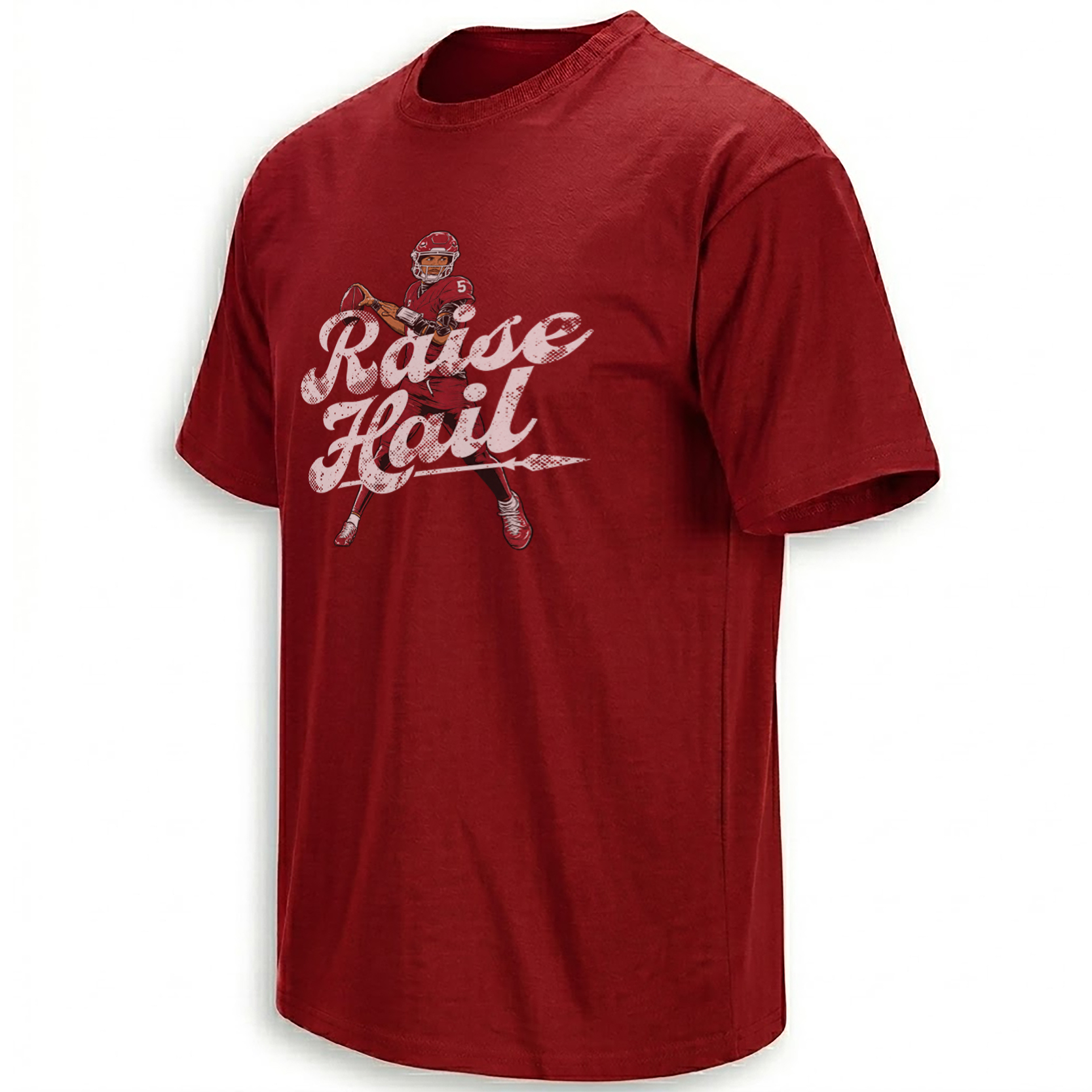
Flowing vintage script, a No. 5 quarterback illustration and a spear underline combine Washington’s established rallying cry with the contemporary identity of its clutch-performing quarterback.
Examine the comeback design →09 / Visual Interpretation Why the Two Washington Football Designs Work Together
The most interesting relationship between the artworks is the contrast between their lettering.
Stop With the Excuses uses rigid, condensed stencil-style capitals. Raise Hail uses large, flowing script that overlaps the central football illustration.
The typography establishes two different emotional registers: confrontation and celebration.
The Diggs design uses forceful uppercase lettering to communicate the urgency of the sideline statement without requiring an illustrated player portrait.
Raise Hail introduces a more fluid, celebratory visual rhythm through oversized cream-colored cursive lettering.
Both artworks incorporate a horizontal spear-inspired element, creating a shared visual reference to historical Washington football imagery.
The first design uses a neutral sand background, while the second uses deep red. Their contrast reinforces their separate roles within the same story.
The Daniels artwork presents an illustrated quarterback holding a football, identifying the contemporary player associated with the comeback without reproducing a verified single frame from the game.
The Diggs composition incorporates cursive memorabilia-style artwork. This graphic element should not be interpreted as an authenticated autograph.
Despite their contrasting lettering, the shared distressed textures and Washington-inspired visual elements allow the two compositions to function as companion pieces.
10 / Football Culture Beyond the Box Score From an Emotional Sideline Exchange to a Shared Washington Memory
Football supporters regularly transform memorable expressions into a shorthand for larger events.
A phrase can preserve the frustration of a difficult first half. A familiar rallying cry can recall the excitement of a last-second winning kick.
Washington’s victory over Cincinnati offered both kinds of cultural material.
The result does not require fans to decide whether Diggs’ intensity or Daniels’ composure was solely responsible for the outcome. Both moments can remain recognizable parts of the same game.
The sideline exchange, Dan Quinn’s response and Washington’s late-game comeback are documented events. No independently established evidence proves that Diggs’ remarks caused Daniels’ subsequent performance. The two designs are presented together because they reflect different aspects of one memorable football evening.
Additional player-inspired artwork can be explored through the Stefon Diggs design search and the Jayden Daniels graphic archive.
The wider NFL collection places these designs within a continuing tradition of football-inspired visual storytelling, where player personalities, spontaneous expressions and unusual game circumstances become part of fan culture.
Washington’s Monday night story began with frustration, continued through a literal interruption of the stadium lights and ended with the football passing through the uprights as time expired.
For the supporters who stayed until the end, November 23 offered another memorable reason to Raise Hail.
Frequently Asked Questions
What does Stop With the Excuses mean in relation to Stefon Diggs?
It references Diggs’ widely discussed sideline exchange during Washington’s November 23, 2026 game against Cincinnati, when the Commanders were experiencing early offensive difficulties.
Was Stefon Diggs yelling directly at Jayden Daniels?
Some reports and fan interpretations suggested Daniels was among the intended recipients. However, the broadcast footage did not conclusively establish the target of every remark.
What did Dan Quinn say about Stefon Diggs’ rant?
Quinn expressed appreciation for Diggs’ competitive intensity when addressing the incident on November 24, 2026.
Who won the Commanders vs. Bengals Week 11 game?
Washington defeated Cincinnati 22–20 on November 23, 2026, at Northwest Stadium in Landover, Maryland.
How did Jayden Daniels lead the comeback against Cincinnati?
Daniels completed passes of 22 and 42 yards to Antonio Williams during the final minute, setting up Drew Stevens’ game-winning 26-yard field goal.
How many yards did Jayden Daniels record against the Bengals?
Daniels recorded 289 passing yards and 55 rushing yards, totaling 344 combined passing and rushing yards.
Who kicked the game-winning field goal for Washington?
Rookie kicker Drew Stevens converted a 26-yard field goal as time expired. He finished the game with five successful field goals.
Did the stadium lights go out during Commanders vs. Bengals?
Yes. A temporary lighting interruption occurred at Northwest Stadium during the third quarter of the November 23, 2026 game.
What does Raise Hail mean to Washington Commanders fans?
Raise Hail is an established Washington football rallying cry connecting the franchise’s historical football vocabulary with its contemporary branding and fan culture.
What inspired the Raise Hail Jayden Daniels Shirt?
The artwork references Daniels’ clutch performance against Cincinnati through vintage script lettering, an illustrated No. 5 quarterback and a horizontal spear-inspired motif.
What makes the Stop With the Excuses Shirt distinctive?
The design features distressed burgundy stencil lettering, two stars, a horizontal spear motif and signature-style artwork on a sand-colored shirt.
Did Stefon Diggs’ sideline speech cause Washington’s comeback?
That causal relationship has not been independently established. The sideline exchange preceded Washington’s improved offensive execution, but the victory involved contributions across the team.
The Stop With the Excuses design and Raise Hail Jayden Daniels design preserve two contrasting expressions of Washington’s dramatic Monday night victory. Discover additional moments through the Washington Commanders design archive, where the personalities, celebrations and memories of Washington football continue to find new forms of visual expression.
Stefon Diggs’ Stop With the Excuses sideline exchange and Jayden Daniels’ clutch Raise Hail comeback capture two memorable moments from Washington’s 22–20 Monday Night Football victory over Cincinnati on November 23, 2026. Distressed stencil typography, vintage quarterback artwork and shared spear-inspired graphics connect both designs with contemporary Washington Commanders fan culture.