
Shohei Ohtani’s “Sho-Time” Returns for the Dodgers’ 2026 NLDS
Los Angeles spent the Wild Card round watching rather than playing. For Shohei Ohtani, that pause may be especially valuable: five more days to move beyond a late-season injury stretch before the Dodgers begin a historic three-peat attempt at Dodger Stadium.
The most important Shohei Ohtani number entering October may not be 30 home runs, 300 career homers or even the No. 17 on his back. It may simply be this: five days.
Los Angeles earned a first-round bye after finishing 100-62, giving Ohtani several extra days between the regular-season finale and NLDS Game 1 on October 3. He had only recently returned from a minimum 15-day injured-list stint caused by lingering issues in his right biceps and left knee, and the Dodgers spent his final five regular-season games evaluating health as much as results.
The early update was encouraging. Los Angeles said Ohtani was feeling strong physically, even though his first five games back produced a modest 5-for-21 line. The postseason question is whether rest and live batting practice can turn that healthier body back into the version of Ohtani who spent much of 2026 at the center of the MVP conversation.
“Sho-Time” survives every stat line because it describes the anticipation before Ohtani does something — not only the thing he eventually does.
October arrives with Ohtani healthier, but still searching for rhythm
Ohtani’s final regular-season line remained elite by ordinary standards: a .275 average, .889 OPS and a team-high 30 home runs. Earlier in the year he also returned to the mound, producing another two-way season before physical issues forced Los Angeles to prioritize getting him healthy for October.
His offense had cooled before the IL stint. During the 24 games before he was shut down, Ohtani hit .198 while his underlying bat-speed and exit-velocity numbers also dipped. The five games after his return were therefore closer to a rehab assignment played in Major League stadiums than a true measure of postseason form.
That explains why the bye matters. The Dodgers do not need Ohtani to prove anything on October 1. They need his swing ready when the lights come on October 3.
The 300th home run made 2026 historic before October began
Ohtani had already given the season a permanent milestone on July 7 at Dodger Stadium. Facing Colorado, he drove a Michael Lorenzen sinker over the left-center-field wall at 112.2 mph for career home run No. 300.
The number placed Ohtani inside another exclusive club, but with a uniquely Japanese footnote: he became the first Japanese-born player ever to reach 300 Major League home runs. At the time, he also had 765 career pitching strikeouts — an almost absurd reminder that traditional hitting milestones tell only half of his story.

Why “Sho-Time” still says more than a number
The SHO-TIME! SHIRT does not try to memorialize the 300th homer, his ERA or one individual Dodgers game. That is the correct choice for this particular nickname.
“Sho-Time” has followed Ohtani through different teams, different roles and different levels of superstardom. It works when he leads off a game. It works when he pitches. It works when an entire stadium stops what it is doing because No. 17 is walking toward the plate.
大谷翔平 is Shohei Ohtani’s name in Japanese. Keeping it prominent beside “SHO-TIME!” allows the graphic to connect his Japanese identity directly with the Los Angeles baseball culture that now surrounds him.
The cartoon takes that global identity and makes it deliberately local. Ohtani walks forward with a bat while a smiling hot-dog character marches beside him. The second figure strongly evokes the Dodger Dog, one of the most recognizable food traditions attached to Dodger Stadium.
That pairing is the visual joke: perhaps baseball’s most globally recognizable active player sharing the frame with something unapologetically ballpark-specific. Japan meets Los Angeles not through flags or a forced cultural collage, but through a superstar, Japanese lettering and stadium food.
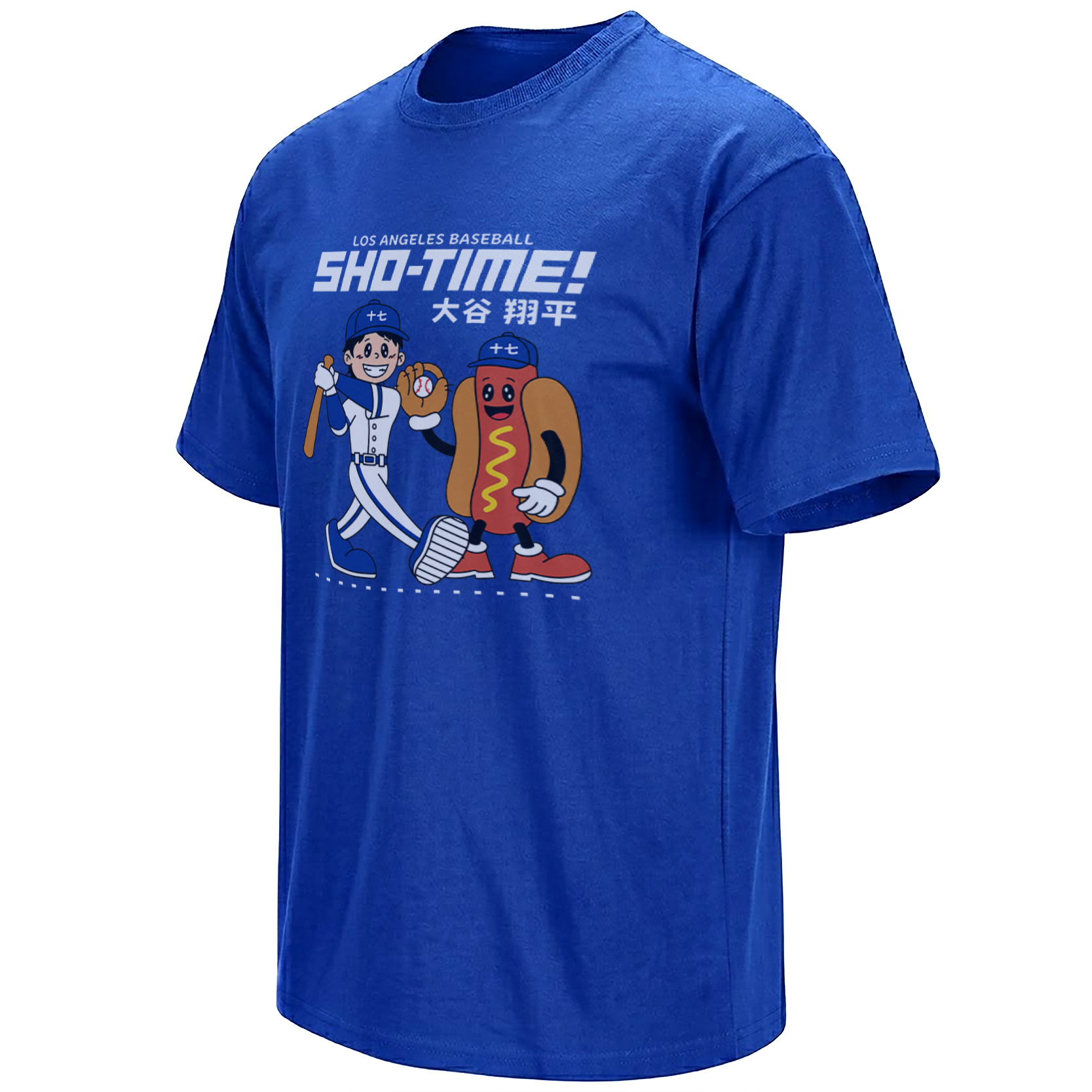
The darker Los Angeles base makes the Japanese lettering, cartoon No. 17 and ballpark-food character read like a bright stadium illustration.
Explore the blue piece →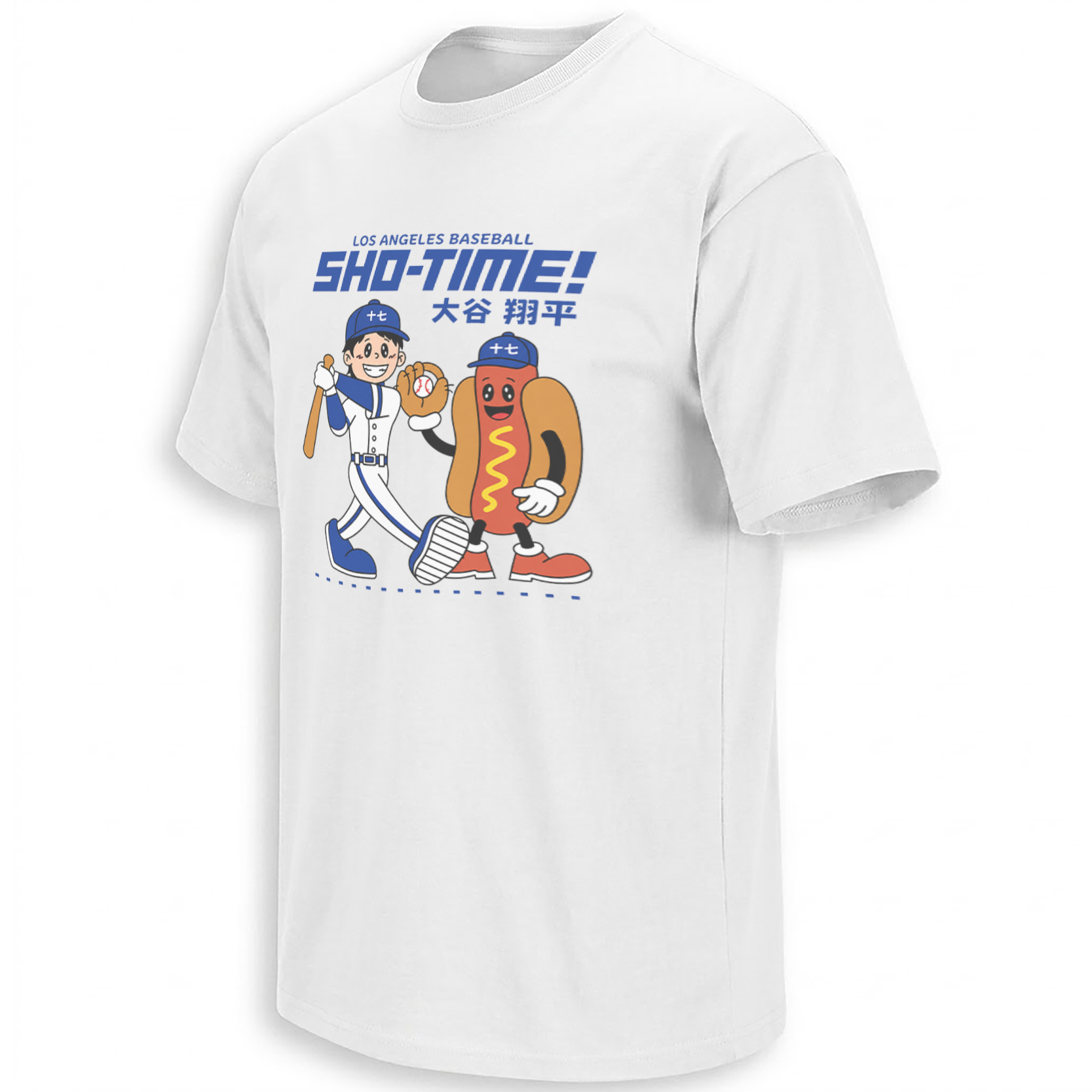
The lighter version pushes the composition toward vintage Japanese-American souvenir art and keeps the royal-blue lettering dominant.
View the illustrated piece →The Dodgers themselves marked the milestone socially
Ohtani’s 300th home run became an immediate official Dodgers moment rather than simply another statistical update. The club highlighted the milestone across its social channels, connecting an individual career number directly to his Los Angeles era.
Now Sho-Time becomes part of a three-peat chase
Los Angeles finished with 100 wins, captured another NL West title and enters the Division Series as the National League’s No. 2 seed. More unusually, the Dodgers are attempting something baseball has not seen in more than a quarter-century: three consecutive World Series championships.
The last club to complete that run was the Yankees from 1998 through 2000. Los Angeles already owns the 2024 and 2025 titles. Eleven more postseason wins would create a new modern dynasty benchmark.
As of October 1, the Dodgers are still waiting to learn whether Atlanta or Philadelphia will arrive at Dodger Stadium. That uncertainty actually suits the “Sho-Time” concept. It is designed for the moment before the result — when Ohtani walks toward the plate and everybody knows something might happen.
The wider Los Angeles Dodgers collection now sits inside that three-peat chase, while the broader MLB collection follows the player moments and postseason language developing across October.
Readers following No. 17 specifically can also browse the Shohei Ohtani product search.
FAQ: Shohei Ohtani, Sho-Time and the 2026 NLDS
What does “Sho-Time” mean?
“Sho-Time” is a long-running nickname associated with Shohei Ohtani and the anticipation surrounding his unusual ability to impact games as both a hitter and pitcher.
What does 大谷翔平 mean on the design?
大谷翔平 is Shohei Ohtani’s name written in Japanese.
Why is there a hot-dog character on the shirt?
The cartoon hot dog is a playful visual reference to the Dodger Dog and the food culture associated with games at Dodger Stadium.
How did Ohtani finish the 2026 regular season?
Ohtani finished at .275 with an .889 OPS and a team-leading 30 home runs despite losing time late in the season to physical issues.
What milestone did Ohtani reach in 2026?
He hit his 300th career MLB home run in July, becoming the first Japanese-born player to reach the milestone.
Who will the Dodgers play in the 2026 NLDS?
As of October 1, Los Angeles is waiting for the winner of the Braves-Phillies Wild Card Series. NLDS Game 1 is scheduled for October 3 at Dodger Stadium.
The Sho-Time graphic works as a Los Angeles cultural snapshot rather than a single-game souvenir — Japanese identity, No. 17, Dodger Stadium food culture and the player around whom another championship run may turn.
SHO-TIME! SHIRT turns Shohei Ohtani’s No. 17 identity into playful Los Angeles baseball art with 大谷翔平 lettering and a Dodger Dog-inspired character as the Dodgers enter the 2026 NLDS.