
The Saddledome’s Final Flames Season Has Officially Begun
Calgary has entered the 1983–2027 chapter printed on the Farewell Season crest: one final year under the saddle-shaped roof before the Flames move toward Scotia Place and a different hockey skyline.
The first night of the Scotiabank Saddledome Farewell Season delivered almost every emotion except the score Calgary wanted. Before puck drop on October 1, string performers played to a standing crowd and a four-minute film moved through more than four decades of arena memories. The Flames were beginning their last season in the building that has defined their place in the Calgary skyline since 1983.
Then Seattle spoiled the hockey portion of the celebration. The Kraken scored three times in the first period and left with a 6–1 victory. Ryan Strome produced Calgary’s only goal in the third. The result was rough, but almost strangely fitting for the premise of an entire farewell season: the ’Dome is not being remembered because every night was perfect. It is being remembered because generations kept returning to it anyway.
That distinction is why the Flames have consistently framed 2026–27 as a farewell rather than merely a final season. The club’s official campaign was built as a thank-you to the building, its teams and the C of Red. The dates printed across the crest — 1983 and 2027 — transform the logo into a timeline before the first paragraph of nostalgia is ever written.
The farewell is bigger than the building because Calgary spent four decades turning that building into a memory container.
Why 1983–2027 Carries So Much Weight in Calgary
The Saddledome opened in October 1983 after just over two years of construction, becoming the Flames’ new home and eventually one of the defining venues of the 1988 Winter Olympics. The roof was its signature from the beginning: a cable-supported form that gave the arena its saddle silhouette and made it instantly readable on the Calgary skyline.
Over the decades, the building became associated with far more than architecture. The Flames’ 1989 Stanley Cup run passed through it. The 2004 playoff surge turned the city red around it. Rivalries with Edmonton kept returning to it. Concerts, Olympic competition, junior hockey, lacrosse and civic events filled the same bowl between Flames games.
The Official Farewell Logo Is Full of Saddledome Architecture
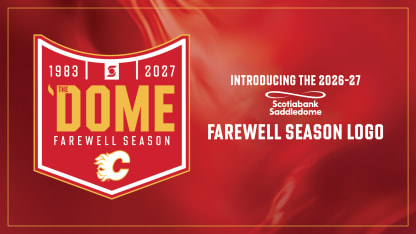
The most interesting part of the official campaign is that the logo itself was designed as a building portrait without drawing the building literally. Its upper border bends downward to echo the famous roofline. Vertical elements reference the Saddledome structure. A horizontal line connects the dates 1983 and 2027 like a lifeline running through the crest.
Even the punctuation has purpose. The apostrophe before “DOME” is shaped like an ember taken from the Flames identity, while the chevron along the bottom references the championship and retired-number banners hanging above the ice. The result reads like a sports shield from a distance and an architectural diagram once examined closely.
Before It Became an Icon, It Was a Construction Site Beside the Corral
Calgary’s own Farewell Season coverage has deliberately gone backward before moving forward. In September, the Flames published a three-part history of how the Olympic Coliseum concept became the Saddledome. One of the archival images shows the building still open to the sky, downtown Calgary rising behind the unfinished concrete and steel.
That image is useful because the arena now feels permanent precisely when everyone knows it is not. Fans who have only known Calgary hockey under the curved roof are experiencing the strange reverse process: an object that once rose piece by piece is now being remembered piece by piece before the franchise leaves it.

“One Last Ride” Moved From Marketing Line to Real Emotion
The Flames introduced the Farewell Season months before the puck dropped, but the campaign became tangible on opening night. The building was dressed for its own remembrance, players arrived on a red carpet and the pregame video framed the arena less as concrete and seats than as the place where Calgary had stored decades of shared experience.
Official social messaging distilled the idea into “One last ride.” That phrase now carries the tension the entire season will have: every night is ordinary hockey on the schedule and simultaneously one fewer night remaining under the roof.
The 6–1 Loss Did Not Ruin the Farewell Story
Seattle’s victory was emphatic enough that Calgary players did not try to soften it afterward. But a farewell season was never likely to unfold as a neat documentary montage. The point is not that the Saddledome will produce one final year of uninterrupted celebration; it is that wins, losses, rivalries and routine nights now happen under a visible countdown.
The current schedule places Vancouver in Calgary on April 10 for the last regular-season home game. Between now and then, every visiting club gets one more chance to appear under the saddle-shaped roof, the Oilers make their final Battle of Alberta trips to the building, and older pieces of Flames history will continue resurfacing through theme nights and archival storytelling.
While the Saddledome completes its final season, Scotia Place continues rising nearby with completion targeted for Fall 2027. Calgary is literally watching one hockey landmark become memory while another becomes physical.
Why the Farewell Shirt Feels More Like a Patch Than Merchandise
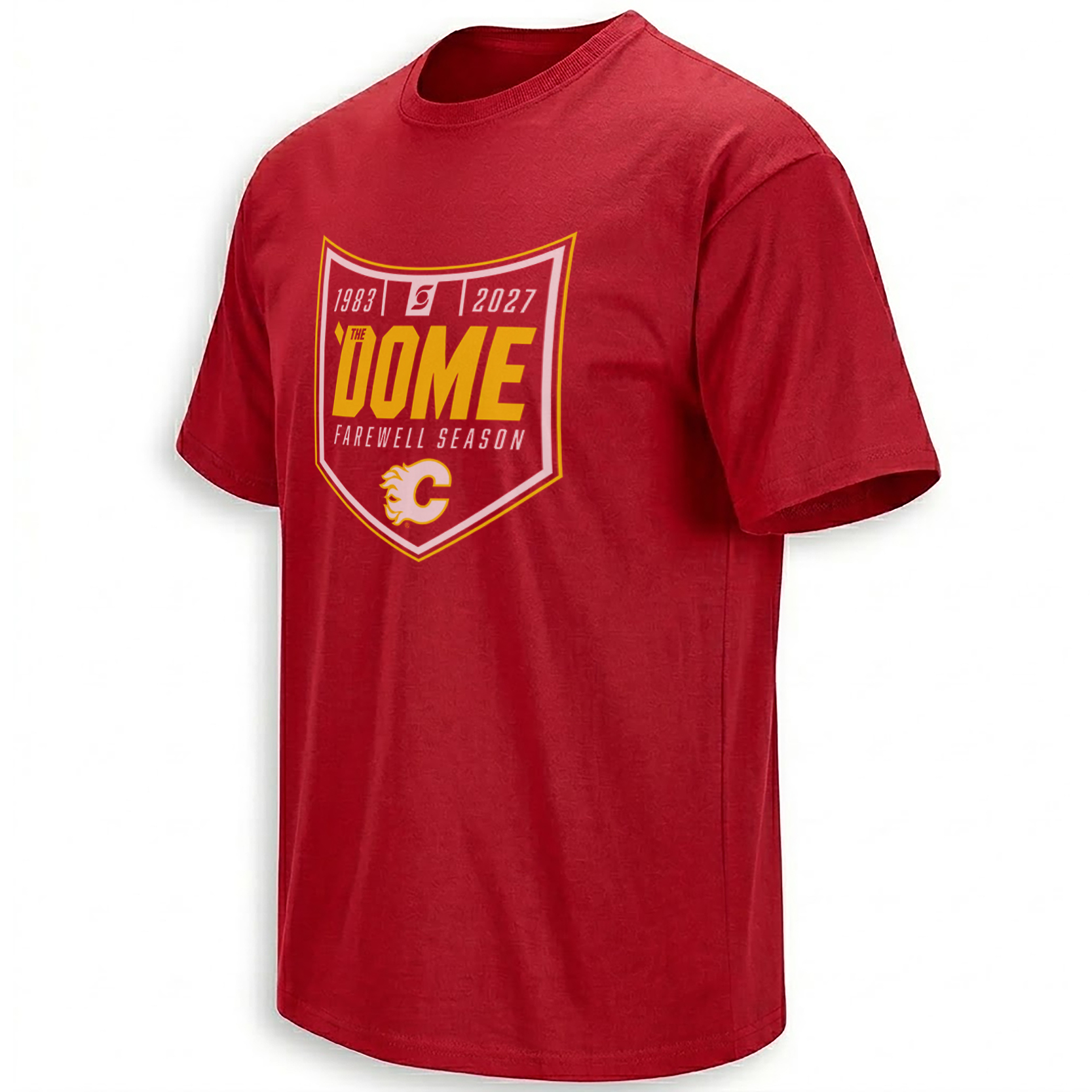
The visual hierarchy is almost ceremonial. Large gold “DOME” lettering dominates the center, but the dates above it determine the meaning. Red, white and gold create the look of a commemorative shoulder patch or arena banner, while the shield silhouette carries the solemnity of an official season marker.
That is why the design works best as an arena artifact rather than generic Flames apparel. It identifies a fixed historical window. After 2027, “1983–2027” will no longer describe a season currently unfolding; it will describe the completed lifespan of the Saddledome as the Flames’ home.
The broader Calgary Flames collection gathers player, rivalry and franchise-history graphics around that same hockey identity, while Ellie Shirt’s NHL collection places the farewell inside the larger culture of arena history and team memory.
FAQ: Saddledome Farewell Season 2026–27
Is 2026–27 the Calgary Flames’ final season at the Saddledome?
Yes. Calgary has officially designated 2026–27 as the Scotiabank Saddledome Farewell Season.
Why does the Farewell Season logo say 1983–2027?
The Saddledome opened in 1983, and the 2026–27 season marks the final Flames season in the building before the franchise transitions to its new arena era.
What happened in the final Saddledome home opener?
The Seattle Kraken defeated Calgary 6–1 on October 1, 2026 after an emotional pregame celebration of the arena’s history.
When is the final scheduled Flames regular-season game at the Saddledome?
The final regular-season home game is currently scheduled for April 10, 2027 against the Vancouver Canucks.
What comes after the Saddledome?
Scotia Place is under construction nearby, with completion targeted for Fall 2027 as Calgary prepares for the next era of Flames hockey.
The The Dome Farewell Season Shirt records Calgary’s 1983–2027 transition in the same shield language used to define the farewell campaign. Continue through the Calgary Flames collection or the broader NHL archive.
The Dome Farewell Season Shirt captures the Calgary Flames’ 1983–2027 Saddledome timeline, the final season under its iconic roof and the transition toward Scotia Place.