Why Phillies Players Are Saying “Run The Damn Ball”
A line that sounds borrowed from an Eagles call-in show has crossed into the Phillies clubhouse, where Garrett Stubbs turned it into a blunt demand for movement, pressure and urgency on the bases.
PHILLIES CULTURE FEATURE · UPDATED JULY 27, 2026
The phrase arrived with perfect Philadelphia bluntness: no diagram, no percentage and no cautious baseball euphemism. “Run The Damn Ball” looks like football language, but inside the Phillies conversation it has become a demand to create action on the basepaths.
The timing gives the slogan extra force. Philadelphia defeated the Yankees 11–4 on Sunday night, July 26, avoiding a sweep as Bryson Stott and Alec Bohm combined for nine RBIs. The victory moved the Phillies to 57–49, but it came after six losses in eight games and a stretch in which the team’s baserunning decisions had drawn visible criticism.
That tension is exactly where clubhouse sayings become useful. A slogan does not need to solve every tactical problem. It needs to compress a mood into language that players and fans can repeat without explanation.
The Garrett Stubbs connection
The baseball version of “Run The Damn Ball” is associated with Garrett Stubbs, the Phillies catcher and utility-minded clubhouse personality whose value has never been limited to his place in the batting order.
The player-linked release described the message as Stubbs’ push for a more aggressive running game. It referred to activity on the bases: forcing defenses to react, looking for an extra 90 feet and refusing to let an inning remain static.
It does not literally ask a baseball manager to call a rushing play. “The ball” becomes shorthand for the whole offensive situation: put runners in motion, apply pressure and play with visible intent.
The expression gained another layer when reports from Citizens Bank Park noted that some Phillies players were wearing shirts carrying the phrase. At that point, it stopped being only a clever crossover joke and began functioning as a piece of clubhouse language.
Stubbs was placed on the injured list in July with left-wrist inflammation, but the slogan’s circulation demonstrates why he remains culturally present around the club. Certain players influence a team through playing time; others also shape its rituals, humor and shared vocabulary.
Philadelphia sports language works best when it sounds less like a campaign and more like something an impatient fan would yell before the next pitch.
Why a football phrase works in baseball
“Run the damn ball” has a long life in football culture. Fans use it when they believe an offense has become too clever, too passive or too dependent on low-percentage plays. In Philadelphia, that demand is especially familiar through Eagles talk radio, tailgates and social-media reactions.
Transferring it to baseball creates the joke, but the emotional meaning survives the move. In both sports, the phrase rejects hesitation. It asks the team to stop overcomplicating the situation and make the opponent deal with physical movement.
The slogan also contains a warning
Aggressive baserunning is not the same as reckless baserunning. The distinction became especially relevant during the Phillies’ July series against the Dodgers, when costly outs and confusing decisions on the bases attracted criticism from broadcasters and fans.
That makes the shirt more interesting than a simple celebration. “Run The Damn Ball” can be read as encouragement, but it can also sound like a challenge: run with awareness, finish the play and make pressure productive rather than self-destructive.
Baseball’s modern language is dominated by measurable concepts—run expectancy, stolen-base probability, sprint speed and matchup value. The shirt deliberately removes all of that precision. It expresses the emotional version of the argument: do something that changes the inning.
The humor depends on the audience recognizing football vocabulary inside a baseball clubhouse. That cross-sport borrowing makes the slogan feel local, because Philadelphia fandom rarely keeps its emotional language confined to one team or one season.
Reading the graphic as clubhouse apparel
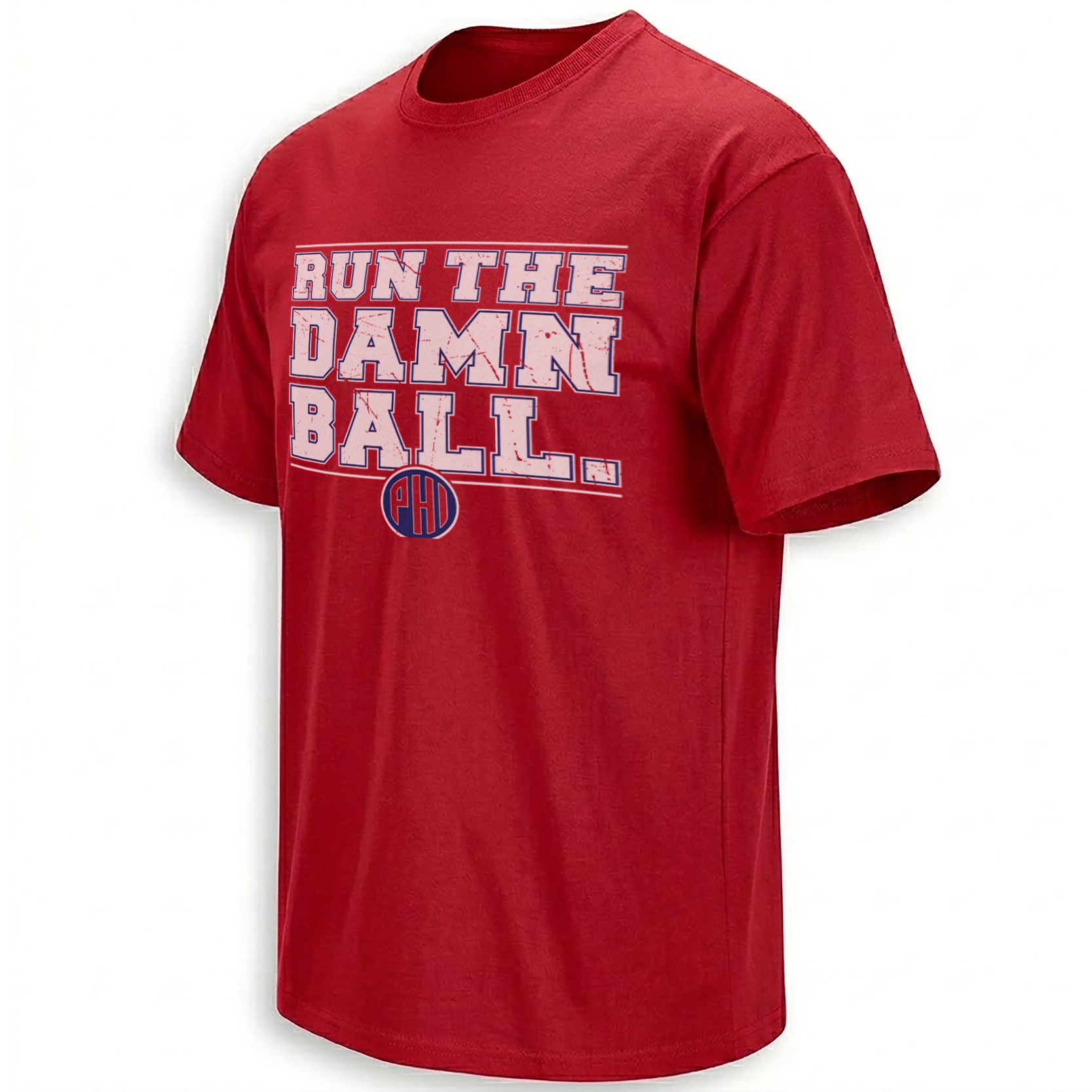
The design uses oversized collegiate lettering instead of player photography. “RUN THE / DAMN / BALL.” is stacked like a locker-room instruction, with the central word carrying the greatest visual weight.
Distressing inside the cream letters keeps the print from looking like a polished corporate campaign. It resembles a shirt that could already have passed between lockers, batting cages and pregame media sessions.
The red base immediately places the image within Philadelphia baseball color language, while dark blue outlines prevent the message from becoming a flat block of white type. The small circular “PHI” mark completes the city reference without competing with the words.
Most importantly, the period remains part of the design. It turns the line from a suggestion into an order. There is no second sentence and no tactical explanation—only the command.
Why fans noticed players wearing it
Fans are used to seeing officially coordinated warmup gear. A blunt phrase becomes more interesting when it appears to come from the social life of the clubhouse itself. It offers a small glimpse of how players communicate away from prepared interviews.
That is why screenshots of clubhouse shirts circulate so quickly. The garment appears to reveal an internal joke, grievance or rallying point before anyone has converted it into a formal team message.
The larger Philadelphia Phillies collection records similar moments when local sayings, player performances and clubhouse personalities become part of the fan vocabulary. Within the broader MLB collection, this design stands out because its meaning depends as much on Philadelphia’s multi-sport culture as it does on baseball itself.
A timestamp from an unsettled Phillies summer
The 2026 Phillies have already moved through a managerial change, a long losing streak, a recovery into the playoff race and another uneven July. Their 11–4 response against New York showed how quickly an anxious atmosphere can turn into an offensive release.
“Run The Damn Ball” belongs to that kind of season. It is not a championship declaration and does not pretend that every problem has disappeared. It records a team and fan base asking for urgency while the outcome remains unresolved.
Years from now, the design may require context: Garrett Stubbs, an active clubhouse personality, Phillies players adopting the phrase and a city translating its familiar football demand into baseball language. That need for context is precisely what makes it a cultural artifact rather than a generic slogan.
Run The Damn Ball Phillies FAQ
Why are Phillies players wearing “Run The Damn Ball” shirts?
The phrase is connected to Garrett Stubbs and his call for a more aggressive running game. Reports from Citizens Bank Park noted that some Phillies players had begun wearing shirts with the message.
What does “Run The Damn Ball” mean in baseball?
In this context, it means creating more pressure and movement on the bases. It is a deliberate crossover from the familiar football demand to run the ball.
Is the phrase associated with Garrett Stubbs?
Yes. The player-linked version of the design was produced in partnership with Stubbs and described as reflecting his push for a more aggressive running game.
What was the Phillies’ record after beating the Yankees on July 26, 2026?
The Phillies improved to 57–49 after defeating the Yankees 11–4 on Sunday Night Baseball.
What does the shirt artwork look like?
It uses large distressed cream lettering with blue outlines on a red shirt, arranging “Run The Damn Ball” like a direct clubhouse instruction.
A clubhouse demand in unmistakable Philly language
Explore the graphic as a timestamp from the 2026 Phillies season and the city’s cross-sport fan culture.