
PE Guy Was Told to “Get a Real Job.” The Internet Joke Writes Itself.
Johnny Hilbrant Partridge built a comedy career by impersonating an impossibly self-important private equity executive. Then someone criticized the comedian for not having a real job — and gave him another perfectly ironic punchline.
The internet is full of people explaining how to build successful careers. Few have turned that obsession into comedy as effectively as Johnny Hilbrant Partridge, the creator of PE Guy, a fictional private equity professional whose extraordinary wealth, professional importance and social connections are apparently relevant to every conversation.
His character has become recognizable through a particular combination of corporate vocabulary, elite lifestyle references and spectacular self-confidence. Expensive vacations, private clubs and impressive professional networks all become opportunities for exaggerated displays of status.
The character’s latest joke began when Partridge shared an account of someone from his personal past criticizing his comedy career. According to his social-media post, the person suggested that he was not funny and should find a real job.
For a comedian whose fictional identity revolves around professional success, the criticism was almost impossibly appropriate.
Who Is PE Guy?
PE Guy is the fictional finance-bro character created by comedian and content creator Johnny Hilbrant Partridge. He began posting the character’s sketches in early 2025, drawing on the mannerisms, language and social habits of affluent professionals.
The PE in the character’s name stands for private equity, a field associated with investment firms that acquire, manage and eventually sell businesses. But the comedy is less about explaining investment structures than about lampooning how wealth and job titles can become entire personalities.
The character speaks as if every social interaction is an opportunity to discuss professional importance. Ordinary experiences become demonstrations of privilege. Modest achievements are presented as enormous strategic successes, while familiar luxury destinations function as evidence of personal superiority.
Partridge’s work has attracted attention beyond the finance industry. Articles in Business Insider, the Boston Globe and other publications have examined the character’s popularity and the ways viewers recognize its exaggerated behaviors.

The Real-Job Criticism That Became the Joke
The original story came directly from Partridge. In a LinkedIn post, he described hearing that someone he had once regarded as family had criticized his comedy during a conversation with mutual acquaintances.
The reported criticism contained two simple observations: the person did not think he was funny, and believed he should pursue a conventional job.
Partridge responded in the theatrical voice of his character, referencing his supposed professional network and suggesting that criticism of his comedic abilities was likely to reach him.
Rather than responding with an extended argument about the legitimacy of his career, he ended the story by returning to the central irony: his supposedly imaginary occupation was going very well.
The identity of the critic was not publicly established in the source reviewed for this article. The criticism should therefore be understood as Partridge’s account of a personal exchange, not an independently verified statement from the unnamed individual.
The Original Social-Media Post
The exchange is particularly useful for understanding the joke because it appeared under Partridge’s own name rather than as an anonymous screenshot circulating without attribution.
The significance of that post is the contrast between the straightforward criticism and the elaborate persona responding to it. PE Guy can turn almost any subject into evidence of his financial importance. A negative review of his entertainment career becomes another opportunity to boast.
Why PE Guy’s Comedy Works Beyond Finance
Private equity is a natural subject for satire because it combines legitimate financial complexity with a recognizable popular image of high compensation, exclusive social networks and relentless professional ambition.
Partridge does not need to explain complicated acquisition financing to make his character funny. Instead, he concentrates on smaller behaviors: mentioning one’s role unnecessarily, treating ordinary travel as a status competition and implying that friendships are valuable primarily because of their connections.
The exaggerated performance makes those habits visible to an audience that may never have worked inside an investment firm. Viewers recognize similar personalities from other environments, including professional networking events, affluent neighborhoods and corporate workplaces.
Catchphrases such as “Due to my role,” “Substantial” and “Decent” work because they sound like ordinary expressions until the character repeats them with excessive seriousness.
The central comic mechanism is consistency. The character’s enormous ego appears in every situation, regardless of whether his perceived achievements are actually relevant.
The Creator Economy Is the Punchline
The idea that online content creation is not legitimate work has become a recurring argument in internet culture. Traditional definitions of employment still influence how many people evaluate careers, even as creators build businesses through advertising, sponsorships, direct audience payments and other forms of media production.
Partridge’s career provides a particularly clear example of that tension. In a June 2026 interview, Business Insider reported that he had developed a substantial business through brand partnerships, personalized videos, merchandise, appearances and platform revenue.
He described operating much of that activity himself, coordinating commercial opportunities while continuing to produce the comedic material that originally attracted his audience.
An October 8, 2026 episode of The CEO Series examined that transformation in greater depth. Partridge discussed his earlier work, the first video that helped establish the character and his approach to turning online attention into a sustainable enterprise.
A private equity executive whose wealth, connections and exceptional professional importance dominate every conversation.
A content creator managing comedy production, brand partnerships, personalized videos, merchandise and media appearances.
The distinction explains why the criticism created such an effective satirical opening. The fictional executive insists that his role is extremely important. Meanwhile, the actor playing him has built a genuine income-producing career through the performance itself.
The Cartoon Shirt Turns Criticism Into a Character Portrait
The EllieShirt He Should Get a Real Job design takes that social-media exchange and presents it as an old-fashioned illustrated slogan graphic.
Large navy lettering frames a smiling cartoon portrait of PE Guy. The character wears a baseball cap featuring a dollar-sign symbol, a simple reference to the financial world and its cultural association with wealth.
The caricature has an intentionally cheerful expression. That choice makes the criticism appear to have little effect on the character’s confidence. In the fictional world of PE Guy, even being mocked is another opportunity to occupy the center of attention.
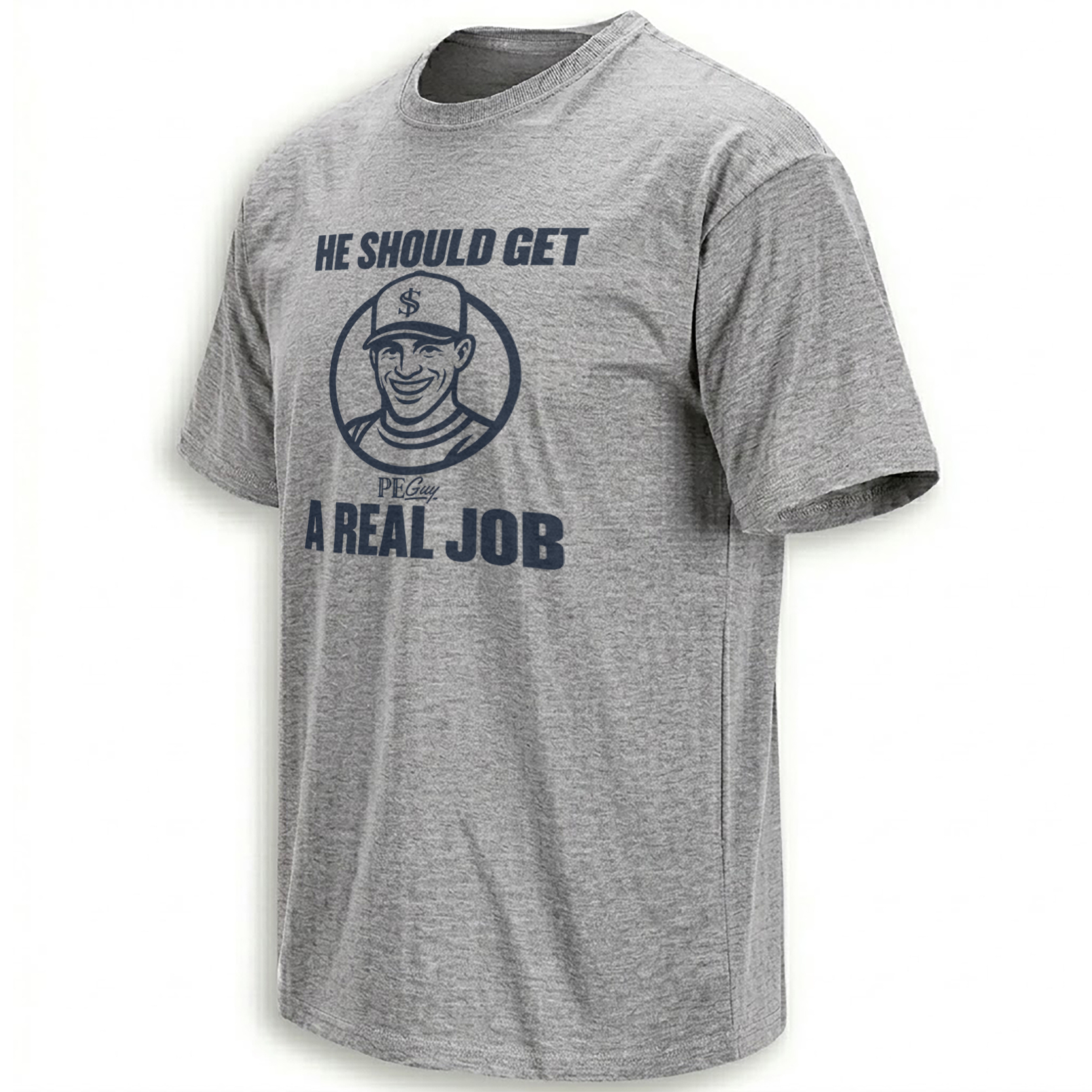
A vintage-inspired caricature transforming a criticism of Johnny Hilbrant Partridge’s comedy career into a self-aware piece of financial satire.
Explore the illustrated graphic →Unlike many meme designs that depend on reproducing a complete screenshot, this graphic reduces the story to three recognizable components: the slogan, the face and the financial symbol.
Its restrained navy-and-gray presentation also contrasts with the character’s extravagant fictional lifestyle. The result resembles a vintage promotional shirt, allowing viewers familiar with PE Guy to supply the missing voice and personality themselves.
Why Finance Satire Has Become a Bigger Cultural Conversation
The popularity of PE Guy belongs to a broader wave of comedy examining wealth, professional status and the social consequences of investment culture.
A feature published by The Guardian on October 9, 2026, explored creators using satire to criticize the private equity industry’s effects on everyday industries, including healthcare, retail and youth sports.
The subject is significant because private equity has become increasingly visible in conversations about ownership, cost pressures and public services. Satire translates complex economic debates into familiar personal behavior, making the underlying themes easier for wider audiences to recognize.
Partridge’s work is especially distinctive because his fictional executive rarely acknowledges that his own behavior might be ridiculous. His absolute certainty allows viewers to experience the joke without the character explaining it.
The “real job” episode introduces another dimension: the difference between externally recognized professional status and the practical work of building an independent creative business.
A Meme About Work, Success and Who Gets to Define Them
The most lasting element of the joke may be its relevance outside finance. Writers, artists, musicians, comedians and digital creators regularly encounter questions about whether their work qualifies as a serious profession.
A conventional job title is often easier to describe than a career assembled from creative projects, partnerships and independent audiences. That does not necessarily make one more legitimate than the other.
Partridge’s response turns the argument into comedy rather than a philosophical debate. The irony is immediately understandable: someone whose online persona constantly advertises career success is being criticized for the unconventional career that made the persona possible.
The design can also be found through EllieShirt’s PE Guy product search, which offers a character-specific route without assigning the piece to an unrelated collection.
The original “real job” criticism is documented through Johnny Hilbrant Partridge’s own account on LinkedIn. His career development is supported by published interviews and reporting. The cartoon graphic is an independent satirical interpretation, not an official statement by the creator.
Frequently Asked Questions
Who is PE Guy?
PE Guy is a satirical private equity executive character created by comedian Johnny Hilbrant Partridge, who became known through Instagram and TikTok sketches beginning in 2025.
Why did someone tell PE Guy to get a real job?
According to Partridge’s own social-media account, someone from his personal past criticized his comedy and suggested that he should pursue a conventional job.
Is Johnny Hilbrant Partridge actually a private equity executive?
No. He is a comedian and content creator portraying an exaggerated fictional private equity professional.
What does PE mean in PE Guy?
PE stands for private equity, an investment industry that the fictional character frequently references through exaggerated professional language and lifestyle claims.
What does the He Should Get a Real Job Shirt reference?
The design references the criticism Partridge described online, combining the phrase with a cartoon portrait and dollar-sign cap to emphasize the irony of his successful comedy career.
The funniest part of the story is that PE Guy hardly needs to change his personality to respond. The He Should Get a Real Job graphic preserves the joke in one compact image: a very confident fictional businessman confronting criticism of the real comedian who created him.
The PE Guy He Should Get a Real Job Shirt turns Johnny Hilbrant Partridge’s social-media response to career criticism into vintage cartoon satire. A grinning finance caricature and bold lettering capture the irony behind the creator’s success.