
Patrick Mahomes Did Not Just Return From Injury — The Reaper Came Back Too
Nine months after a torn ACL ended Kansas City’s 2025 season, No. 15 is back, the Chiefs are 2–0 and the old Grim Reaper mythology suddenly feels less like nostalgia than current football again.
The darkest Patrick Mahomes nickname was born at the exact moment Kansas City looked dead.
January 23, 2022. Buffalo had just taken a 36–33 lead in the AFC Divisional Round. Thirteen seconds remained. The Chiefs needed enough yardage for a field goal, and the football math suggested the night was finished.
Andy Reid gave Mahomes a different instruction. When things were grim, he told his quarterback, go be the Grim Reaper.
Mahomes completed passes to Tyreek Hill and Travis Kelce, Kansas City reached field-goal range, Harrison Butker forced overtime and the Chiefs eventually won 42–36. From that night forward, the Reaper became shorthand for the uncomfortable part of playing Kansas City: the game is not truly dead until No. 15 agrees that it is.
“Return of the Reaper” works because Mahomes did not merely return to the roster. He returned immediately to the kind of endings that created the nickname.
The Comeback Started With a Much Darker Ending
On December 14, 2025, Kansas City’s season collapsed in one afternoon. The Chiefs lost 16–13 to the Chargers, were eliminated from postseason contention and lost Mahomes to a torn ACL in his left knee late in the fourth quarter.
Kansas City confirmed the injury that evening. Mahomes underwent surgery the following day in Dallas and began rehabilitation immediately. NFL reporting later noted that an LCL tear was repaired during the same operation.
The timetable made Week 1 ambitious. Mahomes nevertheless returned for Kansas City’s September 14 opener against Denver.
What happened on his first possession after the injury made the comeback instantly cinematic: Mahomes scrambled 15 yards for a touchdown.

Week 2 Felt Even More Like the Old Reaper
The Denver game proved Mahomes could play. Indianapolis proved he could still live inside chaos.
Kansas City and the Colts traded momentum all night at Arrowhead. Mahomes finished 32-of-47 for 382 yards and three touchdowns, repeatedly answering whenever Indianapolis pushed the game back toward the edge.
Overtime made the symbolism stronger. Mahomes helped position Kansas City for the winning field goal, and the Chiefs escaped 33–30. The victory pushed Mahomes to 10–2 in career overtime games, including the playoffs, while his regular-season overtime record moved to 8–0.
Through two games, he has five passing touchdowns, one interception and a 103.8 passer rating. Those numbers matter, but the emotional part is simpler: the late-game version of Mahomes looks recognizable again.
“Grim Reaper” is not a generic dark nickname added after the fact. It traces directly to Reid’s instruction before one of the most famous drives of Mahomes’ career. The 2026 comeback gives that established mythology a new chapter.
The Official Week 1 Film Shows the Difference Between Healthy and Back
There is a meaningful difference between being medically cleared and looking like yourself. Mahomes’ first two weeks have supplied evidence for both.
His return to scrambling, red-zone improvisation and overtime control is why a phrase from January 2022 suddenly feels useful again in September 2026.
Why the Artwork Makes the Metaphor Literal
The Return of the Reaper Shirt does not use a normal Mahomes action shot.
Instead, a hooded skeletal figure stands beside the typography carrying a large curved scythe. White bone, gray shadows and hard red outlines are isolated against a black shirt base. Small lettering identifies Patrick Mahomes, while the distressed red phrase “RETURN OF THE” leads into the enormous white-and-red word “REAPER.”
That choice is important because the concept has two timelines. The Grim Reaper figure points backward to Buffalo and 13 seconds. “Return” points directly to the ACL injury and the nine-month road back.
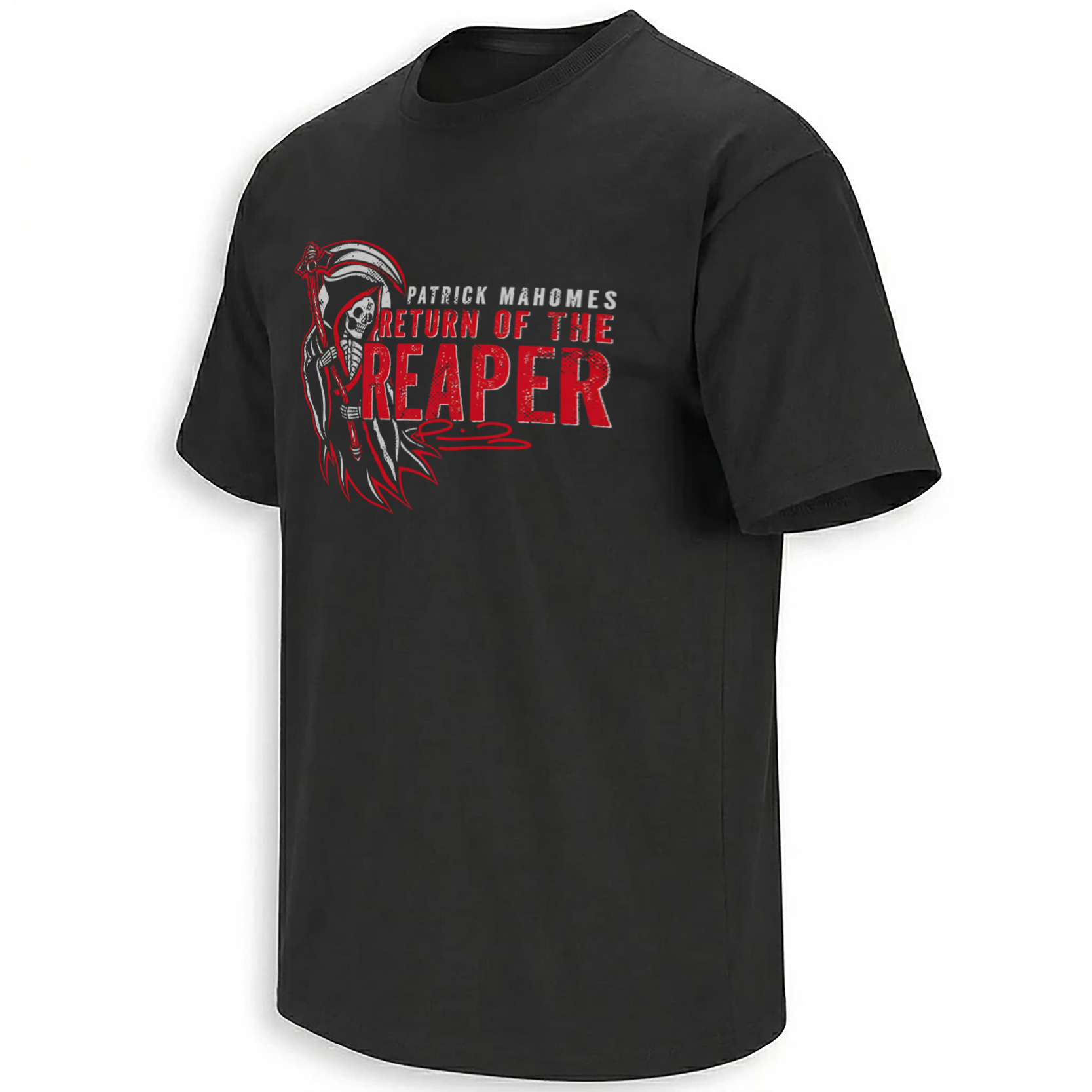
The Grim Reaper, scythe and distressed Chiefs-red typography connect the legendary 13-second comeback identity with Mahomes’ return from ACL surgery.
View the comeback piece →Why the Phrase Is Bigger Than “Mahomes Is Healthy”
Recovery graphics usually celebrate the fact that an athlete returned. The stronger idea here is that the personality of the player’s football returned too.
Mahomes can still extend a play. He can still run when a defense leaves space. He can still turn an overtime possession into a controlled march while everyone else in the stadium understands what his presence means.
That emotional language has been building in Kansas City for years. The wider Kansas City Chiefs collection follows those playoff moments, player identities and Chiefs Kingdom references, while the NFL collection places the comeback inside the larger 2026 season. More No. 15 designs can be found through the Patrick Mahomes search archive.
Frequently Asked Questions
Why is Patrick Mahomes associated with the Grim Reaper?
The association comes from Andy Reid’s message before Kansas City’s famous 13-second comeback against Buffalo in the January 2022 AFC Divisional Round.
What injury did Patrick Mahomes suffer in 2025?
Mahomes tore the ACL in his left knee against the Los Angeles Chargers on December 14, 2025 and underwent surgery the following day.
When did Mahomes return?
He returned to regular-season action against Denver on September 14, 2026 and scored a rushing touchdown on his first offensive possession.
How has Patrick Mahomes played through two games?
He has 566 passing yards, five passing touchdowns and one interception while Kansas City has started the season 2–0.
Why is the design called “Return of the Reaper”?
The phrase combines Mahomes’ established Grim Reaper identity from the Buffalo comeback with his 2026 return from a season-ending knee injury.
The Return of the Reaper design preserves the overlap between Mahomes’ old playoff mythology and his new recovery story, while the Chiefs archive follows what No. 15 does next.
Return of the Reaper Shirt connects Patrick Mahomes’ 2026 ACL comeback with the Grim Reaper identity born from Kansas City’s legendary 13-second playoff escape against Buffalo.