
Nebraska Beats Ohio State 31–28: The Cornhuskers Break Through
A 31-game losing streak against ranked opponents ended in Lincoln. Anthony Colandrea, Quinn Clark and a determined Nebraska defense delivered a victory that sent thousands of fans onto the field.
The final kneel-down meant far more than three points. On November 21, 2026, Anthony Colandrea took the last snap at Memorial Stadium, securing Nebraska’s 31–28 upset of Ohio State. Within moments, a crowd that had endured a decade of frustration poured onto the field. The Cornhuskers had finally beaten an Associated Press Top 25 opponent again.
The last time Nebraska had defeated a ranked team was September 17, 2016, a 35–32 victory over Oregon. Thirty-one consecutive defeats to AP-ranked opponents followed. For a program with five claimed national championships and one of college football’s strongest traditions, the losing streak had become an exhausting measure of how far the team had drifted from its expectations.
Ohio State arrived ranked No. 16 in the AP poll, bringing a nationally prominent brand and its own postseason ambitions to Lincoln. Nebraska entered with a 6–4 record and a home crowd searching for proof that the current team could finish a close game against elite opposition.
The result was a breakthrough that connected the present roster with the long memory of Nebraska Cornhuskers football culture. It was a victory about more than one opponent. It was about ending an unwanted chapter.
Ohio State Scored First. Nebraska Refused to Fold.
The Buckeyes opened the game with a 67-yard touchdown pass from quarterback Luke Fahey to Jeremiah Smith. It was an explosive start that could have discouraged a Nebraska team carrying the weight of previous defeats.
Instead, Colandrea responded with an 11-yard touchdown pass to Luke Lindenmeyer, tying the game at seven. The Huskers then put together a long second-quarter drive that ended with a seven-yard touchdown reception by Kwazi Gilmer.
Colandrea added a 13-yard rushing touchdown later in the quarter, giving Nebraska a 21–7 advantage. Ohio State answered with another Fahey-to-Smith connection before halftime, reducing the lead to 21–14.
The opening half showed something that had often been missing from Nebraska’s recent losses to ranked teams: the Cornhuskers were creating opportunities rather than simply trying to survive.
Colandrea ultimately completed 19 of 28 passes for 200 yards and three passing touchdowns, while rushing for 63 yards and a fourth total touchdown. His performance gave the Huskers both offensive flexibility and the ability to convert difficult third downs.
The Fourth Quarter That Changed Nebraska’s History
Ohio State tied the game 21–21 during the third quarter, setting up another stressful finish. In previous seasons, this was often the point when Nebraska’s supporters had seen an encouraging performance give way to another close defeat.
John Hohl kicked a 33-yard field goal early in the fourth quarter to restore Nebraska’s lead, 24–21. The Blackshirt defense then delivered one of the game’s most important plays.
Jamir Conn challenged Jeremiah Smith on a deep pass attempt near midfield. The ball was tipped away from Smith and intercepted by Victor Evans III, giving Nebraska possession with an opportunity to extend its advantage.
Nine plays later, Colandrea found Quinn Clark on a 26-yard touchdown pass. Clark made the catch near the pylon and spun into the end zone, putting Nebraska ahead 31–21 with 7:46 remaining.
Ohio State answered with a Bo Jackson rushing touchdown, cutting the deficit to 31–28 with 3:49 left. Nebraska still needed to protect a one-possession lead against one of college football’s most recognizable programs.
For ten years, Nebraska had found ways to lose these games. This time, it found the final first downs.
Colandrea Finished the Game With His Legs
The Buckeyes had time for another possession if their defense could get off the field. Nebraska’s offense knew that simply running three plays and punting would give Ohio State another opportunity.
Colandrea refused to leave the outcome to chance. First he converted a third-and-two with a five-yard run around the right side, taking the game to the two-minute timeout.
Later, facing third-and-five with 55 seconds left, Colandrea kept the ball again and gained six yards around the left edge. Ohio State had used its final timeout. The conversion allowed Nebraska to move into victory formation.
It was fitting that the quarterback finished the upset on his feet. His passing had created the lead, but his final runs ensured the defense would not have to defend it again.
The official Nebraska Athletics game report details the game-winning drive and the final sequence.
The Real Image: Memorial Stadium Finally Erupted
When the result became official, Nebraska supporters stormed the field at Memorial Stadium. The gathering created one of the most significant images of the 2026 Cornhuskers season: a mass of red celebrating the end of a losing streak that had lasted more than a decade.
The official Nebraska Athletics photo gallery includes Anthony Colandrea’s celebrations, Quinn Clark’s touchdown, defensive plays and multiple photographs of the Memorial Stadium field storm.

The field storm represented the emotional weight of the result. Fans were not celebrating the end of an unbeaten season or a newly secured championship. They were celebrating a victory that changed how they could think about the program’s immediate future.
For supporters who had watched Nebraska repeatedly come close against ranked opponents, reaching the field after a successful final kneel-down carried a different kind of relief.
How College Football Reacted to the Upset
The victory quickly became a major topic across college football communities. Nebraska’s 31-game ranked-opponent losing streak had been widely cited for years, and the 2026 breakthrough gave fans an opportunity to revisit a decade of frustrating finishes.
The reaction also reflected the result’s wider significance. Ohio State entered the game with College Football Playoff hopes still alive, and the loss damaged those ambitions before its annual rivalry matchup with Michigan.
On r/CFB, the postgame thread attracted thousands of votes and comments, mixing disbelief, congratulations, rivalry jokes and reflections on how important the moment was for Nebraska supporters.
Nebraska-focused outlets approached the result with an even stronger sense of release. Corn Nation described the fourth quarter as one that finally belonged to the Huskers, emphasizing the way the team had protected its lead when another painful ending seemed possible.
Those reactions help explain why the game was bigger than a three-point upset. Nebraska had not merely defeated a ranked opponent. It had finally changed a narrative that had shadowed the team through multiple coaching staffs and generations of players.
The Cornhuskers Graphic Turns a Score Into a Statement
The The Cornhuskers Nebraska 31–28 Ohio State Upset design places the result at the center of a strong Nebraska-themed composition. Its message is deliberately straightforward: the Huskers won, the Buckeyes lost and the date now belongs to Nebraska’s football history.
Scarlet red remains the visual anchor, supported by a restrained collegiate presentation that recalls newspaper headlines and commemorative sports graphics.
That directness is appropriate for this particular moment. The victory does not require elaborate symbolism to become meaningful. The score and opponent already communicate the scale of the accomplishment.
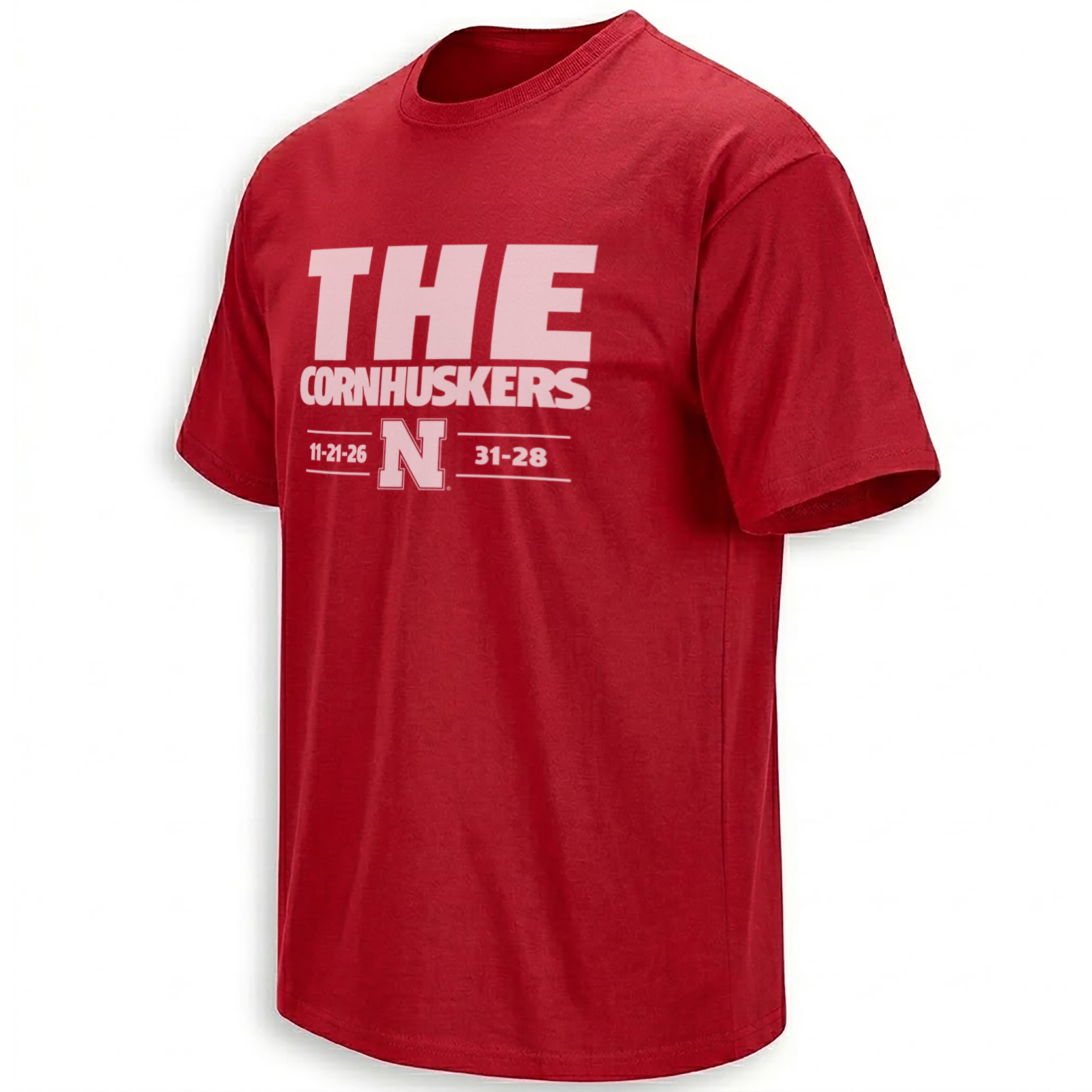
A result-driven commemorative design honoring Nebraska’s 31–28 victory over Ohio State and the end of its decade-long losing streak against ranked opponents.
View the upset graphic →Why the Number 31 Has Two Meanings
In the final score, 31 represents the points Nebraska scored to beat Ohio State. In the larger story, 31 also represents the consecutive losses against AP-ranked opponents that came before this victory.
The coincidence gives the graphic an additional layer of historical meaning. The same number that recorded Nebraska’s winning points also marked the length of its unwanted streak.
Supporters did not need that coincidence to recognize the importance of the outcome, but it creates a memorable connection between the box score and the history that Nebraska finally left behind.
The final margin also matters. A 31–28 game is the kind of contest in which one mistake can erase a strong performance. Nebraska had experienced too many of those endings. On November 21, Colandrea and his teammates completed the final possession and kept the outcome from slipping away.
What the Victory Means for Matt Rhule’s Program
The win was a signature moment for head coach Matt Rhule, but it did not erase every problem Nebraska had faced during the season. The Cornhuskers still stood at 7–4 overall and 4–4 in Big Ten play, with an annual rivalry game against Iowa remaining.
What changed was the evidence of what the team could accomplish. Against a ranked Ohio State opponent, Nebraska made enough plays on offense, produced crucial defensive takeaways and converted late third downs to close out the result.
The performance also highlighted the contributions of multiple players. Lindenmeyer broke Nebraska’s single-season receptions record for a tight end, Gilmer caught seven passes for 73 yards and Jamal Rule carried the ball 23 times for 70 yards.
The Blackshirts limited the Buckeyes to 335 total yards despite Jeremiah Smith’s outstanding receiving performance. It was a collective result that rewarded the work of several position groups.
The broader NCAA collection contains graphics connected to other memorable college football victories, rivalries and historic finishes, while the Nebraska collection keeps this milestone within the visual story of Big Red football.
Frequently Asked Questions
Did Nebraska beat Ohio State in 2026?
Yes. Nebraska defeated Ohio State 31–28 on November 21, 2026, at Memorial Stadium in Lincoln.
What streak did Nebraska end against Ohio State?
The Cornhuskers ended a 31-game losing streak against AP Top 25 opponents. Their previous ranked win came against Oregon in September 2016.
Who was Nebraska’s quarterback in the upset?
Anthony Colandrea completed 19 of 28 passes for 200 yards and three touchdowns, rushed for 63 yards and scored another touchdown on the ground.
Who caught Nebraska’s decisive fourth-quarter touchdown?
Quinn Clark caught a 26-yard touchdown pass from Anthony Colandrea, extending Nebraska’s lead to 31–21 before Ohio State scored again.
How did Nebraska finish the game?
Colandrea converted important third downs with quarterback runs, allowing Nebraska to retain possession and take the final snap in victory formation.
Did fans storm the field after Nebraska beat Ohio State?
Yes. Thousands of Nebraska fans entered the Memorial Stadium field after the final kneel-down to celebrate the upset.
What does the Cornhuskers 31–28 design commemorate?
It preserves Nebraska’s November 21, 2026 victory over Ohio State and the historical significance of ending a decade-long streak against ranked opponents.
The Cornhuskers 31–28 graphic marks the day Nebraska finally broke through against a ranked opponent. The wider Nebraska Cornhuskers archive preserves other moments from the program’s football culture.
Nebraska defeated Ohio State 31–28 on November 21, 2026, ending a 31-game losing streak against AP Top 25 opponents. Anthony Colandrea’s late conversions, Quinn Clark’s touchdown and the Memorial Stadium field storm made the result a defining Big Red moment.