
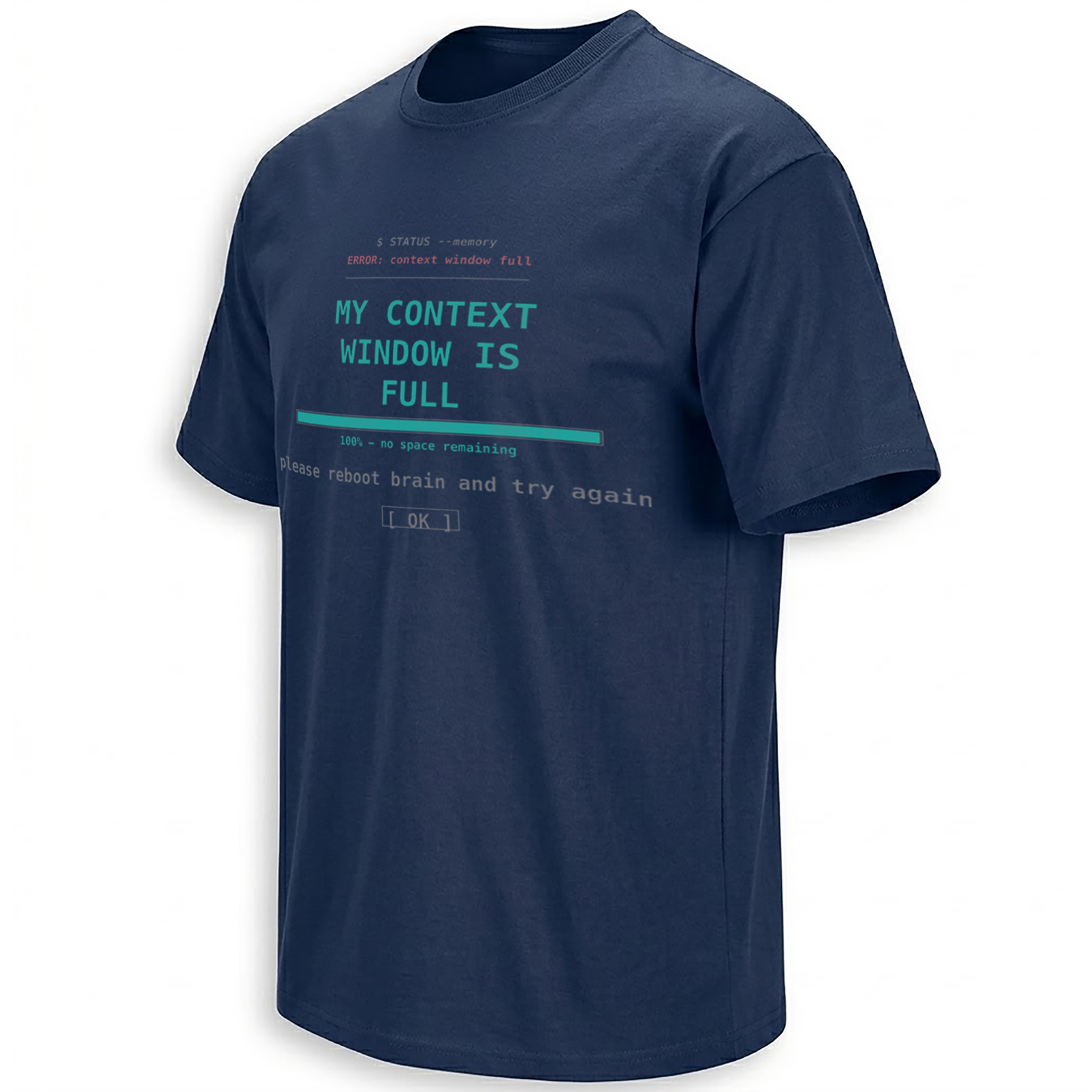
My Context Window Is Full Please start a new chat after my brain reboots.
A technical limit from generative AI has escaped the documentation and become a remarkably precise way to say: too many tabs, too many requests, no working memory left.
The meeting has added one more task. The inbox has produced three follow-ups. Someone asks a perfectly reasonable question, and the brain responds with the emotional equivalent of a token-limit warning: “My context window is full.”
The phrase belongs to a new generation of jokes created by everyday contact with generative AI. People no longer need to be machine-learning engineers to notice that long conversations accumulate history, models sometimes lose track of earlier details and a fresh chat can feel like a clean restart.
Turning that behavior into a human excuse is instantly satisfying. The speaker is not ignoring the request. The available working memory has simply reached capacity. Please summarize, reduce the prompt or try again after a reboot.
“My context window is full” makes mental overload sound less like personal failure and more like a capacity limit every intelligent system must manage.
The AI-era version of “I cannot process one more thing”What Is an AI Context Window?
A context window is the amount of information a generative model can reference while producing a response. It may include the current prompt, earlier conversation turns, instructions, documents, tool results and the model’s new output, depending on the system.
Context is commonly measured in tokens—small units that can represent words, word fragments, punctuation or other content. It is better understood as the model’s active working space than as a complete biography or permanent memory.
Anthropic’s context-window documentation explicitly describes it as a kind of working memory and distinguishes it from the much larger body of data used to train a model. Google’s Gemini documentation similarly compares the context window to short-term memory.
The shirt’s joke depends on that distinction. A full context window does not mean the system knows everything. It means the active workspace is crowded enough that something must be summarized, discarded or moved elsewhere before the conversation can continue effectively.
Context-window behavior differs among models and products. Some reject requests beyond a fixed limit; others compact, summarize or rotate older information. “My Context Window Is Full” is a humorous simplification, not a claim that every AI system fails in exactly the same way.
Why “Context Window” Escaped the AI Lab
Older computer humor relied on broadly visible experiences: frozen screens, low batteries, loading bars and the blue screen of death. Generative AI introduced a different vocabulary into daily life—prompts, hallucinations, tokens, context, agents and new chats.
These terms became culturally useful because millions of people encountered the behavior before learning the formal definitions. A chatbot forgets an earlier instruction. A very long document exceeds a limit. A coding session grows unwieldy. Users learn that the conversation has a finite active space.
“My Context Window Is Full” compresses all of those experiences into one sentence. It is technical enough to reward AI users, yet intuitive enough for everyone else: there is a window, information has filled it, and no more will fit.
The wording circulates across shirts, posts and AI-user jokes, but no single original creator or definitive first viral post is reliably documented. It is best understood as distributed community wordplay that emerged from shared experience with long AI conversations.
Why It Works So Well as a Human Metaphor
Cognitive overload existed long before chatbots. People have always forgotten names under pressure, lost track of instructions and reached the point where one additional request feels impossible. What changed is the metaphor available to describe it.
“My brain is full” sounds childish. “I am overwhelmed” sounds serious. “My context window is full” lands between them: specific, self-aware and funny. It communicates a real limit while softening the refusal.
The phrase also redistributes responsibility. A capacity limit is not a moral defect. Powerful AI systems still require context management; competent humans do too. The joke quietly argues that attention is finite and that asking for a summary is sometimes intelligent system design.
The Difference Between Context and Memory
AI product language often uses “memory” loosely, but a context window is not identical to long-term memory. Context is the information actively available for the present response. A separate memory feature, database or saved profile may persist information across conversations, depending on the product and settings.
That is why opening a new chat can change what the model appears to remember. The new conversation may begin without the full transcript of the old one, even though the underlying model has not been retrained and the platform may preserve selected information elsewhere.
The design deliberately blends these ideas because human experience blends them too. When overloaded, we do not carefully distinguish working memory, long-term recall and attention. We simply know that the next request has nowhere comfortable to land.
Why “Please Start a New Chat” Is the Perfect Ending
The second line changes the joke from diagnosis into protocol. It imagines the tired brain issuing instructions to its user: preserve the important information, close the current session and return only after a clean restart.
“Reboot my brain” adds the final computer metaphor. Rest, coffee, silence or a walk becomes maintenance rather than indulgence. The person is not disappearing; the system is restarting so it can respond again.
This makes the message especially suited to office workers, developers, AI researchers, teachers, parents, online sellers and anyone managing more simultaneous inputs than a single afternoon should contain.
From Model Limitation to Wearable Boundary
On a shirt, the phrase becomes both an insider reference and a warning label. AI-literate viewers recognize tokens and context limits. Everyone else understands the universal visual: the progress bar is red, capacity is gone and further input may be processed unpredictably.
It also captures a specific cultural moment. As AI moves from specialist software into ordinary work and conversation, its technical limitations become metaphors for human life. People are not merely using the tools; they are borrowing the tools’ language to describe themselves.
The design pairs naturally with the Error 404 Sleep Not Found Shirt. One declares that rest is missing; the other reports that working memory is full. Both belong among Ellie Shirt’s newest cultural designs, preserving the vocabulary of digital life as it becomes everyday humor.
Frequently Asked Questions
What does “My Context Window Is Full” mean?
It means an AI system has reached or approached the amount of active information it can process at once. As a human joke, it means the speaker is mentally overloaded and cannot take in another request.
What is a context window in AI?
A context window is the active amount of text and other information a model can reference when generating a response, commonly measured in tokens.
Is a context window the same as AI memory?
Not exactly. Context is the working information available for the current response. Long-term memory or saved information may be handled separately by the product or application.
What happens when an AI context window fills up?
Behavior varies. A system may reject oversized input, truncate or rotate older context, summarize the conversation or ask the user to begin a new session.
Why is “start a new chat” part of the joke?
A new chat represents a clean context space. Applied to a person, it becomes a request for rest, a reset or a simpler explanation before continuing.
Is the My Context Window Is Full Shirt official AI-company merchandise?
No. It is an independent Ellie Shirt design inspired by general generative-AI terminology and the everyday experience of mental overload.
The My Context Window Is Full Shirt turns an AI limitation into the clearest possible status update for an overloaded human brain.
The My Context Window Is Full Shirt transforms an AI token limit into a funny human capacity warning. Made for developers, AI users, office workers and overloaded minds, it says what happens when too many tabs, tasks and conversations fill the brain’s active memory.