MVPETE
Pete Crow-Armstrong’s case is no longer built on spectacular catches alone. Power, speed, patience and historic center-field defense have turned a Wrigley chant into a legitimate National League argument.
“MVPete” works because one added syllable captures the transformation of Pete Crow-Armstrong’s 2026 season: PCA is still doing things in center field that almost nobody else can do, but now his complete game belongs in baseball’s most demanding award conversation.
On July 23, MLB’s official Cubs coverage openly framed the question: could Crow-Armstrong push himself into the National League MVP race? The timing was not random. Two nights earlier at Wrigley Field, he had raced into the ivy-covered wall to steal a hit from Detroit’s Ben Malgeri, then smiled on his way back to the dugout as the crowd resumed its familiar “P-C-A!” chant.
By that point, a second chant was becoming possible. Crow-Armstrong had combined 21 home runs, 25 stolen bases, a .905 OPS and the best defensive value in baseball. “M-V-P” was no longer simply fan exaggeration.
The MVP case begins where fly balls usually end
Crow-Armstrong’s defense has always looked cinematic. He accelerates toward gaps before television cameras fully communicate the danger, closes distances that appear unavailable and finishes plays beside—or directly inside—Wrigley’s ivy.
The 2026 numbers explain why those highlights matter beyond aesthetics. By July 23, PCA had accumulated a Statcast-era record 33 five-star catches. His +20 Fielding Run Value led Major League Baseball.
Cubs manager Craig Counsell described them as plays nobody else was making. That is the essential value of Crow-Armstrong’s glove: it does not merely convert routine opportunities. It changes the expected result of batted balls and removes offense that other center fielders cannot reach.
A PCA catch can look like a bonus highlight. The MVP case asks voters to recognize it as run prevention—the defensive equivalent of offense disappearing into the ivy.
Power plus speed makes “MVPete” more than a glove-first campaign
Through July 22, Crow-Armstrong was the only Major League player with at least 20 home runs and 20 stolen bases. His 21–25 combination placed him on course for a second consecutive 30–30 season.
On July 8 in Baltimore, he hit two home runs and became only the third player in Cubs history to produce back-to-back seasons with at least 20 homers and 20 steals. The combination matters because it compresses multiple roster functions into one player: middle-of-the-order damage, leadoff pressure, elite baserunning and premium-position defense.
The real 2026 breakthrough happened before the swing
The most important development in Crow-Armstrong’s season may be the least spectacular one. He stopped chasing so many pitches.
His swing rate fell from 60.1% in 2025 to 49.8% in 2026—a 10.3-point drop that MLB identified as the largest year-over-year change among qualified hitters. His walk rate climbed from 4.5% to 11.8%, also the biggest improvement in baseball.
That change raised his on-base percentage from .287 in 2025 to .384 entering July 22. It also gave the Cubs a more complete leadoff hitter: pitchers could no longer rely on PCA expanding the zone before his power and speed had a chance to shape an inning.
WALK RATE: 4.5% → 11.8%
The improvement was visible in Chicago’s 11–2 victory over Detroit on July 21. Crow-Armstrong led off with a triple, drew three walks and accepted a bases-loaded free pass. An athlete once defined by the urgency of his swing was now controlling the strike zone.
Historic June changed the scale of the conversation
Crow-Armstrong’s second consecutive All-Star selection was powered by one of the most complete months in Cubs history. Across 26 games in June, he hit .381 with 11 home runs, five doubles, two triples, 20 RBIs, eight stolen bases and a 1.249 OPS.
He became the first Cubs hitter since Nick Castellanos in August 2019 to combine at least 11 homers, 20 RBIs and 40 hits in one month. Adding 17 walks pushed the comparison back to Hack Wilson in 1929 and 1930. Adding eight steals left Crow-Armstrong alone: no Cubs batter had ever assembled all of those elements in a single month.
June mattered because it showed that PCA’s new plate discipline could coexist with aggression. He did not become passive. He became more selective about when to unleash the speed and rotational violence that make his offensive ceiling so unusual.
The unavoidable comparison with Shohei Ohtani
Any 2026 National League MVP campaign has to acknowledge Shohei Ohtani. As of MLB’s July 23 analysis, Ohtani carried a .922 OPS alongside a 1.79 ERA and 95 strikeouts in 85 2/3 innings. His two-way value made him the established favorite.
Crow-Armstrong’s route was different. Rather than combining hitting and pitching, he was attempting to lead the league in total position-player value through offense, baserunning and generational defense. His 6.3 FanGraphs WAR led MLB entering July 22.
That does not make PCA the automatic favorite. It makes the argument legitimate. If he remained near the top of the WAR leaderboard, completed another 30–30 season and continued converting improbable fly balls into outs, voters would have to evaluate two radically different definitions of complete baseball value.
Why the MVPete design arrived at the right moment
The wordplay is compact: “MVP” flows directly into “Pete.” But its cultural value depends on timing. Printed too early, it would feel like optimism. In late July 2026, it had become a wearable campaign slogan supported by an actual statistical case.
The design places Crow-Armstrong at the center of a Chicago baseball movement. Cubs colors, MVP language and PCA’s unmistakable identity turn the artwork into a snapshot of the moment Wrigley’s “P-C-A!” chants started making room for “M-V-P!”
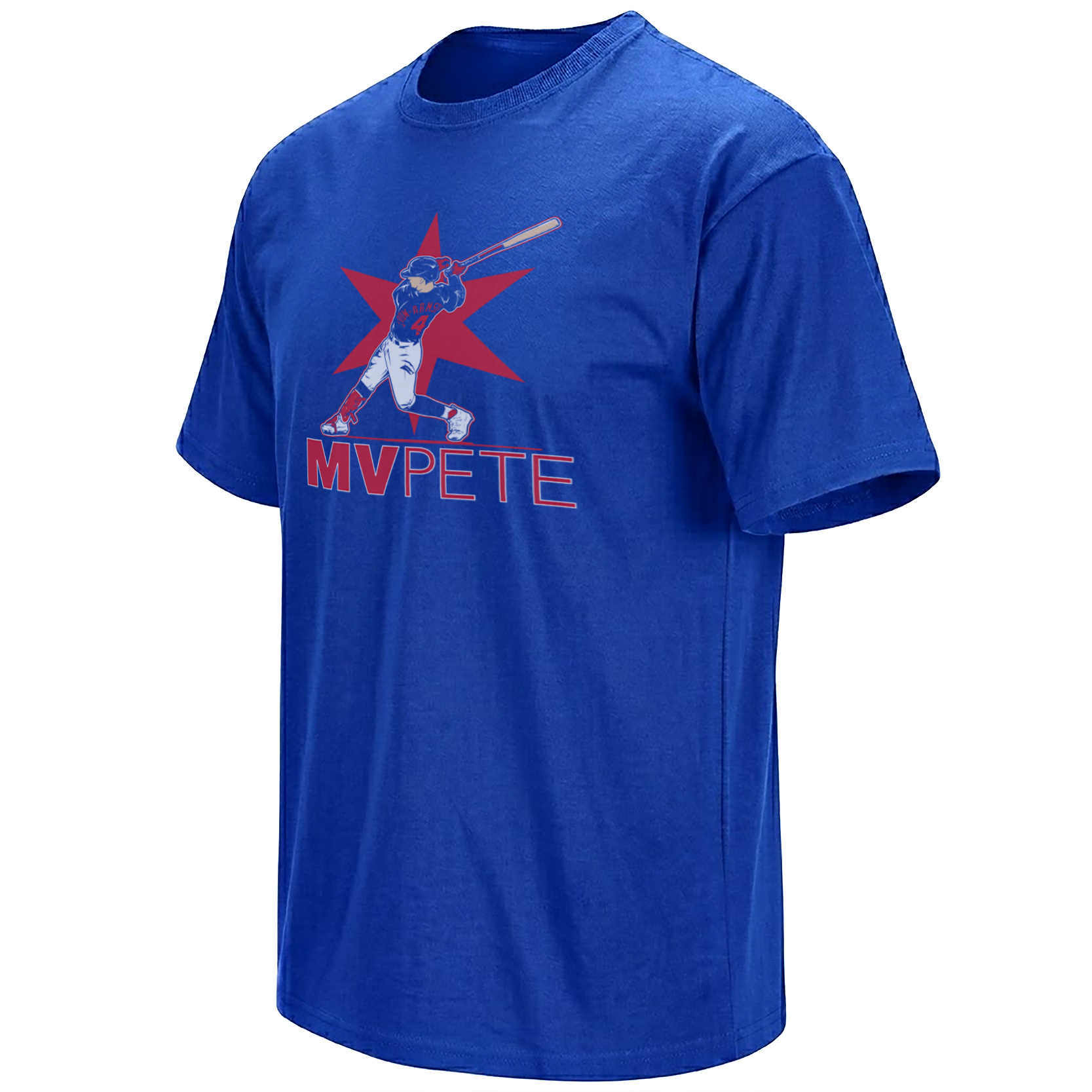
MVPete Shirt
A Cubs campaign graphic for the season Pete Crow-Armstrong combined 20–20 production, historic outfield defense and a transformed approach at the plate.
A campaign slogan earned one impossible play at a time
MVP discussions can flatten players into a single number. Crow-Armstrong resists that treatment. His case lives in the sequence: a walk instead of a chase, a stolen base after reaching, a home run when the pitcher enters his zone, and a five-star catch that prevents the opponent from building the same inning.
“MVPete” translates that full experience into one word. It is playful enough for a crowd chant and serious enough to describe where his season stood.
Through late July, Ohtani remained the formidable standard. But Pete Crow-Armstrong had already achieved something important: he made the National League MVP race require an honest conversation about him.
Readers can explore more player-driven apparel through the verified Chicago Cubs collection, browse the wider MLB collection, or discover the latest cultural releases in Newest.
Frequently Asked Questions
What does MVPete mean?
MVPete combines “MVP” with Pete Crow-Armstrong’s first name. Cubs fans use it as a campaign phrase for his 2026 National League MVP case.
Why is Pete Crow-Armstrong an MVP candidate in 2026?
His case combines 20-homer and 20-steal production, elite baserunning, greatly improved plate discipline and MLB-leading defensive value in center field.
How many five-star catches did PCA have by July 23, 2026?
He had recorded 33 five-star catches, the highest total of the Statcast era at that point.
What changed in Pete Crow-Armstrong’s plate approach?
His swing rate dropped from 60.1% in 2025 to 49.8% in 2026, while his walk rate rose from 4.5% to 11.8%.
Where can fans find more Chicago Cubs designs?
Related apparel is available through Ellie Shirt’s verified Chicago Cubs and MLB collections.