
Milwaukee Brewers. World Series Champions. The Wait Is Over.
Five World Series games. Thirteen postseason games. One hundred and three regular-season wins. After decades of near-misses, the Milwaukee Brewers conquered the Tampa Bay Rays and claimed the franchise’s first World Series championship. This is the complete story — from the final out and the championship’s defining performances to the history, numbers and emotions that made October 2026 unforgettable.

The final out belonged to Trevor Megill. The decisive start belonged to Jacob Misiorowski. The World Series MVP trophy belonged to William Contreras. But the championship itself belonged to something larger: the 2026 Milwaukee Brewers, the first team in franchise history to finish a season on top of the baseball world.
On Wednesday, October 28, 2026, Milwaukee defeated the Tampa Bay Rays 4–1 in Game 5 at Tropicana Field in St. Petersburg, Florida. The Brewers won the best-of-seven World Series four games to one, completing an extraordinary 11–2 postseason after a franchise-record 103-win regular season.
For a franchise that began as the Seattle Pilots in 1969 and relocated to Milwaukee in 1970, the moment closed an immense historical gap. The Brewers had reached the World Series only once before, in 1982. Now, after 44 years without another Fall Classic appearance, they had finally won one.
The Milwaukee Brewers defeated the Tampa Bay Rays 4–1 in the 2026 World Series, clinching the franchise’s first championship with a 4–1 Game 5 victory on October 28. William Contreras was named World Series MVP. Milwaukee finished the postseason 11–2.
01. The Road to Glory: Every Brewers Playoff Game
Milwaukee did not stumble into October with the hope that a few improbable moments would carry the club. The Brewers had been the best regular-season team in baseball, finishing 103–59 and claiming the National League’s top seed.
Their postseason path demanded something different in each round. Against San Diego, Milwaukee survived close games and one loss. Against Los Angeles, the Brewers swept the defending champions. Against Tampa Bay, they handled the tension of a 12-inning defeat before closing out the title on the following night.
Milwaukee advanced past San Diego, winning its fourth game 3–1 on October 7.
A sweep of the two-time defending champions delivered the National League pennant.
Milwaukee won the first three games, lost Game 4 in twelve innings and clinched in Game 5.
Complete 2026 Brewers postseason results
| Round | Date | Opponent | Score | Result |
|---|---|---|---|---|
| NLDS G1 | Oct 3 | Padres | 3–2 | Win |
| NLDS G2 | Oct 4 | Padres | 4–3 | Win |
| NLDS G3 | Oct 6 | Padres | 3–4 | Loss |
| NLDS G4 | Oct 7 | Padres | 3–1 | Win |
| NLCS G1 | Oct 11 | Dodgers | 2–1 | Win |
| NLCS G2 | Oct 12 | Dodgers | 7–4 | Win |
| NLCS G3 | Oct 14 | Dodgers | 6–2 | Win |
| NLCS G4 | Oct 15 | Dodgers | 6–4 | Win |
| WS G1 | Oct 23 | Rays | 3–2 | Win |
| WS G2 | Oct 24 | Rays | 5–4 | Win |
| WS G3 | Oct 26 | Rays | 10–1 | Win |
| WS G4 | Oct 27 | Rays | 3–4 (12 innings) | Loss |
| WS G5 | Oct 28 | Rays | 4–1 | WORLD CHAMPIONS |
The final ledger was extraordinary: eleven playoff victories against only two defeats. Add those eleven wins to the 103 earned during the regular season and Milwaukee completed 2026 with 114 combined regular-season and postseason victories.
These results are drawn from MLB’s official completed 2026 postseason bracket and results.
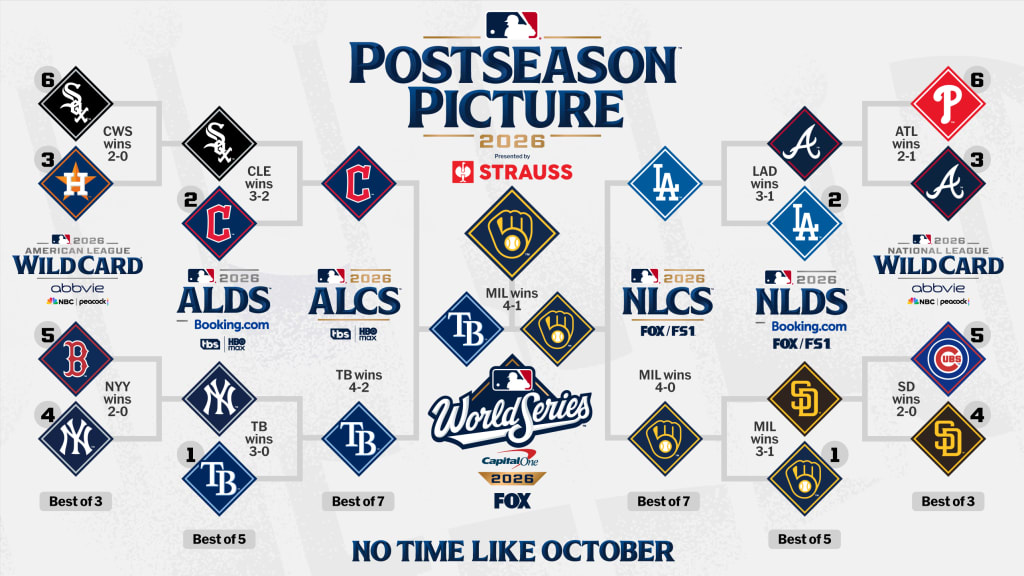
The NLCS sweep was especially significant. The Dodgers had won the previous two World Series titles and carried one of the most decorated rosters in baseball. Milwaukee’s four-game victory was a statement not about which club possessed the most famous names, but about which team executed its baseball more effectively.
02. Brewers vs. Rays: The Entire World Series, Game by Game
The five-game series was more dramatic than its final 4–1 margin suggests. Milwaukee survived a ninth-inning threat in the opener, completed a four-run comeback in Game 2, dominated Game 3, and briefly watched a championship celebration disappear in extra innings of Game 4 before finishing the job.
Game 1 — Brewers 3, Rays 2
Milwaukee’s first World Series game since 1982 began with Christian Yelich driving in a run on a triple and William Contreras adding an RBI single. Jackson Chourio provided a vital insurance run in the seventh. Tampa Bay threatened in the ninth, but Trevor Megill finished the game with a strikeout, preserving a tense one-run victory.
Game 2 — Brewers 5, Rays 4
The Rays scored four runs in the first inning and appeared ready to even the series. Milwaukee kept working. Sal Frelick’s sixth-inning solo home run tied the game, then Brice Turang and Cooper Pratt helped manufacture the go-ahead run in the seventh. A resilient bullpen held Tampa Bay scoreless after the opening inning.
Game 3 — Brewers 10, Rays 1
The signature offensive explosion came in the fifth inning. A replay reversal kept Milwaukee’s opportunity alive with two outs. Seven consecutive two-out hits followed, powering an eight-run inning. Robert Gasser delivered six scoreless innings as the Brewers moved within one victory of their first title.
Game 4 — Rays 4, Brewers 3, 12 Innings
Milwaukee was three outs away from a World Series sweep after Cooper Pratt hit a go-ahead solo home run in the top of the twelfth. Tampa Bay refused to disappear. Jonny DeLuca tied the score and Ben Williamson delivered the walk-off hit, forcing a fifth game and postponing the celebration.
Game 5 — Brewers 4, Rays 1
Jacob Misiorowski pitched 5⅔ scoreless innings. Pratt delivered an RBI single and a sacrifice fly; David Hamilton and Contreras supplied additional run-scoring hits. Megill worked the final two innings. When Richie Palacios grounded out to second, Milwaukee became a World Series champion for the first time.
The series illustrated Milwaukee’s ability to win in several distinct ways: close-game bullpen execution, patient comeback baseball, overwhelming offensive pressure, recovery from disappointment and controlled pitching in a championship clincher.
For the complete video record, watch FOX Sports’ Game 5 highlight timeline or review MLB’s official championship game report.
03. The Anatomy of the Clincher: How Milwaukee Won Game 5
The final score was 4–1, but the story of Game 5 is best understood inning by inning. The Brewers did not rely on a dramatic home run. They created pressure, took advantage of opportunities and repeatedly denied Tampa Bay the momentum needed to extend the World Series.
Second inning: Cooper Pratt strikes first
Brice Turang doubled against Drew Rasmussen. Sal Frelick reached after being hit by a pitch. Pratt then lined an RBI single over the reach of second baseman Ben Williamson, scoring Turang. Milwaukee had its first run and a foothold in the deciding game.
Fifth inning: Milwaukee doubles the lead
Pratt collected another hit, extending his remarkable World Series streak, and David Hamilton brought him home with an RBI single. The 2–0 advantage gave Milwaukee breathing room while Misiorowski controlled the Rays’ lineup.
Sixth inning: Contreras delivers the separation
Yelich reached after being hit by a pitch. Contreras doubled him home, and Pratt later hit a sacrifice fly to score Contreras. Milwaukee’s lead had grown to four runs without a home run in the game.
Ninth inning: the final out
Tampa Bay finally broke through when Chandler Simpson drove in Liam Hicks with a two-out double. The deficit narrowed to 4–1. Megill then induced Richie Palacios to ground out to Brice Turang at second, recording the final out of the 2026 Major League Baseball season.
Misiorowski finished with two hits allowed, one walk and two strikeouts across 5⅔ scoreless innings, departing because of a right calf cramp. Milwaukee’s bullpen covered the remaining outs. Megill, who had navigated late-inning danger in earlier World Series games, secured the final two innings of the championship victory.
The AP reported another detail that makes this title distinctive: Milwaukee scored only 32.1% of its regular-season runs on home runs, the lowest share in MLB. That statistic helps explain why the Game 5 box score, with no home run by either side, so perfectly reflected the Brewers’ broader identity.
Milwaukee 4, Tampa Bay 1. Winning pitcher: Jacob Misiorowski. Pratt: two hits and two RBIs. Contreras: RBI double. Hamilton: RBI single. Megill: final six outs. The deciding game took place at Tropicana Field on October 28, 2026.
04. The Championship’s Defining Players — and the MVP Case Beyond Batting Average
William Contreras was named World Series MVP, but one of the most revealing parts of the series was how many Brewers could have made a compelling case for the award.
Contreras combined offensive consistency with elite work behind the plate. He hit .381 in five games while controlling the Rays’ running game and using the Automated Ball-Strike challenge system to Milwaukee’s advantage.
The award made him the eighth catcher in MLB history to be named World Series MVP.
Those ABS numbers matter. The 2026 World Series was the first to use the Automated Ball-Strike challenge system. Contreras won ten of thirteen challenges, turning his judgment about the strike zone into measurable competitive value.
That is why his MVP performance cannot be reduced to hitting .381. He influenced the game with his bat, his arm, his receiving and his decisions.

Cooper Pratt: the rookie who refused to blink
Pratt became one of the World Series’ most memorable players. At 22, the shortstop recorded hits in six consecutive World Series at-bats, setting a rookie record. He finished with seven RBIs, matching an established rookie mark, and provided the power swing that nearly clinched Game 4.
Jackson Chourio: a five-game hitting record
Chourio finished the World Series 11-for-24, a .458 batting average. His eleven hits were the most ever recorded by a player in a five-game World Series, according to AP’s championship reporting. The young outfielder also connected Milwaukee’s promising future with the franchise’s present triumph.
Jacob Misiorowski: Milwaukee’s October ace
Misiorowski went 2–0 in the World Series with a 0.84 ERA, allowing one run across 10⅔ innings. His 103.5 mph first pitch in Game 1 established a World Series velocity mark in the pitch-tracking era. His calm, scoreless Game 5 start helped close the championship.
Aaron Ashby, Trevor Megill and the supporting cast
Ashby provided 5⅔ scoreless innings with nine strikeouts and a save during the series. Megill recorded the final outs of the clincher. Jake Bauers, the NLCS MVP, contributed the defense and experience Milwaukee needed at first base. Turang, Frelick, Hamilton and the rest of the roster consistently turned small opportunities into runs.
The shared nature of these performances explains why this title is best remembered as a team championship with extraordinary individual chapters, not as a one-player postseason.
05. Why the 2026 Brewers Won: The Baseball Blueprint Behind the Upset Narrative
Milwaukee’s championship is often described as a small-market triumph, and that label has a factual basis. The Brewers operate in the smallest market in Major League Baseball and entered the 2026 World Series with a payroll ranking well below many perennial contenders.
But the underdog framing needs context: the Brewers were not an inferior regular-season team that unexpectedly caught fire in October. They won 103 games and entered the playoffs as baseball’s best team by record. What made them unusual was how they assembled and used that talent.
They produced runs without depending on the home run
Milwaukee’s 32.1% share of runs scored on homers was the lowest in the majors during the regular season, according to the Elias Sports Bureau statistics cited by AP. The Brewers could advance runners with productive contact, stretch hits into extra bases and create pressure through baserunning.
They defended opportunities that opponents thought were open
Contreras’ four caught-stealing plays in the World Series were especially significant against a Tampa Bay club capable of applying pressure on the bases. Behind him, the pitching staff repeatedly limited opponents to manageable innings. Milwaukee’s defense also preserved leads through outstanding individual plays.
They built a roster rather than a collection of headlines
Milwaukee’s front office, led by president of baseball operations Matt Arnold, combined player development, scouting, trades and analytics. The club repeatedly adjusted after losing or moving prominent players, yet kept replenishing its talent pipeline.
That work helped create a roster in which emerging talents could contribute immediately. Pratt debuted in the majors in June 2026, but by October he was delivering pivotal World Series hits.
They embraced an identity that already existed before the championship
Manager Pat Murphy’s emphasis on group responsibility was documented long before the final game. His players spoke about trust, friendship and competing for one another. The title did not invent those qualities; it gave them the most public possible validation.
The distinction matters when comparing Milwaukee with the Dodgers and Rays. Los Angeles had a star-laden roster and two recent championships. Tampa Bay had won 98 regular-season games and the American League pennant. Milwaukee defeated both by executing its own approach with remarkable consistency.
This success also arrived amid debate over payroll disparities in MLB. According to AP, the 2026 World Series was the first since 1991 between clubs in the lower half of MLB payroll rankings, with Milwaukee and Tampa Bay both outside the top fifteen. The result does not settle baseball’s financial debates, but it supplies an important case study in how resource allocation and development can influence championship outcomes.
06. The Long History: Why 1957, 1982 and 2026 All Matter
There is a distinction every accurate history of the Brewers’ championship must make. The 2026 title was the first World Series championship for the Milwaukee Brewers franchise. It was not the first time a Milwaukee-based Major League Baseball team had won the World Series.
The Milwaukee Braves defeated the New York Yankees to win the World Series, giving the city its previous major-league baseball championship.
Harvey’s Wallbangers won the American League pennant but lost the World Series to St. Louis in seven games.
The Brewers won their first franchise World Series, defeating Tampa Bay in five games after an 11–2 postseason.
The Braves relocated to Atlanta after the 1965 season. Milwaukee regained a Major League franchise in 1970 when the Seattle Pilots moved to Wisconsin and became the Brewers.
The 1982 team remains central to the city’s identity. Managed by Harvey Kuenn and powered by the likes of Robin Yount, Paul Molitor and Cecil Cooper, the Brewers came within one victory of winning the World Series but fell to the Cardinals.
That disappointment did not stop Milwaukee from celebrating. As MLB historian Adam McCalvy documented in a retrospective, fans organized a major parade for the 1982 American League champions despite the defeat. The affection was so strong that the homecoming became a beloved piece of franchise folklore.
It is one of the most revealing facts about Brewers fandom: the city celebrated its baseball heroes before they ever delivered a World Series championship.
Forty-four years later, the 2026 team completed a different ending. The franchise’s past no longer stopped at the heartbreak of 1982. Its history now included a championship.
1957 was a Milwaukee Braves championship. 1982 was a Milwaukee Brewers American League pennant, not a World Series title. 2026 was the Brewers’ first World Series championship. These achievements belong to different teams and eras but share the city’s baseball history.
The old ball-in-glove logo makes that history visual. Introduced in 1978, it incorporates stylized lowercase letters “m” and “b” into the shape of a baseball glove and ball. Its familiar image connects the 1982 pennant era with the 2026 champions.
07. “I’ve Waited My Whole Life”: What the Championship Meant to Milwaukee
In St. Petersburg, the Brewers celebrated on the field. In Milwaukee, thousands watched the same moment from American Family Field, where the team had organized a Game 5 viewing party.
It was an unusual scene. The playing surface was empty, but the stadium was alive with supporters. When the final out arrived from more than a thousand miles away, confetti fell and the scoreboard announced the words that had never appeared there for a Brewers championship before.
The title connected multiple generations. Some supporters remembered Harvey’s Wallbangers. Others remembered Christian Yelich’s MVP season in 2018 and the painful Game 7 NLCS defeat that year. Younger fans were witnessing their first World Series championship of any kind.

Wisconsin Public Radio documented the human side of the achievement with interviews from supporters who connected the Brewers to their marriages, children and decades of family life. It is a useful reminder that a championship’s meaning is not fully captured by a box score.
For many fans, Milwaukee baseball had been present at important moments in their lives before it ever delivered the biggest prize in the sport. The 2026 championship added one more shared memory to those personal histories.
Bob Uecker’s absence was part of the night
The late broadcaster Bob Uecker, who died in January 2025 after 54 seasons calling Brewers games, was inseparable from Milwaukee’s baseball identity. Generations knew the franchise through his voice.
Before the World Series, Uecker’s family released a message that recognized the significance of the opportunity and encouraged Milwaukee to win in its own way.
The championship therefore carried an emotional dimension beyond the current roster. It belonged to people who had followed decades of games, including supporters who wished Uecker could have called the final out himself.

08. “Win Our Way,” Pocket Pancakes and a Bunch of Gamers: The Cultural Story
The 2026 Brewers had a remarkable collection of phrases that connected their personalities to fans. Long before Milwaukee won the championship, followers had embraced the club’s humor and unusual clubhouse identity.
Win Our Way became Won Our Way
“Win Our Way” was a documented Brewers postseason motto. It expressed an approach built around team execution instead of copying the style of star-driven opponents. After the championship, fans could turn the phrase into a statement of fact: We Won Our Way.
Pat Murphy’s pocket pancakes
The manager’s spontaneous appearance with a pancake from his pocket during a televised game in August 2025 became a memorable part of Brewers internet culture. What began as an absurd baseball interview moment developed into a shared inside joke between the team and its supporters.
The power of friendship
Milwaukee’s players repeatedly emphasized their relationships and trust. Closer Trevor Megill was among those who helped popularize the language of friendship in describing the team’s chemistry. The phrase was playful, but the underlying idea was serious: players understood and valued one another.
A bunch of gamers
After the Brewers swept the Dodgers in the NLCS, Murphy’s description of Milwaukee as a group of gamers became another shorthand for the team’s identity. The contrast between star power and collective competitive character was a theme that continued through the World Series.
None of those stories replaces the baseball accomplishments. Rather, they explain why the Brewers became a distinctive cultural phenomenon. The team had a recognizable personality before the trophy arrived, and the championship gave its phrases a permanent place in baseball memory.
The club’s online celebration joined thousands of fan reactions across Wisconsin and beyond. Those digital posts became part of the championship’s historical record alongside the official results, photographs and television footage.
09. Milwaukee Brewers 2026 World Series Parade: Official Details
The celebration is scheduled to continue in downtown Milwaukee on Friday, October 30, 2026, when the Brewers will hold their Parade of Champions and Championship Rally.
According to the club’s official announcement, the parade begins at 10:00 a.m. Central Time at North 4th Street and West Wisconsin Avenue. It will proceed through downtown before ending at Henry Maier Festival Park, where fans can attend a championship celebration.
The festival grounds are scheduled to open at 8:00 a.m. with public festivities continuing into the afternoon. Admission to the parade route and general festival grounds is free, subject to capacity. A separate amphitheater program requires tickets.
Parade start: 10 a.m. CT. Starting point: N. 4th St. and W. Wisconsin Ave. Destination: Henry Maier Festival Park. Rally grounds open at 8 a.m. Check the official Brewers parade information page for current access, transportation, viewing and ticket details.
The date matters. As of this article’s publication on October 29, the parade has been announced but has not yet taken place. Photographs or quotes from the future event should not be presented as historical evidence until the celebration occurs.
10. The Images That Will Define Milwaukee’s Championship
Every championship produces photographs that outlive the season. In Milwaukee’s case, the visual record includes the final-out celebration, the Commissioner’s Trophy, Contreras’ MVP ceremony, the clubhouse celebrations and supporters overwhelmed by emotion at American Family Field.
The TMJ4/AP World Series photo gallery also features Christian Yelich holding the Commissioner’s Trophy with his teammates, Trevor Megill celebrating the final out and Contreras celebrating his MVP achievement.
The Associated Press World Series photo gallery provides additional action photography across the series, while Wisconsin Public Radio’s original photo essay documents the emotional response at American Family Field.
Championship graphics as a record of fan culture
Photographs preserve the exact moments. Graphic designs preserve the symbols, phrases and ideas that supporters associate with the season. A trophy illustration recalls the achievement. The classic glove logo invokes the franchise’s history. A roster tribute records the people who played. A slogan like “Won Our Way” preserves the team’s identity.
The following visual archive connects several of those storytelling approaches. Each is a different interpretation of the same championship rather than a replacement for documentary journalism.
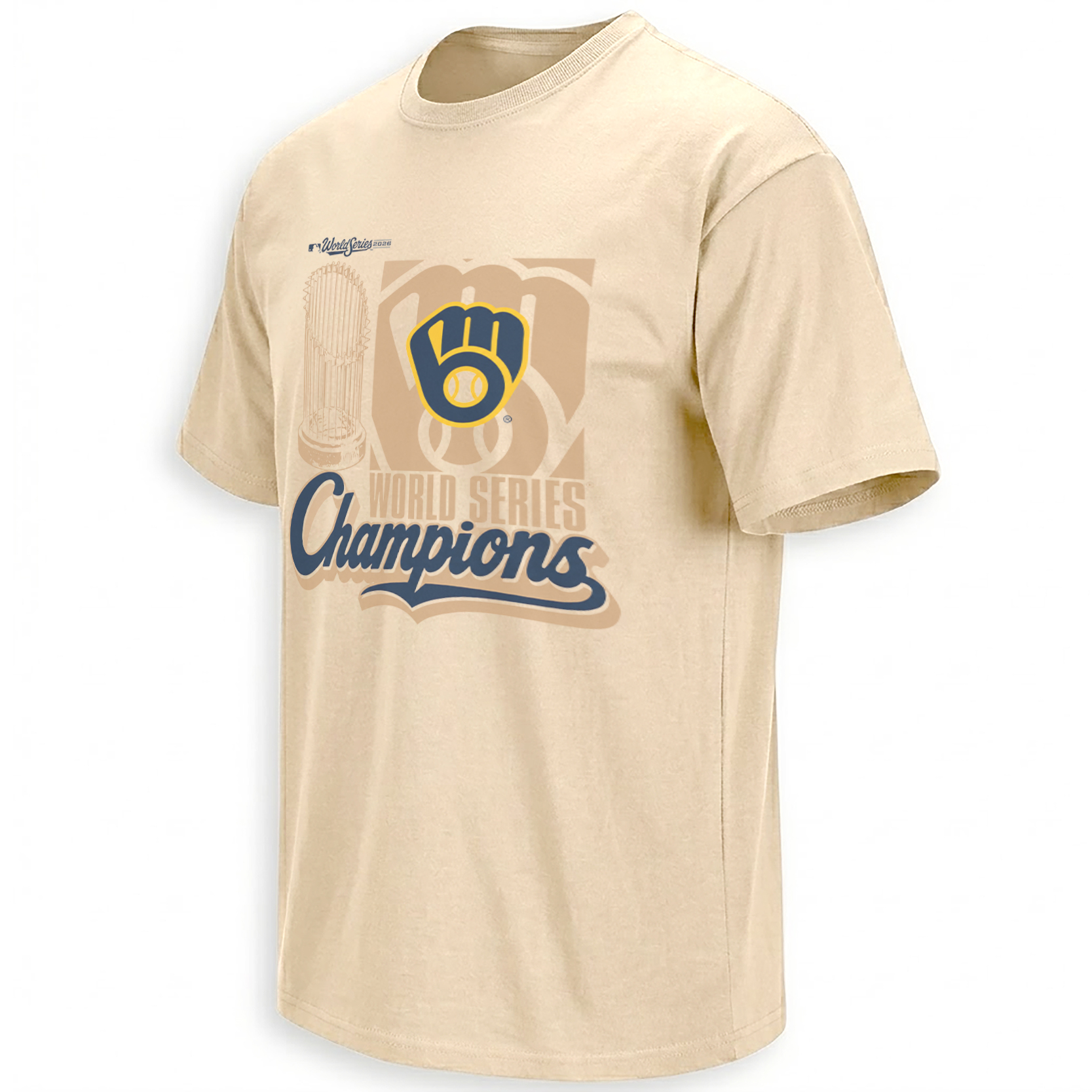
Milwaukee’s first World Series championship represented through its ultimate prize.
View the trophy graphic →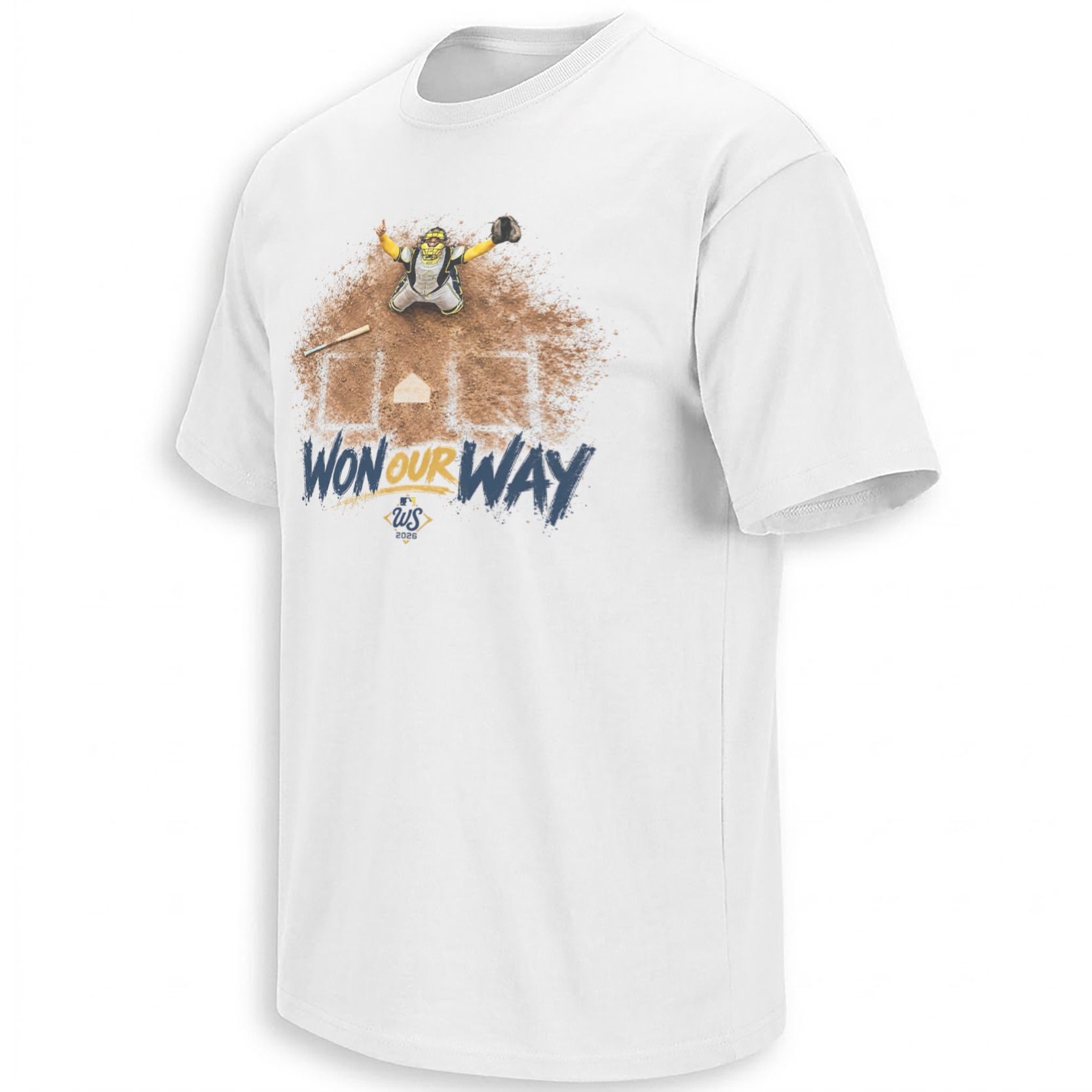
A catcher-centered tribute to one of the championship’s defining performances.
Explore the MVP graphic →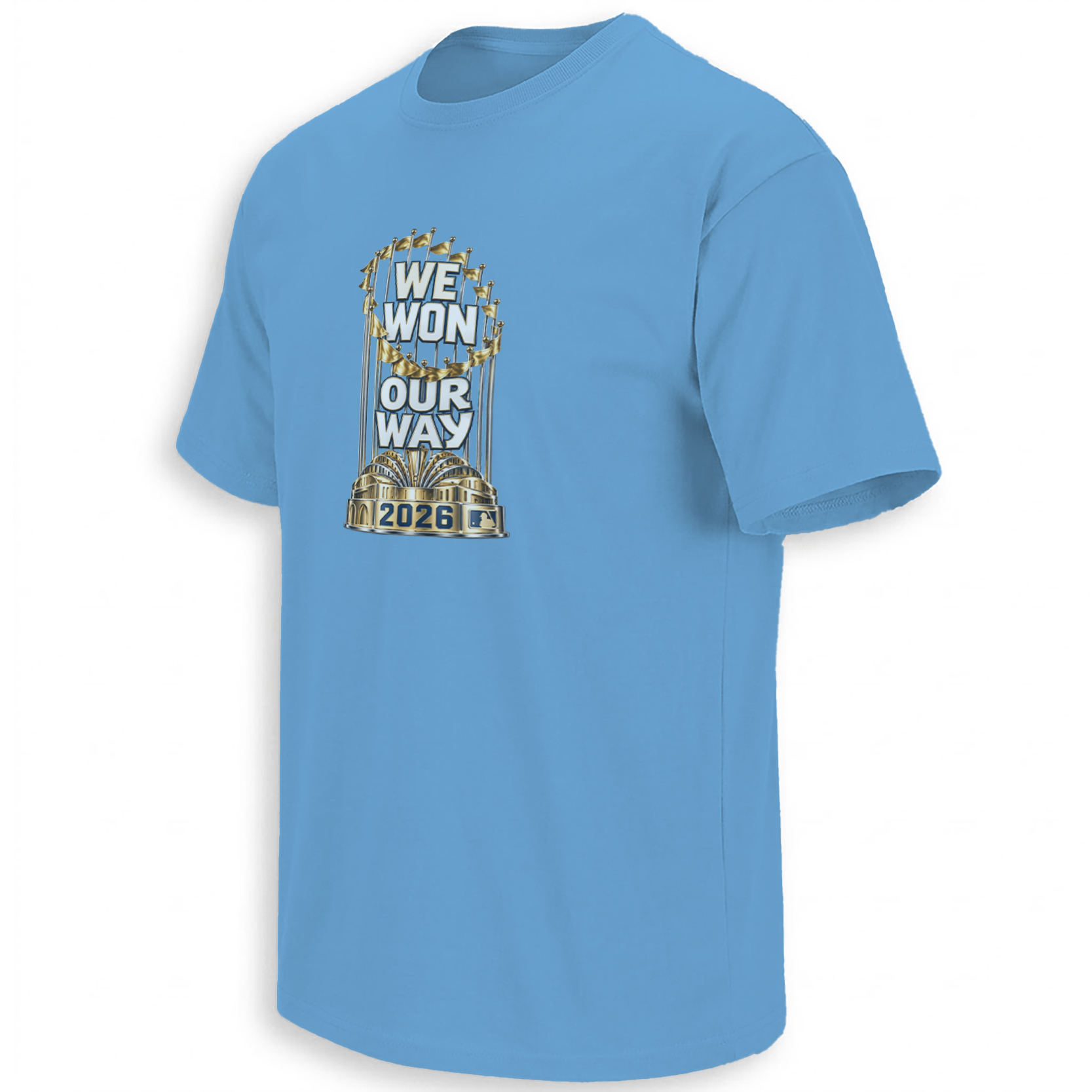
Milwaukee’s postseason identity transformed into a championship declaration.
View the championship slogan →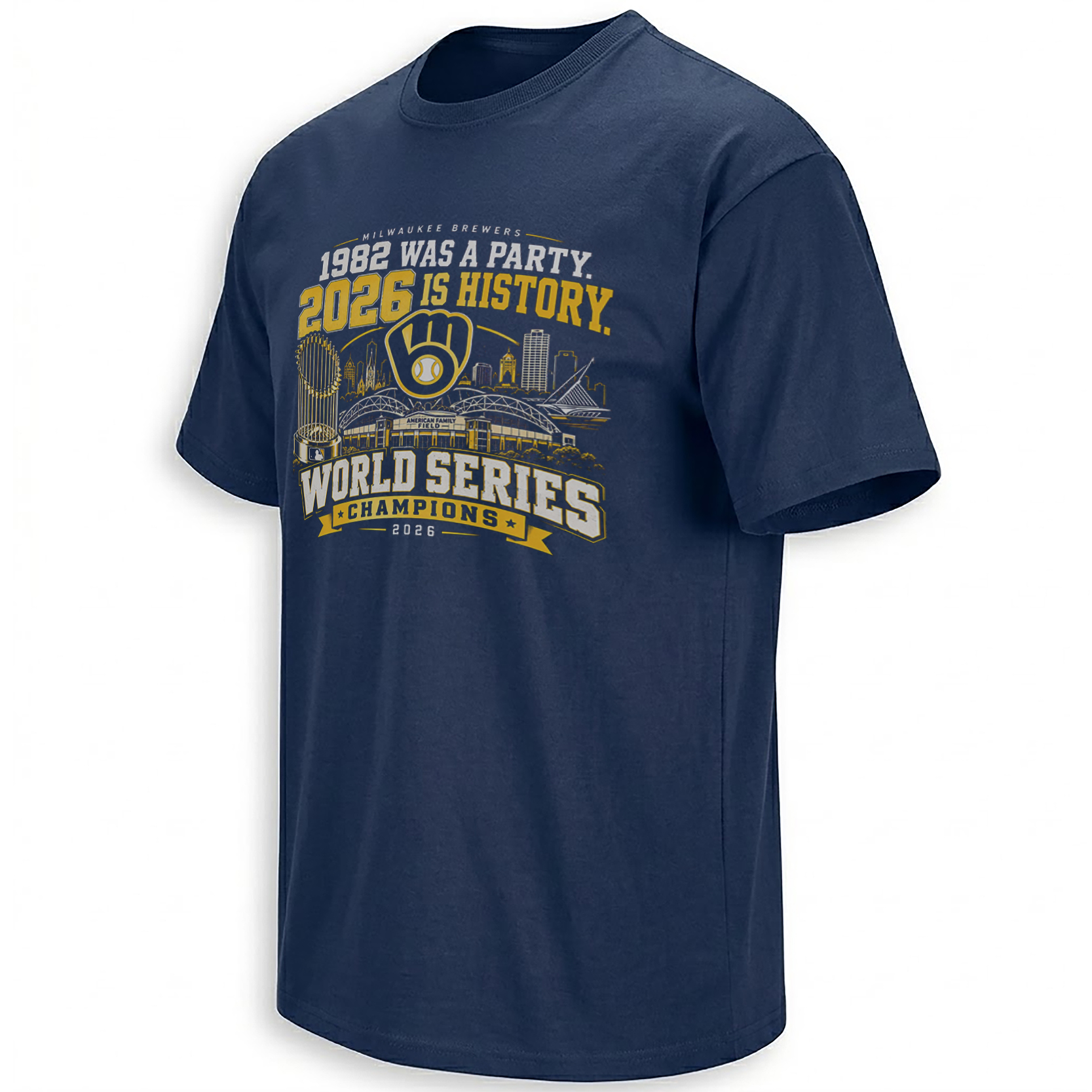
Two famous Milwaukee baseball eras linked by a forty-four-year wait.
Explore the history graphic →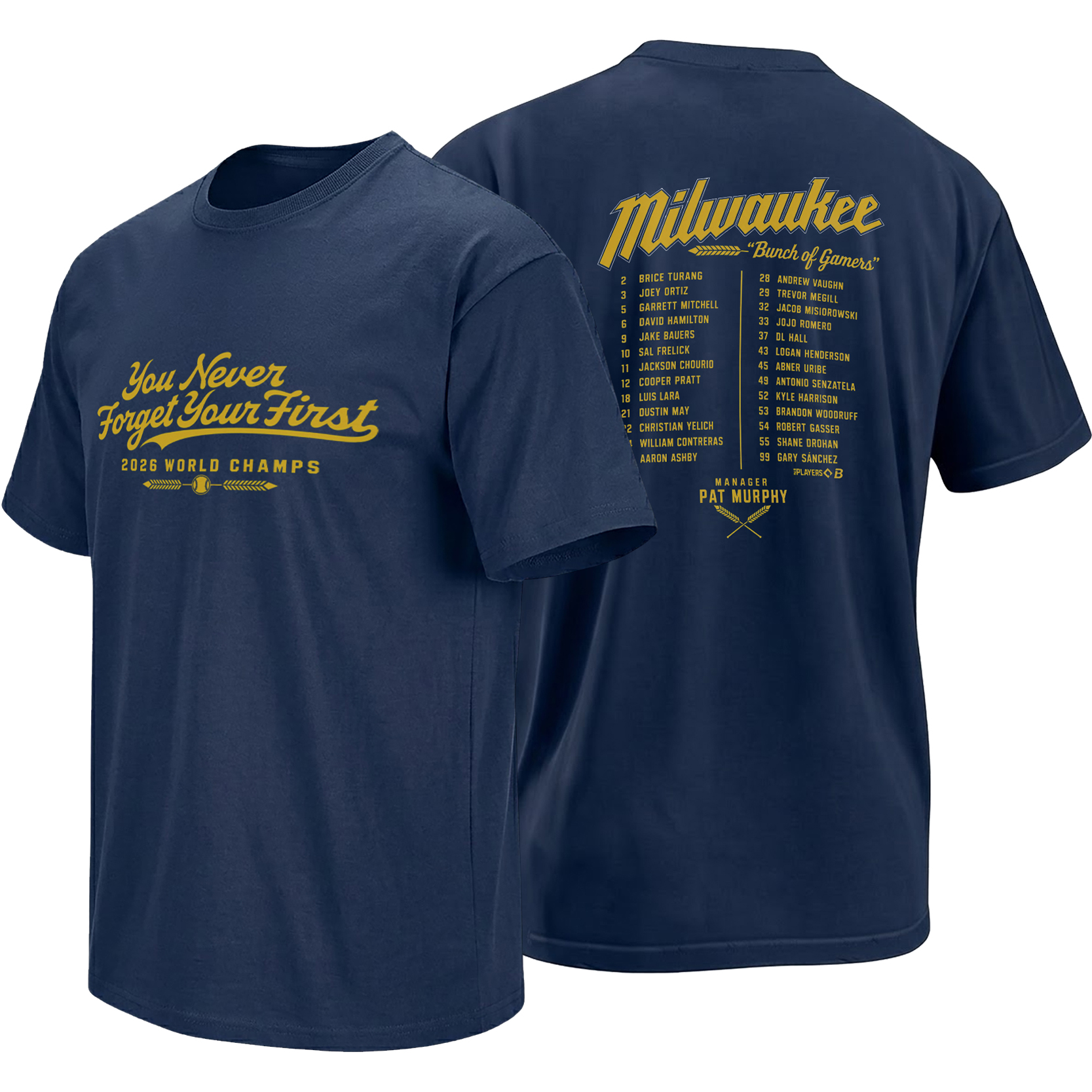
A two-sided reminder of the emotional first title and the roster behind it.
View the roster tribute →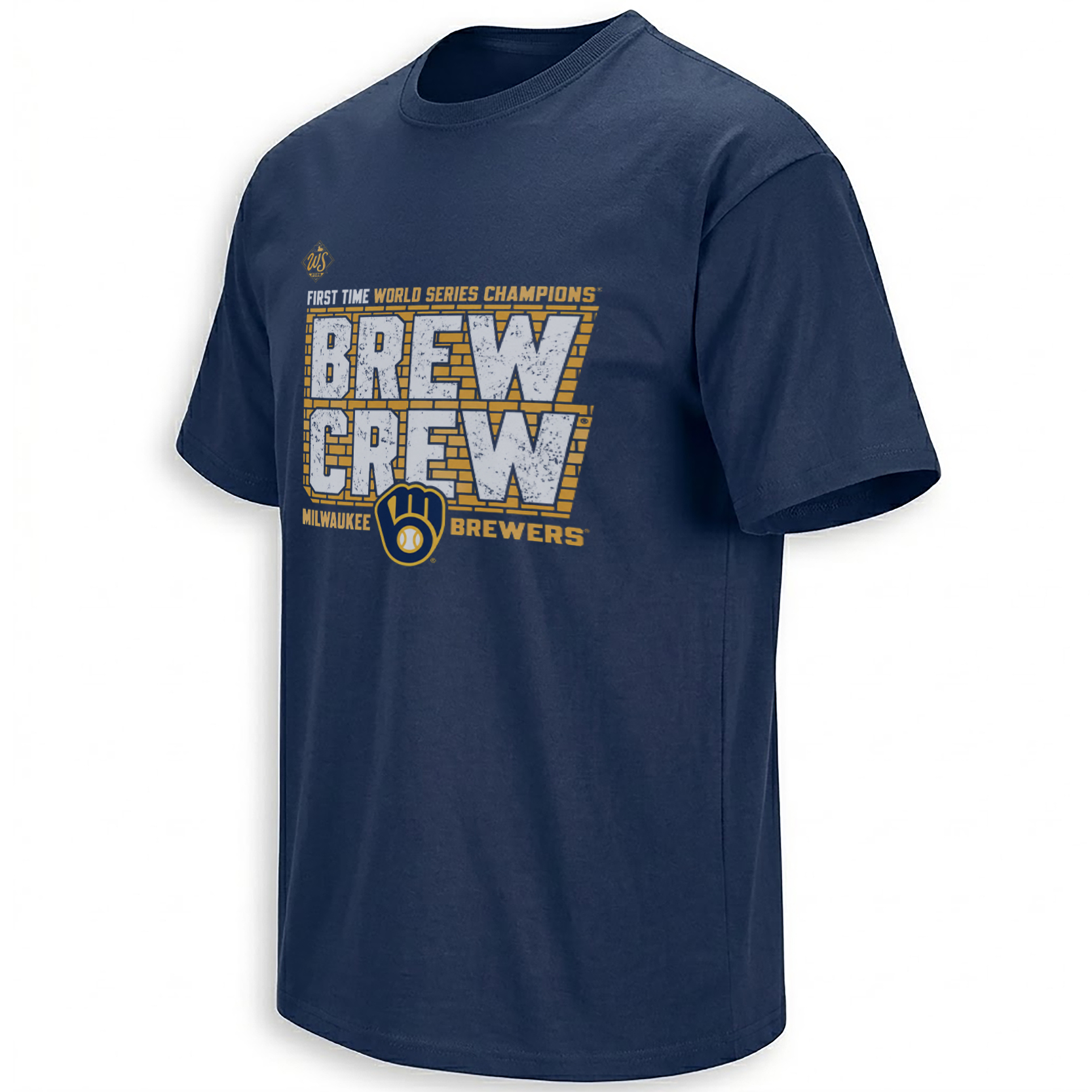
Milwaukee’s longtime nickname given a completely new historical meaning.
Explore the Brew Crew graphic →Discover more of the season’s design stories in the Milwaukee Brewers collection, or browse the broader MLB collection. Related player-focused archives include William Contreras, Christian Yelich, Jackson Chourio, Jacob Misiorowski and Pat Murphy.
11. Frequently Asked Questions About the Brewers’ 2026 Championship
Who won the 2026 World Series?
The Milwaukee Brewers won the 2026 World Series, defeating the Tampa Bay Rays four games to one.
When did the Brewers clinch their first World Series championship?
The Brewers clinched on Wednesday, October 28, 2026, with a 4–1 victory in Game 5 at Tropicana Field in St. Petersburg, Florida.
What was the final Brewers vs. Rays World Series score?
Milwaukee won the series 4–1. The individual game results were Brewers 3–2, Brewers 5–4, Brewers 10–1, Rays 4–3 in twelve innings, and Brewers 4–1.
Who won the 2026 World Series MVP award?
Milwaukee catcher William Contreras won the Willie Mays World Series MVP Award after batting .381 with four RBIs, throwing out four attempted base stealers and winning ten of thirteen ABS challenges.
What was the Brewers’ 2026 postseason record?
Milwaukee went 11–2, defeating the Padres 3–1 in the NLDS, sweeping the Dodgers 4–0 in the NLCS and beating the Rays 4–1 in the World Series.
Had the Milwaukee Brewers ever won the World Series before 2026?
No. This was the Brewers franchise’s first World Series title. The club reached the Fall Classic in 1982 but lost to the St. Louis Cardinals in seven games.
Did a Milwaukee team win the World Series in 1957?
Yes. The Milwaukee Braves won the 1957 World Series. That championship belonged to a different franchise from the Milwaukee Brewers.
Who pitched for the Brewers in the championship-clinching game?
Jacob Misiorowski started Game 5 and threw 5⅔ scoreless innings. The Milwaukee bullpen completed the victory, with Trevor Megill recording the final two innings.
When is the Brewers 2026 World Series championship parade?
The parade is scheduled for Friday, October 30, 2026, at 10 a.m. Central Time, starting at North 4th Street and West Wisconsin Avenue in Milwaukee and ending at Henry Maier Festival Park.
What does “Win Our Way” mean for the 2026 Brewers?
It was a documented postseason motto reflecting Milwaukee’s team-first approach to winning through pitching, contact hitting, baserunning, defense and collective execution.
12. Research Sources and Editorial Verification
This championship guide draws from MLB’s official postseason record, original reporting by Associated Press and Reuters, and Wisconsin Public Radio’s on-the-ground coverage of Milwaukee’s reaction. The sources serve different purposes: official scores establish the results, game reporting documents performances and local interviews preserve the emotional history.
- MLB.com — Complete 2026 postseason results and bracket. Official scores and dates for all rounds.
- MLB.com — Brewers clinch the World Series in Game 5. Detailed final-game reporting and player reactions.
- MLB.com — How the 2026 Brewers became champions. Team construction, culture and championship analysis.
- Associated Press — Brewers beat Rays 4–1 in Game 5. Final-out reporting, records and postseason context.
- Associated Press — William Contreras’ World Series MVP performance. Batting, defense, ABS challenges and other MVP candidates.
- Reuters — Milwaukee wins first World Series title. Independent championship report.
- Wisconsin Public Radio — Milwaukee’s championship celebration. Original interviews and photographs from American Family Field.
- MLB.com — The 1982 Brewers parade after the World Series defeat. Historical context.
- Milwaukee Brewers — Official 2026 championship parade information. Current event details.
- FOX Sports — World Series Game 5 highlight timeline. Visual record of the clinching game.
The championship is now part of Milwaukee’s permanent sporting history. The results are fixed. The records belong to the players. The emotional meaning will continue evolving as families remember where they were when the final out happened.
For a city that celebrated the 1982 Brewers even in defeat, the 2026 team supplied the one experience that had always been missing. The Brewers are no longer merely a franchise with beloved pennant winners and memorable Octobers.
They are World Series champions.
The definitive 2026 Milwaukee Brewers World Series championship guide: every playoff result, all five games against the Tampa Bay Rays, William Contreras’ MVP performance, Jacob Misiorowski’s Game 5 start, franchise history, fan celebrations and championship culture.