
Lane Kiffin’s Spot the Ball Era at LSU
The coach arrived in Baton Rouge surrounded by expectations. A simple football command became a way of answering them, and a 31-0 October shutout supplied its clearest demonstration yet.
The scoreboard at Tiger Stadium on October 17 offered the sort of answer that football coaches prefer to give without a speech: LSU 31, Mississippi State 0.
The result ended a difficult stretch of criticism around Lane Kiffin’s first season leading the Tigers. LSU entered the afternoon ranked No. 22 and faced No. 16 Mississippi State. A home conference shutout, the program’s first against an SEC opponent in Tiger Stadium since 2006, gave Baton Rouge a reminder of how quickly expectations can change when the ball is finally in play.
Kiffin’s phrase “Spot the Ball” fits that atmosphere. It reduces a remarkably complex football environment — rankings, transfers, contracts, social media arguments, recruiting pressure and championship expectations — to the simplest possible instruction. Put the football on the field. Then find out what happens.
Where “Spot the Ball” Fits Into Kiffin’s LSU Story
The phrase has documentary context rather than being an internet invention attached to the coach afterward. On September 5, LSU’s official athletics site published a feature titled “Lane Kiffin Embraces LSU’s Unique Culture in a No Comfort Zone.” That piece concluded its introductory discussion of opportunity, responsibility and the Tigers’ new leadership with the instruction to spot the ball.
It was an economical way of framing Kiffin’s arrival. LSU did not hire an untested coach searching for an identity. It hired one of the sport’s most closely watched personalities, a coach already associated with aggressive offense, unconventional public communication and the constant scrutiny of SEC football.
His move from Ole Miss to LSU was inherently dramatic. A coach leaving one SEC program for a conference rival creates a story that extends beyond tactics. Players, supporters and rival fan bases inevitably read the decision in terms of loyalty, ambition and competitive opportunity.
But none of those interpretations throws a pass or tackles an opponent. That is why the slogan works as an expression of the competitive moment: the argument ends when the whistle blows and the next snap begins.
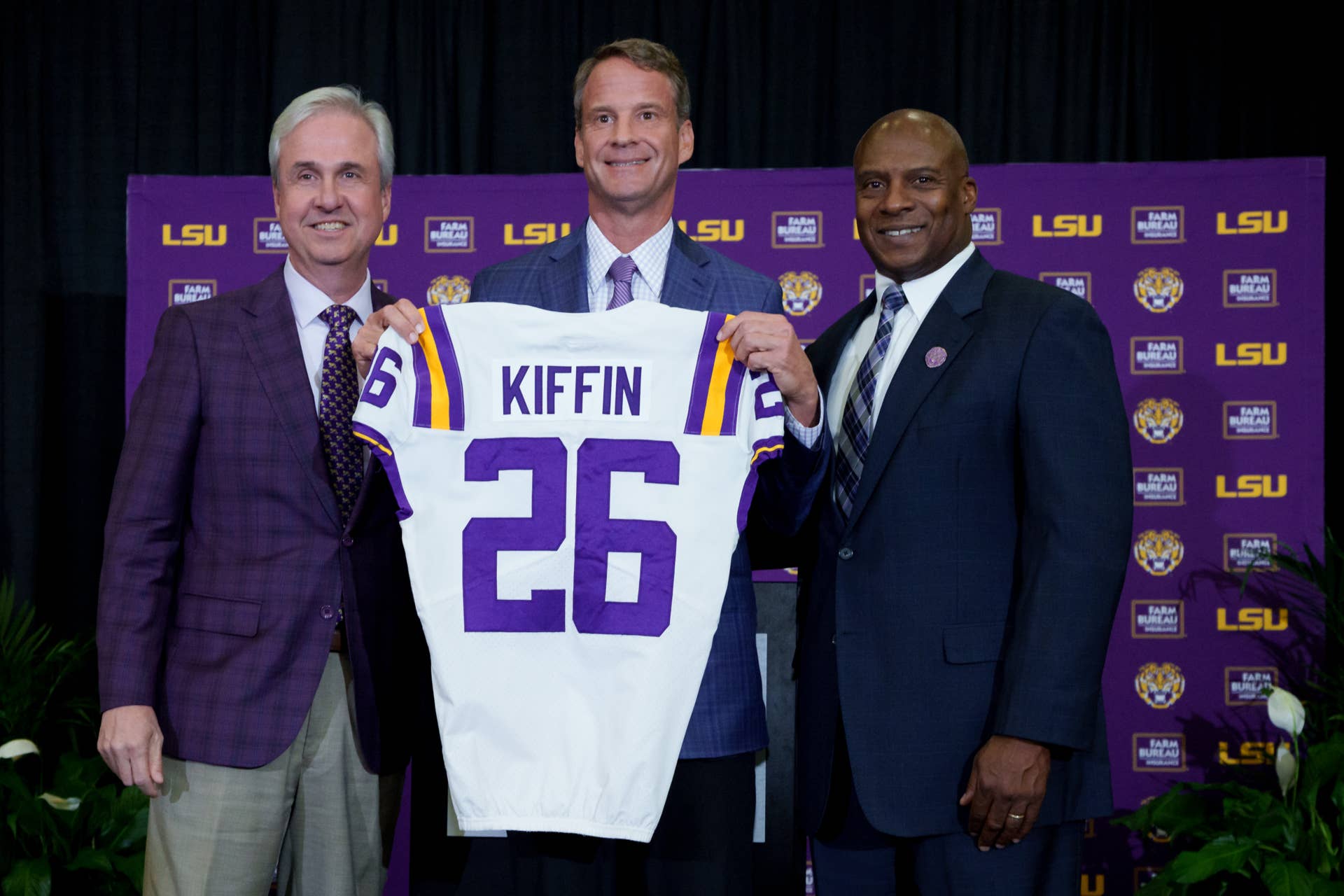
From the Coaching Announcement to the Pressure of October
Kiffin’s appointment immediately changed the expectations around LSU. He inherited not only the demands of a historic football program but also the scrutiny that follows major personnel turnover and high-profile recruiting. The Tigers assembled a widely discussed transfer class, including quarterback Sam Leavitt, and entered 2026 with little room for the patience usually extended to rebuilding programs.
That pressure was intensified by the rhythms of SEC football. One week can make an offense look revolutionary; the next can revive uncomfortable questions about execution, discipline and coaching decisions. LSU experienced those swings during the first half of the season.
A 35-34 overtime defeat at Kentucky became another example of the league’s unforgiving margins. Even when an offense produces explosive plays and finds creative ways to score, one possession can decide how the entire week is remembered.
By the time Mississippi State arrived in Baton Rouge, the circumstances made a disciplined response particularly meaningful. LSU needed to demonstrate control against a nationally ranked opponent, not merely win another exchange of arguments about its long-term ceiling.
Put the ball down. Let the next snap speak for itself.
EDITORIAL INTERPRETATION OF THE SPOT THE BALL MOTTO — NOT A DIRECT KIFFIN QUOTEWhy the 31-0 Shutout Changed the Conversation
Sam Leavitt completed 31 of 38 passes for 289 yards, throwing four touchdowns without an interception. The numbers were unusually efficient, but their significance went beyond quarterback statistics. They suggested a degree of offensive control that LSU had struggled to sustain consistently.
The defense supplied the other half of the statement. Linebacker TJ Dottery recorded 12 tackles, and the Tigers did not allow Mississippi State to score. LSU’s official recap noted that the program had not previously shut out an SEC opponent at home since a victory over Kentucky on October 14, 2006.
There is an important distinction between winning decisively once and proving a complete season has turned around. A shutout cannot erase earlier defeats. It does, however, provide evidence that a team can execute at the level supporters believe it should reach. Against Mississippi State, the Tigers did precisely that.
For fans, the satisfaction was immediate. Instead of debating hypothetical offensive potential, they could point to a finished result. Instead of projecting what a reconstructed roster might become, they had a complete performance against a ranked conference opponent.
The Visual Meaning of the Spot the Ball Graphic
The EllieShirt Spot the Ball design captures this football-first philosophy through LSU’s purple-and-gold visual language. Rather than treating the slogan as a complicated coaching manifesto, it presents the words as the center of the composition, supported by LSU Tigers identity and the association with Kiffin’s 2026 season.
The phrase is powerful because it is short and declarative. “Spot” is an instruction, “the ball” identifies the object, and the entire line creates a sense of movement toward the next play. In graphic form, those four words carry the same directness as a sideline command.
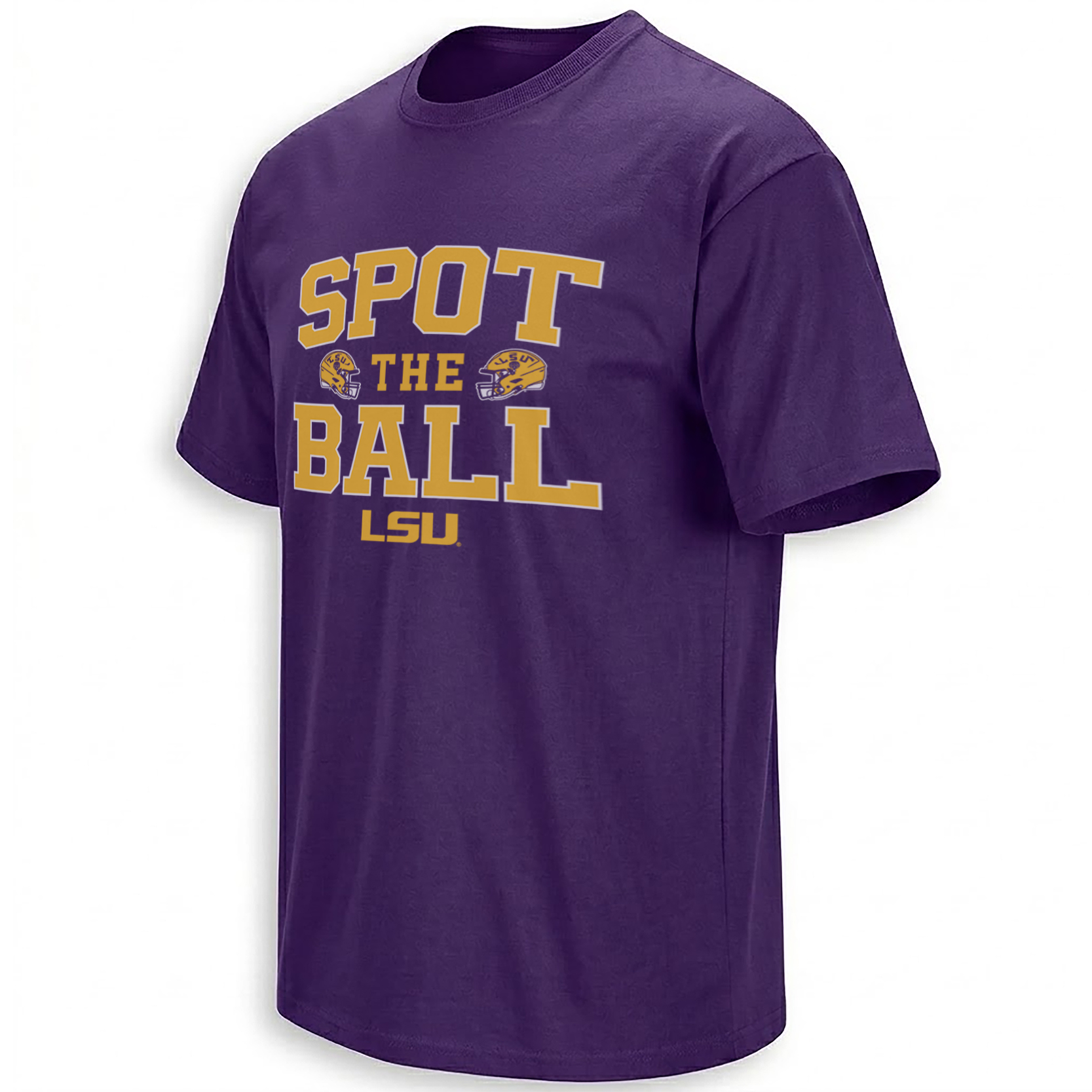
A football-first phrase tied to a high-pressure coaching arrival and the rituals of LSU’s new season.
View the LSU graphic →Unlike a final-score graphic, this design is not confined to one Saturday. It expresses an ongoing attitude toward uncertainty. In September it could represent anticipation; after the Kentucky loss, resilience; following the Mississippi State shutout, visible proof of what preparation can produce.
That adaptability is why short coaching phrases often survive longer than detailed game-day commemorations. Their meaning changes along with the season, allowing a familiar graphic to absorb new experiences without rewriting its central message.
Why the Phrase Resonates in Baton Rouge
LSU football occupies a distinctive place in Louisiana culture. The team is not simply another weekend entertainment option. Tiger Stadium, campus tailgates, family rituals and generational expectations create a public emotional environment in which coaching decisions are intensely personal to many supporters.
Success in Baton Rouge is judged against the program’s championship history. Fans are accustomed to measuring current teams alongside previous national contenders, not only against the immediate opponent. That creates an unusual burden for any new coaching staff.
The phrase “Spot the Ball” offers an escape from excessive prediction without asking supporters to lower their standards. It shifts attention from whether LSU looks like a championship team in October to whether it is prepared to compete on the next Saturday.
There is also an unmistakable irony in Kiffin adopting such a stripped-down football message. He is one of college football’s most public-facing coaches, yet the slogan minimizes public-facing performance. It suggests that reputation, commentary and online reactions eventually have to surrender to actual competition.
Verified reporting: The language and coaching context are documented in LSU’s September 5 feature. The October 17 score and player statistics come from the official LSU game recap. The text does not claim that the slogan originated with Kiffin personally.
One Slogan, an Entire LSU Season
LSU’s remaining schedule will determine how the first Kiffin season is ultimately judged. The Mississippi State victory offered a statement but not a completed verdict, and the challenges of SEC football rarely allow a team to remain comfortable for long.
The broader LSU Tigers collection documents the program through team symbols, football traditions and moment-specific graphics. The NCAA collection places this story alongside the rivalries and changing identities that shape college athletics. Fans interested in the coach’s own cultural footprint can also explore Lane Kiffin-related designs.
Whatever happens later in the year, the idea behind “Spot the Ball” will remain straightforward. The next opponent is not beaten by a press conference. The next game cannot be decided by recruiting rankings or commentary. At some point, everybody has to line up and play.
Frequently Asked Questions
What does Spot the Ball mean in LSU football?
It is a football-first expression associated with Lane Kiffin’s LSU era, emphasizing competition and execution rather than predictions or outside commentary.
Is Lane Kiffin LSU’s head coach in 2026?
Yes. Kiffin entered the 2026 season as LSU’s 37th head football coach after leaving Ole Miss.
What happened in LSU’s October 17, 2026 game?
LSU defeated No. 16 Mississippi State 31-0 at Tiger Stadium. Quarterback Sam Leavitt threw four touchdown passes, and LSU recorded its first home SEC shutout since 2006.
Did Lane Kiffin invent the phrase Spot the Ball?
The phrase is an established football expression. LSU’s official coverage connected it to Kiffin’s arrival, but the available evidence does not establish that he invented it.
The LSU Spot the Ball graphic reflects the tension, confidence and unfinished business of Lane Kiffin’s first year in Baton Rouge. The next chapter begins where every football game begins: with the ball on the field.
LSU Spot the Ball Lane Kiffin Shirt reflects the football-first attitude of the Tigers’ 2026 season. The phrase connects LSU’s coaching transition, SEC expectations and a memorable 31-0 shutout against Mississippi State.