
Kyle Tucker’s Season Wasn’t a Coronation. Then Came the Grand Slam.
“King Tuck” followed Kyle Tucker to Los Angeles before his first Dodgers season had proven worthy of the crown. On September 11 in Miami, a 3-for-3 night, a grand slam and five RBIs finally gave the nickname a fresh 2026 image powerful enough to match the mythology.
Baseball nicknames are convenient because they can survive slumps longer than statistics do.
Tucker entered September with a first Dodgers season that had not always resembled a royal procession. The production had dipped below the expectations attached to one of baseball’s biggest offseason additions, and the crown imagery around “King Tuck” sometimes felt more aspirational than descriptive.
Then came Miami on September 11. Tucker went 3-for-3, tripled, drove in five runs and crushed a seventh-inning grand slam that transformed a close game into a 6–1 Dodgers lead. Los Angeles won 6–2 for its eighth consecutive victory.
The ball left his bat at 103.8 mph, traveled 394 feet and became Tucker’s 14th home run of the season. It was his sixth career grand slam and his first since 2023. A double was the only thing missing from a cycle.
A crown works best when one swing can make four runners cross home plate.
The Grand Slam Arrived at the Right Time
Los Angeles had already started September moving in the right direction. Tucker collected three hits and homered during a 14–1 win over Cincinnati two days earlier. The Miami performance turned that improvement into something harder to ignore.
With two outs in the seventh and the bases loaded, Tucker drove Cade Gibson’s sweeper over the right-field wall. The Dodgers had been leading only 2–1. One swing converted a tense late-inning game into a five-run advantage.
That context is more useful than simply saying Tucker “got hot.” The slam carried leverage. It broke the game open. And because it came during the club’s longest winning streak of the season, it placed Tucker directly inside Los Angeles’ September pennant push.
The eight-game streak ended the next day, and Miami ultimately won the series with a Sunday walk-off. That does not erase Friday’s performance; it makes the grand slam a specific high point rather than pretending the Dodgers remained unstoppable afterward.
“King Tuck” Has History Before Los Angeles
The nickname did not begin when Tucker became a Dodger. Fans had used “King Tuck” long before his move west, building crown graphics and royalty language around a player known for a smooth left-handed swing and quietly elite all-around production.
Los Angeles gave that identity a new visual setting. Tucker now wears No. 23 in royal blue and plays on a roster crowded with stars, meaning a nickname has to compete for attention in a city already full of baseball celebrity.
That is precisely why the crown remains useful. It gives Tucker a visual identity separate from generic Dodgers typography.
The September Swing Made the Cartoon Feel Current
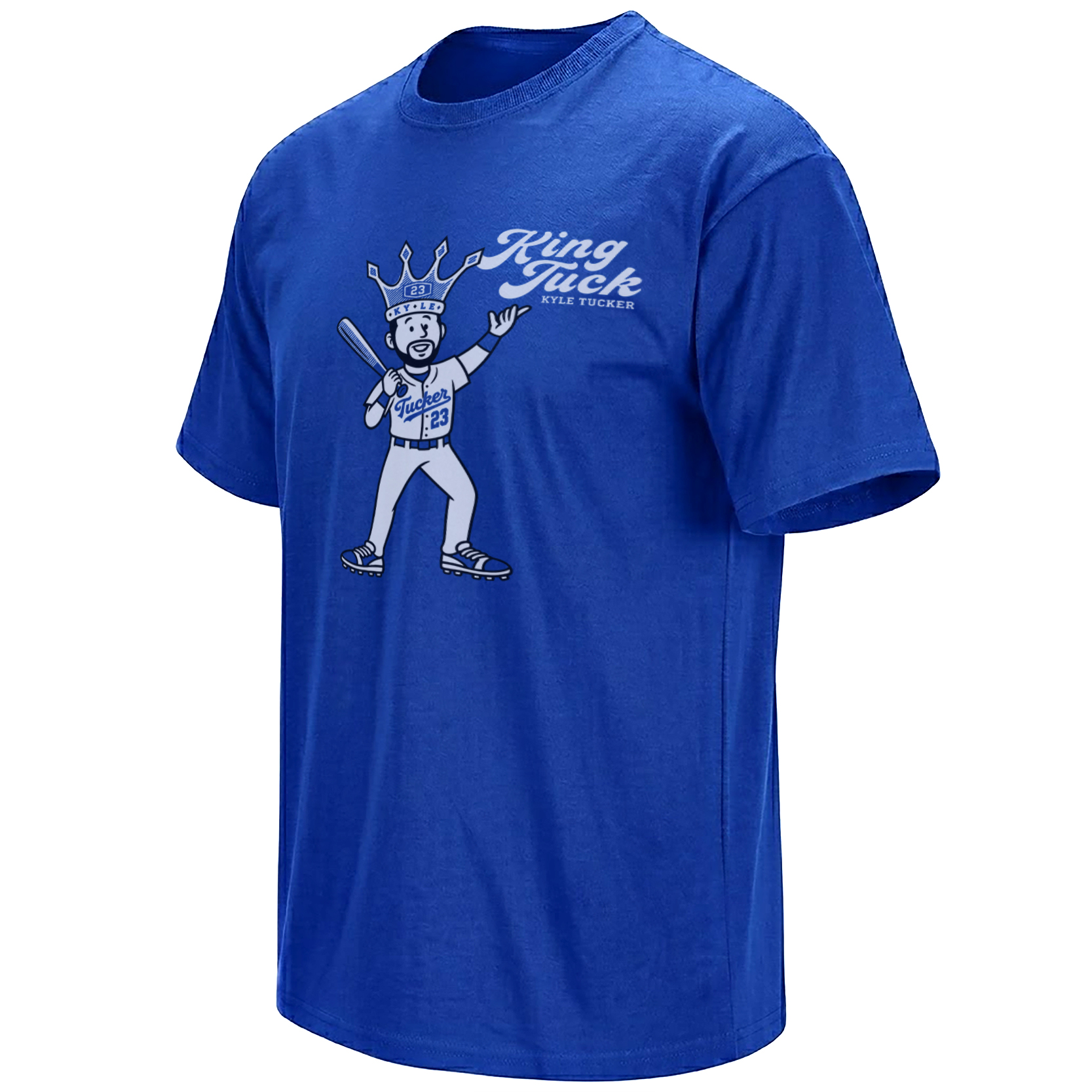
The King Tuck Shirt does not try to recreate the Miami grand slam frame by frame.
Instead, it turns Tucker into a character: royal-blue No. 23 uniform, bat over the shoulder, oversized crown marked “KYLE,” and the “King Tuck” identity sitting beside him like a title card.
That cartoon approach is smarter for a nickname piece because it can absorb multiple moments. Friday’s grand slam becomes evidence for the crown rather than the sole reason the design exists.

Why the Imperfect Season Makes the Crown More Interesting
If Tucker had dominated every week from Opening Day, “King Tuck” would function as straightforward praise. A complicated season makes it more fan-like.
Nicknames are often acts of belief. Supporters use them through cold stretches because they refer to the player they know can reappear. The Miami game supplied exactly that version of Tucker: disciplined at the plate, dangerous with runners on base and capable of changing a late inning immediately.
The Dodgers lost the next two games in Miami, so the story is not a fake “and then everything was perfect” arc. September still has work left. That uncertainty actually keeps the nickname alive as part celebration, part expectation.
Readers following Tucker can browse the Kyle Tucker product search. The Los Angeles Dodgers collection follows the current roster and pennant-race moments, while the MLB collection provides the wider baseball context.
Frequently Asked Questions
What did Kyle Tucker do against Miami on September 11, 2026?
Tucker went 3-for-3 with a triple, grand slam and season-high five RBIs in the Dodgers’ 6–2 victory.
How far did Kyle Tucker’s grand slam travel?
MLB measured the seventh-inning grand slam at 394 feet with a 103.8 mph exit velocity.
Did Tucker hit for the cycle?
No. He finished one double short of the cycle.
What does “King Tuck” mean?
“King Tuck” is a long-running Kyle Tucker nickname that uses royalty language and crown imagery around his baseball identity.
Why does the design show No. 23?
The No. 23 detail identifies Tucker specifically with his current Los Angeles Dodgers chapter.
The King Tuck graphic carries Tucker’s nickname across the whole Dodgers era, while the Dodgers archive follows the September race around him.
King Tuck Shirt turns Kyle Tucker’s Dodgers-era No. 23 identity into cartoon baseball royalty, arriving as his 3-for-3, five-RBI grand-slam performance in Miami gives the longtime nickname a fresh September 2026 moment.