One City. One Team. New York’s Championship Moment.
The Knicks’ first NBA championship in 53 years turned Manhattan’s skyline, its streets and Madison Square Garden into a shared celebration of New York basketball.
For decades, New York Knicks fans measured each new season against two distant dates: 1970 and 1973. Those were the years that gave Madison Square Garden its first two NBA championship banners. Every generation that followed inherited the same question. When would New York finally hang another?
On June 13, 2026, the question was answered. The Knicks defeated the San Antonio Spurs 94–90 in Game 5 of the NBA Finals to claim the franchise’s third championship. It ended a 53-year wait, but its meaning was immediately bigger than one final score. Across New York, people celebrated in orange and blue, transforming familiar streets and buildings into extensions of the Garden.
On October 20, the story reached another milestone when the championship banner was raised before the Knicks’ season opener. The moment brought together former champions and the modern title-winning roster, reminding the city that the wait was no longer part of its unfinished history.
Why One City, One Team Means Something Different in New York
New York has never been a simple, uniform sporting community. Its neighborhoods have different traditions, rivalries and loyalties. The five boroughs can feel like distinct worlds, and supporters bring those identities into every season.
Yet Knicks basketball has a particular relationship with the city. Madison Square Garden occupies an iconic position in Manhattan, and the franchise’s history reaches across generations of families, playgrounds and neighborhood bars. A successful Knicks team becomes a citywide conversation; a championship turns that conversation into a cultural event.
The 2026 team gave supporters a new group of names to remember. Jalen Brunson led New York through the postseason and delivered 45 points in the decisive Finals game. Karl-Anthony Towns, Josh Hart, OG Anunoby and their teammates became part of the championship memory, while earlier legends remained central to the city’s understanding of its basketball past.
The phrase One City, One Team does not suggest that every New Yorker follows the same club. Instead, it describes the rare ability of a championship to create a shared moment across otherwise separate parts of the city.
When New York’s Skyline Turned Orange and Blue
After the Finals, New York’s celebration extended above street level. City Hall announced plans to illuminate municipal buildings in Knicks colors, and photographs captured the skyline reflecting the championship atmosphere.
That image matters because a skyline is a geographic signature. The Empire State Building, Manhattan towers and familiar architectural silhouettes establish New York instantly. When those structures glow in orange and blue, the result becomes a visual representation of the city’s connection with its basketball team.

It is an especially effective visual for supporters who live far from New York. They may not have attended the deciding Finals game, but the skyline remains a familiar symbol of home. A single image can connect the championship with memories of growing up in the city, moving away or following the Knicks from another part of the world.
June 18: The Canyon of Heroes Becomes Knicks Territory
The title received its largest public celebration on June 18, when the Knicks traveled through Lower Manhattan in the franchise’s first ticker-tape championship parade. The route followed Broadway’s Canyon of Heroes from the Battery Park area toward City Hall.
The scene united the imagery of a classic New York parade with the distinctive colors of Knicks basketball. Crowds filled sidewalks, raised phones and cheered as players and staff rode through a corridor of historic buildings. Confetti and blue-and-orange apparel turned the Financial District into a basketball celebration.
The players received the keys to the city during the festivities. For the franchise, this was civic recognition of an achievement that decades of supporters had waited to experience. For younger fans, it was a firsthand memory rather than something preserved in recordings of the 1970s teams.
How the One City One Team Artwork Captures the Celebration
The One City One Team Knicks 2026 Champions Shirt builds its composition around the most recognizable parts of this story: the New York skyline, basketball imagery, championship lettering and the team’s orange-and-blue identity.
Its skyline is more than decorative scenery. Those buildings represent the city that watched the Finals, welcomed the parade and celebrated across generations. The basketball elements establish the sporting event, while the lettering turns the graphic into a concise statement of collective pride.
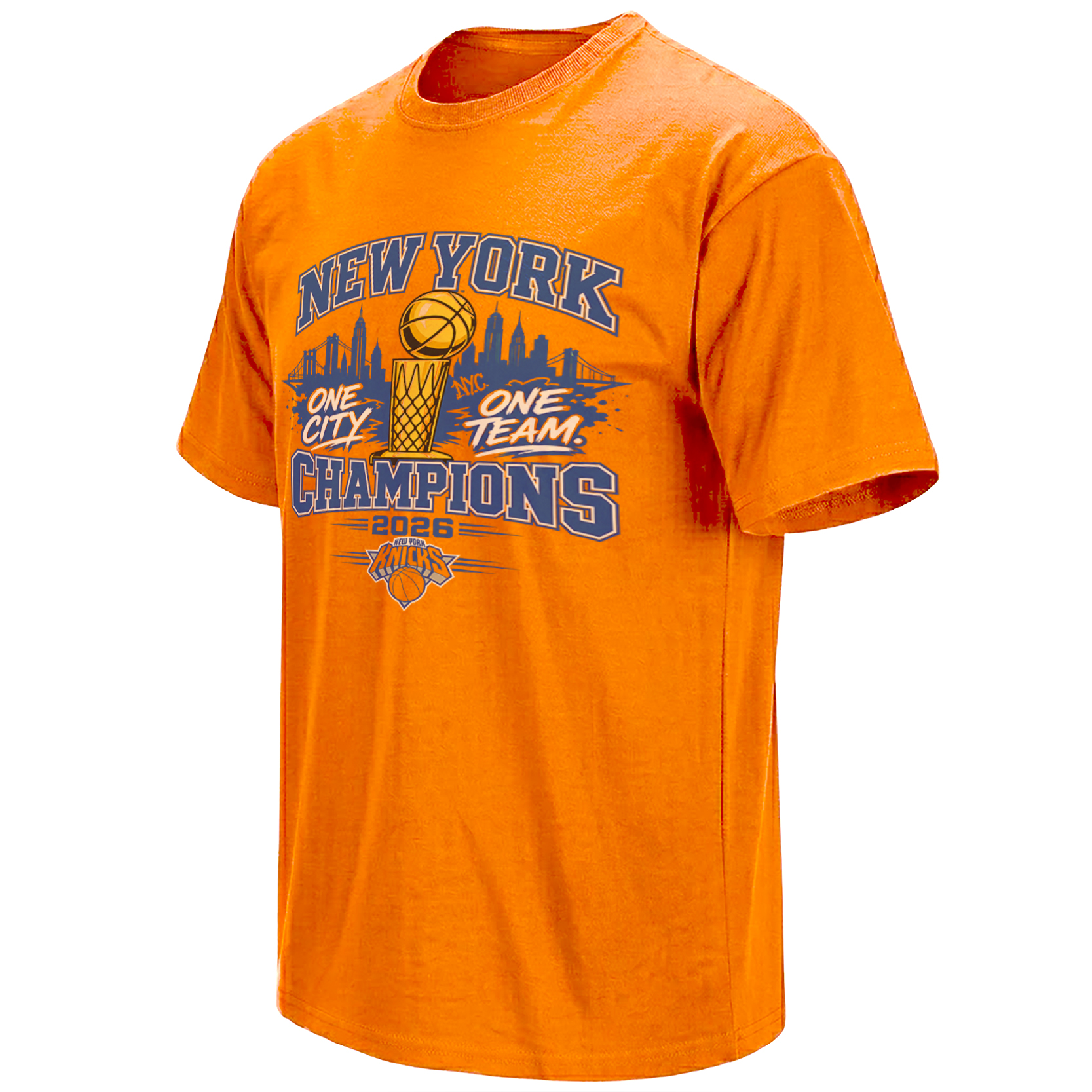
A city-centered championship graphic combining NYC architecture, basketball symbolism and New York’s historic third NBA title.
View the skyline design →The artwork follows a tradition of championship posters that use recognizable architecture to place an achievement within a specific community. Rather than relying on a crowded roster montage, it gives the city itself a prominent visual role.
The color contrast also carries meaning. Orange creates a sense of celebration and urgency, while blue gives the composition a connection to the familiar appearance of Knicks uniforms and arena graphics. Together they communicate the event before the reader examines the details.
Banner Night: A New Chapter Above the Garden Floor
On October 20, 2026, the Knicks received their championship rings and watched a new banner ascend at Madison Square Garden. Legends from the franchise’s earlier championship era, including Walt Frazier, Bill Bradley and Earl Monroe, attended the ceremony.
The symbolism was difficult to miss. For more than five decades, the banners from 1970 and 1973 had represented the team’s highest achievement. Now a third banner joined them, allowing the current generation to claim a permanent place in Knicks history.
Philadelphia defeated New York 106–100 in the season opener that followed, a reminder that another basketball campaign had already begun. Yet the result did not alter the ceremony’s importance. The title was secured; the banner would remain.
A Visual Archive of the 2026 Knicks
Championship memorabilia often survives because it preserves the feelings surrounding an event rather than merely repeating a score. A skyline graphic can recall the parade, the city lights and the public reaction long after the tactical details of the Finals have faded.
The broader New York Knicks collection brings together player references, title celebrations and visual stories from different stages of the franchise. The NBA collection places these images within a wider tradition of basketball championships and fan culture.
One City One Team works as a New York championship memory piece. The skyline identifies the community, the basketball imagery identifies the achievement, and 2026 marks the moment those two histories came together.
Frequently Asked Questions
When did the New York Knicks win the 2026 NBA Finals?
The Knicks clinched the championship on June 13, 2026, defeating the San Antonio Spurs 94–90 in Game 5.
How many NBA championships have the Knicks won?
The Knicks have won three NBA titles: 1970, 1973 and 2026.
When was the Knicks championship parade?
New York celebrated with a ticker-tape parade through Lower Manhattan on June 18, 2026.
When did the Knicks raise their 2026 championship banner?
The ceremony took place at Madison Square Garden on October 20, 2026.
What does One City One Team symbolize?
It connects the Knicks’ title with New York’s shared celebration, using the city skyline and basketball imagery to represent the championship’s cultural meaning.
The city skyline and Madison Square Garden now tell different parts of the same championship story. The One City One Team graphic preserves the view from outside the arena: New York celebrating together.
One City One Team Knicks 2026 Champions Shirt captures New York’s first NBA title in 53 years through an NYC skyline and basketball design, inspired by the championship parade, orange-and-blue city lights and Madison Square Garden banner ceremony.