“Killing Freedom Only Took One Little Prick”: Why Fauci Satire Is Back in the Conversation
A pandemic-era pun has returned to a political landscape where Anthony Fauci, vaccine mandates and arguments over personal liberty are again being fought over in Congress — six years after COVID transformed American public life.
For anyone who thought America had finished arguing about Anthony Fauci, the summer of 2026 offered a clear answer. On July 29, the former longtime director of the National Institute of Allergy and Infectious Diseases returned to Capitol Hill under subpoena and repeatedly invoked his Fifth Amendment right while facing questions about the government’s pandemic response.
A week later, a Republican-led Senate committee voted to hold him in contempt. The episode pulled one of the most polarizing figures of the COVID era directly back into national political coverage and revived arguments that had never fully disappeared: lockdowns, masking, vaccine policy, institutional trust and the limits of government power during an emergency.
That renewed context explains why a slogan such as “Killing Freedom Only Took One Little Prick” can suddenly read like a political time capsule and a current provocation at the same time. The phrase is built as satire. “Prick” operates as both a reference to an injection and an insult aimed at Fauci, compressing years of anger into one intentionally abrasive line.
The slogan works as political satire because it does not attempt to summarize pandemic policy. It compresses an entire grievance into one needle-sized pun.
Why Fauci Became a Symbol Bigger Than His Actual Office
Fauci directed NIAID from 1984 through 2022 and served through administrations of both parties. During COVID-19, his frequent appearances at briefings and in interviews turned a career infectious-disease official into one of the most recognizable faces of the federal response.
That visibility also turned him into a political symbol. Supporters saw a scientist trying to explain a dangerous and rapidly changing outbreak. Critics increasingly associated him with restrictions, masking guidance, vaccine promotion and a public-health establishment they believed had accumulated too much authority.

The “Freedom” Argument Was Never Only About a Vaccine
By 2021, vaccines had become entangled with a much wider argument about government authority. Critics objected to requirements imposed by governments, employers and institutions, while public-health officials argued that vaccination could reduce severe disease and help societies move out of emergency restrictions.
Those conflicts reached the Supreme Court. In January 2022, the Court blocked the Biden administration’s OSHA vaccination-or-testing rule for large employers, concluding that the agency had exceeded the authority Congress had given it. At the same time, separate legal disputes produced different outcomes for requirements affecting federally funded health-care facilities.
Fauci was an influential adviser and public advocate for vaccination, but he did not personally possess unilateral authority to impose every lockdown, workplace rule or vaccine requirement in the United States. Pandemic policy came from a patchwork of federal agencies, states, local governments, employers, schools and health systems.
That distinction matters editorially because the shirt’s wording is not a literal description of how American government worked. It is political caricature: one highly visible person becomes shorthand for a much larger system.
Why the Slogan Is Designed Like a Political Attack Line
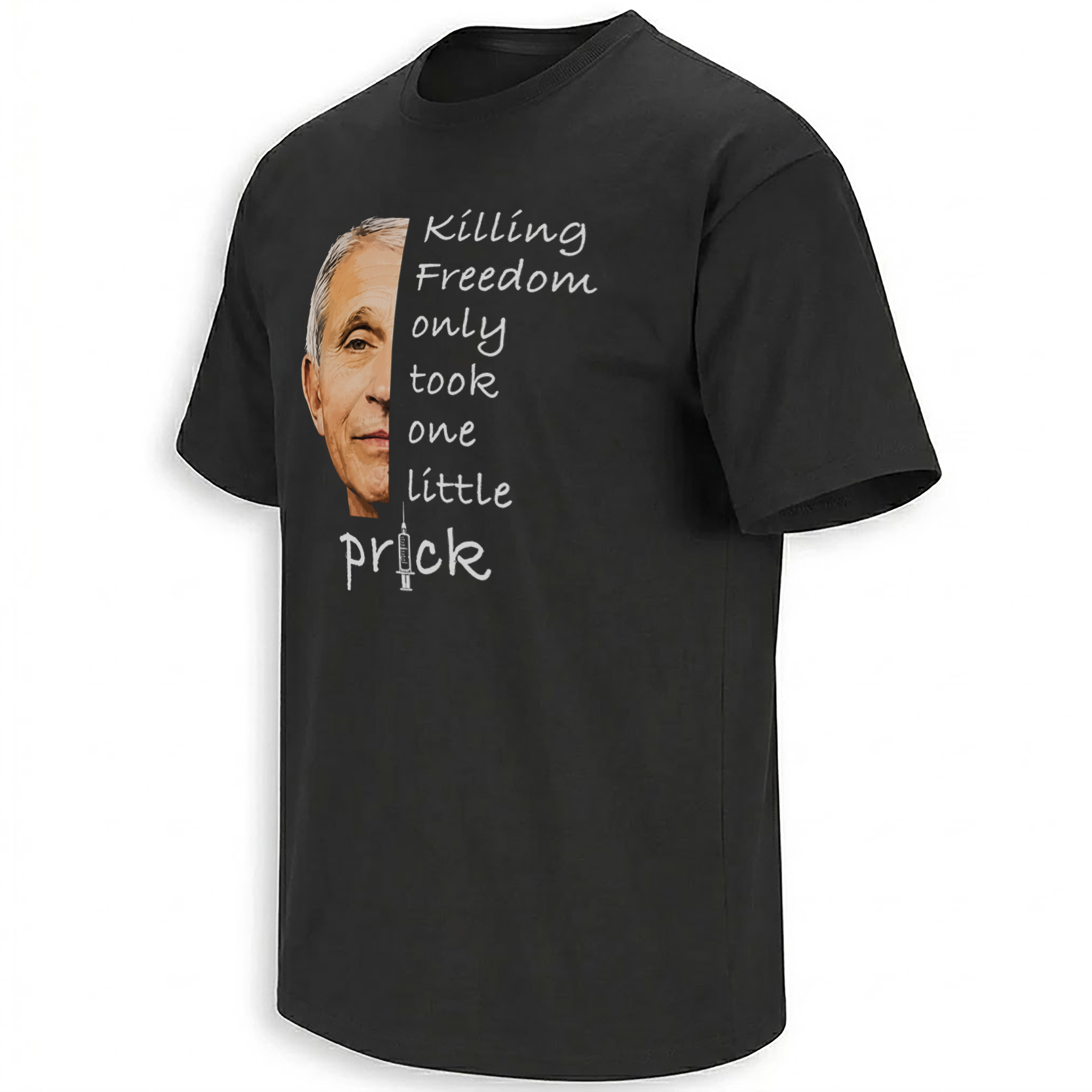
Political graphics work differently from policy papers. They reward compression, exaggeration and instant recognition. The viewer needs to understand the target, the grievance and the joke almost before finishing the sentence.
“One little prick” achieves that through double meaning. The needle invokes vaccination without requiring additional explanation. The insult personalizes the criticism. “Killing freedom” then widens the subject from one medical intervention to the larger liberty debate that dominated protests, court cases and partisan arguments.
As shorthand for anger about mandates, institutional pressure, employment consequences and what they viewed as excessive government power during the pandemic.
The fragmented nature of U.S. pandemic authority, the public-health rationale behind vaccination and restrictions, and evidence that COVID vaccines reduced the risk of severe outcomes.
Why the Joke Has New Relevance in August 2026
The striking part of the current moment is not simply that Fauci is being discussed again. It is that political institutions are actively reopening the arguments of 2020–22.
Reuters reported that Fauci’s July 2026 Senate appearance centered on longstanding disputes about the pandemic response and NIH-funded research. AP subsequently framed the contempt battle as evidence of the enduring power of COVID grievances in American politics.
Republicans leading the new scrutiny present it as overdue accountability. Fauci and his defenders describe the campaign against him as political retaliation and maintain that allegations of wrongdoing have not been supported by credible evidence. That disagreement is itself part of the story: America is not merely debating what happened during COVID; it is debating who gets to define the historical record.
That makes old slogans newly searchable. A political graphic created around the emotional language of mandates can re-enter circulation because the same names, accusations and liberty arguments have returned to congressional hearings and national headlines.
From Pandemic Protest Language to Political Memory
Six years is long enough for a protest slogan to change function. During the pandemic, anti-mandate language could feel immediate and operational: schools were deciding policies, employers were writing rules and people were making decisions about vaccination.
In 2026, the same language increasingly operates as historical identity. Wearing or sharing it can signal how a person remembers that period — as a necessary emergency response, as institutional overreach, or as a complicated mixture of both.
That broader ecosystem is why the design belongs naturally inside Ellie Shirt’s Politics collection. The category is strongest when it functions as an archive of political language rather than pretending every slogan is a neutral statement of fact. Readers browsing the wider Newest Shirts archive can see how older controversies become current again when the news cycle reactivates them.
Frequently Asked Questions
What does “Killing Freedom Only Took One Little Prick” mean?
It is an anti-Fauci political satire slogan. “Prick” works as a double meaning referring both to a vaccine injection and to an insult, while “killing freedom” expresses opposition to pandemic-era mandates and restrictions.
Did Anthony Fauci personally impose all COVID vaccine mandates?
No. Fauci strongly promoted vaccination and advised the federal government, but mandates and restrictions were issued through many different federal, state, local, institutional and private authorities.
Why is Fauci back in political news in 2026?
Fauci appeared before a U.S. Senate committee on July 29, 2026, under subpoena and repeatedly invoked the Fifth Amendment. The Republican-led committee later voted to hold him in contempt, reviving national debate about the pandemic response.
Did courts challenge federal COVID vaccine mandates?
Yes. In January 2022, the U.S. Supreme Court blocked OSHA’s broad vaccination-or-testing rule for large employers, finding that the agency lacked sufficient congressional authority for the regulation.
Why does Fauci remain such a strong political symbol?
His unusually visible role during COVID made him a stand-in for the broader public-health establishment. Supporters and critics therefore attach larger arguments about science, government authority, vaccination and institutional trust to his image.
The Killing Freedom Only Took One Little Prick design preserves one side of that political memory, while the broader Politics collection tracks the slogans and personalities that continue to shape American political culture.
Killing Freedom Only Took One Little Prick Shirt uses Anthony Fauci and a vaccine-needle double meaning to capture the anti-mandate political satire that has returned to the spotlight amid renewed COVID-era scrutiny in 2026.