Kazuma Okamoto Reached 30. The Big Oak Has Taken Root.
Toronto signed a proven Japanese power hitter and received something nobody in Blue Jays history had seen: a rookie with 30 home runs. With September now deciding the Wild Card race, Kazuma Okamoto’s “Big Oak” nickname suddenly carries the weight of an entire first MLB season.
The ball left Kazuma Okamoto’s bat in the second inning on September 8 and disappeared over the left-field wall in West Sacramento. Toronto already led because Josh Smith had homered one batter earlier. Then No. 7 made it back-to-back and reached a number no Blue Jays rookie had ever reached before.
Thirty home runs.
Toronto beat the Athletics 4-2, moved back into the middle of the American League Wild Card fight and watched its biggest first-year power story acquire a clean milestone. Okamoto had already broken the franchise rookie homer record when he passed Eric Hinske’s old mark of 24. Thirty turned the season into a different category.
“Big Oak” sounded like a clever Scott Boras nickname in January. Thirty home runs later, Toronto has actual baseball attached to it.
The Nickname Arrived Before the Home Runs
When Toronto introduced Okamoto in January, the nickname conversation was already unusually good. In Japan he had been called “Big Baby,” while agent Scott Boras coined “Big Oak.” Okamoto himself seemed comfortable with the simpler “Kazu.”
Sportsnet reported the Big Oak line during his introductory press conference, and MLB’s current player bio now lists the nickname directly. That matters for the artwork because the phrase is not something reverse-engineered from a tree graphic after the season began.
It crossed the Pacific with him.
What changed is the context. In January, “Big Oak” was an entertaining detail attached to a four-year signing. By September, the nickname belongs to Toronto’s home-run leader during a season in which the club still has meaningful games left.

Thirty Home Runs Means Something Different for a “Rookie” Like Okamoto
Calling Okamoto a rookie is technically correct and culturally misleading at the same time. He arrived in Major League Baseball after eleven seasons with the Yomiuri Giants and 248 NPB home runs.
He had already been a six-time NPB All-Star, a three-time Central League home-run leader and part of Japan’s 2023 World Baseball Classic championship team. Toronto was not waiting for a prospect to discover whether professional pitching frightened him.
The actual question was translation: would Japanese power survive major-league velocity, breaking-ball shape, travel and a completely different pitching ecosystem?
Thirty homers gives a persuasive answer. MLB also placed Okamoto in a historic 2026 rookie trio alongside Sal Stewart and Munetaka Murakami — the first season in which three rookies reached 30 home runs.
The Design Turns the Nickname Into Toronto Geography
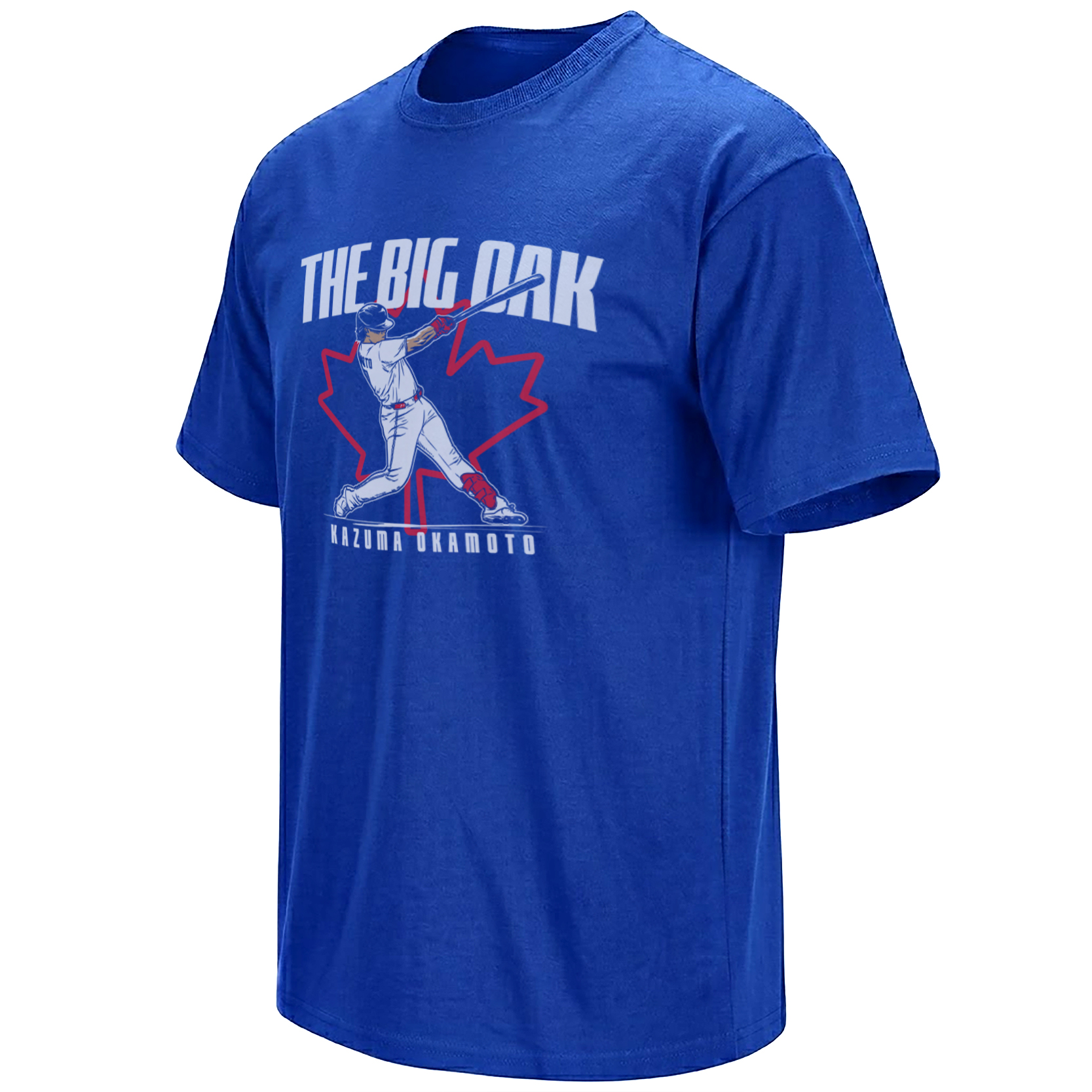
A full right-handed follow-through sits inside a Canadian maple-leaf outline while oversized Big Oak typography converts Okamoto’s real nickname into a Toronto player identity.
View the Big Oak piece →The most important shape in the artwork is not an oak leaf. It is a maple leaf.
That decision makes the design about Okamoto’s Toronto chapter rather than illustrating the nickname too literally. The oak exists in the words; Canada exists in the large red outline behind the hitter.
Blue, white and red complete the geographic move. Okamoto’s batting follow-through carries the center of the composition, while THE BIG OAK stretches across the upper section in condensed capitals. His actual name appears underneath with enough spacing to behave like a player-poster credit.
The graphic does not need bark textures or a cartoon tree. Okamoto is the oak. The maple leaf identifies where he has taken root, while the full-swing pose supplies the power that makes the nickname believable.
September Is Turning Big Oak Into a Baseball Story
Okamoto did not simply stumble into homer No. 30 during an empty final month. He entered the week heating up while Toronto remained within reach of the final Wild Card.
Three days before the milestone, he had four hits and drove in the go-ahead run against Kansas City as the Blue Jays climbed above .500 for the first time in months. Then came homers on consecutive nights against the Athletics.
After reaching 30, Okamoto redirected attention toward the playoff chase rather than his personal benchmark. That response fits the way his first year has developed: a famous hitter from Japan learning to carry a different lineup while Toronto’s season keeps demanding another meaningful at-bat.
The Japan-to-Toronto Story Is Why the Graphic Has Depth
Okamoto entered North America with a fully developed baseball identity. That creates a different kind of cultural translation from a normal rookie story. Canadian fans are not watching a player grow from the minors; they are learning the vocabulary of a star who already had a decade of history somewhere else.
Big Baby. Young General. Big Oak. No. 7. Yomiuri power hitter. Japanese national-team champion. Blue Jays rookie record holder.
Those identities overlap rather than replace one another. The maple-leaf graphic works because Toronto has become the newest layer, not because everything before Canada disappeared.
Ellie Shirt’s confirmed Toronto Blue Jays collection holds that developing visual archive, while the broader MLB collection connects Okamoto’s first season with the wider 2026 baseball conversation. Readers following him specifically can also browse the Kazuma Okamoto product archive.
Frequently Asked Questions
Why is Kazuma Okamoto called Big Oak?
Scott Boras coined “Big Oak” as one of Okamoto’s nicknames during his move to Toronto. Sportsnet reported it during his introductory press conference, and MLB’s player bio also lists Big Oak.
How many home runs has Okamoto hit in 2026?
Okamoto reached 30 home runs on September 8 against the Athletics during his first MLB season.
Is Okamoto the first Blue Jays rookie with 30 home runs?
Yes. He had already broken Toronto’s rookie home-run record at 25 and became the franchise’s first rookie to reach 30.
Where did Okamoto play before Toronto?
He spent eleven seasons with the Yomiuri Giants in Nippon Professional Baseball before joining the Blue Jays for 2026.
Why does the Big Oak design include a maple leaf?
The maple leaf visually connects Okamoto’s nickname and power-hitting identity to his new baseball home in Toronto and Canada.
The Big Oak design captures Okamoto’s first MLB season through the combination that now defines it: Japanese power history, a Toronto maple leaf and a No. 7 swing strong enough to rewrite the Blue Jays rookie record.
The Big Oak Shirt captures Kazuma Okamoto’s record-setting Blue Jays rookie season through his authentic Big Oak nickname, powerful No. 7 swing, Canadian maple-leaf imagery and the 30-home-run milestone that defined his first MLB year.