
Just Let Trans Folks Live Their Lives: Why a Simple Message Feels Urgent in 2026
At a moment when transgender identity is repeatedly pulled into courts, schools, workplaces and national politics, one brightly colored sentence offers a deliberately uncomplicated response: let people live.
The most emotionally effective protest messages are often the ones that refuse to imitate the complexity of the argument around them. They do not arrive carrying a policy memo, a legal citation or a cable-news script. They reduce the conversation to the human consequence beneath it.
“Just let trans folks live their lives” belongs to that tradition. It does not ask the reader to master every court case or legislative fight before recognizing another person’s dignity. It presents freedom from constant scrutiny as an ordinary expectation rather than a radical concession.
That directness feels especially relevant in 2026. Pride celebrations in cities including New York and San Francisco unfolded alongside renewed conflict over transgender healthcare, school policies, sports participation and public recognition. In early August, federal workers also challenged a government policy excluding coverage for gender-affirming care, arguing that the restriction discriminated against transgender and gender-nonconforming employees.
The sentence works because it refuses to treat a person’s everyday existence as a debate stage.
A Protest Message Built Around Normal Life
Public language about transgender people is frequently framed through institutions: legislatures, courts, athletic associations, hospitals and school boards. Those institutions matter because their decisions shape access, safety and legal recognition. Yet the institutional framing can also make ordinary lives disappear behind abstract terminology.
The phrase on this design reverses that pattern. Its subject is not a policy category. It is “folks,” an intentionally familiar word. Its demand is not domination, punishment or even agreement. It is space: the ability to move through work, school, family life and public life without being turned into a permanent symbol in somebody else’s political argument.
That is why the message can function both as Pride language and as everyday solidarity. It does not require a parade route to make sense. It can appear in a crowd, at a community gathering, on a college campus or in an ordinary grocery-store line and retain the same meaning.
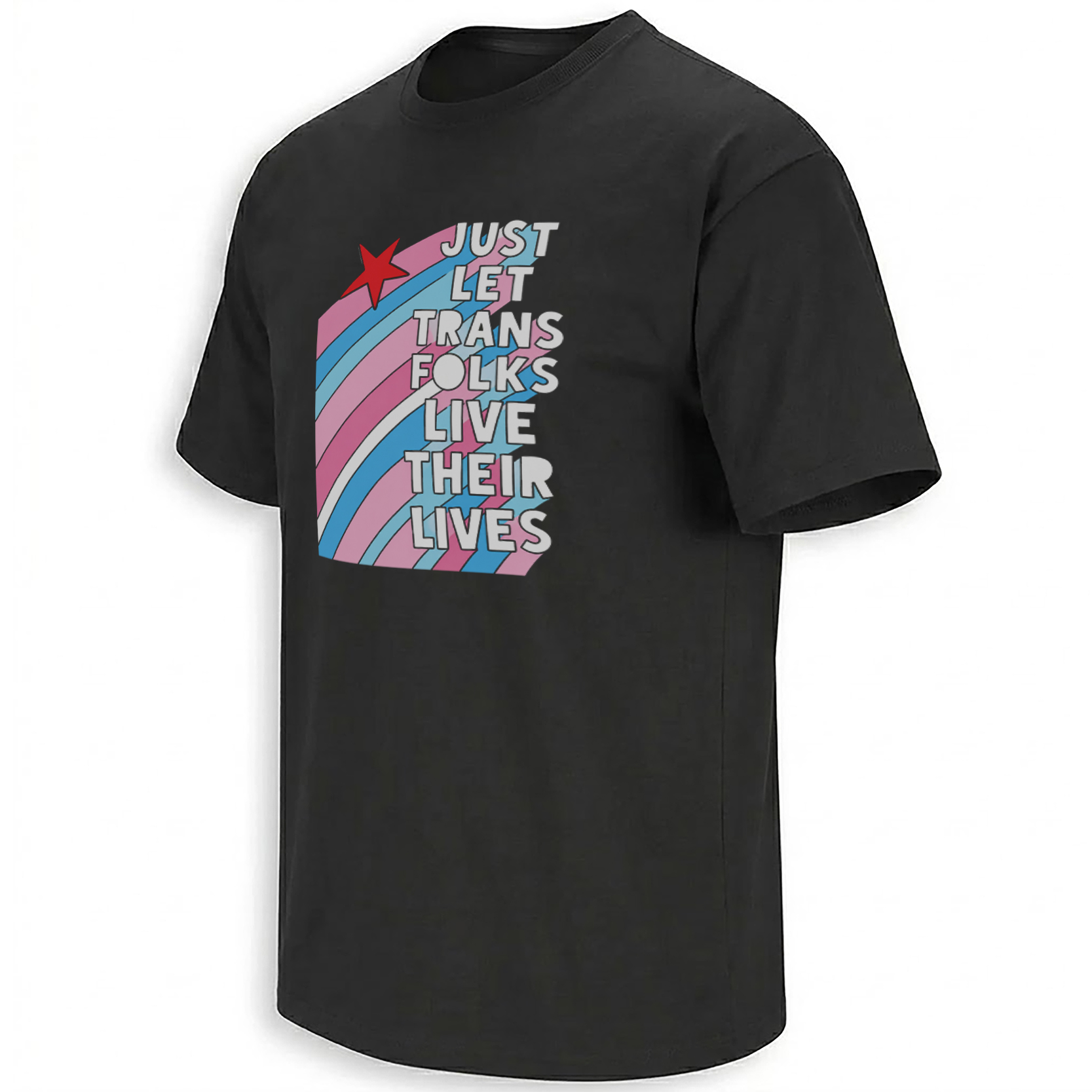
Why the Color Palette Changes the Emotional Tone
The artwork draws from the familiar light blue, pink and white palette associated with transgender Pride. Those colors matter because they prevent the message from feeling visually punitive. The words are firm, but the composition remains open, warm and celebratory.
Protest graphics often lean on red, black and condensed typography to communicate urgency. This design chooses another strategy. Rounded retro lettering and soft flag colors suggest care before confrontation. The visual language says that the subject is human life, not political spectacle.
The shooting-star element adds motion and optimism. It makes the statement feel closer to a handmade Pride sign, community flyer or vintage social-justice graphic than an official campaign logo. That informality helps the words remain personal.
The design balances advocacy and approachability. Large typography makes the demand readable from a distance, while the pastel color sequence keeps the emotional center grounded in community, care and the possibility of a less hostile public conversation.
From Pride Celebration to Everyday Advocacy
Pride has always carried two energies at once. It is a celebration of identity, survival and community, but it is also a public response to exclusion. The balance between those roles becomes more visible during periods when LGBTQ+ rights are being actively contested.
In that environment, a phrase like this functions as a bridge. It can be worn by a transgender person expressing self-determination, by a family member communicating protection, or by an ally refusing to remain neutral when another community is being treated as a permanent political problem.
The wording is also intentionally broader than a single controversy. It does not bind itself to one sports ruling, healthcare case or school policy. Instead, it names the principle beneath all of them: people should be able to construct ordinary lives without their identity becoming an invitation for public interference.
Why Simplicity Is Not the Same as Avoiding the Issue
Calling for people to be left alone can sound modest, but the message carries real weight when basic privacy and autonomy are under pressure. Simplicity here is a rhetorical choice. It strips away the language that allows the human impact of a policy to be discussed as though no individual person is affected.
The design does not claim that every legal or medical question is simple. Instead, it argues that the starting point should be simple: transgender people are people, and their ability to live safely and openly should not depend on being endlessly examined by strangers.
Within Ellie Shirt’s LGBT Pride collection, the graphic sits among designs that use humor, affirmation and protest language to document how LGBTQ+ communities communicate identity in public. The newest releases place that message alongside other current cultural moments, showing how apparel can operate as a visual record of what people are defending, celebrating and discussing now.
Frequently Asked Questions
What does “Just Let Trans Folks Live Their Lives” mean?
It is a direct appeal for transgender people to have dignity, safety, privacy and the freedom to live without constant political or social interference.
Why does the message feel especially relevant in 2026?
Transgender rights remain central to disputes involving healthcare, schools, sports, employment and government policy, making ordinary life and personal autonomy recurring public issues.
Why does the design use blue, pink and white?
Those colors are widely associated with transgender Pride and give the advocacy message a recognizable visual connection to trans identity and community solidarity.
Is the phrase meant only for transgender people?
No. The message can also be carried by friends, relatives and allies who support transgender dignity and oppose discrimination or unnecessary interference in people’s private lives.
Why does simple protest language often spread widely?
A concise phrase can move easily between demonstrations, social posts and everyday conversation while keeping the emotional meaning understandable without extensive explanation.
The Just Let Trans Folks Live Their Lives design preserves that position in the visual language of Pride, while the wider LGBT Pride archive records the humor, defiance and solidarity communities use to remain visible.
Just Let Trans Folks Live Their Lives Shirt uses transgender Pride colors, retro protest lettering and a direct appeal for dignity, personal freedom and solidarity during a renewed national debate over trans rights.