
Junior Caminero’s Foul Pole Homer and the Night Tropicana Field Roared Again
One towering home run, an unforgettable trip around the bases and a ballpark that had survived its own remarkable comeback turned the Rays’ 2026 pennant clincher into a Tampa Bay memory.
For a moment, Junior Caminero had to wait. The ball he had launched toward left field was traveling close enough to the line that even the Tampa Bay Rays slugger could not immediately celebrate. Then it struck the foul pole at Tropicana Field, confirming a two-run home run that would become one of the defining images of the 2026 American League Championship Series.
It was the seventh inning of Game 6 against the Cleveland Guardians on October 19. Caminero had entered the at-bat without a postseason home run in his career, despite hitting 42 during the regular season. With one swing against Cleveland closer Cade Smith, he changed the score, the atmosphere and the narrative around his October.
The homer pushed Tampa Bay’s lead to 5–1. The Rays eventually won 7–3, clinching their third American League pennant and reaching the World Series for the first time since 2020. The opponent waiting on Friday, October 23: the Milwaukee Brewers, another team seeking its first World Series championship.
The Swing That Found the Foul Pole
Caminero had been waiting to deliver a signature October home run. The young third baseman’s regular-season power was already established, but his first 34 career postseason at-bats had passed without a homer. Against the Guardians, the opportunity arrived at a critical point in Tampa Bay’s pennant-clinching game.
Cade Smith threw a first-pitch splitter, and Caminero sent it towering toward the left-field corner. The ball had enough distance, but its direction created suspense. When it clanged off the pole, the moment belonged to Tampa Bay.
The home run was worth two runs on the scoreboard, but the emotional value went further. It was Caminero’s first postseason homer, delivered in a potential clinching game before a sellout crowd inside the Rays’ recently restored home ballpark.
A Home Run Trot That Became a Celebration of Its Own
Caminero did not rush around the bases. He took 13.23 seconds to reach first, turning toward the Rays dugout to pound his chest and roar. By the time he completed his circuit, 38.66 seconds had passed, making it the second-slowest uninterrupted home run trot recorded by Statcast since 2015.
The leisurely pace was part anticipation, part emotional release. Once the ball struck the pole, Caminero had earned his celebration, and the crowd had time to absorb it with him. His gestures captured the exhilaration of a young star who had finally delivered the postseason swing everyone knew he was capable of producing.
After rounding third, Caminero pointed to the stands and crossed his arms in tribute to former Rays outfielder Randy Arozarena, whose crossed-arm pose became a familiar symbol of Tampa Bay postseason baseball. Arozarena was in attendance, making the gesture an especially meaningful connection between two different Rays playoff eras.
The home run changed the score. The celebration turned it into a Rays postseason memory.
That connection to Arozarena also helped place the 2026 pennant in a longer franchise story. Tampa Bay reached the World Series in 2008 and 2020, building a postseason history around unexpected heroes, memorable characters and teams that succeeded without matching the payrolls of baseball’s richest organizations.
The Tropicana Field Comeback Behind the Home Run
To understand why this celebration carried unusual emotional weight, it helps to remember what Tropicana Field looked like two years earlier. On October 9, 2024, Hurricane Milton tore through the Tampa Bay area and ripped apart the stadium’s roof, leaving the ballpark badly damaged and the Rays facing an uncertain future at their longtime home.
The team spent the 2025 regular season at George M. Steinbrenner Field in Tampa while the Trop underwent extensive repairs. The roof was restored, new facilities were prepared and the stadium reopened for Rays baseball on April 6, 2026, after 561 days without a home game inside the dome.
When the Rays returned, they found a renewed connection with the building. The club improved the scoreboard, upgraded its sound system and welcomed supporters back beneath a new roof. The familiar setting had become a symbol of resilience for a region that had endured significant hurricane damage.
The foul-pole home run and Tropicana Field belong in the same cultural story. One is a spectacular sporting moment; the other is the restored home in which that moment became part of Tampa Bay’s collective memory. The connection is historical, not merely visual.
Photographic Evidence of the Rays’ ALCS Run
The actual faces and gestures of this postseason provide the documentary foundation for the artwork. Caminero’s expressive celebrations and Tampa Bay’s return to a crowded Tropicana Field are central to the story of the team’s October run.
Open MLB’s original highlight and photographic coverage ↗
The moment is especially recognizable because of the way Caminero held himself after making contact. His deliberate movements, chest-pounding celebration and eventual Arozarena pose supplied several images that supporters could easily recall and reinterpret.
The Foul Pole Homer: A Celebration Preserved in Graphic Form
The Foul Pole Homer illustration isolates the most memorable aspects of Caminero’s big night: his identity, the decisive swing and the emotion that followed. Unlike a generic postseason graphic, the design belongs to a specific at-bat, inning and location.
A home run that merely clears the wall can be spectacular, but one that strikes the foul pole has its own visual character. The vertical yellow line becomes a defining part of the play. Combined with Caminero’s celebration, it provides a natural basis for a memorable baseball illustration.
The Trop: A Ballpark That Became Part of the Story
The companion Tropicana Field design approaches the moment from the venue rather than the player. Its roof-inspired typography turns the stadium’s unmistakable shape into the central graphic element.
The Trop has never needed to resemble an open-air baseball cathedral to matter to Rays fans. Its enclosed atmosphere, catwalks, distinctive roof and history of surprising postseason performances have given it a character all its own. The building’s restoration made those features even more emotionally significant in 2026.
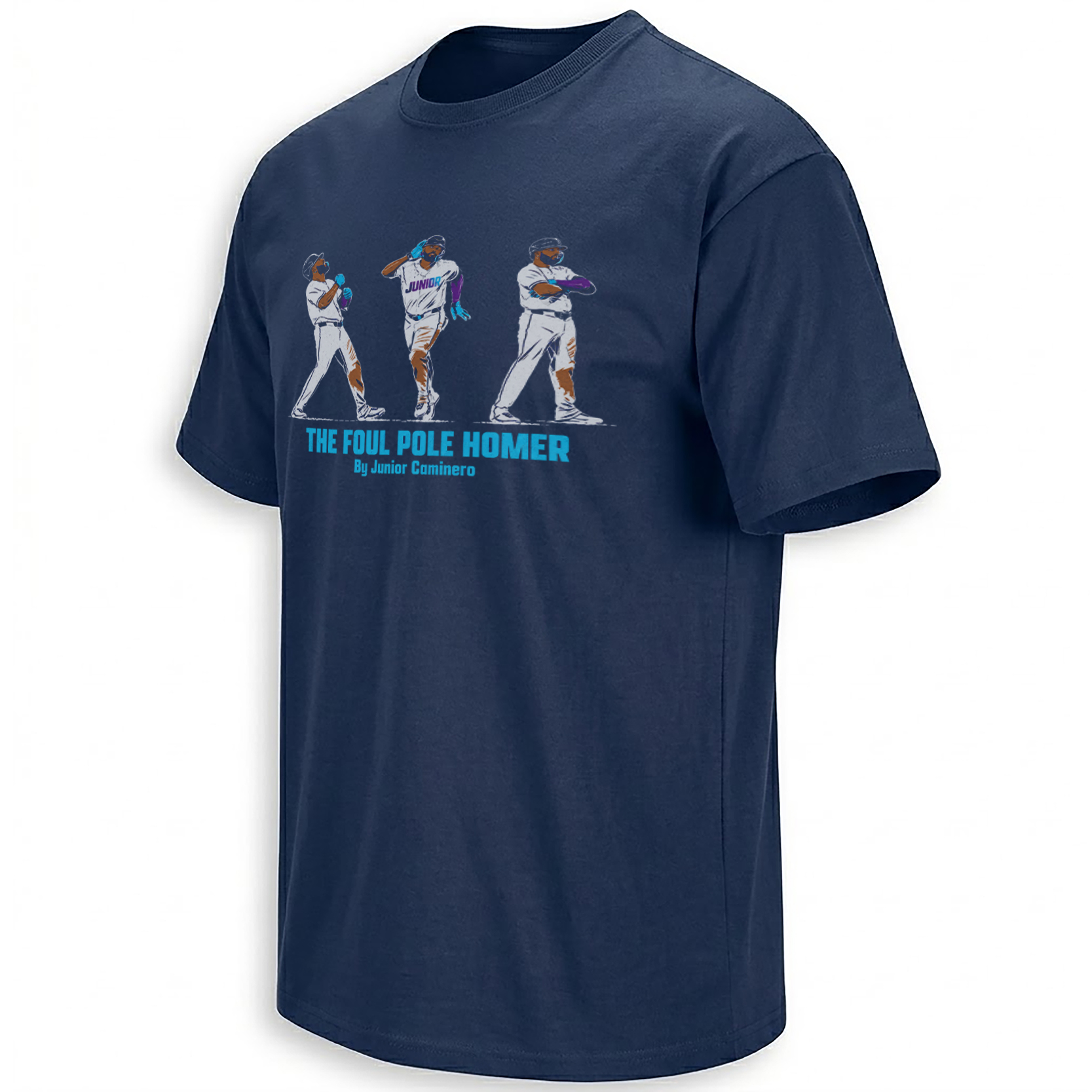
A celebratory graphic inspired by the seventh-inning homer that helped send the Rays to the 2026 World Series.
View the Caminero design →
A stadium-inspired typographic tribute to Tampa Bay’s restored dome and its renewed place in Rays history.
View The Trop artwork →The Rest of the Game: How Tampa Bay Clinched the Pennant
Caminero’s homer was the most visually memorable swing, but Tampa Bay’s victory required contributions throughout the lineup. Richie Palacios delivered a two-run double in the second inning, giving the Rays an early advantage and keeping pressure on Cleveland.
Freddy Peralta worked 5 1/3 innings, allowing one run, and strengthened his case for ALCS MVP honors. His performance built on an impressive series in which his pitching helped Tampa Bay control several important stretches.
Yandy Díaz added a two-run homer in the eighth, providing insurance after Cleveland threatened to close the gap. The Guardians scored twice during a tense eighth inning, but Tampa Bay maintained its advantage and completed the 7–3 victory.
The result secured a third American League championship for the franchise. For Caminero and the Rays, the moment also carried significance because it happened at the Trop, the same building whose future had seemed uncertain after Hurricane Milton.
How Two Designs Tell One Championship Journey
These two designs preserve different parts of the same evening. The Foul Pole Homer is about an individual moment of athletic brilliance. The Trop is about the environment, shared memory and regional identity that gave the moment its meaning.
That distinction makes them effective companions without making either one dependent on the outcome of the World Series. Caminero’s home run is already part of the historical record. Tropicana Field’s return is already a significant chapter in the franchise’s relationship with St. Petersburg.
The combination also reflects a wider characteristic of baseball fandom. Supporters often remember not only who delivered a decisive hit but where they were when it happened, what the stadium sounded like and how the people around them responded.
The broader Tampa Bay Rays collection captures player moments, postseason language and local ballpark references, while the MLB collection places these graphics inside baseball’s wider visual culture.
Frequently Asked Questions
When did Junior Caminero hit the foul-pole home run?
Caminero hit his two-run foul-pole homer in the seventh inning of ALCS Game 6 against Cleveland on October 19, 2026.
What was the final score of ALCS Game 6?
The Tampa Bay Rays defeated the Cleveland Guardians 7–3 to win the American League pennant and reach the 2026 World Series.
Why did Caminero copy Randy Arozarena’s pose?
After his home run, Caminero crossed his arms in tribute to former Rays postseason star Randy Arozarena, who was watching the game at Tropicana Field.
Why was Tropicana Field important in 2026?
The stadium reopened in April 2026 after its roof was damaged by Hurricane Milton in October 2024, allowing the Rays to return after playing their 2025 home schedule elsewhere.
Who will the Rays face in the 2026 World Series?
Tampa Bay will face the Milwaukee Brewers, with Game 1 scheduled for October 23, 2026, in Milwaukee.
Junior Caminero’s decisive homer and Tropicana Field’s restoration now occupy the same chapter of Tampa Bay baseball history. Explore The Foul Pole Homer, The Trop and the wider Rays visual archive as the franchise prepares for another World Series.
Junior Caminero’s 2026 ALCS Game 6 foul-pole homer and Tropicana Field’s remarkable return inspire two Tampa Bay Rays graphics, connecting a historic postseason celebration with the restored home of Rays baseball.