
Jeremiah Smith Reached the Top of Ohio State’s Record Book — and He Got There Early
A 23-yard catch against Kent State moved Jeremiah Smith past Michael Jenkins for the most career receiving yards in Ohio State history, turning another September afternoon in Columbus into a handoff between generations of Buckeyes receivers.
There was nothing visually extravagant about the play that changed Ohio State history. Early in the first quarter against Kent State on September 19, Julian Sayin found Jeremiah Smith for 23 yards. Smith secured the ball, moved upfield and reached the Golden Flashes’ 10-yard line. Then the number attached to his career changed.
Smith entered the afternoon with 2,873 receiving yards. Michael Jenkins’ program record stood at 2,898. After an earlier 13-yard reception, the 23-yarder pushed Smith beyond the mark that had survived for more than two decades.
The Buckeyes were headed toward a 59–3 victory, but that single reception gave the afternoon a second meaning. Ohio State has produced a remarkable line of receivers — Jenkins, David Boston, Cris Carter, Chris Olave, Emeka Egbuka, Marvin Harrison Jr. — and a junior wearing No. 4 had just moved above all of them in one of the position’s cleanest statistical categories.
The remarkable part is not simply that Smith owns the record. It is how much football may still remain after reaching No. 1.
The Record Arrived Before the Career Felt Finished
That timing is what separates this achievement from an ordinary career milestone. Smith reached the top during the third game of his junior season. He had already built 1,315 receiving yards as a freshman in 2024 and another 1,243 in 2025, creating a pace that transformed the school record from a distant target into something realistically vulnerable before his third college September was complete.
Against Kent State, Smith finished with five receptions for 85 yards, leaving Ohio Stadium with 2,958 career receiving yards. The program’s official recap placed him 182 yards from entering the Big Ten’s career top 10. At the same time, he remained within range of Ohio State’s career receptions and receiving-touchdown records.

Ohio State’s Receiver History Makes the Number Feel Bigger
At some programs, becoming the career receiving leader is primarily about longevity. At Ohio State, the list itself changes the emotional weight. The Buckeyes have repeatedly sent wide receivers from Columbus into the NFL while producing stars across very different offensive eras.
Smith’s climb therefore works like an index of names familiar to several generations of fans. He passed Egbuka, Boston, Carter, Olave and Harrison before arriving at Jenkins. Each name carries a different visual memory: different jerseys, quarterbacks, rivalry games, postseason runs and versions of Ohio Stadium.
That history is why “Receiving Yards King” works as fan language. It compresses a complicated statistical ladder into one instantly understood idea: after decades of elite Ohio State wideouts, Smith now occupies the top line for career yardage.
The Crown Is Doing Real Work in the Graphic
The Jeremiah Smith Receiving Yards King design approaches the moment as a coronation rather than a stat card. That choice matters because the record is not framed around one spectacular touchdown or a single opponent. It is cumulative.
Oversized “JEREMIAH SMITH” lettering establishes the player before the eye reaches the achievement. His scarlet No. 4 figure cuts through the typography in motion, while the small crown above him visually answers the phrase below: “ALL-TIME OHIO STATE RECEIVING YARDS KING.”
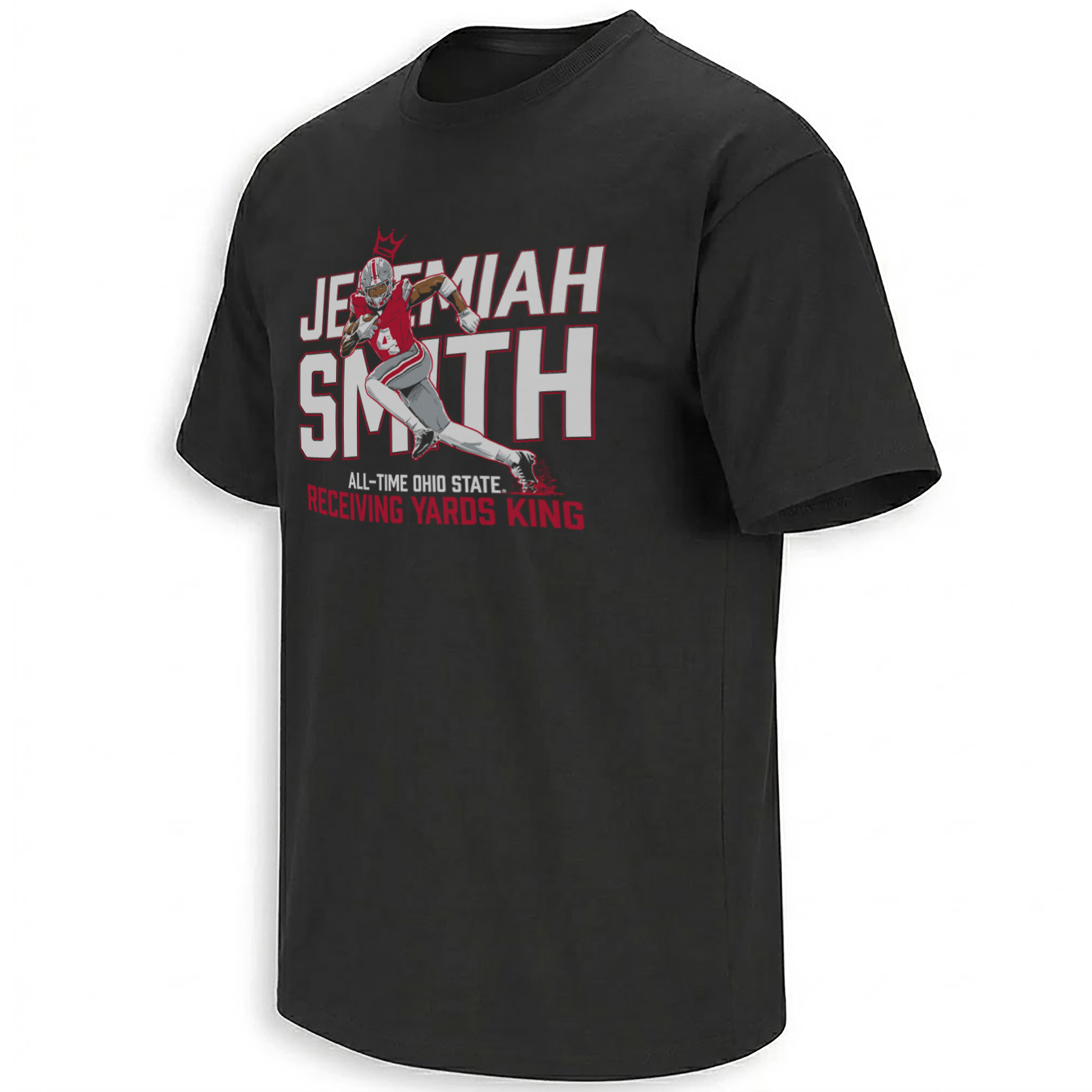
The crown, No. 4 action figure and direct record language freeze the exact point when Smith became the name at the top of Ohio State’s receiving-yardage list.
View the record graphic →Black, scarlet, white and silver keep the artwork inside familiar Buckeyes visual territory, while the collegiate lettering makes it feel closer to a record-book poster than a generic player portrait. The crown is deliberately small: the achievement, rather than royalty imagery, remains the headline.
Why This Moment Is Different From a Normal Early-Season Record
The calendar gives the moment unusual tension. Smith is not reaching the end of a four-year career and collecting a final number. He has moved into first place while the rest of the 2026 season is still unfolding.
That changes how fans process the milestone. The number 2,958 is already historic, but it is not necessarily final. Every future catch can now create separation between Smith and the receiving history behind him. The conversation shifts from “Can he catch Jenkins?” to “How far can he move the record?”
For anyone following Smith specifically, Ellie Shirt’s Jeremiah Smith search archive collects the player-driven moments surrounding his Ohio State career. The wider Ohio State Buckeyes collection places this record beside the program’s other player, rivalry and championship graphics, while the NCAA collection connects it to the broader college-football season.
Frequently Asked Questions
What Ohio State record did Jeremiah Smith break?
Smith became Ohio State’s all-time leader in career receiving yards, moving past Michael Jenkins’ previous program record of 2,898 yards.
When did Jeremiah Smith break the receiving-yards record?
He broke it on September 19, 2026, during Ohio State’s home game against Kent State.
What play put Jeremiah Smith into first place?
A 23-yard reception from Julian Sayin in the first quarter moved Smith beyond Jenkins’ career total.
How many career receiving yards did Smith have after the Kent State game?
Smith finished the game with 2,958 career receiving yards after catching five passes for 85 yards.
Why does the graphic call Smith the “Receiving Yards King”?
The phrase reflects his new position at the top of Ohio State’s career receiving-yardage list, while the crown turns that statistical ranking into a simple visual symbol.
The Receiving Yards King graphic captures the September afternoon Smith moved to No. 1, while the Ohio State archive tracks the wider Buckeyes story around him.
Jeremiah Smith Shirt captures the moment Ohio State’s No. 4 passed Michael Jenkins to become the program’s all-time career receiving-yards leader, using scarlet record typography, an action portrait and a crown built around the new No. 1.