
Jake Bauers’ 11-Pitch Homer Made Milwaukee Believe. Garrett Mitchell Made It a Movement.
A 12-pitch walk, an 11-pitch home run and two back-to-back swings turned the Brewers’ patient identity into a National League pennant. By Thursday night, Bauers and Mitchell had written the ending together.
On October 14 at Dodger Stadium, Jake Bauers refused to surrender an at-bat. The Los Angeles Dodgers had just moved ahead 2–1, and Blake Snell had spent much of the night making Milwaukee hitters look helpless. Then Bauers kept spoiling pitches. The eleventh became a two-run home run that changed the lead, the volume in the ballpark and the shape of the 2026 National League Championship Series.
Garrett Mitchell stepped in immediately afterward and homered, too. Milwaukee won Game 3 by a 6–2 score. One night later, the two players were central again as the Brewers overcame a four-run deficit, won 6–4, swept Los Angeles and reached the World Series for the first time since 1982. Bauers finished the series as NLCS MVP.
The sequence became an origin story for the pennant: one swing embodied stubbornness, the next embodied momentum.
NLCS Game 2
NLCS Game 3
NLCS Game 4
Why was Jake Bauers’ 11-pitch home run so extraordinary?
Its power was in the buildup. In Game 2, Bauers had already exhausted Yoshinobu Yamamoto with a 12-pitch walk, extending a rally in a 7–4 Milwaukee victory. Two nights later, Snell attacked him with changing speeds and shapes. Bauers kept the plate appearance alive with two-strike foul balls before finally finding the fastball he could drive.
The blast, projected at roughly 412 feet by Statcast, traveled into the right-field seats. It was not merely the hit that mattered; it was the labor required to reach it. Milwaukee had made patience a weapon, and Bauers compressed that identity into eleven pitches television viewers could count along with him.

Eleven pitches made the moment possible. One swing made it impossible to forget.
Editorial observation · not a player quotationWhat happened when Garrett Mitchell came to the plate?
Mitchell made sure there was no time for Los Angeles to recover emotionally. Coming up directly after Bauers, the center fielder drove a solo homer of his own, stretching the seventh-inning advantage to 4–2. These were consecutive home runs by teammates whose paths to this stage had been anything but straightforward.
Bauers had spoken publicly about stretches when he considered getting away from baseball altogether. Mitchell had spent years fighting through injuries. On the same night, their separate experiences became a shared image: one hitter walking back toward a jubilant dugout, another approaching home plate, and the visiting side acting like this ballpark belonged to Milwaukee.
Game 4 made the pairing even harder to separate. Bauers delivered a two-run ground-rule double and drew a bases-loaded walk to tie the game. Mitchell supplied the go-ahead sixth-inning home run. The Brewers did not simply protect their Game 3 surge; they reproduced the partnership with a World Series berth on the line.
How did the “Rake Bauers” and “Bauers Mitchell ’26” graphics capture it?
One design is about the individual battle. The navy Rake Bauers — The Marathon Man graphic uses monumental gold lettering and a number-nine batting figure. Its baseball pun makes immediate sense to anyone who watched Bauers grind through those exhausting plate appearances.
The other design is deliberately lighter: sky-blue fabric, gold serif names, a prominent “’26” and the phrase “THIS IS MY CREW.” Framed like a vintage campaign ticket, it casts Bauers and Mitchell as running mates. It is a baseball parody of campaign typography, not an actual political endorsement or a quotation attributed to the players.
Two different journeys. Two unforgettable seventh-inning swings.
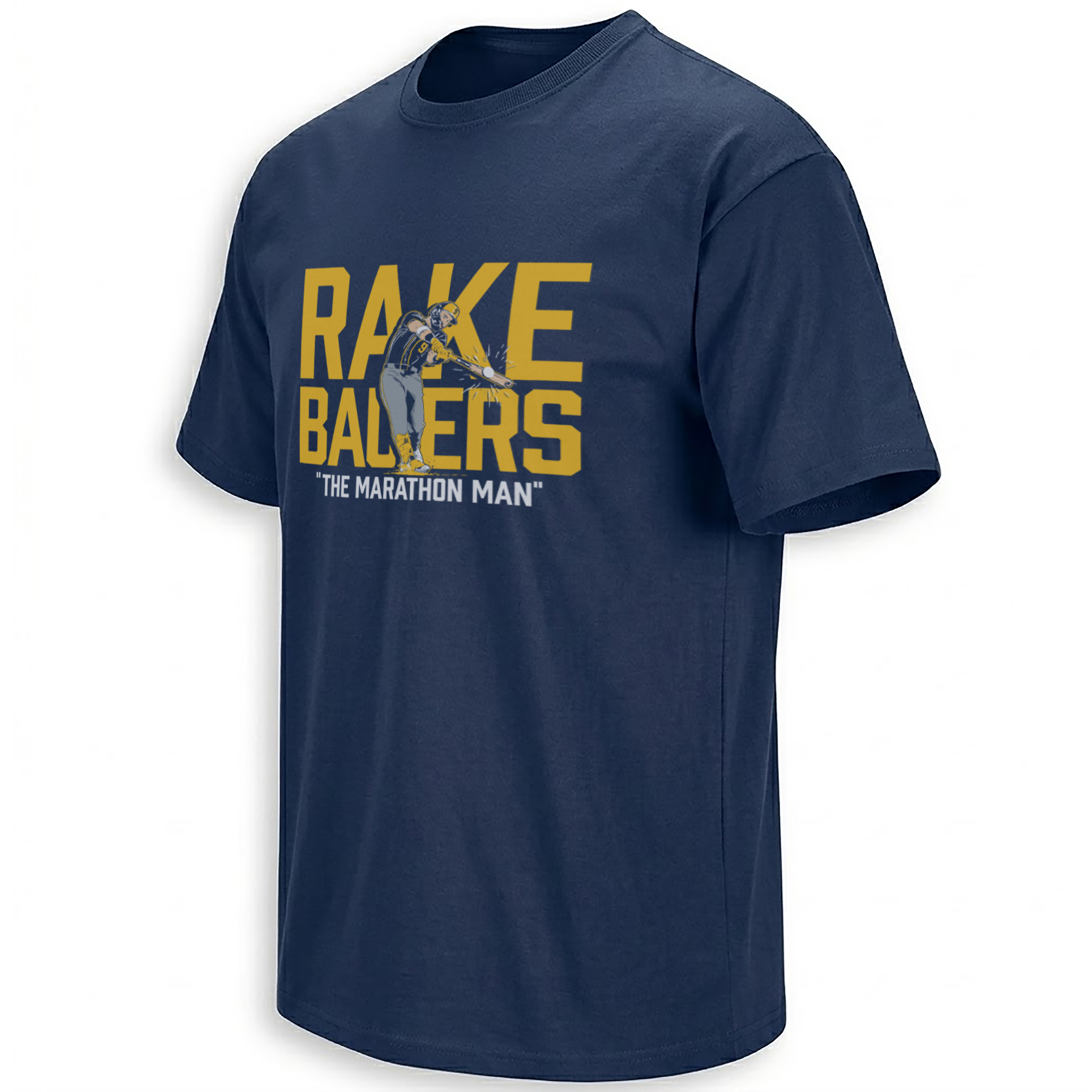
A gold-and-navy visual timestamp of the eleven-pitch home run and the hitter who refused to give in.
Explore the individual moment →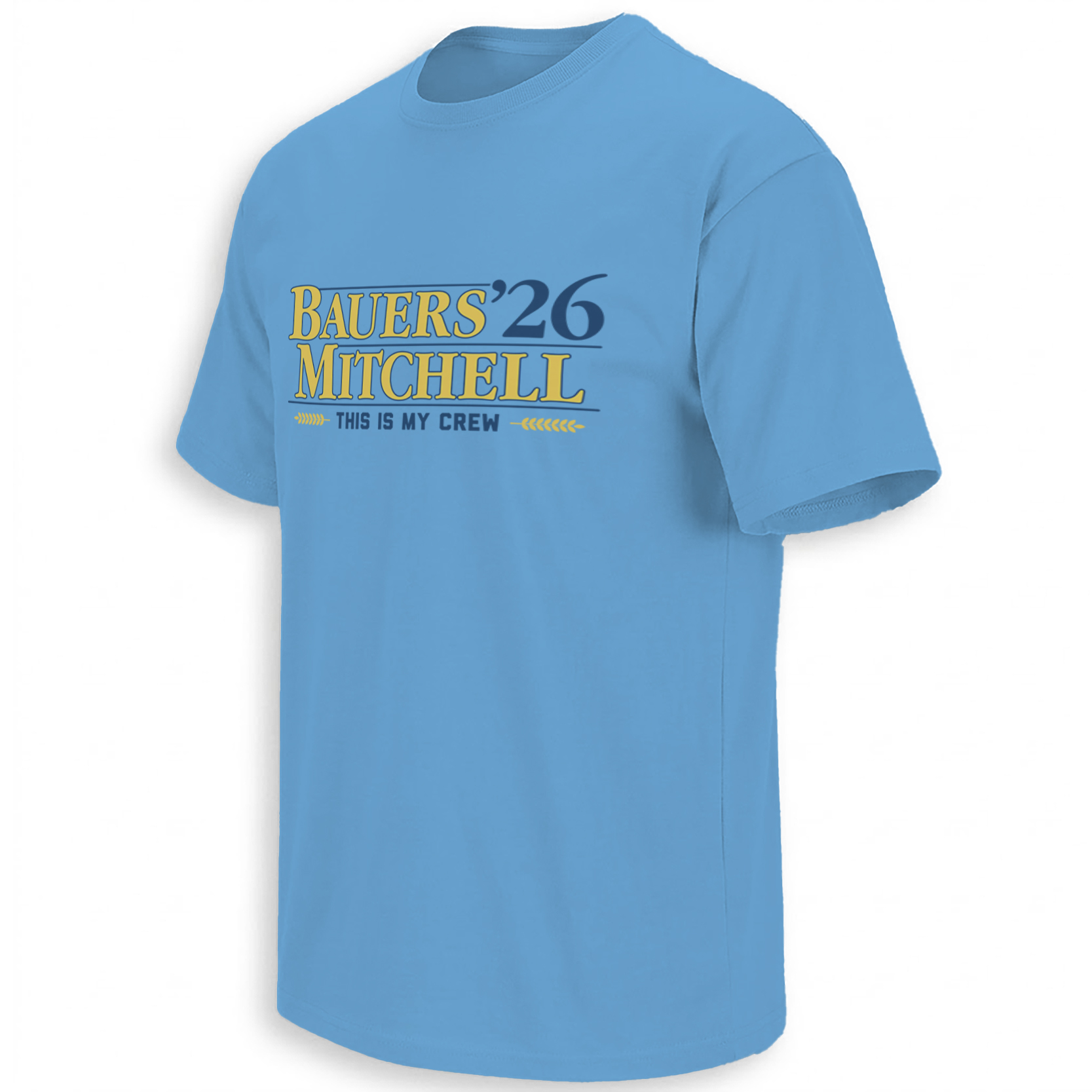
Two names turn a consecutive-homer moment into a witty campaign-style symbol of Brew Crew unity.
Explore the two-player graphic →Why did the at-bat connect with baseball fans online?
Because viewers could watch its difficulty accumulate in real time. On Reddit, the original full-at-bat clip sparked discussion about every foul ball and the sense that Milwaukee had found its defining October sequence.
Milwaukee’s fan language now has several layers: the marathon at-bat, the back-to-back home runs and the final sweep. They fit naturally into the evolving Milwaukee Brewers collection, while the broader MLB shirts archive shows how a single postseason can generate so many different visual memories. Follow the individuals through Jake Bauers designs and Garrett Mitchell designs.
Frequently Asked Questions
What happened in Jake Bauers’ 11-pitch at-bat?
In NLCS Game 3 on October 14, 2026, Bauers hit a go-ahead two-run home run against Blake Snell on the eleventh pitch of his seventh-inning plate appearance.
Why are Jake Bauers and Garrett Mitchell paired together?
They hit back-to-back seventh-inning home runs in Game 3, then both contributed decisive plays in Milwaukee’s Game 4 pennant-clinching comeback.
Did the Brewers win the 2026 National League pennant?
Yes. Milwaukee swept the Los Angeles Dodgers 4–0 in the 2026 NLCS and advanced to its first World Series since 1982.
What does Bauers Mitchell ’26 mean?
It is a campaign-poster-inspired baseball graphic linking the two Brewers players to the 2026 postseason. It is not a real political ticket.
The Marathon Man and Bauers–Mitchell ’26 graphics keep different pieces of the same October story in view: a hitter’s persistence, a teammate’s immediate answer and a city headed back to the Fall Classic.
Jake Bauers’ eleven-pitch home run and Garrett Mitchell’s back-to-back blast became signature images of the Brewers’ 2026 NLCS sweep. The Rake Bauers Marathon Man and Bauers Mitchell ’26 designs interpret that pennant-winning October through dramatic baseball lettering and playful campaign-poster imagery.