If You Ever Feel Stupid The Meaning Behind a Controversial Trump Supporters Satire Shirt
A familiar motivational setup takes an unexpected political turn. This minimalist back-print graphic offers an example of how partisan internet humor travels from short-form expressions into contemporary statement fashion.
Political satire does not always arrive as a detailed editorial cartoon or an extended argument. Sometimes, it appears as a short sentence that relies on an unexpected reversal of expectations.
The If You Ever Feel Stupid design uses that structure to express a critical attitude toward supporters of Donald Trump. Its message belongs to a recognizable category of partisan humor in which political disagreement is compressed into a brief, deliberately provocative expression.
The composition is notable for its absence of elaborate imagery. White lettering, a dark background and a direct political reference carry the entire message.
Within the broader Anti Trump collection , the design represents a typography-centered approach to political expression rather than a portrait, campaign-symbol graphic or policy-specific illustration.
The History of Political Satire in American Visual Culture

Source: Library of Congress. This historical illustration is unrelated to Donald Trump and is included to document the longer tradition of American political satire.
Long before social-media captions and graphic shirts, political commentary appeared in newspapers, illustrated magazines and printed materials. Artists used exaggeration, symbolism and irony to communicate attitudes toward political events and public figures.
Historical publications such as Puck demonstrate how a single illustration could carry an argument or criticism without requiring an extended article.
Contemporary statement apparel uses a different medium but can serve a comparable expressive function. A garment becomes a portable surface for a political viewpoint, a joke or a personal declaration.
The comparison concerns the communication format, not an equivalence between historical political controversies and contemporary American politics.
What Does the If You Ever Feel Stupid Shirt Say?
The graphic begins with a sentence that resembles familiar reassurance or motivational advice. Instead of delivering encouragement, it changes direction and introduces a partisan insult.
If you ever feel stupid…
Just think of Trump’s supporters
And it will go away.
The joke depends on sarcastic comparison. It presents the speaker as someone who restores confidence by contrasting themselves with a political group they dislike.
That is the viewpoint expressed by the slogan. It is not a factual assessment of the intelligence, character or qualifications of people who support Donald Trump.
The opening resembles a reassuring message addressed to someone experiencing self-doubt.
The reference to Trump’s supporters changes the subject from personal confidence to political disagreement.
The final phrase completes the sarcastic comparison without presenting a policy argument or supporting evidence.
Where Did the Political Quote Originate?
Variations of this wording appear across online merchandise platforms. Listings using the same expression can be found independently of the Ellie Shirt product.
Similar versions also substitute other political figures or their supporters into the same sentence structure. This suggests that the expression functions as a reusable partisan joke format.
The available examples do not establish a reliable original author, first publication date or connection to a specific political event.
Consequently, the wording is best described as circulating political sarcasm rather than a documented quotation from a politician, comedian or public speech.
Why the Minimalist Black-and-White Back Print Matters
The If You Ever Feel Stupid Shirt places the statement across the upper back of a black garment using prominent white lettering.
Instead of surrounding the text with political portraits, flags or decorative emblems, the composition treats the sentence itself as the primary graphic element.
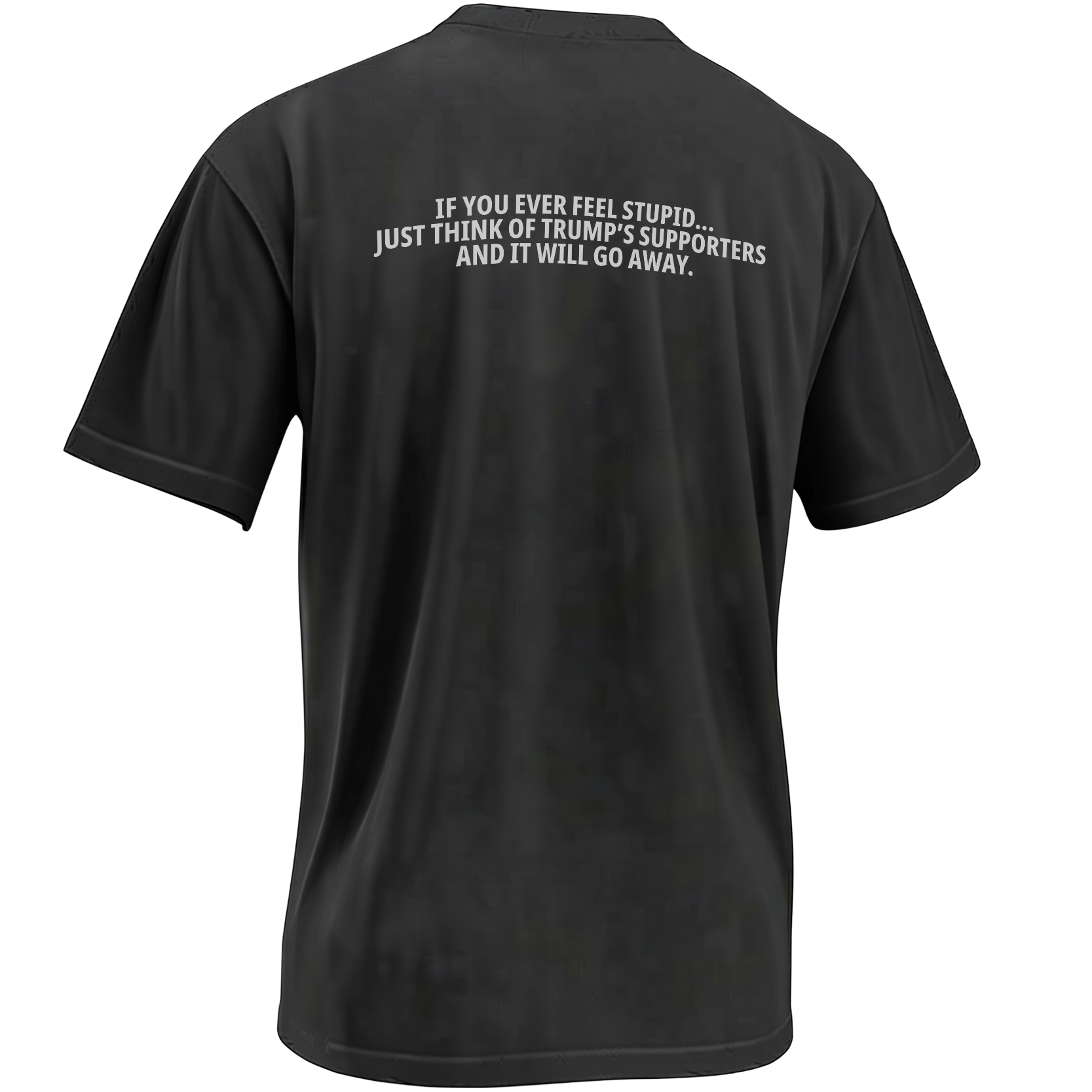
A black-and-white political statement graphic using direct typography, sarcastic comparison and an upper-back print composition.
View the complete artwork →The back-print placement also changes the viewing experience. Unlike a conventional chest graphic, the message is encountered from behind the wearer. This creates a presentation closer to a printed sign than a decorative emblem.
High-contrast lettering reduces visual distractions. The viewer does not need to recognize a caricature or interpret several competing symbols before understanding the intended message.
Political Statement Shirts and Partisan Identity
Political apparel can communicate support, opposition, criticism, humor or affiliation. Different designs may use similar visual techniques while expressing substantially different viewpoints.
Supporters of a political figure may interpret a slogan as a declaration of solidarity. Opponents may use comparable typography and humor to communicate criticism or frustration.
The same design principles therefore appear across competing political communities: recognizable names, memorable phrases, simplified compositions and strong contrasts.
Those visual similarities are part of the reason political statement fashion is an interesting subject of cultural analysis independently of the reader’s own political preferences.
A provocative political slogan expresses an attitude. Its rhetorical effectiveness does not establish the accuracy of its underlying assumptions. People can hold different political preferences for many reasons, and a slogan alone cannot explain them.
Why the Design Is Not Tied to One Election or News Event
Some political graphics commemorate an exact campaign speech, legislative decision or election result. The If You Ever Feel Stupid artwork does not identify such an event.
There is no date, policy reference or numerical claim within the displayed quotation. Its meaning instead comes from an explicitly partisan interpretation of a familiar sarcastic sentence.
This makes the design a general statement of political opposition rather than a documentary record of a specific November 2026 development.
How Internet Sarcasm Becomes Wearable Typography
Short-form internet humor often depends on quick recognition. A familiar introduction gives the audience a sense of what to expect, and an abrupt change of direction produces the intended comic effect.
When transferred to apparel, the same structure must remain understandable without an accompanying conversation or explanatory caption.
Typography becomes especially important in this context. Line arrangement, spacing and contrast determine how easily the message can be read and how the setup and conclusion relate to each other.
The If You Ever Feel Stupid graphic illustrates this process through its reliance on language rather than a complicated illustrated scene.
The Anti Trump collection contains designs expressing opposition and political criticism. The broader Donald Trump-related design archive includes graphics representing different political viewpoints and forms of satire. Together, these categories illustrate the role of apparel as a medium for political expression.
Frequently Asked Questions
What does the If You Ever Feel Stupid political shirt mean?
It expresses criticism of Donald Trump’s supporters through a sarcastic comparison presented as a humorous response to personal self-doubt.
Is the quote a factual statement about Trump supporters?
No. It is a partisan insult and expression of political opinion, not a factual assessment of anyone’s intelligence.
Who originally wrote the If You Ever Feel Stupid quote?
The original author has not been reliably established. The expression appears across several online merchandise platforms.
Is the slogan an official political campaign statement?
No official campaign origin has been established. The wording is presented as independent political satire.
Is the design connected to a specific event in 2026?
No specific event has been verified as the inspiration for this artwork. Its message is general political sarcasm.
What does the shirt’s back print feature?
It features the complete political quotation in contrasting white lettering across the upper back of a black garment.
Why does the artwork use black and white?
The monochrome presentation emphasizes readability and keeps attention on the wording rather than decorative imagery.
The If You Ever Feel Stupid Shirt presents a critical political slogan referencing Donald Trump’s supporters through minimalist white typography on a black back-print graphic, illustrating the relationship between partisan internet humor and statement fashion.