“Fuck ’Em Both ’26” Turns Party Fatigue Into a Campaign Poster
With the November 3 midterms approaching, American politics is once again being reduced to red-versus-blue arithmetic. The bluntest counter-message is also one of the simplest: what if the frustration is with the entire choice?
The 2026 midterm election is entering its final stretch in an unusually sour political atmosphere. A Reuters/Ipsos poll completed in late September put President Donald Trump’s approval rating at 32%, while registered voters in the same survey preferred Democratic congressional candidates to Republicans 43% to 35%. Cost of living remained the issue voters most frequently identified as decisive.
None of those numbers mean voters are suddenly enthusiastic about the political system itself. Gallup reported in January that a record 45% of U.S. adults identified as political independents during 2025, compared with 27% identifying as Democrats and 27% as Republicans. Gallup also cautioned that the shift did not represent a broad surge in affection for the Democratic Party: favorable ratings for both major parties remained weak.
That gap between voting behavior and political attachment is the space where a graphic like “Fuck ’Em Both ’26” makes sense. It is not a candidate slogan. It does not tell the viewer what box to check. It takes the visual grammar of an election sign and uses it to reject the emotional bargain behind the sign.
The joke is not that red and blue are identical. The joke is that a growing number of Americans do not feel emotionally represented by either label.
Why Anti-Party Language Feels Especially Natural in 2026
American elections still operate overwhelmingly through the Democratic and Republican parties, but party identification and voter psychology are not the same thing. Someone can vote Democratic while refusing the Democratic label, vote Republican without feeling loyal to the GOP institution, or move between parties from one election cycle to another.
Gallup’s record independent figure captures that distance. Forty-five percent is not evidence of a unified third-party ideology; independents themselves lean in different ideological directions. What the number does show is that party identity is increasingly less automatic for a large share of the country.
That matters in an election season dominated by cost-of-living anxiety, foreign-policy arguments, redistricting fights and candidate attempts to separate themselves from unpopular national figures. Republicans are dealing with internal disagreements over Trump’s agenda, while Democrats have their own ideological and candidate-level disputes in competitive states. The midterms are formally a contest between parties, but the public conversation contains plenty of frustration inside those parties as well as outside them.

The Artwork Borrows the Look of the System It Is Mocking
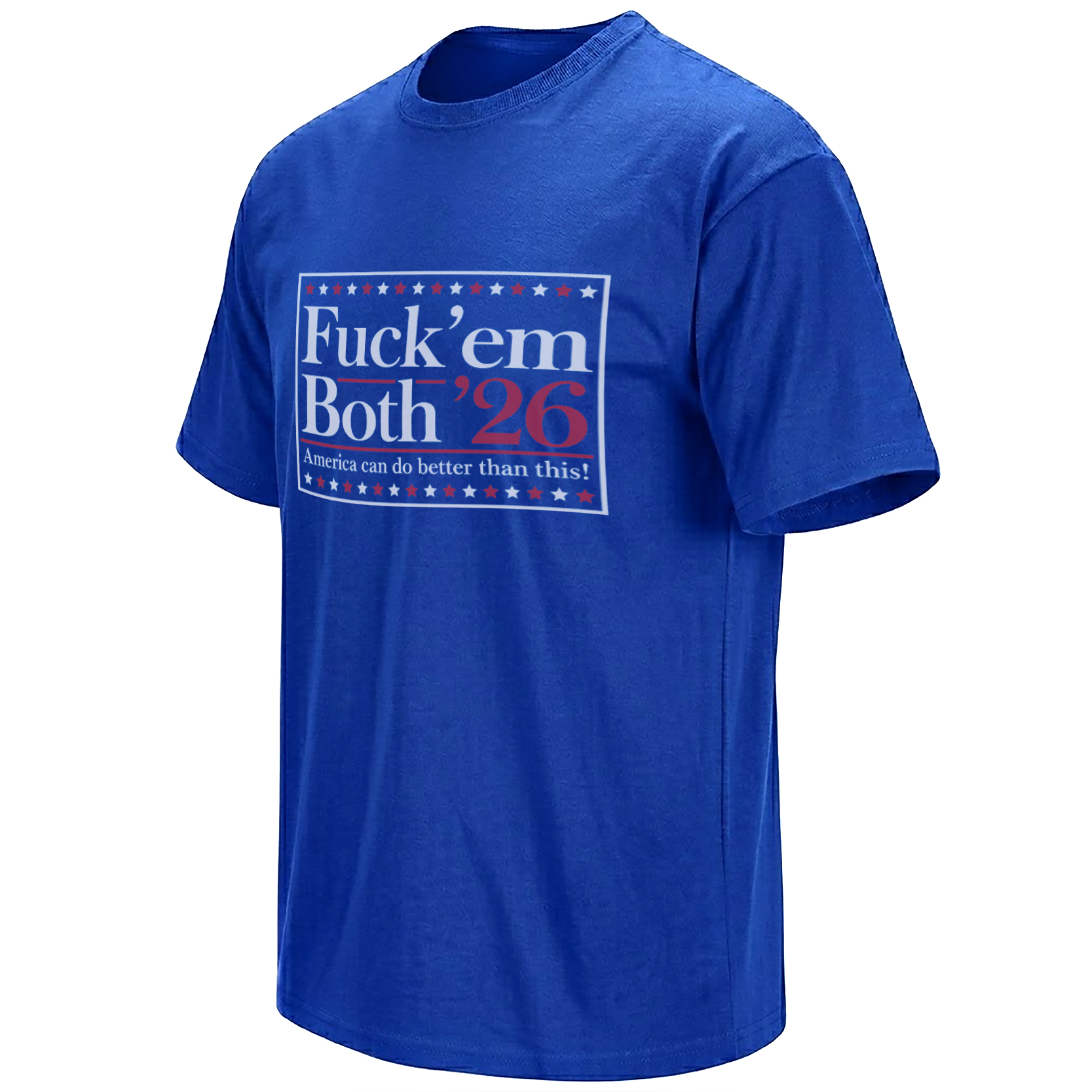
The visual trick in the Fuck ’Em Both ’26 Shirt is that it looks legitimate for half a second.
The royal-blue shirt, white border, rows of stars and serif election typography all belong to the familiar language of American campaign merchandise. “’26” is enlarged in red exactly where a candidate surname or election year might normally dominate a yard sign. The composition is orderly, patriotic and almost institutional.
Then the eye reads the actual headline.
“America Can Do Better Than This” Changes the Tone
The smaller line beneath the profanity is important. Without “America can do better than this!” the design would function mainly as nihilism — two parties dismissed with no second thought.
The added sentence shifts the emotional center from pure rejection toward political disappointment. It reads less like “nothing matters” and more like “the available conversation is not good enough.” That is a different category of protest language.
The graphic therefore belongs to a long American tradition in which campaign aesthetics are turned against campaigns themselves. Election posters, patriotic stars, candidate typography and red-white-and-blue palettes are highly recognizable visual codes. Satire becomes immediate when those codes deliver a message the viewer would never expect on an official candidate sign.
The artwork deliberately avoids caricatures of individual politicians. Its target is broader: binary party politics. That makes the typography, campaign border and 2026 date more important than any portrait could be.
Why the Design Works Better Without a Candidate Face
Political apparel often ages at the speed of the politician printed on it. This design avoids that problem by turning the election structure itself into the subject.
That also keeps the message open to multiple interpretations. A progressive disappointed with Democrats can read it one way. A conservative angry with Republican leadership can read it another. A centrist or independent voter can treat it as rejection of polarization. Someone else may simply read it as dark election-year humor.
Those interpretations are not politically identical, and the design does not pretend they are. Its cultural usefulness comes from the overlap: dissatisfaction strong enough to make party labels themselves the punchline.
From Campaign Merch to Protest Artifact
As November approaches, the wider Ellie Shirt politics collection functions as a running archive of the jokes, arguments, slogans and ideological collisions surrounding the 2026 cycle.
The “Fuck ’Em Both ’26” graphic occupies a specific place inside that archive. It is not candidate merch disguised as satire. It is anti-candidate merch using the exact design vocabulary candidates normally claim for themselves.
That contradiction is why the piece feels so connected to the current moment. The election is unavoidable. Party enthusiasm is not.
Frequently Asked Questions
What does “Fuck ’Em Both ’26” mean?
The phrase is anti-two-party protest language aimed broadly at dissatisfaction with both Democrats and Republicans rather than support for a specific 2026 candidate.
Why is 2026 important to the design?
2026 is a U.S. midterm election year, with congressional elections scheduled for November 3 and control of Congress at stake.
Are more Americans identifying as political independents?
Gallup reported that 45% of U.S. adults identified as independents in its 2025 annual average, a record high in its polling series.
Does the shirt support a third-party candidate?
No specific candidate or third party appears in the artwork. The graphic works as a broader criticism of the two-party political environment.
Why does the design look like traditional campaign merchandise?
The stars, red-white-and-blue palette, serif typography and oversized election year intentionally imitate conventional American campaign graphics so the anti-party message lands as visual satire.
The Fuck ’Em Both ’26 design captures one strand of 2026 political frustration, while the wider politics archive tracks the slogans and visual arguments surrounding the election cycle.
Fuck ’Em Both ’26 Shirt turns 2026 midterm frustration into campaign-poster satire, pairing classic red-white-and-blue election typography with the blunt line “America can do better than this!”