
Dallas Keeps Changing. The Quarterback Argument Never Does.
Dak Prescott opened his 11th Dallas season with another night under the microscope. Behind him sit Tony Romo and Troy Aikman — two completely different quarterback eras that explain why the numbers 4, 9 and 8 can tell Cowboys fans an entire story without a caption.
Dallas opened the 2026 season on Sunday Night Football with a 28–20 loss to the New York Giants, and almost immediately the old Cowboys ritual returned: measure the quarterback against everyone who came before him.
Dak Prescott completed 22 of 34 passes for 175 yards, two touchdowns and one interception. It was not a disastrous performance, but it arrived inside a loss, and Dallas quarterback culture has never been interested in separating statistics from the result for very long.
That is the environment surrounding No. 4 in Year 11. Prescott is already the franchise’s career passing-yard leader, having moved beyond Tony Romo during the 2025 season. Yet Romo still owns the Dallas record for passing touchdowns at 248. Prescott entered 2026 needing five to tie it; two touchdown passes in the opener moved him to within three.
Dallas does not remember quarterbacks as a clean statistical ranking. It remembers them as eras — and every era inherits the argument from the one before it.
Why 4–9–8 Reads Like a Dallas Timeline
Numbers carry unusual weight in Cowboys culture. No. 8 immediately opens the door to the 1990s dynasty, Super Bowl nights and Troy Aikman’s place at the center of one of football’s most recognizable championship teams.
No. 9 moves the mood into the Tony Romo era: improvisation, impossible escapes from pressure, huge regular-season numbers, late-game drama and the permanent tension between how brilliant he could look and how ruthlessly playoff exits shaped his public legacy.
No. 4 is the bridge from that era into the present. Prescott took over in 2016 after Romo was injured and never gave the job back. A decade later, he has moved beyond Romo in passing yards and is now approaching the touchdown record as well.
The individual Ellie Shirt search archives for Dak Prescott, Tony Romo and Troy Aikman make that timeline visible across different generations of Dallas graphics.

Prescott Has Already Crossed One Romo Line
The most important recent shift happened in November 2025. Prescott surpassed Romo’s 34,183 career passing yards and became the most prolific passer in Cowboys history by that measure.
It was a strange milestone because it did not settle the debate. Dallas quarterback discourse rarely works that way. Romo’s supporters can point toward efficiency, improvisation and the shape of the teams around him. Prescott supporters can point toward longevity, accuracy, production and records already transferred into his name. Aikman’s résumé immediately changes the terms again because championship success sits above both.
The “After Dark” Graphic Rejects the Usual Legends Treatment
Traditional quarterback tribute art tends to behave like a museum wall: heroic faces, stadium lighting, signatures, statistics and a hierarchy that tells the viewer how seriously to take every person in the frame.
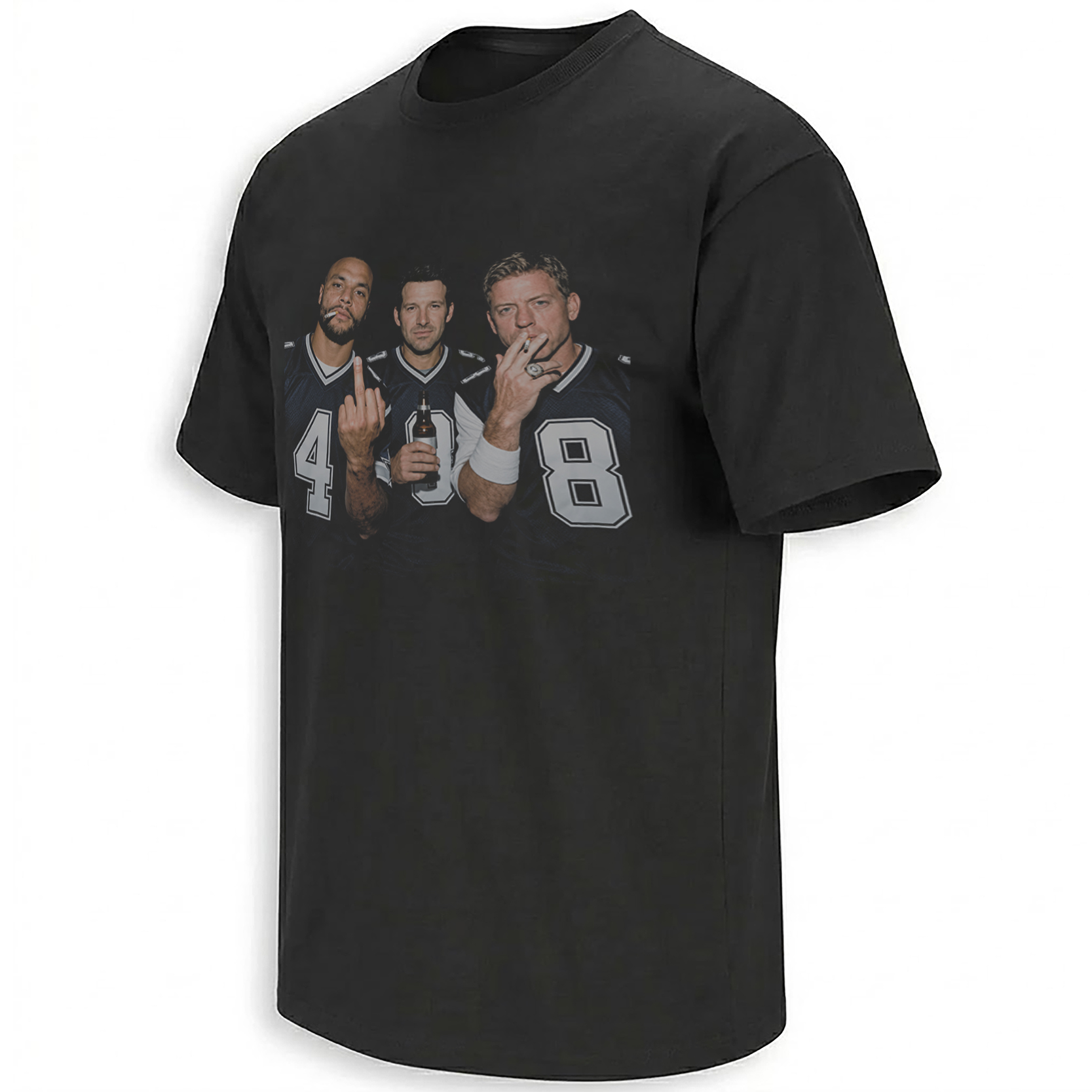
The Dallas QB Legends Shirt deliberately ruins that formality.
The 4–9–8 sequence is still recognizable as a three-era Dallas timeline, but everything around it feels like a fictional photograph from after the official cameras disappeared. Cigarettes, a bottle, a ring and an irreverent gesture replace the standard stadium heroism.
That distinction matters: the artwork is parody, not documentation. It is not claiming that Prescott, Romo and Aikman actually gathered for this scene. Instead, it takes the seriousness surrounding Dallas quarterback mythology and pushes it into fan-fiction nightlife.
Black space, navy uniforms, pale numbers and off-camera behavior make the composition feel closer to a bootleg late-night photograph than a licensed legends poster. The lack of headline text forces the viewer to decode 4–9–8 first.
Why Aikman Still Changes Every Dallas QB Debate
Statistics alone cannot reproduce Troy Aikman’s place in Cowboys memory. Dallas’ official history credits him with leading the team to three Super Bowl titles, including a Super Bowl XXVII MVP performance.
That creates the impossible standard facing every later quarterback. Romo could own passing records and still be judged against postseason results. Prescott can surpass those records and still enter each new season carrying the same question.
That is why the 4–9–8 design works culturally. The three numbers are not three versions of the same career. They represent three different arguments about what a Dallas quarterback is supposed to be.
The Week 1 Loss Made the Legacy Conversation Current Again
Dallas’ 28–20 defeat in New York did not create the quarterback debate, but it switched it back on. Prescott threw two touchdowns, yet the Cowboys finished with only 244 total yards and spent much of the night chasing the Giants’ control of possession.
In another market, that might simply be one bad opening result. In Dallas, every prime-time loss becomes part of a much older conversation about expectation, visibility and the distance between strong quarterback play and another Lombardi Trophy.
The wider Dallas Cowboys collection functions as a visual archive of that pressure, mixing current-player moments with throwbacks and fan humor. The broader NFL collection places those Dallas arguments inside the larger weekly rhythm of football culture.
Frequently Asked Questions
What do the numbers 4, 9 and 8 represent in Dallas quarterback culture?
The sequence naturally maps onto Dak Prescott’s No. 4, Tony Romo’s No. 9 and Troy Aikman’s No. 8, creating a shorthand timeline across three major Cowboys quarterback eras.
Is Dak Prescott the Cowboys’ all-time passing-yard leader?
Yes. Prescott passed Tony Romo’s former franchise mark of 34,183 career passing yards during the 2025 season.
How close is Dak Prescott to Tony Romo’s passing touchdown record?
Romo finished with 248 Cowboys touchdown passes. Prescott entered 2026 five short and threw two touchdowns in Week 1, leaving him three away from tying the record.
Why is Troy Aikman still the championship benchmark?
Aikman quarterbacked Dallas through three Super Bowl championship seasons in the 1990s, giving his era a postseason résumé later Cowboys quarterbacks are constantly measured against.
Is the Dallas QB Legends After Dark artwork a real photograph?
No. The cigarettes, bottle, ring and exaggerated body language are presented as a fictional parody composition rather than documentary imagery of a real gathering.
The 4–9–8 After Dark piece turns that quarterback lineage into fan-culture parody, while the Dallas Cowboys archive keeps tracking the new moments that continually reopen the debate.
Dallas QB Legends Shirt turns the No. 4, No. 9 and No. 8 quarterback eras into an irreverent After Dark parody as Dak Prescott closes in on Tony Romo’s remaining Dallas passing record.