
Houston Was Down to Its Last Strike. Then Christian Walker Ended the Night.
A five-run 10th inning, two last-strike escapes and one 405-foot Christian Walker blast turned an August division game against Seattle into one of Houston’s loudest finishes of 2026.
The Astros had already lost control of the night once. They led Seattle 5–2, watched the Mariners erase that advantage, then entered the bottom of the 10th trailing 7–5 against closer Andrés Muñoz. Houston was down to its final strike twice. The inning should have ended before Christian Walker ever had a chance to become the headline.
Instead, Isaac Paredes brought one run home. Jose Altuve kept the inning alive on an 0–2 pitch. Daulton Varsho fought through two swinging strikes and tied the game. Then Walker saw a slider and made the entire sequence feel like setup.
His three-run homer traveled a Statcast-projected 405 feet to left field at 108.2 mph. Final score: Astros 10, Mariners 7. Fireworks above Daikin Park, teammates pouring out of the dugout, and one of baseball’s cleanest pieces of accidental wordplay waiting for the internet: Christian Walk-off.
The five-run inning created the possibility. Walker supplied the frame everyone remembers.
The Walk-Off Only Makes Sense If You Remember How Close Houston Was to Losing
A walk-off can flatten everything that happened before it. The ball leaves the bat, the dugout empties and the final image replaces the previous three hours. This one deserves the setup because Houston had to survive several endings before Walker could create the real one.
Seattle had scored five unanswered runs after falling behind 5–2, including two in the top of the 10th. Against Muñoz, one of the league’s toughest late-inning arms, Houston repeatedly reached the edge of defeat.
The Mariners enter the bottom of the 10th with momentum and a two-run lead after completing a long comeback.
Paredes cuts the deficit, Altuve extends the inning and Varsho’s two-strike single brings Houston level.
Walker attacks Muñoz’s second pitch and sends the slider 405 feet, removing the need for another pitch.
That last detail is why walk-offs occupy a strange emotional category in baseball. A normal home run changes the score. A walk-off removes the future. There is no defensive half-inning, no next response and no opportunity for the opponent to repair the damage.
Houston’s Social Feed Understood the Ending Immediately

MLB’s own headline leaned into the same linguistic gift with “Christian Walk(off).” That kind of phrase works because it does not need invention layered on top of the player. His actual surname already contains the first half of the event.
Why “The C Walk-Off” Works as a Piece of Fan Language
The The C Walk-Off Shirt reduces a chaotic inning to a compact label. “C” points back toward Christian. “Walk-Off” describes the action. The phrase feels like the title of a highlight rather than an advertisement.
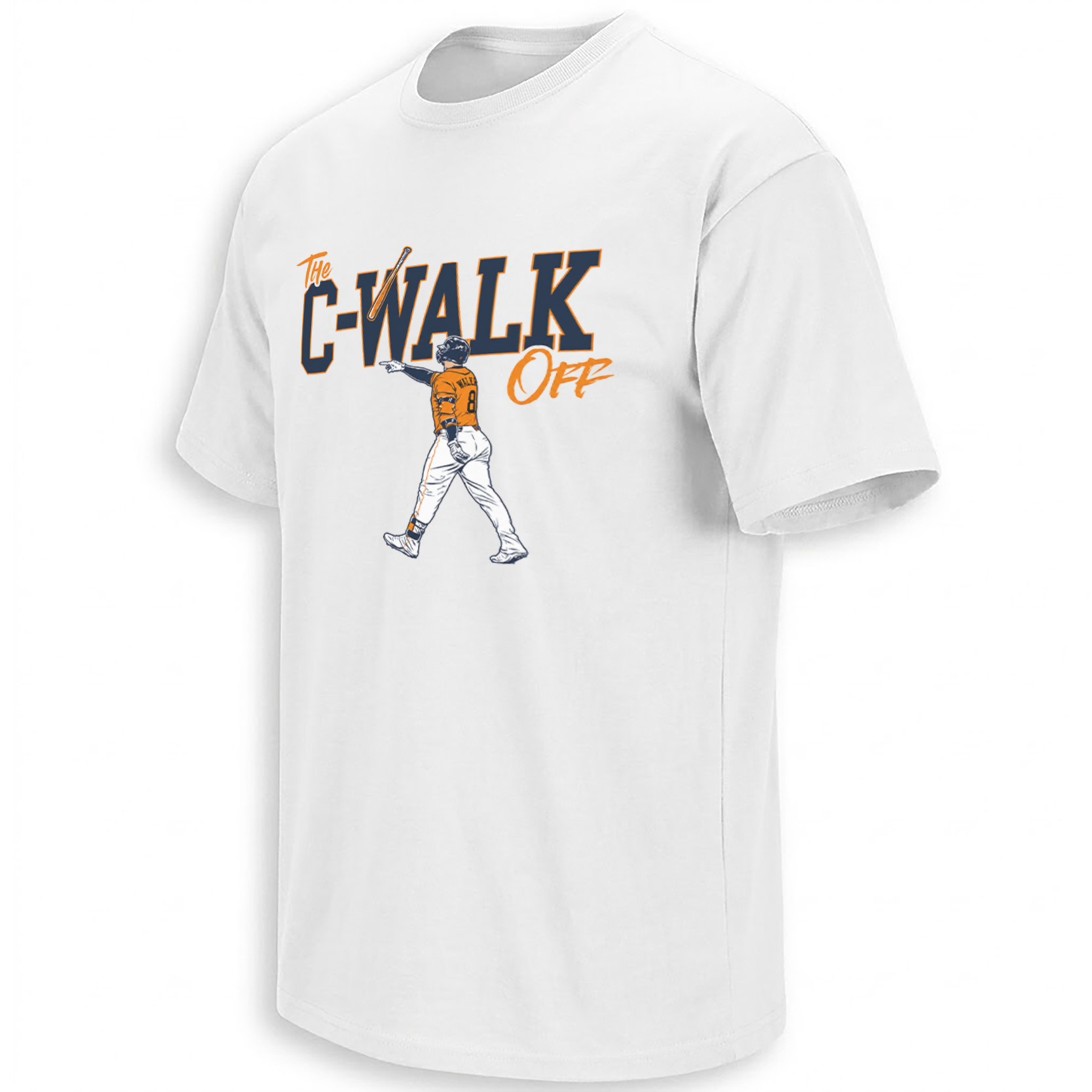
Houston colors are particularly useful for this type of moment because dark navy creates night-game atmosphere while orange reads like stadium fireworks. The graphic therefore does not need literal pyrotechnics covering the entire composition. Color already carries some of the emotional memory.
Walk-off graphics work best when they feel immediate. Strong type, Houston orange and the abbreviated “C Walk-Off” language resemble the kind of phrase a fan might post seconds after the ball disappears.
The Swing Was Walker’s Third Career Walk-Off Homer
The moment also had personal history. MLB identified the homer as Walker’s third career walk-off blast and his second against Seattle. That makes the game feel less like a random night when the right hitter happened to be standing in the box.
Walker had already built his reputation around power and run production. What gave this home run extra weight was Houston’s position in the season. The victory pushed the first-place Astros to a season-high three-game AL West lead over Texas at the time, while sending Seattle six games back.
August baseball changes the emotional meaning of a dramatic win. A walk-off in April can be memorable. A walk-off inside a division race carries standings attached to the celebration.
The Rest of the Inning Is Why Walker’s Celebration Felt So Big
It would be easy to tell the story as Walker versus Muñoz. The better version leaves room for the at-bats that made the matchup possible.
Paredes started the scoring. Altuve kept the inning alive while behind 0–2. Varsho, struggling after arriving from Toronto, swung through two sliders and then adjusted enough to tie the game. Only after all of that did Walker receive the opportunity to end it.
Walker’s own reaction reflected that. Rather than treating the home run as a solo rescue act, he focused attention on the at-bats before his and on the dugout reaction afterward. That is part of what makes the image culturally useful: one player’s swing becomes shorthand for an inning that required an entire lineup to refuse the ending Seattle had prepared.
Houston’s Current Baseball Archive Has a New Ending
Sports apparel becomes most interesting when a phrase can return a viewer to a specific sequence rather than simply identify a team. “The C Walk-Off” now has one: two-run deficit, two-strike survival, game tied, Walker at the plate, fireworks.
The broader Houston Astros collection can function as that season-long visual archive, while the wider MLB collection places Walker’s finish beside the other player moments changing the 2026 pennant race.
Readers searching specifically for the first baseman can also browse Christian Walker designs on Ellie Shirt .
Why Walk-Offs Become Memory Faster Than Ordinary Wins
Most baseball victories gradually become final. A team builds a lead, protects it and eventually watches the last out arrive. Walk-offs reverse the rhythm. The audience moves from uncertainty to certainty in one swing.
That suddenness is why the images become durable: the hitter watching the flight, the first step toward first base, the dugout crossing the foul line, teammates waiting at home plate.
Christian Walker’s August 14 homer arrived with all of those ingredients plus a division-race context and a five-run inning that should not have happened against that closer. “The C Walk-Off” works because the phrase preserves the final punctuation without pretending Walker was the only sentence.
Frequently Asked Questions
When did Christian Walker hit the 2026 walk-off homer against Seattle?
Walker hit the three-run walk-off home run on August 14, 2026, in the bottom of the 10th inning at Daikin Park in Houston.
What was the final score of Astros vs. Mariners?
Houston won 10–7 after scoring five runs in the bottom of the 10th inning.
How far did Christian Walker’s walk-off home run travel?
Statcast projected the homer at 405 feet with an exit velocity of 108.2 mph.
How many career walk-off home runs does Christian Walker have?
The August 14 homer was Walker’s third career walk-off home run and his second walk-off homer against Seattle.
What does “The C Walk-Off” design reference?
The phrase connects Christian Walker’s name with the walk-off finish, preserving the Houston comeback as a compact piece of fan language.
The C Walk-Off graphic preserves Walker’s final swing, while the broader Houston Astros archive follows the other moments shaping the club’s 2026 run.
The C Walk-Off Shirt captures Christian Walker’s three-run, 405-foot homer that finished Houston’s wild five-run 10th against Seattle on August 14, 2026 and turned an AL West thriller into an instant Astros memory.