
Why Charlie Kirk Became Charlie Brown: Inside the Viral Kirkification Meme
A yellow zigzag shirt, a familiar round-headed comic silhouette and one politically recognizable face create “Charlie Kirk Brown”—a remarkably quiet graphic produced by one of the internet’s loudest and strangest meme cycles.
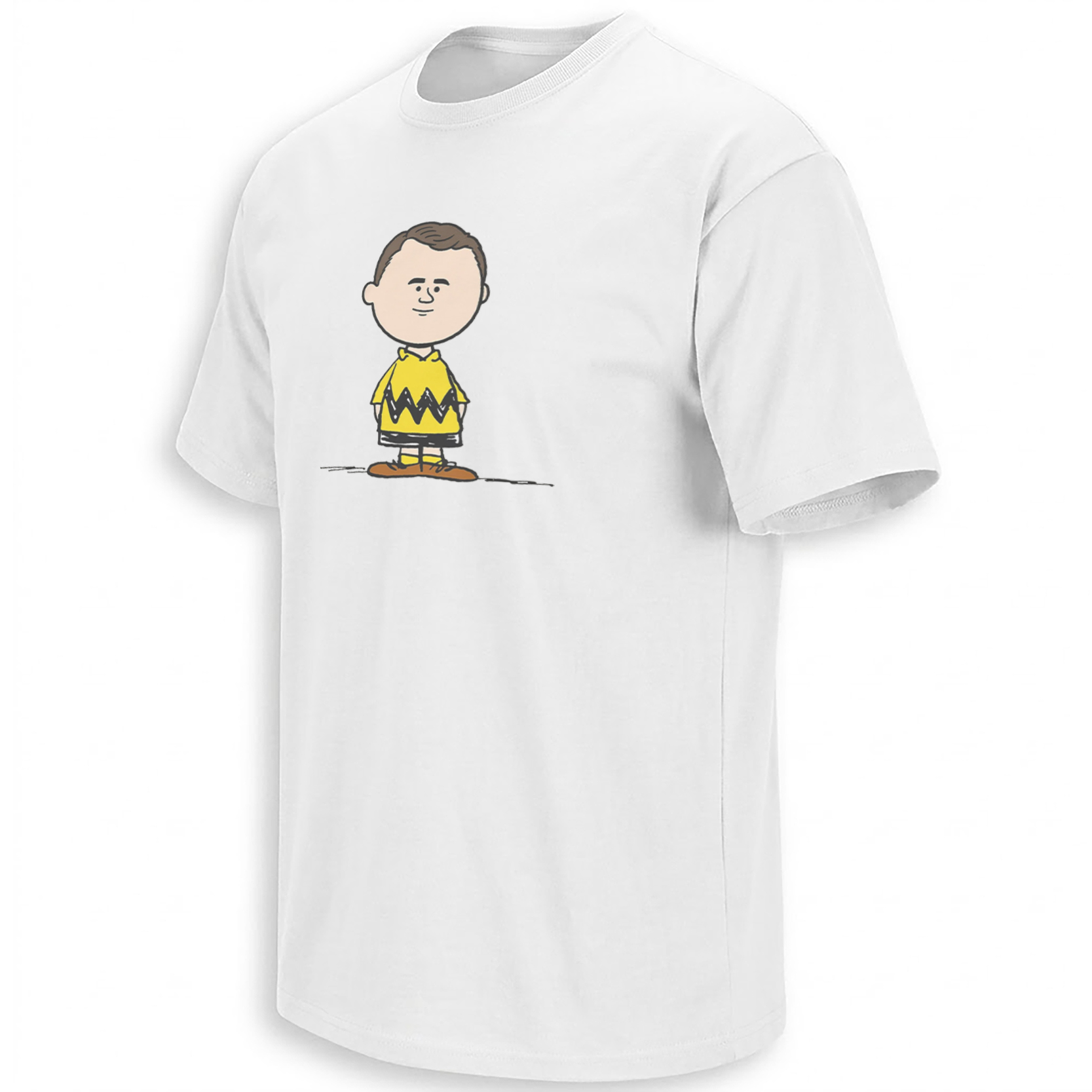
The joke does not require a caption. A small cartoon figure stands alone in the recognizable yellow shirt with its black zigzag stripe, black shorts and brown shoes. But the head no longer belongs to the anxious child culturally associated with that silhouette. It has been “Kirkified.”
That single substitution is the complete mechanism. “Charlie Brown” becomes “Charlie Kirk Brown,” while the calm, almost empty presentation allows the viewer to discover the alteration without being instructed where to look.
It is a compact example of how contemporary meme culture works: find an image almost everyone already knows, change one piece of its identity and allow recognition to do the rest.
Kirkification does not create an entirely new picture. It inserts one face into a memory the audience already carries.
What does “Kirkified” actually mean?
Kirkification is the practice of digitally replacing or reshaping a person’s face so that it resembles conservative activist Charlie Kirk. The edits spread across social platforms after Kirk’s death in September 2025, placing his features onto celebrities, historical paintings, movie characters and older reaction images.
The format became unusually durable because it was not tied to one caption or one source photograph. Almost any existing image could be absorbed into the trend. The Mona Lisa could be Kirkified. A movie poster could be Kirkified. A cartoon character could be Kirkified.
By July 2026, major cultural reporting had begun treating the phenomenon as more than a passing face-swap joke. The meme had become part of Kirk’s uncontrolled online afterlife—a mixture of political mockery, generative-AI experimentation, dark humor and deliberately meaningless repetition.
Why Charlie Brown creates the perfect linguistic collision
Many Kirkified edits depend entirely on visual surprise. Charlie Kirk Brown adds a verbal joke that survives even when the image is described aloud.
The two names already share “Charlie.” Replacing “Brown” with “Kirk” would be the obvious move, but the meme keeps all three parts. The deliberately awkward result—Charlie Kirk Brown—sounds like two public identities have collided without either one fully disappearing.
That awkwardness matters. Internet language often becomes memorable precisely because it feels slightly incorrect. A phrase that would be cleaned up by a traditional copy editor can become stronger as a meme when its seams remain visible.
The artwork understands the power of restraint
The Charlie Kirk Brown Shirt avoids adding reaction text, political slogans or an explanatory title. The central figure is small, surrounded by generous blank space and grounded by a single hand-drawn horizontal line.
The yellow top, black zigzag, shorts and brown shoes preserve the visual rhythm of the original comic-strip child. The substituted head uses Kirk’s swept brown hair and simplified facial structure, but it remains drawn in the same gentle line-art language as the body.
White, sand and sport grey change the temperature of the joke
These backgrounds emphasize the clean comic-strip presentation. The illustration feels like a panel removed from a newspaper and placed directly onto fabric.
The warmer neutral gives the graphic an aged-paper quality, strengthening the tension between nostalgic cartoon language and a current internet meme.
Is Kirkification political satire or simply absurdism?
It can be both, and that ambiguity is central to the trend. Charlie Kirk built his public profile through political confrontation, campus debates and highly shareable video clips. After his death, supporters attempted to stabilize his image through tribute and memorial language.
The internet moved in the opposite direction. Kirkification made his likeness transferable and uncontrollable. Every new face swap weakened the possibility that one organization or political community could determine how the image should be interpreted.
Some users employ the format as explicit ridicule. Others repeat it because recognizing a Kirkified face in an impossible location has become its own reflexive joke. The meme can carry political hostility, generational irreverence and visual nonsense at the same time.
The artwork combines recognizable comic-strip and political-meme language as fan-made parody. It should not be interpreted as an official collaboration with a comic publisher, Charlie Kirk’s estate or Turning Point USA.
Why this version acts as a timestamp of 2026 internet culture
Without knowledge of Kirkification, the image looks like a slightly unfamiliar cartoon character. With that context, it becomes immediately attached to the months following one of the most contentious political killings of 2025.
The design also records the growing role of accessible face-swapping and generative tools. Meme-makers no longer need to wait for a skilled Photoshop edit or an existing reaction photograph. A recognizable identity can be pushed through hundreds of cultural templates within hours.
That speed produces an unusual kind of folk archive: repetitive, frequently tasteless, politically unstable and nearly impossible for its original subject to control. Charlie Kirk Brown preserves one of the quieter entries in that archive.
The design joins Ellie Shirt’s newest cultural and internet releases, where a product can function as a timestamp for a meme before the feed moves on to its next transformation.
Frequently Asked Questions
What does Kirkification mean?
Kirkification is an internet meme format in which a face, character or existing image is digitally altered to resemble Charlie Kirk.
Who is Charlie Kirk Brown?
Charlie Kirk Brown is a parody combination of Charlie Kirk and the familiar Charlie Brown comic-strip character.
Why does the design have no slogan?
The visual and verbal recognition provides the joke. Keeping the composition empty allows viewers to notice the altered face for themselves.
Why did Kirkified memes become popular?
The format is easy to reproduce across countless existing images and allows political satire, dark humor and visual absurdity to overlap.
Is Charlie Kirk Brown an official comic character?
No. It is a fan-created parody produced from the broader Kirkification meme trend.
The complete Charlie Kirk Brown design captures the moment an endlessly repeated political face swap entered one of America’s most recognizable cartoon silhouettes.
Charlie Kirk Brown places a Kirkified face inside a familiar yellow-zigzag cartoon silhouette. The minimalist crossover captures the absurd, politically unstable meme culture that surrounded Kirk’s online image in 2026.