NOT 1 LIE TOLD Ryan Clark, Aaron Rodgers and the Steelers Controversy
Four words from a former Pittsburgh safety became a defining response to Aaron Rodgers’ public criticism of Mike McCarthy. Behind the statement lies a complicated story about football leadership, loyalty and the emotional identity of the Steelers.
Aaron Rodgers spent a substantial portion of his November 25 appearance on The Pat McAfee Show explaining his disagreement with Pittsburgh Steelers head coach Mike McCarthy. Former Steelers safety Ryan Clark needed only a few words to express his reaction.
Posting on X that Wednesday, Clark responded to Rodgers’ account with the phrase “Not 1 lie told.” His statement immediately became part of the wider discussion surrounding the quarterback’s departure from Pittsburgh.
The timing made Clark’s response particularly significant. Rodgers had been benched ahead of Pittsburgh’s Black Friday game against Denver. His subsequent public interview introduced allegations about McCarthy’s preparation and relationships within the organization. The Steelers released Rodgers later that day.
For followers of the Pittsburgh Steelers and the wider NFL fan community , the story became a conversation about more than the starting quarterback position. It raised questions about leadership, organizational standards and how former players understand the franchise’s identity.

Rodgers photographed during the Steelers’ October 18, 2026 game against Tampa Bay, approximately five weeks before his departure from Pittsburgh.
Photograph by ANTbook365, published on Wikimedia Commons under the CC0 1.0 public-domain dedication . This archival image does not depict the November 25 interview.
What Did Ryan Clark Say About Aaron Rodgers?
Clark’s response appeared on November 25, shortly after Rodgers discussed his experiences with McCarthy on The Pat McAfee Show. His post indicated that the account was consistent with information Clark had heard.
The statement was subsequently reproduced by several football publications, including Steelers Now and Pro Football Network .
Its appeal as a piece of internet language came from its simplicity. A lengthy interview involving numerous complaints and complicated football relationships had acquired an immediately recognizable response.
Importantly, Clark’s statement represents his assessment of the account. It should not be treated as an independent investigation establishing every allegation made during Rodgers’ interview.
Why Aaron Rodgers’ Pat McAfee Interview Became Such a Major NFL Story
Rodgers’ public appearance followed news that Pittsburgh would change quarterbacks ahead of its game against the Denver Broncos. Instead of limiting his comments to the benching, Rodgers discussed his broader disagreements with the coaching staff.
His account included allegations concerning McCarthy’s participation in meetings, preparation and communication with players on the defensive side of the roster. He also described the now widely reported halftime incident involving the Packers name.
Reuters’ November 25 reporting confirmed that Pittsburgh released Rodgers following his interview. The quarterback’s departure brought an unexpectedly abrupt conclusion to his reunion with McCarthy.
What Has Actually Been Confirmed About the Steelers Controversy?
The volume of discussion surrounding the interview makes it especially important to distinguish established developments from attributed allegations and individual opinions.
The Steelers released the veteran quarterback on November 25 following his public criticism of McCarthy.
Rodgers made several allegations about preparation, meetings and communication within the Steelers organization. These remain attributed claims unless separately established.
Reporting on November 26 indicated that multiple NFL sources supported several aspects of Rodgers’ account. This does not establish every allegation made during the interview.
Clark’s social media statement expressed his support for Rodgers’ account based on information he indicated he had heard.
In its November 26 follow-up , Reuters reported that multiple sources had corroborated several of Rodgers’ allegations, while the organization intended to retain McCarthy as its head coach.
The resulting picture is more complicated than a short internet slogan can communicate. Pittsburgh had made its quarterback decision, Rodgers had publicly explained his position, and the coach remained responsible for directing the team’s season.
Why Ryan Clark’s Reaction Matters to Pittsburgh Fans
Clark is not simply an outside commentator discussing a football controversy. His career includes eight seasons with the Pittsburgh Steelers, connecting his perspective with the franchise’s previous defensive and championship culture.
His response also carried an interesting media dimension because he had previously criticized Rodgers publicly. His willingness to support the quarterback’s account on this occasion was therefore notable within their established history of football commentary.
Clark’s subsequent comments praised the ability of former Steelers head coach Mike Tomlin to connect with different personalities within the organization. The discussion moved beyond Rodgers’ immediate departure and into a comparison of Pittsburgh’s coaching eras.
Clark emphasized Tomlin’s ability to communicate with players and manage complex locker room relationships. His comments reflected appreciation for the former coach’s leadership.
Rodgers’ departure introduced public questions about communication and organizational direction under McCarthy, while the Steelers remained focused on their ongoing season.
This is one reason the conversation resonated beyond the usual arguments about quarterback performance. Supporters were also considering which characteristics they associated with Pittsburgh football itself.
Readers following those different personalities can explore the Ryan Clark , Aaron Rodgers and Mike Tomlin design searches to discover visual references associated with their football careers and public commentary.
From Green Bay’s Championship Partnership to Pittsburgh’s Fallout
The Rodgers-McCarthy disagreement carried an additional historical dimension because of their previous relationship in Green Bay. They had worked together during a lengthy and championship-winning chapter of Packers football.
Their shared Super Bowl XLV victory came against the Pittsburgh Steelers, giving their later reunion in Pittsburgh an unusual place in NFL history.
That background explains why the November controversy drew attention from supporters beyond Pittsburgh. Followers of the Green Bay Packers were watching two familiar figures publicly navigate the breakdown of a relationship that had once defined an important championship era.
The history between the two individuals does not resolve the competing accounts of their Pittsburgh tenure. It does, however, help explain the unusual cultural weight attached to their public disagreement.
The NOT 1 LIE TOLD Shirt: When a Social Media Reaction Becomes Football Art
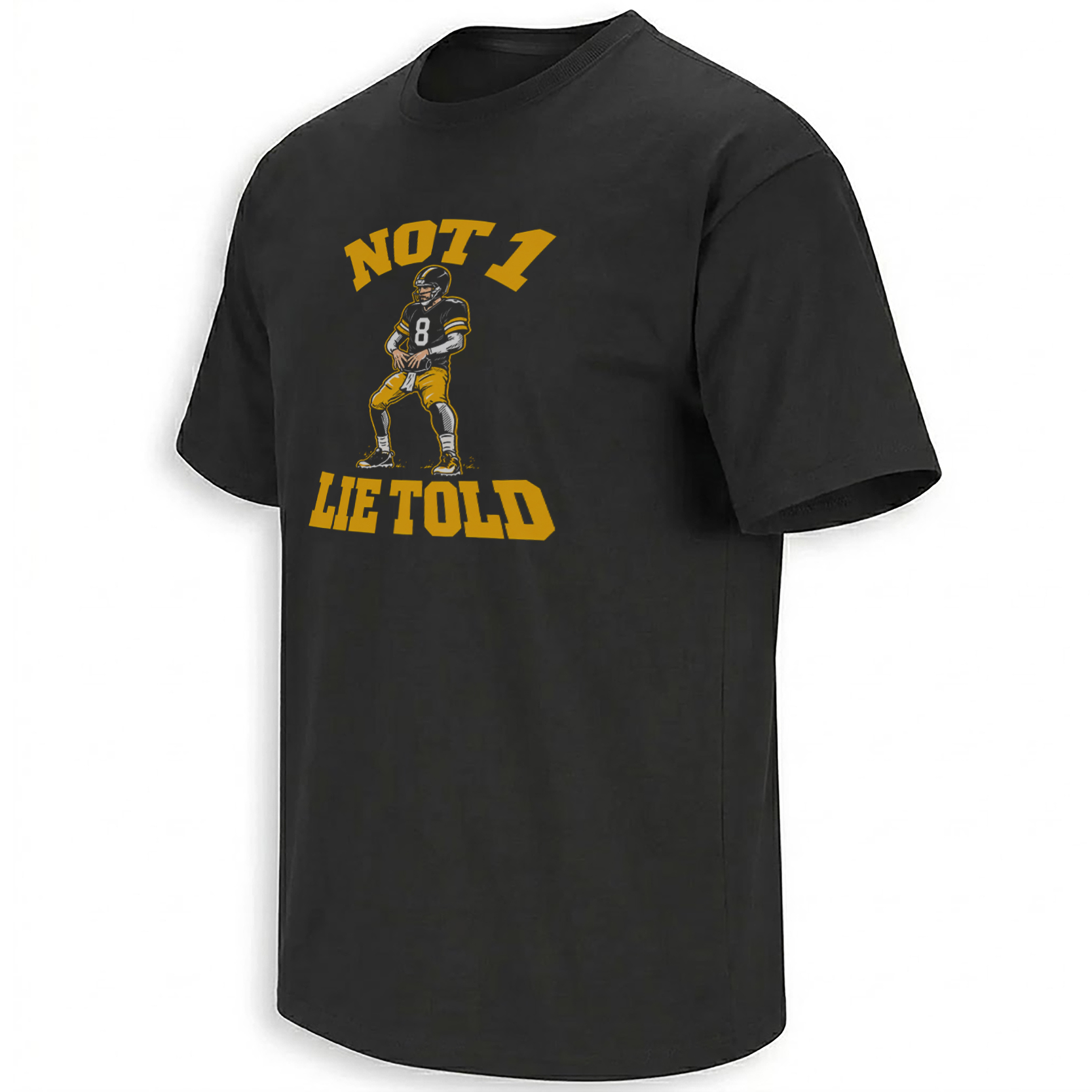
The NOT 1 LIE TOLD graphic translates Clark’s short response into a composition centered on a vintage number 8 quarterback illustration.
Its golden-yellow lettering and dark football palette associate the phrase with Pittsburgh, while the number 8 establishes the Aaron Rodgers connection without requiring a reproduction of the original social media interface.
LIE TOLD
A vintage quarterback illustration and Pittsburgh-inspired football typography preserve Ryan Clark’s recognizable response to the Aaron Rodgers controversy.
Explore the graphic →The artwork is different from a traditional player tribute because its subject is not a particular touchdown, career record or championship achievement. It preserves a statement made by another former NFL player in response to a controversial media appearance.
The portrait establishes the person at the center of the story, while the text preserves the public reaction that followed it.
Why the Number 1 Matters in the Graphic
Social media language frequently compresses expressions into forms that are quicker to recognize and repeat. Clark’s use of the numeral 1 rather than the written word one became a distinctive component of the original statement.
The large athletic lettering gives the short statement the character of a traditional football graphic rather than a conventional social media screenshot.
The jersey number connects the composition with Rodgers’ Pittsburgh identity and distinguishes the subject of the quote from its author.
The familiar football palette establishes the regional and franchise context without relying on a complicated background.
The illustrated quarterback gives a contemporary internet statement the appearance of a collectible graphic from football’s visual archive.
Retaining the numeral 1 helps preserve the exact visual character of Clark’s statement. It is a small typographic decision that connects the graphic with the original November 25 post.
How NFL Fan Culture Turns Commentary Into Collectible Graphics
Football supporters have long used short expressions to preserve moments that matter to their communities. Coaching comments, television interviews and unexpected phrases can become recognizable cultural references.
Social media has accelerated that process. An interview can generate numerous responses within hours, while one especially compact phrase can become a shorthand for the larger conversation.
In this case, the NOT 1 LIE TOLD expression provides an identifiable reference to Clark’s reaction while the quarterback illustration establishes the central personality of the story.
The graphic’s long-term significance does not depend on predicting the outcome of Pittsburgh’s coaching situation. It records how a particular moment was discussed, interpreted and visually remembered during Thanksgiving week in 2026.
Frequently Asked Questions
Who said Not 1 Lie Told about Aaron Rodgers?
Former Pittsburgh Steelers safety Ryan Clark posted the phrase on X on November 25, 2026, in response to Aaron Rodgers’ public criticism of Mike McCarthy.
What does Not 1 Lie Told mean?
The expression communicates Clark’s belief that Rodgers’ account was consistent with information Clark had heard. It represents his assessment rather than independent verification of every allegation.
Did Aaron Rodgers originally say Not 1 Lie Told?
No. The phrase was Ryan Clark’s social media response to Rodgers’ November 25 interview on The Pat McAfee Show.
Why did Aaron Rodgers criticize Mike McCarthy?
Following his benching, Rodgers publicly discussed disagreements with McCarthy concerning coaching, preparation and communication within the Pittsburgh Steelers.
When did the Steelers release Aaron Rodgers?
Pittsburgh released Rodgers on November 25, 2026, after his public criticism of McCarthy.
Why did Ryan Clark mention Mike Tomlin?
Clark used the controversy to discuss Tomlin’s ability to communicate with players and manage different personalities during his previous tenure as Pittsburgh’s head coach.
Why is Aaron Rodgers wearing number 8 in the design?
Number 8 references Rodgers’ Pittsburgh Steelers jersey identity, connecting the illustrated quarterback with the November 2026 controversy.
What does the NOT 1 LIE TOLD Shirt represent?
The artwork documents Ryan Clark’s response to Aaron Rodgers through black-and-gold football colors, vintage quarterback illustration and prominent typography preserving the recognizable statement.
Were all of Aaron Rodgers’ allegations independently confirmed?
Subsequent reporting indicated that multiple sources corroborated several of Rodgers’ allegations. However, that does not establish every claim made during his interview.
- Ryan Clark — Original Not 1 Lie Told social media statement , November 25, 2026.
- Steelers Now — Ryan Clark’s Response and Comments About Mike Tomlin .
- Reuters — Steelers Release Rodgers After Criticism of McCarthy , November 25, 2026.
- Reuters — Subsequent Reporting on the Rodgers Allegations , November 26, 2026.
- Sports Illustrated — NFL Reactions to Aaron Rodgers’ Interview .
- Pro Football Network — Ryan Clark and James Harrison Respond .
- The Pat McAfee Show — November 25, 2026 .
- Wikimedia Commons — Aaron Rodgers with the Steelers, October 18, 2026 . Photograph by ANTbook365, CC0 1.0.
The NOT 1 LIE TOLD graphic preserves Ryan Clark’s recognizable response through Pittsburgh-inspired football illustration. Explore the wider Steelers collection for other visual records of the personalities, phrases and unexpected stories that continue to shape football culture.
The NOT 1 LIE TOLD Shirt captures Ryan Clark’s November 25, 2026 response to Aaron Rodgers’ public criticism of Mike McCarthy through a vintage number 8 quarterback illustration, golden-yellow football typography and Pittsburgh’s black-and-gold visual identity.