Here We Go Packers? How Mike McCarthy’s Halftime Mistake Rewrote Pittsburgh’s Favorite Football Chant
A Steelers fight song that has survived decades of football history suddenly has an unexpected parody, thanks to Aaron Rodgers, Mike McCarthy and one misplaced reference to Green Bay.
Pittsburgh football has a soundtrack. Long before the latest coaching controversy, generations of Steelers supporters knew exactly which team name belonged at the end of their familiar rallying phrase. During Thanksgiving week in 2026, however, one unexpected halftime story made that tradition available for an entirely different kind of performance.
On November 25, Aaron Rodgers appeared on The Pat McAfee Show and described an incident involving Pittsburgh head coach Mike McCarthy. During the Steelers’ 19–16 defeat to the Philadelphia Eagles three days earlier, McCarthy had ended a halftime huddle by saying the name of his former team, the Green Bay Packers.
The coach subsequently acknowledged the embarrassing episode. What followed was an unusually fertile opportunity for football satire: if the wrong team name could enter Pittsburgh’s halftime huddle, what would happen if it entered the city’s famous fight song?
The resulting “Here We Go Packers?” graphic belongs to the intersection of Pittsburgh Steelers culture , Green Bay Packers history and the wider NFL meme community . Its humor depends on understanding Pittsburgh’s traditions before understanding the controversy.

Here We Go: The Sound of Pittsburgh Football
Local football traditions rarely begin with a marketing department. They develop through repetition: radio broadcasts, family gatherings, tailgates, neighborhood celebrations and the songs that return whenever a season acquires postseason significance.
Roger Wood’s Steelers fight song, originally written in 1994, became one of those recurring Pittsburgh traditions. Over the years, updated versions have reflected changing rosters and renewed championship ambitions while preserving the recognizable rallying expression at the center of the song.
Roger Wood introduced a football anthem that would continue to evolve with Pittsburgh’s postseason generations. CBS Pittsburgh documented its history and recurring updates.
The tradition remained active in 2026. In January, the Pittsburgh Post-Gazette covered Wood’s latest revision ahead of the Steelers’ playoff appearance.
That history explains why the parody has a distinctly local character. The phrase “Here We Go” is not an arbitrary introduction to a football joke. It is recognizable language from Pittsburgh’s established supporter culture.
Why Mike McCarthy’s Packers Chant Changed the Joke
The actual halftime controversy concerned a three-count followed by the Packers name. It did not involve McCarthy singing Roger Wood’s fight song or saying the complete phrase “Here We Go Packers?”
That distinction is essential to understanding the artwork. The design is a creative extension of the reported incident, connecting the misplaced Packers reference with a different Pittsburgh football ritual.
According to Reuters’ November 25 reporting , Pittsburgh released Rodgers following his public criticism of McCarthy. The two had previously shared thirteen seasons in Green Bay and a championship-winning partnership.
Their Super Bowl XLV victory came against Pittsburgh. That historical connection makes the return of Green Bay language especially recognizable to supporters of both franchises.
For readers following the broader stories surrounding Mike McCarthy and Aaron Rodgers , the fight song parody is one of several ways football culture has interpreted their public split.
From the Halftime Huddle to AFC North Meme Culture
The simplest rivalry jokes tend to travel well because they do not require a complicated explanation. A three-count and an unexpected team name can summarize a much larger football controversy.
On Reddit, members of the AFC North Meme War community were already discussing the possibility of adding “Packers on 3” to their community flair. The discussion demonstrates how a phrase can move from a specific news event into an ongoing vocabulary of divisional rivalry.
The “Here We Go Packers?” interpretation goes one step further than simply repeating the reported words. It asks the audience to imagine another familiar Pittsburgh tradition experiencing the same verbal mix-up.
For rival supporters, the phrase can function as a joke about Pittsburgh’s difficult week. For Steelers supporters, it can become a piece of self-deprecating humor. For Green Bay fans, it recalls McCarthy’s long association with their franchise.
The Here We Go Packers? Shirt and the Art of the Wrong Chorus
The visual treatment deliberately avoids making the story more complicated. There is no need for a portrait of McCarthy, an illustrated locker room or an elaborate scene involving Rodgers.
Instead, the design borrows the visual authority of traditional black-and-gold football lettering and places the unexpected Packers reference directly beneath it.
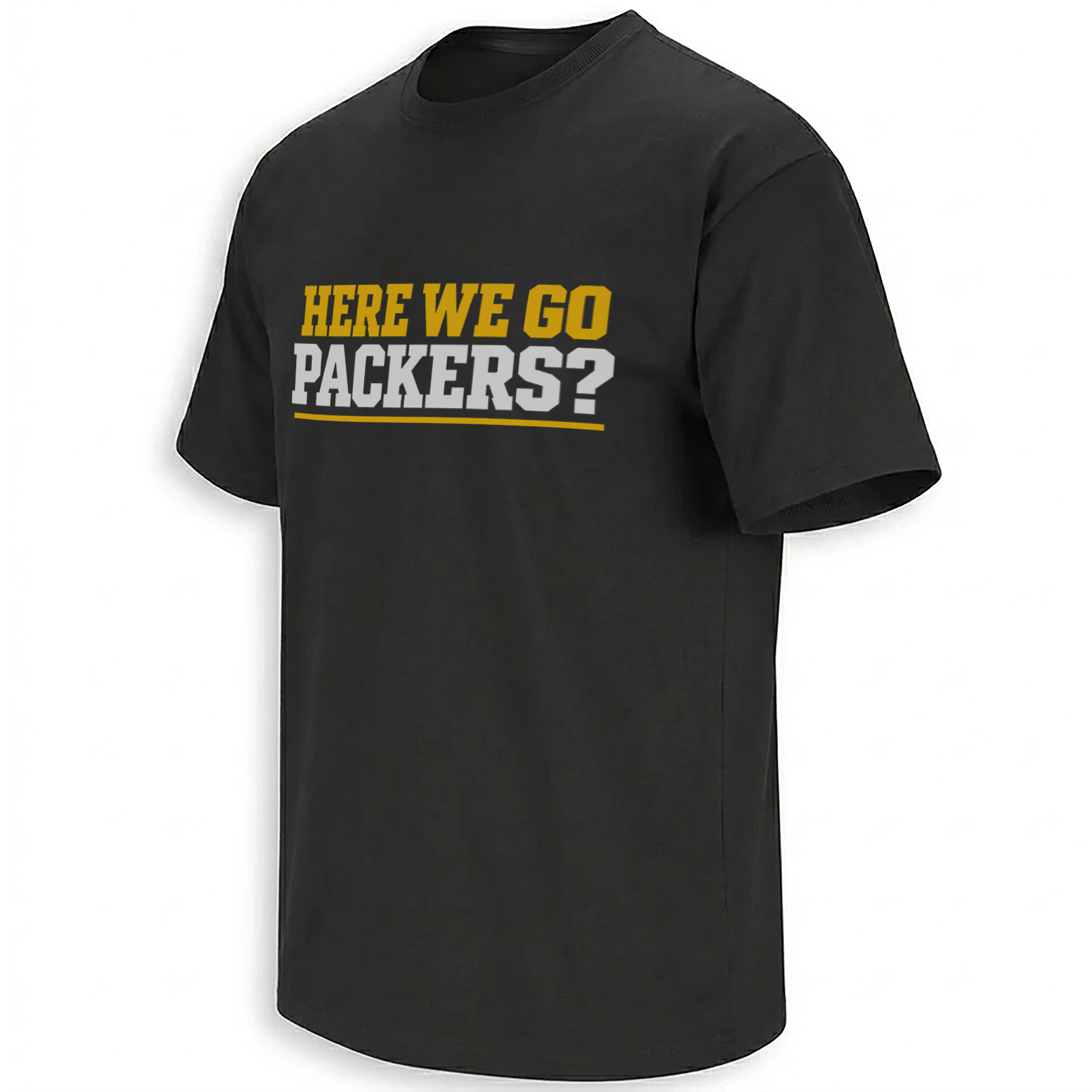
Pittsburgh’s recognizable rallying expression meets Green Bay’s unexpected name in a two-line typographic parody. The question mark supplies the final note of disbelief.
Explore the graphic →How Typography Delivers the Entire Punchline
The graphic works through three carefully organized visual elements: the familiar opening phrase, the unexpected franchise name and a single piece of punctuation.
Black provides the visual foundation, while gold supplies the familiar Pittsburgh character. The white lettering creates enough contrast for the altered team name to be understood immediately.
A thin gold underline completes the arrangement without introducing unnecessary decorative elements. The artwork does not need an official team logo because the relationship between the phrase and the palette already establishes the cultural context.
In design terms, the audience encounters recognition first and contradiction second. That small delay is where the humor lives.
When Football Tradition Becomes Self-Deprecating Humor
Pittsburgh’s established football identity is precisely what makes this parody possible. Without decades of black-and-gold tradition and the familiarity of the rallying expression, the altered phrase would carry far less meaning.
The graphic consequently preserves two different cultural moments. It refers to the events of November 2026, but it also depends on a supporter tradition that predates those events by more than thirty years.
The result belongs to a familiar category of football humor: the ability of supporters to turn an uncomfortable chapter of their team’s history into a phrase they can repeat on their own terms.
Frequently Asked Questions
What does Here We Go Packers mean?
Here We Go Packers? is a creative football parody combining Pittsburgh’s traditional Here We Go rallying phrase with Mike McCarthy’s reported Packers halftime chant in November 2026.
Did Mike McCarthy actually say Here We Go Packers?
No. The reported halftime chant was 1-2-3 Packers. Here We Go Packers? is an independent satirical adaptation rather than a verified quotation from McCarthy.
Who originally wrote the Steelers Here We Go fight song?
Roger Wood wrote the original Steelers fight song in 1994 and has produced updated versions over the years.
Why is the Here We Go Packers design black and gold?
Black and gold establish Pittsburgh’s football identity, making the unexpected Packers name a deliberate visual contradiction.
What does the question mark mean on the Packers parody shirt?
The question mark expresses confusion and disbelief. It distinguishes the parody from a straightforward Green Bay supporter slogan.
When did the Mike McCarthy halftime incident become public?
Aaron Rodgers discussed the November 22 halftime incident on The Pat McAfee Show on November 25, 2026.
- CBS Pittsburgh — History of Roger Wood’s Steelers fight song .
- Pittsburgh Post-Gazette — The 2026 fight song update .
- Reuters — Aaron Rodgers’ release following his criticism of Mike McCarthy .
- NBC Sports — McCarthy acknowledges the Packers halftime chant .
- Reddit — AFC North Meme War community discussion .
The Here We Go Packers? design records the joke through familiar football typography rather than an elaborate caricature. The wider Pittsburgh Steelers collection follows the slogans, traditions and unexpected moments that continue to shape black-and-gold fan culture.
The Here We Go Packers? Shirt combines Pittsburgh’s historic rallying phrase with Mike McCarthy’s November 2026 halftime chant through gold-and-white athletic lettering, a black football palette and a question mark that completes the satire.