1-2-3 Packers: Mike McCarthy’s Halftime Slip Becomes a Steelers Meme
Aaron Rodgers exposed an unexpected locker room moment. Mike McCarthy acknowledged it. Now Pittsburgh’s black and gold has collided with Green Bay’s football identity in one of the most unusual NFL memes of Thanksgiving week.
NOV 22
WEEK 11
Pittsburgh lost a football game in Philadelphia on November 22. Three days later, the defeat acquired an entirely different cultural identity: a three-count, the wrong team name, and a head coach whose previous football life suddenly became part of his current team’s public drama.
Speaking on The Pat McAfee Show on November 25, Aaron Rodgers recalled Pittsburgh head coach Mike McCarthy ending a halftime huddle during the Steelers’ 19–16 loss to the Philadelphia Eagles with the words “1-2-3 Packers.” McCarthy subsequently addressed the incident while speaking to reporters, describing the situation as embarrassing.
The story emerged amid a much larger rupture between Rodgers and McCarthy, culminating in Pittsburgh releasing its veteran quarterback. Yet the misplaced Packers chant was the detail that could travel most easily beyond a discussion about football operations. It was short enough for a meme, recognizable enough for a rivalry joke, and uncomfortable enough to capture the mood surrounding the Steelers.
Across the wider NFL fan culture , the episode has brought two instantly recognizable football identities into an unlikely conversation: the Pittsburgh Steelers and the Green Bay Packers . For once, the crossover was not created by an on-field rivalry or a player trade. It began with a reportedly misplaced word.

What Happened During the Steelers’ Halftime Huddle?
The chant did not occur during a game against Green Bay. Pittsburgh was playing Philadelphia, which makes the reference to the Packers particularly conspicuous. Rodgers’ account placed the incident inside the Steelers’ halftime gathering, where the team was supposed to be regrouping for the second half.
The story became public the following Wednesday. Rodgers discussed the incident during an extended interview that also addressed his disagreements with the coaching staff and the circumstances surrounding his benching. NBC Sports’ Pro Football Talk subsequently reported McCarthy’s acknowledgment of the chant.
Pittsburgh loses 19–16 to the Eagles. The halftime huddle becomes the setting for the Packers chant.
Pittsburgh moves toward Mason Rudolph as its starting quarterback, benching Rodgers.
The Pat McAfee Show interview brings the halftime story into the public conversation.
The Steelers coach addresses reporters and acknowledges the embarrassing episode as Pittsburgh moves forward without Rodgers.
Why Saying “Packers” Carries So Much History
McCarthy’s connection to Green Bay is hardly incidental. He coached the Packers from 2006 through 2018, and his partnership with Rodgers produced a Super Bowl XLV championship. Their victory in that game came against, of all teams, the Pittsburgh Steelers.
That historical detail gives the current meme an additional layer. Two figures associated with one of Green Bay’s defining championship eras reunited in Pittsburgh, only for their shared Packers history to resurface during a public disagreement in 2026.
McCarthy’s official Steelers coaching biography places those thirteen seasons in Green Bay at the center of his NFL head-coaching experience. The Packers reference consequently carries years of accumulated football history rather than functioning as a random team name.
For fans following Mike McCarthy-related graphics and Aaron Rodgers fan culture , the episode represents an unusually compact collision of two careers, two franchises and a complicated coaching partnership.
Mike McCarthy’s Response to Aaron Rodgers
McCarthy addressed reporters at the UPMC Rooney Sports Complex on November 25. His response acknowledged the halftime episode while also presenting a different perspective on the broader disagreement with Rodgers.
Pittsburgh’s official reporting confirmed that Rodgers had been released and that Mason Rudolph would take over ahead of the Denver Broncos game. McCarthy emphasized the need to redirect attention toward football and the team’s remaining season.
That distinction matters. The Packers chant is an acknowledged incident, but the wider accusations made during the interview should not automatically be treated as independently established facts. Nor does the incident establish why McCarthy said the wrong team name.
How “Packers on 3” Became NFL Meme Language
Football huddles have their own familiar rhythm. Players gather, someone delivers a message, and the group breaks on a shared count. The team name at the end is supposed to reinforce collective identity.
Replace that name with another franchise and the entire ritual becomes a joke. The humor is built into the structure of the phrase: a recognizable countdown followed by a word that belongs somewhere else.
On Reddit, a Steelers community discussion was already considering the chant’s potential longevity as a meme. Meanwhile, AFC North Meme War users requested community flair incorporating the phrase. The joke was becoming a reusable part of divisional fan language.
Steelers supporters can use the expression as self-deprecating humor. Packers supporters can recognize the familiar name in an unfamiliar environment. Rival AFC North fans can deploy it as a punchline without explaining the entire Rodgers-McCarthy dispute.
Those different uses explain why the phrase works as a meme beyond the original interview. Its meaning changes depending on the fan wearing it, repeating it or posting it.
Black and Gold Meets Green and Gold
Industrial football heritage, hard-edged sports typography and a strong visual association with Pittsburgh.
A historic franchise identity, championship memory and the coaching era referenced by the misplaced chant.
Both teams share gold as a familiar component of their visual language. Black and dark green, however, place that gold inside two very different football cultures.
That visual relationship makes the “1-2-3 Packers” meme particularly suitable for graphic interpretation. A Pittsburgh-inspired composition can carry Green Bay’s name without losing its black-and-gold identity. The contradiction becomes the central design idea.
Jersey typography adds another dimension. Large athletic numerals normally identify an individual player. Here, the sequence 123 functions as a verbal reference rather than a genuine player number. It turns the countdown into an instantly recognizable graphic device.
Four Designs Inspired by the 1-2-3 Packers Meme
Ellie Shirt’s four interpretations approach the halftime story through different visual treatments. Rather than attempting to reproduce an undocumented locker room scene, the series preserves the phrase, the football aesthetic and the collision between the two franchise identities.
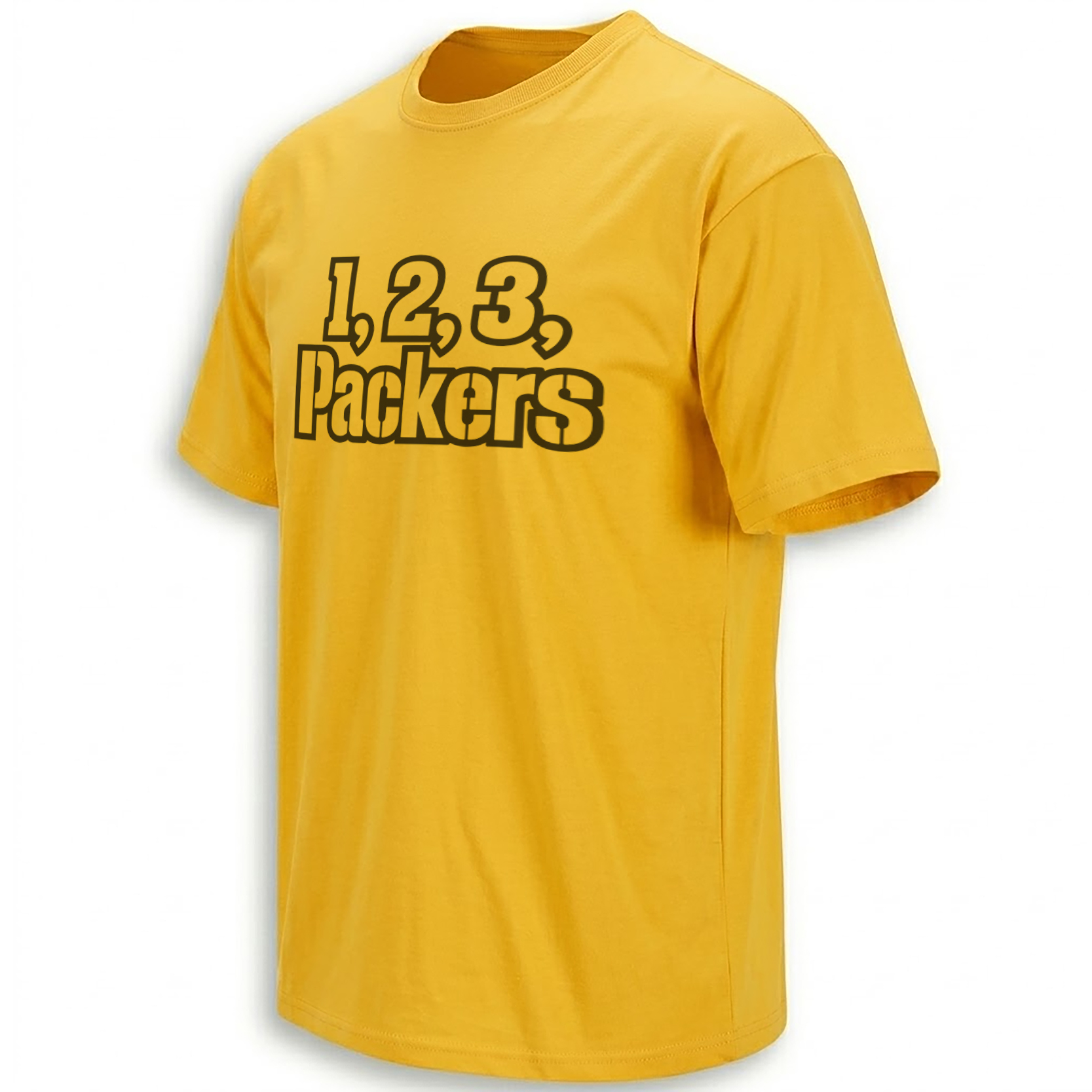
The central phrase becomes a standalone football joke, preserving the countdown that defined the November 25 conversation.
Explore the chant graphic →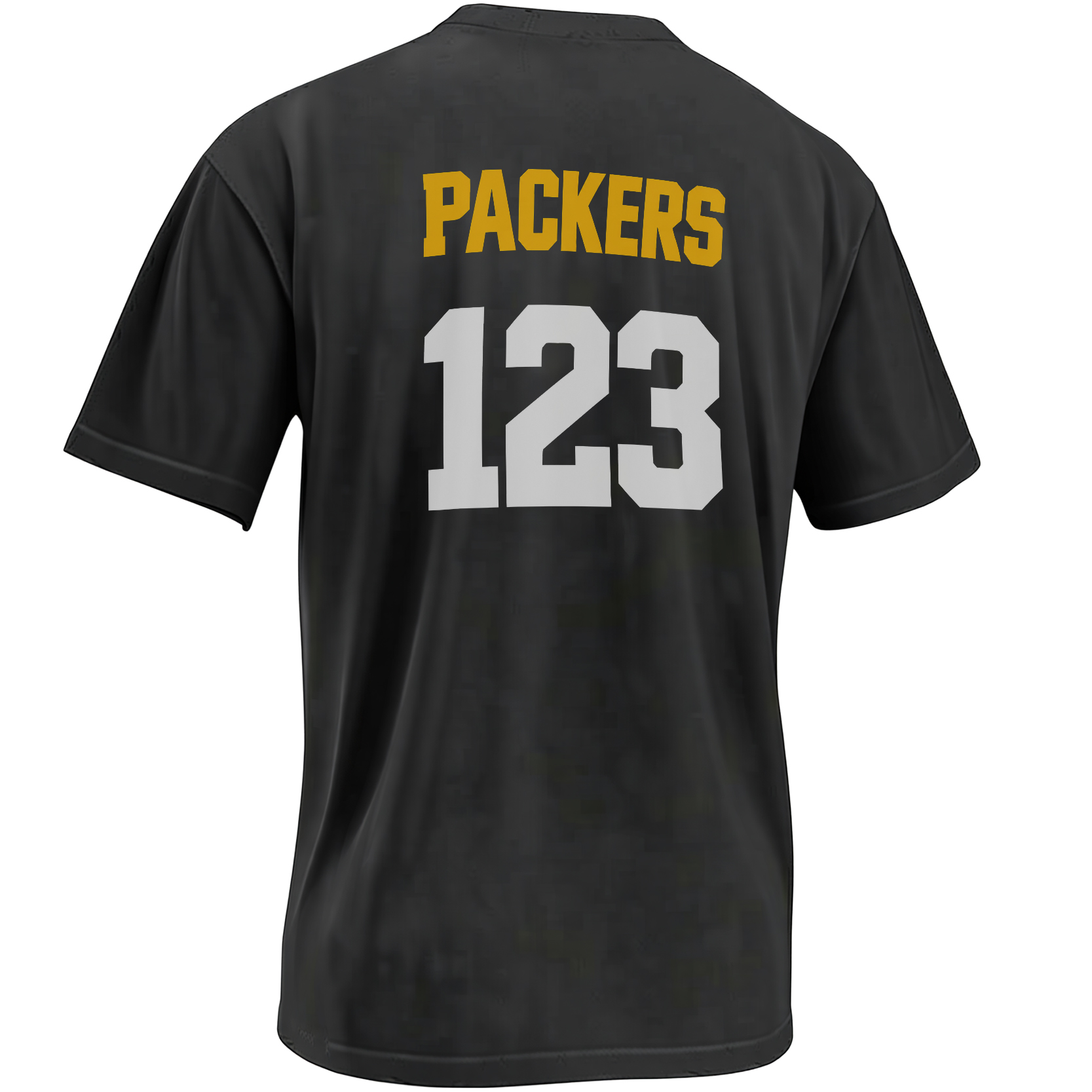
The three-count takes the visual role of a jersey number, transforming familiar football apparel language into satire.
View the jersey interpretation →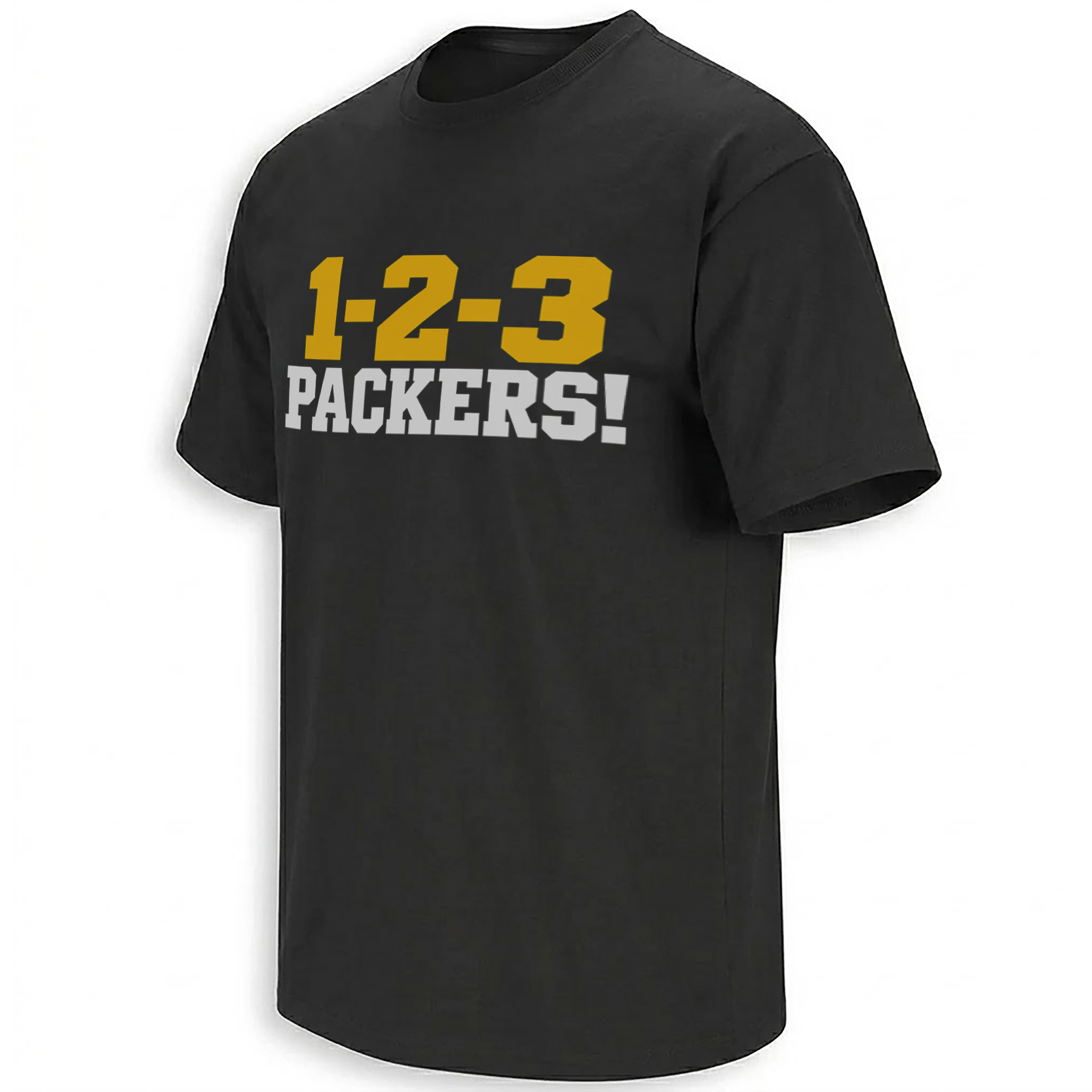
Pittsburgh’s familiar palette emphasizes the visual contradiction at the center of the original halftime story.
See the black-and-gold edition →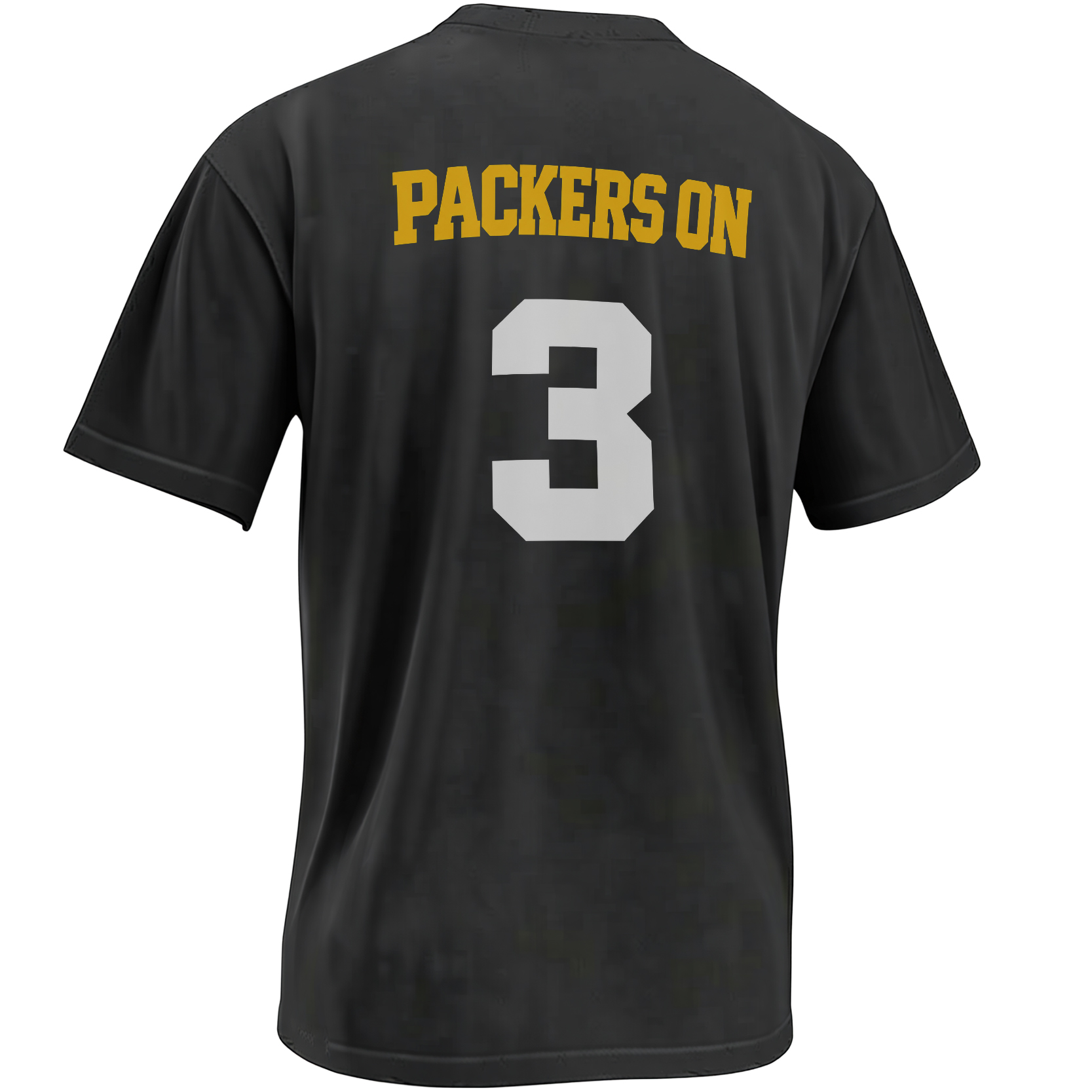
A familiar football huddle instruction becomes a compact piece of internet language associated with the controversy.
Explore Packers on 3 →Why the Number 123 Works as a Football Graphic
The most effective visual jokes often require very little explanation. In this case, the number 123 provides the entire setup before the reader even reaches the team name.
Athletic block lettering gives the phrase the authority of ordinary football merchandise. The joke emerges when that conventional visual structure delivers an unconventional message.
The jersey-inspired versions are especially interesting because they resemble the familiar relationship between a name and number, but their purpose is different. Instead of representing an athlete’s roster identity, they document a moment in fan discourse.
The black-and-gold treatment keeps that moment grounded in Pittsburgh. The Packers reference supplies the contradiction, while the football typography connects the joke to the huddle where it originated.
The Steelers’ Thanksgiving Week Has a New Punchline
Pittsburgh entered Thanksgiving week with a 6–4 record and a significant game against Denver approaching. The coaching controversy therefore arrived at a moment when the team still had meaningful football objectives.
That combination of competitive pressure and public embarrassment gives the meme a different texture from an ordinary celebration graphic. It captures the experience of following a team when its off-field story briefly overwhelms its on-field narrative.
Sports humor has always provided fans with a vocabulary for disappointment. Sometimes that vocabulary is a nickname. Sometimes it is an awkward press conference. In this case, it is a countdown and a franchise name that appeared in the wrong football environment.
The Steelers collection and Packers collection represent two established fan identities. The “Packers on 3” graphic series occupies the unusual space between them, recording the moment those identities became part of the same internet joke.
Frequently Asked Questions
Did Mike McCarthy really say 1-2-3 Packers?
Yes. Aaron Rodgers revealed the halftime chant on November 25, 2026, and McCarthy subsequently acknowledged the embarrassing incident when addressing reporters.
When did the 1-2-3 Packers incident happen?
The incident occurred at halftime of the Pittsburgh Steelers’ 19–16 loss to the Philadelphia Eagles on November 22, 2026. It became public three days later.
Where did Aaron Rodgers reveal the Packers chant?
Rodgers discussed the incident during his November 25, 2026 appearance on The Pat McAfee Show.
Why is the Packers reference significant for Mike McCarthy?
McCarthy coached Green Bay from 2006 through 2018 and won Super Bowl XLV with Aaron Rodgers, defeating the Pittsburgh Steelers in that championship game.
What does Packers on 3 mean?
Packers on 3 is a meme-friendly variation of the halftime chant associated with Mike McCarthy. It adapts the familiar football huddle countdown into a joke about the Steelers coach referencing his former team.
Why are the 1-2-3 Packers designs black and gold?
Black and gold reference Pittsburgh’s football identity. Combining those colors with the Packers name emphasizes the contradiction that makes the halftime story recognizable as a fan meme.
What does 123 represent on the jersey meme shirt?
The number 123 represents the three-count associated with the halftime chant. It is a graphic reference to the incident, not an actual NFL player jersey number.
Are the Packers on 3 designs official NFL jerseys?
No. The designs are independent fan-culture graphics inspired by the reported halftime incident and subsequent internet discussion. The jersey-style typography functions as a parody design element.
- NBC Sports — McCarthy acknowledges the 1-2-3 Packers halftime incident (November 25, 2026).
- Pittsburgh Steelers — Urgency high for a time to push through (November 25, 2026).
- Sports Illustrated — McCarthy’s response to Aaron Rodgers’ comments .
- The Pat McAfee Show — November 25, 2026 .
- Pittsburgh Steelers — Mike McCarthy coaching biography .
- Reddit — AFC North Meme War, Packers on 3 flair discussion .
- Wikimedia Commons — Rodgers and McCarthy, August 2026 training camp . Cramerwiki, CC0 1.0.
The 1-2-3 Packers graphic and Packers on 3 jersey interpretation preserve the language of a remarkable Thanksgiving-week football controversy. Follow the wider NFL collection for other visual records of the moments, rivalries and unexpected jokes that shape football’s internet culture.
The 1-2-3 Packers and Packers on 3 shirt series captures Mike McCarthy’s November 2026 Steelers halftime chant, revealed by Aaron Rodgers, through black-and-gold football graphics, jersey-inspired typography and AFC North meme culture.