
Electrician’s Pain Scale: The Dark Humor Behind Voltage Jokes
Six familiar voltage references, increasingly absurd reactions and one uncompromising safety reminder. The Electrician’s Pain Scale captures a distinctive form of skilled-trade humor in which the technical language is real, the consequences are fictional and the professional warning is entirely serious.
Every skilled trade develops jokes that sound slightly different to the people who actually do the work. For electricians, a voltage rating can be the beginning of a technical discussion, a familiar reference to industrial equipment or the setup for an exceptionally dark punchline.
In the electrical trade community, jokes comparing unexpected electrical shocks to coffee and other exaggerated experiences have circulated for years. An August 2023 discussion in Reddit’s r/electricians community contains examples of that humor alongside serious accounts of workplace incidents and unsafe practices.
By November 2026, versions of the Electrician’s Pain Scale concept can be found across novelty merchandise, transforming familiar electrical terminology into a fictional infographic. The exact original creator of the complete six-level design remains unverified.
The Electrician’s Pain Scale Shirt, featured within Ellie Shirt’s newest designs, brings those references together through industrial warning graphics, escalating jokes and a final instruction that separates occupational comedy from actual electrical work.
The voltage-based reactions printed on the artwork are fictional jokes. No voltage should be interpreted as safe to touch based on this graphic. Electrical injuries can be severe or fatal. This novelty apparel is not electrical PPE, a safety reference chart or a substitute for professional training and required workplace procedures.
Technical File 01 What Is the Electrician’s Pain Scale?
The Electrician’s Pain Scale is a novelty graphic that assigns humorous fictional reactions to several voltage ratings encountered in electrical terminology.
The featured design references 12V, 24V, 120V, 208V, 277V and 480V. Rather than providing measured physical effects, it uses increasingly exaggerated language to create the appearance of a technical classification system.
Its central joke comes from presenting absurd descriptions in a format that resembles an industrial reference chart. An audience familiar with electrical systems recognizes the numbers immediately, while the accompanying wording deliberately abandons technical seriousness.
The fictional reactions include references to coffee, apprentices discovering new vocabulary and an exaggerated encounter with one’s ancestors. The humor depends on escalating absurdity, not on the accuracy of the supposed physical experiences.
Similar merchandise designs demonstrate that the joke has several variations. Their circulation does not establish which version came first or whether any particular person originated the complete concept.
Technical File 02 Why Electricians Understand This Kind of Dark Humor
Occupational humor often develops around language, routines and responsibilities shared by people working in the same profession. The technical vocabulary becomes part of the comic setup.
For electrical workers, that vocabulary includes voltage, circuits, testing instruments, troubleshooting and the procedures associated with controlling hazardous energy. Terms that might sound unfamiliar to outsiders can become immediately recognizable material for trade-specific jokes.
The Electrician’s Pain Scale also uses a familiar relationship between experienced tradespeople and apprentices. The apprentice-related line exaggerates the surprise that someone new to the profession might experience when encountering its more demanding responsibilities.
This is best understood as a comic archetype, not an endorsement of exposing apprentices or any other workers to energized equipment.
The punchlines belong on the shirt. The precautions belong on the job.
Technical File 03 The Industrial Warning Sign Behind the Visual Language

This authentic electrical-room warning sign illustrates the bold typography, strong contrast and direct wording associated with industrial safety communication. It is a related visual reference, not the original source of the featured shirt artwork.
Industrial warning signs are designed to communicate important information without unnecessary visual complexity. Large letters, recognizable symbols and contrasting colors help communicate the presence of hazards.
The featured graphic borrows this visual vocabulary through a yellow lightning bolt, condensed uppercase lettering, colored blocks and a striped warning banner.
The contrast between a serious-looking presentation and deliberately absurd descriptions is central to the humor. It makes the artwork resemble an official technical document while the wording reveals its actual purpose as novelty art.
Technical File 04 Why Voltage Alone Cannot Predict Electrical Injury
Unlike the fictional pain scale, real electrical hazards cannot be accurately ranked through voltage labels alone. Electrical injury depends on several interacting factors and can involve electric shock, burns and other serious consequences.
The European Agency for Safety and Health at Work identifies multiple variables affecting electrical exposure, including current path, contact duration, frequency, skin conditions and body impedance.
The current passing through the body is an important determinant of physiological injury.
The route through the body influences which tissues and organs may be affected.
The length of electrical contact can influence the severity of the resulting injury.
Environmental conditions, resistance and other characteristics can alter the nature of exposure.
Electrical safety information from MIT Environmental Health and Safety similarly emphasizes the importance of current and its pathway through the body.
Consequently, the green and red sections in the shirt’s graphic must not be interpreted as real boundaries between safe and dangerous electrical contact.
Technical File 05 How the Electrician’s Pain Scale Artwork Is Constructed
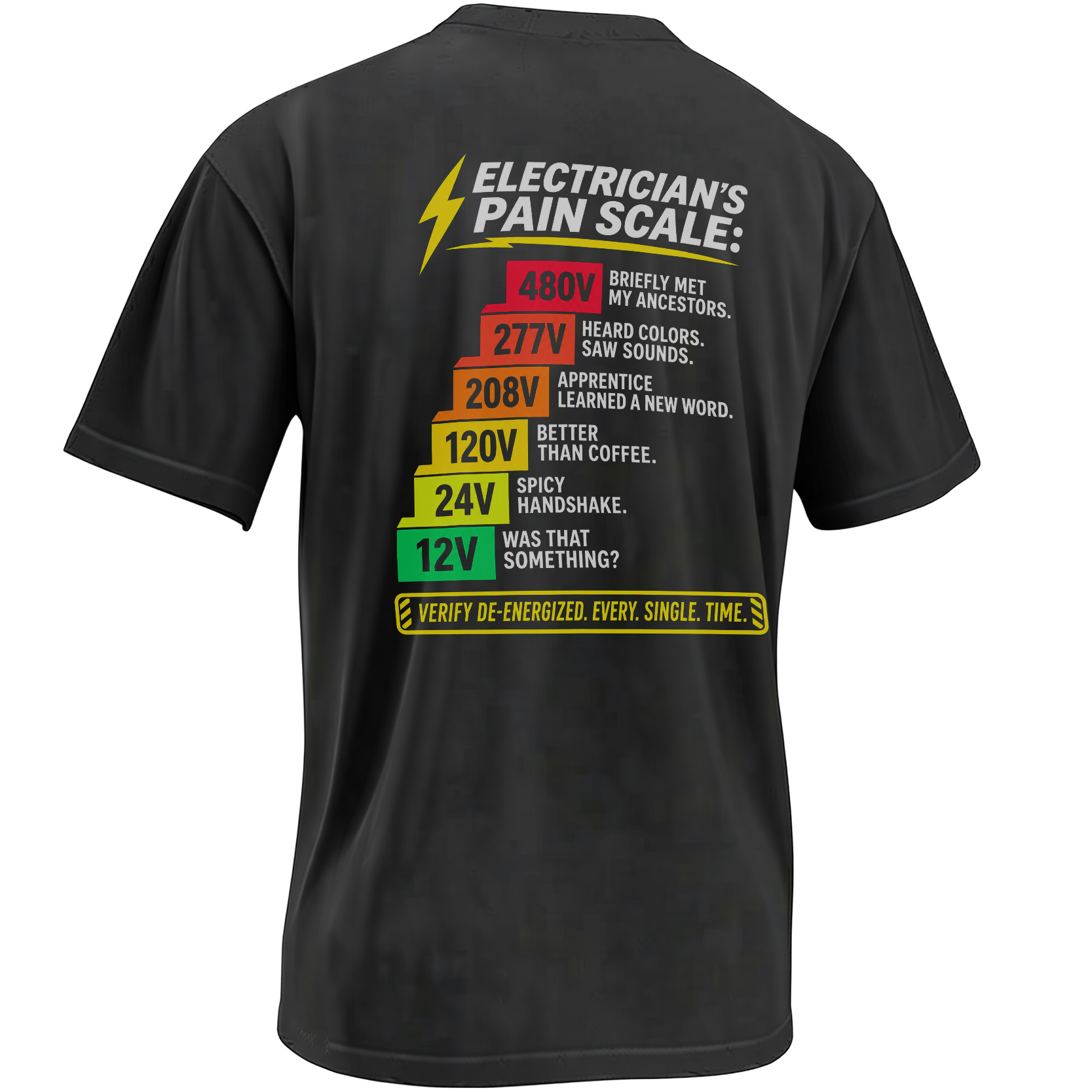
A staircase-shaped arrangement of six colored voltage references combines technical typography, fictional trade humor and a genuinely important professional safety reminder.
Examine the back-print graphic →The oversized back print places the numerical references along a diagonal staircase, creating an immediate sense of visual escalation.
Each colored block contains bold black voltage numerals, while the accompanying off-white lettering delivers the corresponding fictional joke.
The progression from green through yellow, orange and red recalls familiar color conventions used in warning graphics. Here, those colors organize the comic narrative rather than communicate an actual electrical risk assessment.
Immediately establishes the connection to electrical work and industrial hazard communication.
Provides a visual rhythm that supports the increasingly exaggerated punchlines.
Creates the appearance of technical equipment labels and industrial reference graphics.
Breaks the fictional comedy sequence with a direct reminder about electrical safety.
Technical File 06 The Real Meaning of Verify De-Energized
The final yellow banner contains the most important statement in the composition: Verify De-Energized. Every. Single. Time.
Unlike the fictional reactions above it, this message reflects an established principle of electrical workplace safety.
In the United States, OSHA’s electrical work practice standard, 29 CFR 1910.333, establishes requirements concerning de-energization and verification by qualified personnel in applicable workplace circumstances.
The principle is also reflected in discussions within electrical trade communities. A July 2025 post in r/electricians emphasized speaking up about unsafe conditions, questioning assumptions and prioritizing the safety of apprentices and experienced workers alike.
The shirt’s final message therefore changes the character of the entire design. It begins as occupational satire but ends by acknowledging the professional responsibility underlying the jokes.
Technical File 07 Why Skilled-Trade Humor Becomes Statement Fashion
Trade-themed clothing can communicate professional identity without relying on a company uniform or employer logo. Familiar terminology becomes a form of recognition between people who understand the same working environment.
An electrical apprentice, a maintenance technician and an experienced electrician may approach the artwork from different professional perspectives. Yet the combination of electrical references and exaggerated humor provides a common cultural vocabulary.
That vocabulary distinguishes the design from generic graphics built around a lightning bolt or a collection of tools. The specific language creates the connection to the profession.
The strongest feature of the Electrician’s Pain Scale is ultimately its contrast: six fictional reactions presented with technical seriousness, followed by a safety message that is not fictional at all.
Frequently Asked Questions
What does the Electrician’s Pain Scale mean?
It is a novelty joke that combines recognizable voltage ratings with exaggerated fictional reactions associated with electrical trade humor.
Is the Electrician’s Pain Scale a real safety chart?
No. Its descriptions are fictional and must not be used to assess electrical hazards or predict the severity of an electrical injury.
What voltage levels appear on the artwork?
The design references 12V, 24V, 120V, 208V, 277V and 480V as part of its fictional comedy chart.
Who originally created the Electrician’s Pain Scale joke?
The original creator of the complete six-level expression has not been independently verified. Several variations circulate in electrical trade communities and novelty merchandise.
Can voltage alone determine electrical injury severity?
No. Electrical injury is influenced by current, exposure duration, current path, contact conditions and other interacting factors.
What does Verify De-Energized mean?
It refers to confirming that relevant electrical circuits and equipment have been de-energized through applicable professional safety procedures. OSHA specifies verification requirements for qualified personnel in covered workplace circumstances.
Why does the graphic use yellow and black hazard stripes?
The stripes reference industrial warning graphics and emphasize the contrast between fictional electrical jokes and the serious final safety message.
Is the Electrician’s Pain Scale Shirt electrical protective clothing?
No. It is casual novelty apparel and is not represented as arc-rated clothing, electrical PPE or a substitute for required protective equipment.
The Electrician’s Pain Scale design preserves a recognizable form of electrical trade humor through industrial graphics and an oversized back print, alongside the wider Ellie Shirt statement design archive. Its final message remains the one part of the artwork that should never be mistaken for a punchline.
Electrician’s Pain Scale Shirt combines six fictional voltage-based jokes, colorful industrial warning graphics and an oversized back print with the serious professional reminder Verify De-Energized. Every. Single. Time.