Can’t Feed ‘Em Don’t Breed ‘Em: The Political Slogan Explained
A confrontational phrase with decades of political history continues to generate disagreement about parental responsibility, public assistance and reproductive freedom. Behind its deliberately blunt wording lies a much more complicated American social policy debate.
Political slogans have a remarkable ability to turn complicated disagreements into a handful of memorable words. They can express frustration, define a worldview and provoke an argument before anyone has discussed the details of the underlying policy.
On November 23, 2026, a Reddit discussion about the Can’t Feed, Don’t Breed argument generated contrasting reactions concerning financial preparedness, childhood hardship, reproductive decisions and public assistance.
Some participants emphasized the responsibility of adults to prepare financially before having children. Others argued that the statement overlooks changing economic circumstances and the importance of protecting children from poverty. The discussion illustrates the persistence of the disagreement, although it is not a representative survey of public opinion.
The Can’t Feed ‘Em Don’t Breed ‘Em Shirt expresses one side of this debate through a complete political slogan and oversized back-print typography. It belongs within Ellie Shirt’s Politics collection, where written statements communicate identifiable political and social viewpoints.
Understanding the phrase requires distinguishing its rhetorical message from the actual operation of American public assistance programs, while also recognizing its controversial historical associations.
01 / Understanding the Language What Does Can’t Feed ‘Em Don’t Breed ‘Em Mean?
Don’t Breed ‘Em The Government Is Not Your Baby’s Daddy
The wording is reproduced here as the subject of cultural and political analysis, rather than as a factual policy statement.
The first part of the slogan presents financial preparedness as a condition of responsible parenthood. Its wording suggests that adults should consider their ability to provide necessities before deciding to have children.
The second part adds an explicit criticism of perceived dependence on public assistance. By describing government as something other than a child’s parent, the expression argues that the primary responsibility for raising children should remain with their parents.
Together, the two phrases communicate a viewpoint associated with personal accountability, financial independence and skepticism toward expansive government welfare.
Critics interpret the wording differently. They argue that it can stigmatize low-income parents, reduce complex family circumstances to individual choice and imply that financial hardship should determine who is entitled to have children.
02 / The Historical Record The History of Can’t Feed ‘Em Don’t Breed ‘Em
The exact author of the complete slogan remains unverified. However, its shorter rhyming form has a documented history in American political commentary and bumper-sticker culture.
During debates about welfare in North Carolina in the 1990s, the phrase appeared in political campaigning and public discussion. Later retrospective reporting documented its association with arguments emphasizing individual financial responsibility.
In 2008, WBAL-TV reported a controversy involving a Maryland housing official whose vehicle displayed the shorter slogan. Affected residents and a state legislator criticized the message, illustrating how the same statement can take on additional significance when displayed by someone responsible for public services.
The shorter rhyming slogan appears in political discussions about welfare and family responsibility. Later reporting documents its use in North Carolina.
WBAL-TV reports criticism of the slogan when displayed on a local housing official’s vehicle.
A Reddit discussion includes a user’s account of encountering related parental-responsibility and government baby daddy bumper stickers. The anecdote documents online discussion, not independently verified original authorship.
A November 23 Reddit thread again brings competing perspectives on parenthood, financial hardship and social assistance into the same discussion.
The Jim Crow Museum’s artifact archive includes a textile patch combining a variant of this slogan with a racist caricature. That documented use demonstrates that the phrase has also appeared within explicitly discriminatory material. It does not establish that every contemporary use has the same intention, but it is relevant to understanding why the wording may provoke strong objections.
The historical evidence establishes circulation across multiple decades and formats. It does not identify the original creator of the complete two-part expression or establish a single uniform meaning for every person who has used it.
03 / The Policy Background Why Government Assistance Is Central to the Debate
Government food assistance in the United States has a history considerably older than the slogan. Programs developed during the twentieth century addressed agricultural conditions, unemployment and household access to food.

This historical food coupon illustrates an early American approach to food assistance. It provides documentary context for the policy debate underlying the modern slogan rather than representing the slogan’s original artwork.
The modern debate often combines several distinct programs under the general label of welfare. That can create misunderstandings because those programs have different purposes, eligibility requirements and administrative structures.
| Program | General Purpose |
|---|---|
| SNAP | Helps eligible households purchase qualifying food. Eligibility depends on applicable financial and nonfinancial requirements. |
| TANF | Provides a framework for assistance and services for eligible families with children, with programs administered through states and territories. |
| Child Support Services | Helps establish and enforce parental financial support obligations. Government agencies assisting with collection do not thereby become the parent responsible for paying child support. |
| WIC | Provides nutrition-related support to eligible pregnant and postpartum women, infants and young children. |
Official information from USAGov’s TANF guide, the Office of Child Support Services and federal family assistance resources helps distinguish these functions.
The programs do not all operate as substitutes for parental financial obligations. Some provide nutritional support to eligible households, while others help establish and enforce the responsibilities of parents themselves.
04 / Competing Perspectives Personal Responsibility Versus the Social Safety Net
The disagreement surrounding the slogan involves two questions that are related but not identical: how adults should prepare for parenthood, and how society should respond when children and families experience hardship.
Supporters emphasize the substantial responsibilities associated with raising children. They argue that prospective parents should consider housing, food, healthcare and other necessities, and that public resources should be administered responsibly.
Critics emphasize that families can encounter unexpected hardship after children are born. They argue that assistance can protect children from circumstances beyond their control and that poverty should not determine a person’s reproductive rights.
These perspectives do not necessarily exclude every element of one another. A person can support careful financial planning before parenthood while also supporting assistance for children experiencing food insecurity.
The most substantial disagreement concerns how those principles should be translated into policy, how public programs should be funded and what assumptions should be made about families seeking assistance.
A slogan can express a position in seconds. It cannot resolve the circumstances of every family affected by that position.
05 / The Current Conversation Why the Slogan Is Still Being Discussed in November 2026
The Reddit discussion published on November 23, 2026 illustrates the continued relevance of the shorter expression in online political and social commentary.
Participants disagreed over whether the message represented practical advice, an overly simplistic view of poverty or an inappropriate judgment of personal reproductive decisions.
The existence of contrasting views within the thread is significant because it demonstrates how the same short expression can lead to different interpretations. However, participation in a particular online community cannot establish the views of the American population as a whole.
06 / The Graphic as a Political Object Why the Design Uses Only Four Lines of Typography
Political statement clothing frequently relies on direct written communication rather than elaborate illustrations. The featured design follows that tradition, placing the complete expression across the back of a black shirt.
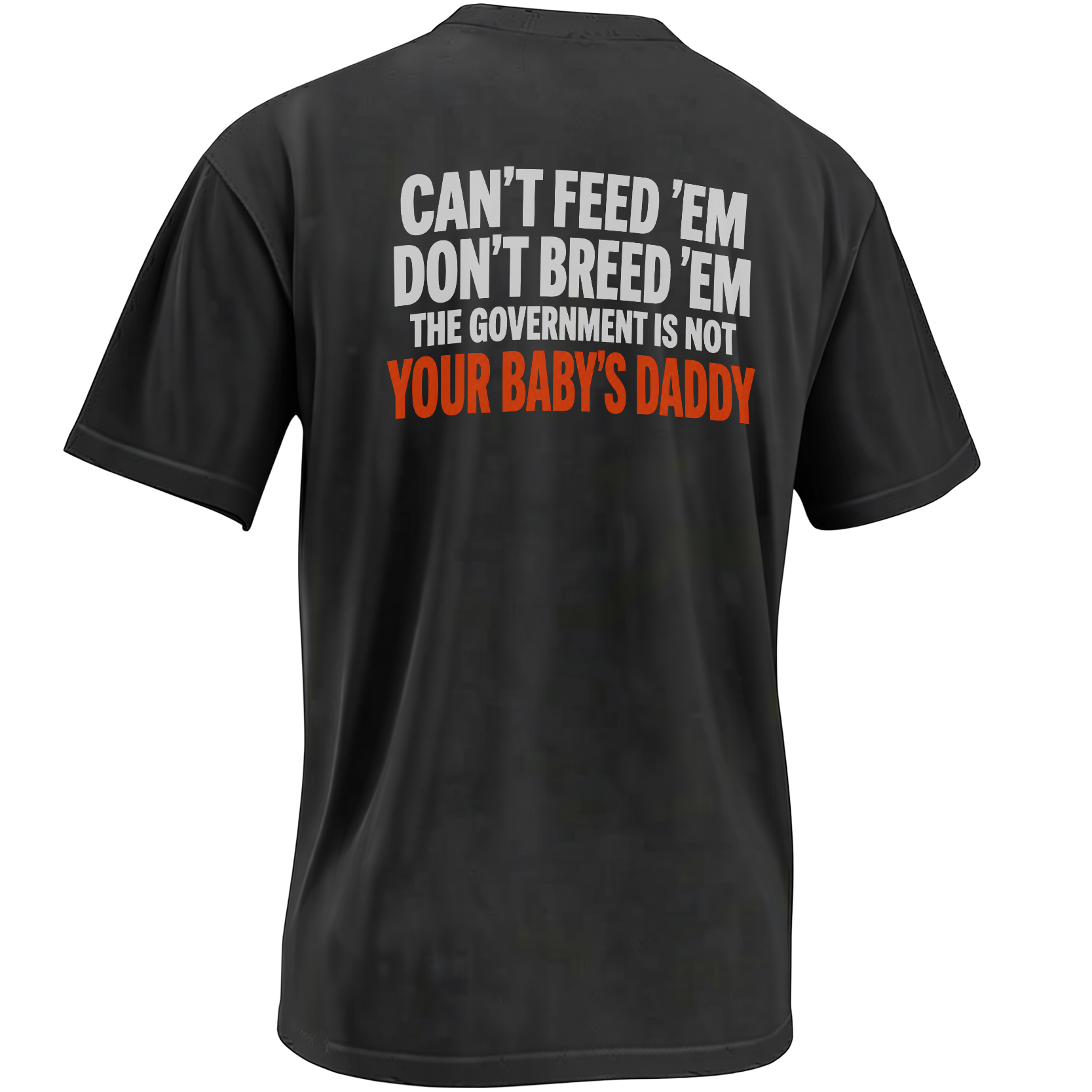
Four lines of condensed uppercase lettering preserve the complete political expression. White establishes the initial statement, while burnt orange emphasizes the controversial government baby daddy conclusion.
Examine the back-print artwork →The composition uses contrasting typography rather than portraits, political party symbols or supporting illustrations. That visual restraint keeps attention on the written message and its rhetorical structure.
The tall, heavy letterforms create the visual character of political posters and traditional bumper-sticker typography.
The upper lines establish the initial argument through strong contrast against the black background.
The final line receives a separate color treatment, distinguishing the statement’s rhetorical conclusion from its introductory language.
The large back graphic follows a familiar format for written statements designed to be read in public settings.
Unlike a campaign graphic featuring a candidate’s likeness, this composition communicates a general political viewpoint. The artwork does not identify a particular officeholder, political campaign or specific legislative proposal.
07 / Language and Cultural Reception Why the Rhyme Makes the Slogan Memorable and Controversial
The words feed and breed create a short rhyme that makes the opening statement easy to remember. Repeating the abbreviated word ’em reinforces its conversational rhythm.
However, the use of breed when discussing human parenthood also contributes to the controversy. Critics may regard that terminology as dehumanizing, particularly when directed toward people experiencing poverty or social disadvantage.
The second part of the slogan adopts the informal expression baby’s daddy to criticize perceived government dependency. Its tone is intentionally confrontational rather than technical.
Both linguistic choices demonstrate the difference between political rhetoric and policy explanation. The expression communicates an identifiable attitude, but its compact wording omits the eligibility rules, administrative details and individual circumstances involved in social assistance.
As a cultural artifact, the graphic belongs to the tradition of American political statements printed on clothing, posters and bumper stickers. As an argument about public policy, it remains open to substantial disagreement.
Frequently Asked Questions
What does Can’t Feed ‘Em Don’t Breed ‘Em mean?
The slogan expresses the viewpoint that prospective parents should consider their ability to financially support children before having them. Critics argue that its wording can stigmatize people experiencing poverty.
What does The Government Is Not Your Baby’s Daddy mean?
It is a political expression criticizing perceived reliance on government assistance and emphasizing the financial responsibilities of parents.
Who originally created the Can’t Feed ‘Em Don’t Breed ‘Em slogan?
The original creator of the complete expression has not been independently verified. Variations of its shorter wording have appeared in American political discussions and bumper-sticker culture for decades.
Is Can’t Feed ‘Em Don’t Breed ‘Em a new slogan in 2026?
No. Historical examples predate 2026, although a Reddit discussion on November 23, 2026 demonstrates the continued relevance of the underlying argument.
Why is the slogan controversial?
It raises disagreements about parental responsibility, poverty, public assistance and reproductive autonomy. Its historical use alongside racist imagery in some contexts also contributes to concerns about stigmatization.
Does receiving government assistance eliminate parental responsibilities?
No. Public assistance programs and parental support obligations are distinct. Child support agencies, for example, can help establish and enforce the financial obligations of parents.
Is the slogan associated with conservative political viewpoints?
Its emphasis on financial independence, personal accountability and skepticism toward government welfare is commonly associated with conservative political arguments, although individual interpretations vary.
Does the shirt endorse a specific political candidate?
The featured artwork communicates a general political statement without identifying a specific candidate, party logo, election campaign or legislative proposal.
What makes the Can’t Feed ‘Em Don’t Breed ‘Em design distinctive?
It combines four lines of condensed uppercase lettering, a black background, white typography and a burnt-orange final line in an oversized back-print composition.
The Can’t Feed ‘Em Don’t Breed ‘Em graphic preserves a recognizable and controversial expression from American political discourse. Within the wider Ellie Shirt Politics collection, it represents the tradition of using written statements to communicate viewpoints about government, individual responsibility and public life.
Can’t Feed ‘Em Don’t Breed ‘Em Shirt features the complete The Government Is Not Your Baby’s Daddy political slogan through oversized white and burnt-orange back-print typography, reflecting a controversial viewpoint in America’s debate over parental accountability and welfare.