I Don’t Argue With My Big Sister: She’s Always Right, Just Ask Her.
Every family has its own mythology. For some younger siblings, that mythology begins with an older sister who remembers everything, has an opinion about everything and has apparently never been wrong about anything.
There is a particular kind of confidence that comes from having known someone since the day they were born. An older sister may remember childhood stories her younger sibling would prefer to forget, offer advice before being asked and possess an impressive collection of evidence supporting her own version of family history.
With Thanksgiving arriving in the United States on November 26, 2026, those familiar relationships have a particularly timely cultural setting. Family gatherings can bring siblings back together, allowing old jokes, childhood memories and long-running disagreements to resurface.
The phrase I Don’t Argue With My Big Sister captures that dynamic through an affectionate exaggeration. It begins with apparent respect for an older sibling before revealing that her lifelong record of being correct is apparently certified by the older sister herself.
The I Don’t Argue With My Big Sister Shirt translates the statement into bold, colorful typography. Its place within Ellie Shirt’s family collection reflects a broader tradition of using clothing to communicate the jokes and personalities that make individual family relationships recognizable.
The original author of the complete slogan has not been independently established. Its appeal lies in a familiar relationship rather than a verified celebrity quotation or a single documented viral event.
According to the Old Farmer’s Almanac, Thanksgiving falls on November 26 in 2026. For families gathering during the holiday season, sibling humor offers a familiar way to reconnect through shared memories and playful disagreements.
Chapter One / The Punchline What Does I Don’t Argue With My Big Sister Mean?
The complete statement reads: I don’t argue with my big sister. She’s older than me and she’s been right since the day I was born. Just ask her.
The humor depends on the difference between what the younger sibling appears to be saying and what the conclusion actually implies.
At first, the statement resembles a straightforward acknowledgment of an older sister’s experience. She is older, has lived through certain situations first and may have accumulated knowledge that a younger sibling has not yet acquired.
The next part exaggerates that reasonable observation into a claim of uninterrupted correctness stretching back to the younger sibling’s birth.
The final instruction, Just Ask Her, changes the meaning of everything that came before it. Rather than presenting the claim as independently established fact, the speaker invites the audience to consult the person most likely to agree with it.
Every family has its historians. The big sister just happens to be the chief editor.
This final reversal gives the statement its affectionate sarcasm. It allows younger siblings to acknowledge their older sister’s confidence while quietly teasing her reputation for having the final word.
Chapter Two / Shared History Why Sibling Humor Feels Different From Other Jokes
Siblings frequently possess a shared history that makes their humor different from the jokes exchanged between acquaintances or coworkers.
An apparently ordinary phrase can refer to an event that happened years earlier. A familiar expression can remind both people of a childhood disagreement. A single word can sometimes replace an entire story.
Research by Amy L. Paine and colleagues, published in the British Journal of Developmental Psychology in 2019, examined spontaneous humor during play involving 86 seven-year-old children and their older or younger siblings. The researchers documented different forms of humor and considered how the characteristics of sibling relationships influenced those exchanges.
In a Concordia University feature about the research, the researchers also discussed how shared experiences can provide siblings with material for their playful interactions.
These studies concern childhood relationships and should not be interpreted as proof that every adult sibling relationship operates in the same way.
They do, however, provide useful context for understanding why jokes built around years of shared experiences can feel particularly natural within families.
The Big Sister statement draws its emotional energy from that familiarity. Its humor is not simply about someone who enjoys being right. It is about someone whose younger sibling has had a lifetime to notice it.
Chapter Three / The Family Album Sisterhood Has Always Contained More Than One Emotion
Traditional representations of sisterhood often emphasize loyalty, protection and affection. Family portraits and paintings frequently use physical closeness to communicate the emotional significance of sibling relationships.

Chaudet’s painting presents a tender visual interpretation of sisterhood. Contemporary sibling humor offers a different language for expressing familiarity and affection: teasing, exaggerated claims and inside jokes that make sense within a particular relationship. The painting is included as related cultural imagery, not as the source of the modern slogan.
A humorous statement about an older sister does not need to deny that affection exists. It can simply express it through a less sentimental vocabulary.
Instead of describing the relationship through traditional declarations of gratitude, the younger sibling acknowledges a recurring personality trait. The joke becomes a way of saying that this person has been a recognizable part of family life for as long as the speaker can remember.
That is one reason sibling-related clothing can feel personal even when it does not contain a customized name or family photograph.
Chapter Four / The Rules The Unwritten Big Sister Rulebook
Popular family humor often portrays the older sister as a combination of advisor, protector, storyteller and unofficial authority.
These are comic archetypes rather than universal facts about birth order. Older sisters have different personalities, responsibilities and relationships with their younger siblings.
The appeal of the archetype lies in its exaggerated familiarity. Families that recognize parts of their own relationships can enjoy the joke without treating it as a scientific description of every sibling.
The older sister may have a remarkably detailed recollection of the childhood event that everyone else remembers differently.
A familiar comic version of big sister energy involves offering an opinion before the younger sibling has finished explaining the situation.
A seemingly forgotten family incident may return as entertainment during dinner, holiday gatherings or conversations with friends.
The final rule captures the exaggeration at the center of the shirt’s statement. Verification is available directly from the big sister.
The humor comes from recognizing these exaggerated roles without requiring them to describe a relationship perfectly.
Sometimes the older sister really does offer good advice. Sometimes the younger sibling has the better argument. The joke simply imagines a family universe in which the older sister has already settled the matter.
Chapter Five / Visual Language Two Colors, One Unmistakable Family Statement
The featured artwork presents the complete joke through a tightly arranged combination of athletic block lettering, condensed type and handwritten-style script.
Instead of using hearts, family illustrations or sentimental decorative imagery, the design allows the wording to communicate the relationship directly.
The navy and black presentations preserve the same light-blue, white and yellow typography while creating slightly different visual moods.
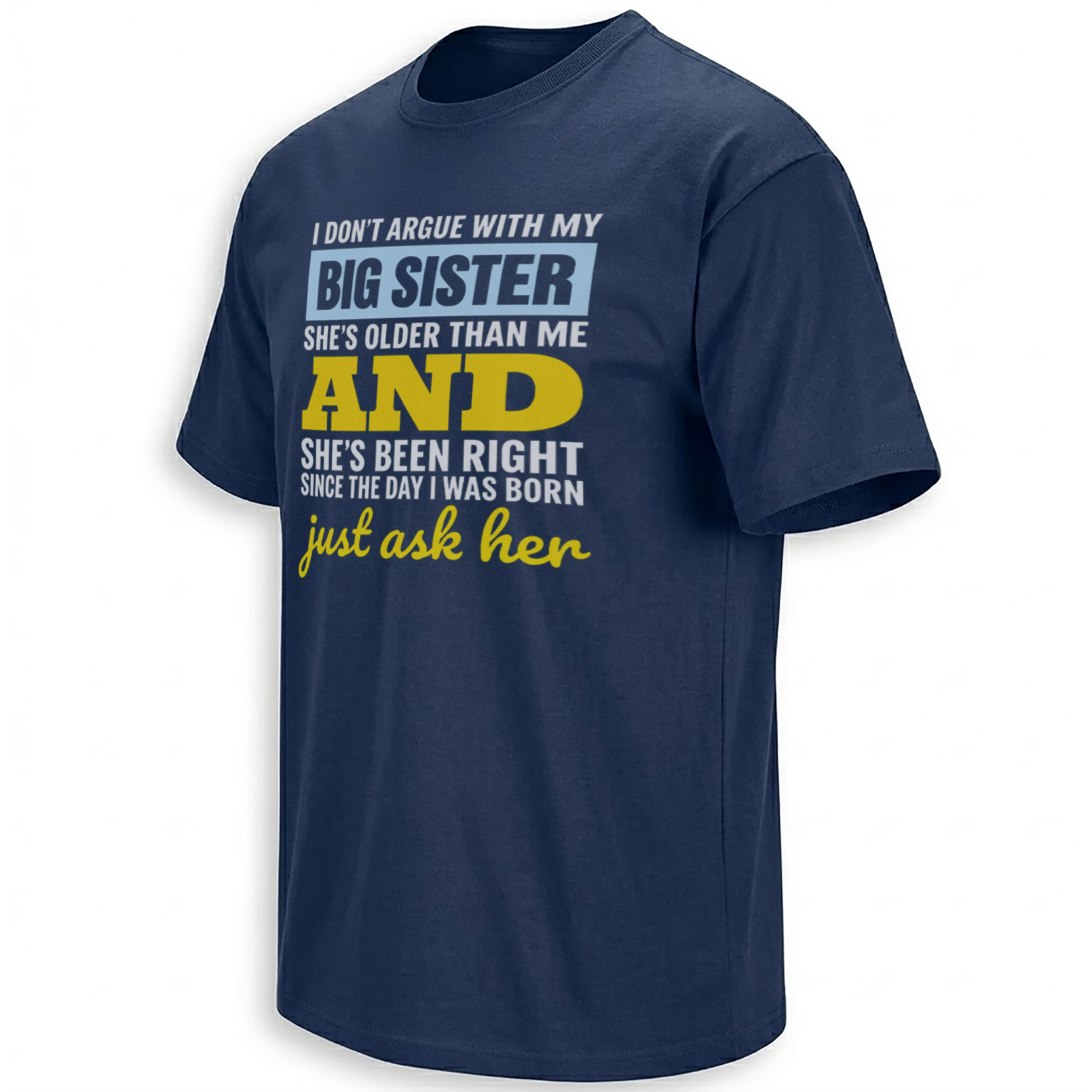
The navy background complements the light-blue nameplate and golden-yellow punchline, creating a colorful family statement with an athletic graphic character.
Explore the navy edition →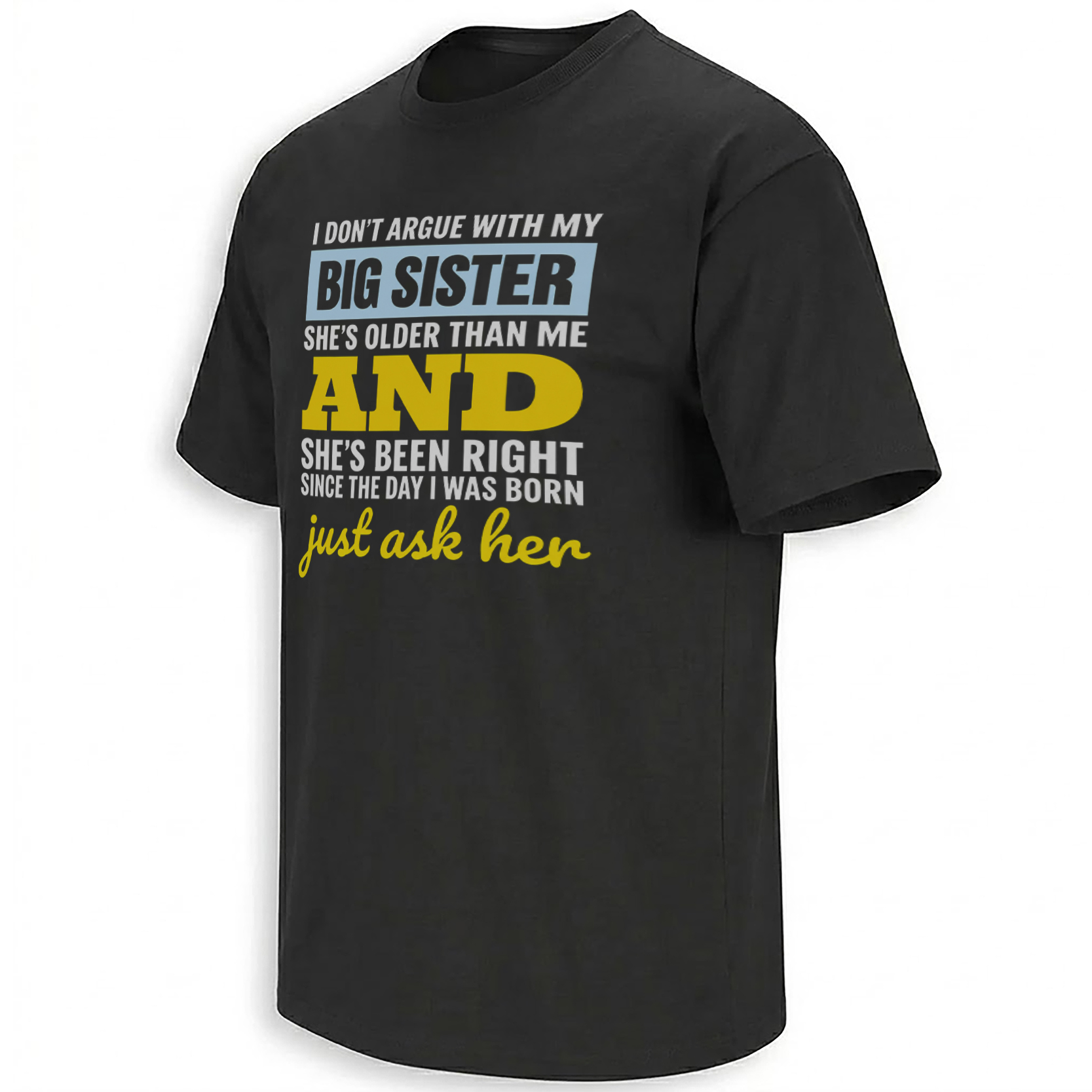
The neutral black background strengthens the contrast of the blue banner and yellow lettering, placing greater emphasis on the sarcastic final line.
Explore the black edition →These are two presentations of the same artwork rather than two different jokes. The composition, wording and main typographic hierarchy remain consistent.
Navy creates a softer relationship between the background and light-blue accent. Black produces a more pronounced contrast, giving the same lettering a stronger statement-fashion appearance.
Chapter Six / Typography Lab How the Lettering Creates Comic Timing
The artwork establishes its own reading rhythm by alternating between different letter sizes, colors and typographic personalities.
The light-blue banner establishes the older sister as the main subject of the entire statement.
Oversized yellow slab-serif lettering introduces a deliberately emphatic pause before the exaggerated claim.
Handwritten-style lettering changes the tone from a formal declaration to a familiar sarcastic aside.
The opening white lettering reads like an introduction to a personal statement. BIG SISTER immediately identifies the relationship, while the oversized AND creates the visual equivalent of a speaker building toward an important revelation.
The final script is particularly effective because it appears less formal than the preceding text. It feels like a comment added after the main declaration, introducing the comic twist that changes the meaning of the entire composition.
Yellow connects the transition and the punchline, while the blue banner anchors the subject. The result is a lively visual hierarchy that preserves the timing of the original written joke.
Chapter Seven / Family Traditions Why Big Sister Humor Works at Family Gatherings
Holiday gatherings often give siblings an opportunity to revisit the personalities and relationships they developed while growing up.
An adult who has spent years establishing an independent life may still recognize the humor of being introduced as someone’s little brother or little sister.
The I Don’t Argue With My Big Sister statement fits that experience because it treats the sibling relationship as something that can remain recognizable even as both people grow older.
A setting where shared memories, familiar family roles and long-running jokes may return around the dinner table. Related seasonal designs appear in the Thanksgiving collection.
A humorous expression of sibling familiarity during the season of personal gifts, family visits and affectionate teasing.
An opportunity to celebrate the older sister’s personality without relying entirely on traditional sentimental birthday messages.
A family-themed occasion for recognizing sisterhood through shared memories, affectionate jokes and individual expressions of the relationship.
A conversation starter that references a recognizable sibling dynamic without requiring an explanation of a specific childhood incident.
The statement is equally understandable when worn by a younger brother or a younger sister. Its wording identifies the older sibling without specifying the gender of the person delivering the joke.
It can also carry a different comic meaning when selected by the older sister herself. In that situation, the shirt becomes a playful assertion of the very confidence that the younger sibling is supposed to be teasing.
Chapter Eight / Beyond the Joke Why Affectionate Teasing Can Feel More Personal Than a Compliment
Not every family expresses closeness through elaborate declarations of affection. Some relationships are characterized by shared stories, familiar nicknames and gentle teasing.
When that teasing is mutually enjoyed, it can reflect an understanding of another person’s personality developed through years of interaction.
The qualification matters. Humor that feels affectionate to one sibling may feel uncomfortable to another, and no family stereotype captures every relationship.
The Big Sister statement is most meaningful when both people recognize the exaggeration and understand the affection behind it.
Within the wider family shirts collection, the design represents a particular form of family expression: celebrating an individual personality through a joke rather than through a generalized declaration about sisterhood.
Years may pass, childhood disagreements may become family stories, and siblings may develop completely independent lives. The familiar joke can remain recognizable through all of those changes.
As for whether the big sister really has been right since the day her younger sibling was born, the statement has already provided its preferred method of verification.
Just ask her.
Frequently Asked Questions
What does I Don’t Argue With My Big Sister mean?
It is an affectionate sarcastic statement about an older sister who supposedly has been right about everything since her younger sibling was born.
What is the full I Don’t Argue With My Big Sister quote?
I don’t argue with my big sister. She’s older than me and she’s been right since the day I was born. Just ask her.
Why is the Just Ask Her punchline funny?
It invites the audience to verify the older sister’s supposedly perfect record of being right by asking the person most likely to agree with the claim.
Who originally created the Big Sister Is Always Right quote?
The original author and first documented appearance of the exact statement have not been independently verified.
Is the statement intended for younger brothers or sisters?
It can represent either a younger brother or a younger sister because the wording does not specify the gender of the person making the statement.
Is the big sister joke affectionate or insulting?
It is framed as playful sibling sarcasm. Its meaning depends on the relationship and whether both siblings enjoy the teasing.
What is the difference between the navy and black designs?
Both feature the same statement and light-blue, white and yellow lettering. The navy and black backgrounds create different levels of contrast.
Why does the artwork emphasize the word AND?
The oversized yellow lettering creates a visual pause between the reasonable observation that the sister is older and the exaggerated claim that she is always right.
Why is the statement relevant during Thanksgiving and Christmas?
Family gatherings provide a natural setting for shared childhood memories, familiar sibling personalities and affectionate family jokes.
Does the slogan mean older sisters are always right in real life?
No. It is a humorous exaggeration rather than a factual claim about birth order or the personalities of older sisters.
The I Don’t Argue With My Big Sister design captures a familiar sibling relationship through colorful typography and affectionate sarcasm, alongside the wider Ellie Shirt family collection celebrating the personalities, memories and inside jokes that give each family its own language.
I Don’t Argue With My Big Sister Shirt celebrates lifelong sibling humor through light-blue athletic lettering, bold yellow typography and the sarcastic Just Ask Her punchline, presented in classic navy and black editions.