My Boss Said I Intimidate Coworkers: The Deadpan Office Joke
An imaginary performance review takes an unexpected turn when an employee responds to criticism with silence. The result is a remarkably efficient joke about office hierarchy, intimidating expressions and the art of saying absolutely nothing.
Some performance reviews end with an action plan. Others, according to one particularly dry piece of office humor, end with the manager apologizing.
The My Boss Said I Intimidate Coworkers joke imagines a familiar workplace conversation taking an absurd turn. A manager raises a concern about an employee’s intimidating demeanor. Instead of disputing the observation, the employee responds with a stare until the manager withdraws.
Versions of this joke have circulated through online humor collections and novelty apparel. In 2026, it appears among the workplace jokes collected by PunPlunge, alongside familiar complaints about meetings, management and performance reviews. Its original author and first appearance remain unverified.
The My Boss Said I Intimidate Coworkers Shirt, featured within Ellie Shirt’s newest designs, translates the exchange into monochrome typography, presenting an imaginary workplace confrontation with the seriousness of an official announcement.
Case File 01 What Does the My Boss Said I Intimidate Coworkers Joke Mean?
The full statement reads: My boss said I intimidate coworkers. I stared at him until he apologized.
Its central mechanism is a contradiction. The employee responds to an accusation by demonstrating the very behavior that prompted it.
Ordinarily, a person receiving such feedback might offer an explanation, express surprise or ask for examples. The fictional employee takes none of those approaches. Instead, the response provides an exaggerated demonstration of intimidating silence.
There has been some concern about your intimidating demeanor.
Maintains eye contact.
Apologizes.
Editorial reconstruction illustrating the structure of the joke, not a transcript of a documented workplace conversation.
The ending reverses the expected distribution of authority. The person responsible for delivering criticism becomes the person expressing regret.
That reversal is what makes the statement a piece of office satire rather than an ordinary complaint about management. It imagines a moment in which professional hierarchy temporarily stops operating as expected.
Case File 02 Why Deadpan Humor Makes the Punchline Work
Deadpan comedy relies on presenting an absurd situation without the expressive signals normally associated with telling a joke.
The speaker does not announce that something funny is about to happen. The absurdity emerges through a serious description, an unexpected action or a deliberately understated reaction.
In this particular joke, the absence of dialogue from the employee is essential. A lengthy sarcastic comeback would introduce an entirely different comic mechanism.
Silence leaves the manager’s original concern hanging in the air. The reader imagines the uncomfortable pause and understands why the conclusion is so disproportionate to an ordinary performance discussion.
The employee does not win the argument. The employee becomes the argument.
This is also why the expression works well as a short written statement. It contains its own setup, response and conclusion. No additional character illustration or workplace background is necessary.
Case File 03 Office Hierarchy Has Been Comedy Material for Generations
Modern workplace memes may circulate through messaging apps, social feeds and screenshots, but the relationship between management and employees has long provided material for popular comedy.
Early newspaper cartoons regularly found humor in uncomfortable introductions, office status, professional ambition and the differences between what employees said publicly and what they thought privately.

Dorgan’s cartoon is unrelated to the origin of the modern slogan. Its relevance lies in the broader tradition: workplaces generate recognizable roles, and comedy can temporarily rearrange those roles for an audience.
The boss may possess formal authority, but the employee often becomes the storyteller. The audience is invited to see familiar workplace rituals from a different angle.
Contemporary office humor continues that tradition through jokes about unnecessary meetings, complicated procedures, impossible deadlines and conversations that could have ended much sooner.
Case File 04 What Workplace Humor Research Actually Tells Us
Humor at work is not simply a distraction from professional responsibilities. It is also a form of communication shaped by relationships, expectations and organizational culture.
A 2025 review by Cecily D. Cooper and Maurice E. Schweitzer, published in the Annual Review of Organizational Psychology and Organizational Behavior , describes the potential benefits and risks of humor within organizations, including its role in communication, trust and cooperation.
A separate 2026 study of leader humor and employee burnout examined survey responses from 239 employees in mainland China. It found an association between leader humor and lower burnout under the conditions studied.
That finding does not mean every joke improves workplace relationships. Different styles of humor can produce different reactions, particularly when professional power and personal boundaries are involved.
The distinction is important here. The intimidating-coworkers joke is an exaggerated fictional scenario. Its comic value does not depend on actual employees making their colleagues feel uncomfortable or unsafe.
The statement is best understood as a satire of workplace personalities rather than advice about handling feedback.
Case File 05 The Internet’s Fascination With the Intimidating Personality
Online personality humor frequently exaggerates the difference between someone’s intentions and the way other people interpret their behavior.
A quiet person might be described as mysterious. A concentrated expression might be mistaken for irritation. Someone who communicates directly might acquire a reputation for being unusually serious.
The intimidating-coworkers statement draws on those familiar possibilities, while pushing them into a comic extreme. It gives the fictional speaker an exaggerated confidence that would be difficult to reproduce in a real conversation.
The audience is not required to believe the incident happened. It only needs to recognize the type of personality being described and the awkwardness of the imagined encounter.
That makes the expression adaptable to jokes among friends, discussions about office personalities and humorous self-descriptions outside the workplace.
Case File 06 How Vintage Typography Delivers the Joke
The featured artwork does not illustrate a manager, a desk or an employee staring across a conference table. Instead, it uses six lines of carefully arranged text to reconstruct the entire exchange.
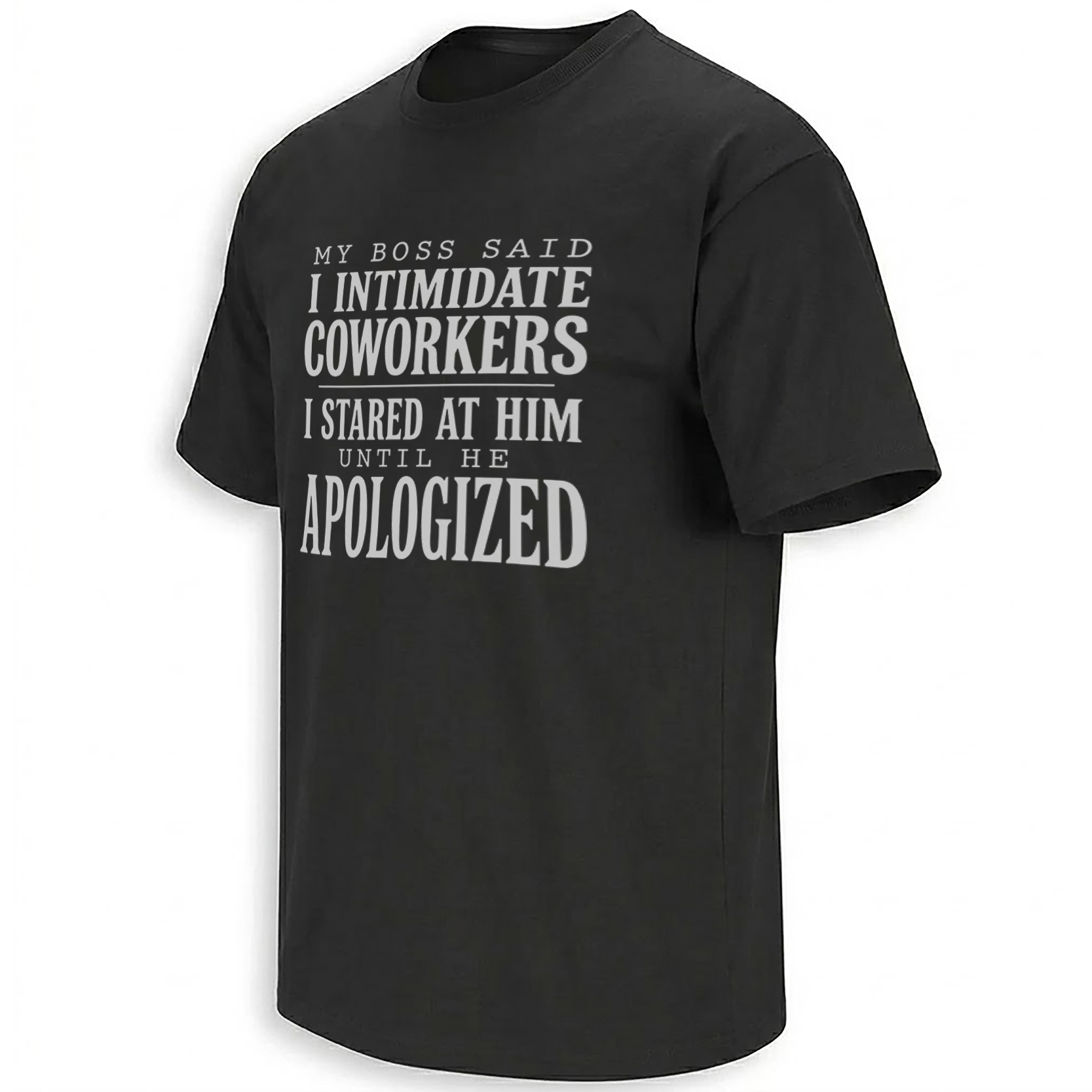
Restrained monochrome lettering and an oversized final word give an absurd performance-review scenario the visual authority of a formal workplace announcement.
Examine the graphic →The design begins with smaller, widely spaced letters spelling out the manager’s introduction. The next two lines increase in size, emphasizing the criticism that establishes the comic conflict.
A horizontal rule separates the allegation from the response. This detail functions like a pause in spoken comedy, allowing the reader to absorb the setup before continuing.
The last word, APOLOGIZED, occupies the strongest position in the lower half of the composition. Its enlarged condensed lettering makes the conclusion the visual destination of the entire design.
Black and white create a restrained editorial appearance, reinforcing the seriousness of the delivery.
The emphasized accusation introduces tension before the reader reaches the unexpected response.
A visual interruption separates setup and punchline, reproducing the timing of a spoken joke.
Oversized condensed type gives the apology the strongest visual emphasis in the composition.
The absence of illustration is a deliberate advantage. An expressive cartoon might tell the reader exactly how the employee looked, but the typography allows each person to imagine a different version of the encounter.
It is a design in which the written statement performs the entire comedy routine.
Case File 07 Why Office Sarcasm Continues Beyond the Office
Workplace jokes are often recognizable even to people who have never worked in a traditional corporate office. Their underlying themes concern authority, awkwardness, reputation and the gap between professional behavior and private reactions.
The boss-and-employee relationship supplies a familiar narrative framework. The intimidating stare supplies the unexpected disruption.
Once the statement is removed from the setting of an actual performance review, it becomes a portable piece of character-based humor. It can describe an imaginary version of a person’s reputation without requiring a real incident.
That portability is central to sarcastic statement fashion. A complete comic situation can be communicated through a short phrase that the audience understands immediately.
The Ellie Shirt design archive includes other examples of contemporary expressions translated into typography, including the related No Matter How Much I Try to Be Nice design. Both use contrasting expectations to turn everyday frustration into a deliberately exaggerated joke.
Frequently Asked Questions
What does the My Boss Said I Intimidate Coworkers joke mean?
It describes an imaginary employee responding to criticism about being intimidating by staring at the manager until the manager apologizes.
What is the full My Boss Said I Intimidate Coworkers quote?
My boss said I intimidate coworkers. I stared at him until he apologized.
Who originally wrote the intimidating coworkers joke?
The original author and first documented appearance have not been independently verified.
Why is the I Stared at Him Until He Apologized punchline funny?
The fictional employee demonstrates the behavior being criticized, reversing the expected outcome of a workplace feedback conversation.
Is the slogan based on a real workplace incident?
No specific workplace incident has been verified as the source of the statement. It is presented as an exaggerated office joke.
What type of humor does the statement use?
It combines deadpan comedy, workplace satire, exaggeration and a reversal of authority.
What makes the My Boss Said I Intimidate Coworkers Shirt distinctive?
Its monochrome serif typography, contrasting letter sizes and horizontal divider create visual timing that emphasizes the unexpected apology.
Does the joke encourage intimidating coworkers?
No. It uses an absurd fictional scenario for comic effect rather than recommending intimidation as a response to workplace feedback.
The My Boss Said I Intimidate Coworkers design preserves the complete deadpan exchange through vintage editorial typography. It belongs to a wider tradition of workplace sarcasm in which an ordinary professional conversation becomes an unexpectedly memorable comedy routine.
My Boss Said I Intimidate Coworkers Shirt transforms an imaginary performance review into deadpan office humor through bold monochrome typography and the unexpected I Stared at Him Until He Apologized punchline.