No Matter How Much I Try to Be Nice: The Fuck Off Button Meme
A polite intention, an inevitable interruption and one spectacularly impolite punchline. The Fuck Off Button statement transforms everyday frustration into a vintage-style declaration of exhausted patience.
Most people begin the day with reasonably good intentions. They plan to be considerate, patient and pleasant. Then somebody discovers the one subject, comment or unnecessary inconvenience capable of testing the entire arrangement.
The joke behind the Fuck Off Button meme begins with that familiar contradiction. It acknowledges the effort involved in maintaining a friendly attitude before delivering the exaggerated response that makes the statement memorable.
By November 2026, versions of the expression can be found across novelty merchandise and online graphic designs. Some use recognizable cartoon characters; others present the complete phrase as a standalone typographic joke.
The No Matter How Much I Try to Be Nice Shirt belongs to the latter approach. It removes the illustrated character and allows distressed vintage lettering to deliver the punchline independently.
The original author and first appearance of the slogan remain unverified. Rather than belonging to a confirmed celebrity quotation or a single documented viral event, its humor emerges from a recognizable pattern of everyday social frustration.
What Does the Fuck Off Button Meme Mean?
The complete slogan describes someone who makes an effort to remain nice but repeatedly encounters people capable of provoking an exceptionally blunt reaction.
Its central metaphor comes from a familiar English expression: pressing or pushing someone’s buttons.
The Cambridge English Dictionary treats the expression as an informal idiom about provoking a response from another person. The physical action of pressing a button becomes a metaphor for triggering an emotional reaction.
The Fuck Off Button version extends that idea into absurdity. It imagines the speaker as a machine equipped with a specific control for the moment when ordinary patience is exhausted.
Good intentions are included. Unlimited patience is not.
The statement works because the audience does not need a detailed explanation of what happened. The suggestion that someone has found the wrong button allows readers to supply their own familiar situation.
The Three-Part Anatomy of a Sarcastic Joke
The wording follows a recognizable comic structure. It begins with a reasonable declaration, introduces a recurring complication and finishes with an unexpectedly aggressive conclusion.
The speaker establishes an ordinary desire to remain pleasant and socially considerate.
Another person introduces the frustration that disrupts the speaker’s intended behavior.
A familiar idiom becomes an imaginary mechanism for releasing accumulated irritation.
The middle of the statement is especially important. Without it, the expression would simply be a rude command. With the setup intact, the profanity becomes the conclusion of a miniature narrative.
The speaker’s self-description also introduces a degree of self-awareness. The humor acknowledges the distance between the person someone intends to be and the reaction they might privately imagine during a frustrating situation.
Why “Pushing Buttons” Is Such an Effective Visual Metaphor

This humorous adaptation of a physical button photograph offers a related visual metaphor. An instruction not to press something immediately raises the possibility that someone will do exactly that. The Fuck Off Button statement transfers the same contradiction into everyday interpersonal humor.
Buttons are unusually efficient symbols. They suggest that a small action can produce an immediate and potentially disproportionate result.
That logic appears in emergency switches, industrial controls, fictional machines and countless comic situations. A single physical gesture becomes shorthand for activating an entire sequence of consequences.
Applied to human patience, the metaphor makes the emotional transition easy to understand. There is a normal operating state, an interruption and a sudden change in behavior.
The joke does not require an actual illustrated switch. The words alone allow the reader to imagine the mechanism. This is one reason the typography-only version remains understandable without a cartoon or character.
Why Profanity Can Make an Ordinary Statement Funny
Profanity does not automatically create comedy. Its effect depends on timing, context, audience expectations and the relationship between the speaker and the people hearing it.
In this case, the strongest comic element is the contrast between the statement’s opening and ending. The beginning promises social restraint, while the conclusion deliberately abandons polite language.
In their 2010 research, Peter McGraw and Caleb Warren examined how humor can emerge when something challenges an expectation or social norm while also being perceived as sufficiently harmless. The framework offers one useful explanation for why exaggerated profanity can produce amusement in an appropriate context.
The Fuck Off Button meme illustrates that tension. Its closing language breaks the expectation established by the polite beginning, but the imaginary button and exaggerated setup can make the violation feel playful rather than literal.
A philosophical discussion published by Cambridge University Press, Why Is Swearing (Sometimes) Funny?, also examines why taboo language can become humorous under certain circumstances.
The qualification matters. The same statement may be amusing among friends who share a taste for blunt humor and inappropriate in a professional or unfamiliar environment. Its meaning is influenced by where and how it is expressed.
Why This Design Looks Like a Vintage Warning Sign
The featured design turns the full sarcastic statement into an ornamental typographic composition. Rather than adopting the visual language of a contemporary screenshot meme, it recalls older pub signs, painted notices and traditional novelty graphics.
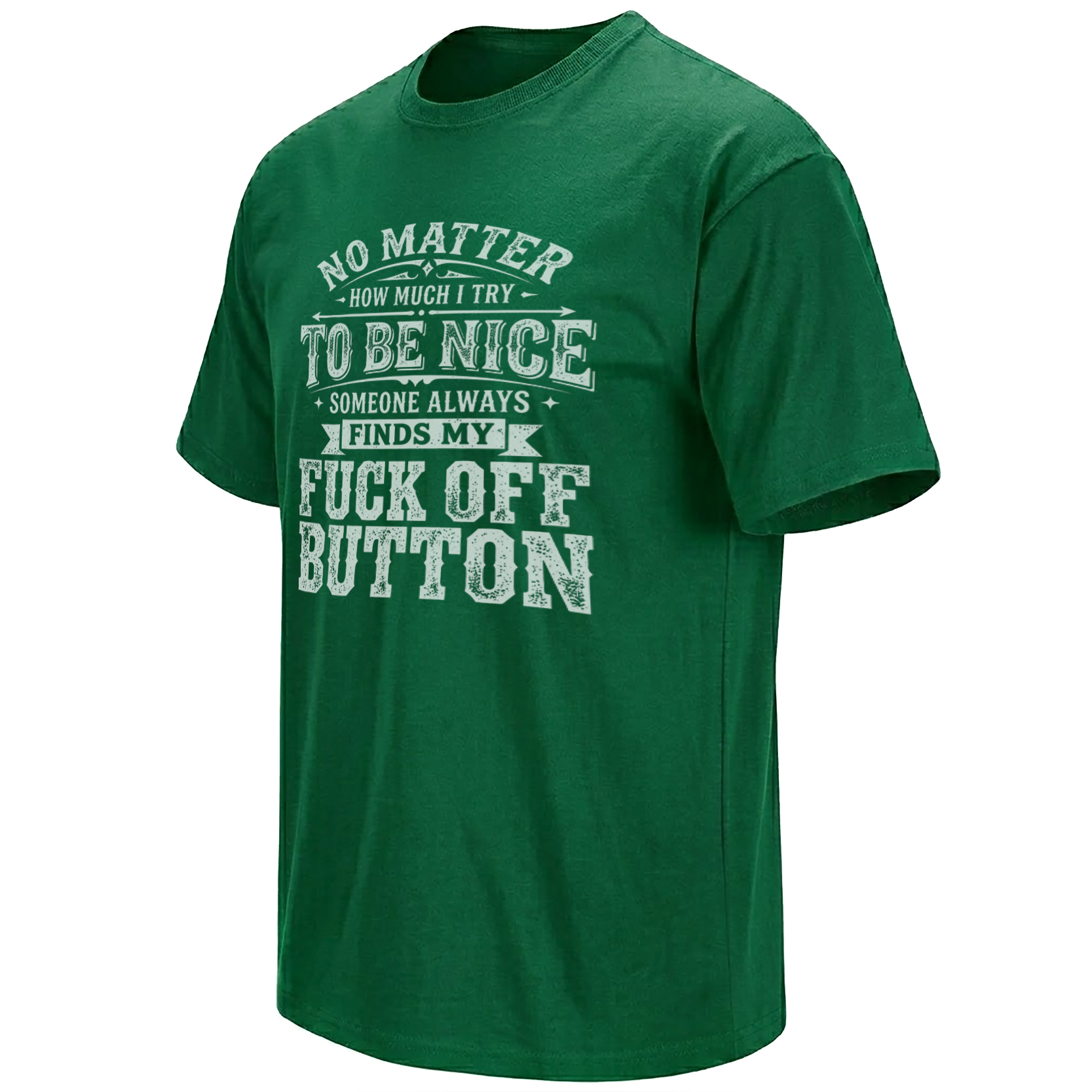
Forest-green fabric, weathered cream lettering, ornamental flourishes and an oversized uncensored punchline give the familiar sarcasm statement the appearance of a vintage warning notice.
Inspect the graphic →The layout does much of the storytelling. Curved lettering and decorative details give the upper portion a traditional signboard appearance. The composition initially looks almost formal, establishing a visual expectation of restraint.
A ribbon-style element introduces a transition into the oversized lower lettering. The change in scale gives the final words the same emphasis a comedian might create through a carefully timed pause.
| Visual Element | Editorial Interpretation |
|---|---|
| Forest Green | A restrained, traditional palette reminiscent of old pub signage and painted notices. |
| Weathered Cream Ink | Distressed textures create the visual familiarity of an older printed graphic. |
| Decorative Serif Lettering | Formal lettering contrasts with the informality of the joke. |
| Ribbon and Flourishes | Ornamental details introduce a pause before the final line. |
| Oversized Punchline | Bold lettering emphasizes the abrupt shift from politeness to frustration. |
The artwork’s visual contradiction mirrors the language. An old-fashioned, carefully arranged composition carries a deliberately unrefined message.
This contrast is central to the design’s personality. The graphic could have used loud neon colors or an angry illustrated character. Instead, it presents its profanity with the decorative seriousness of a traditional notice.
From Internet Memes to Character-Free Statement Fashion
Contemporary internet humor frequently places familiar expressions beside cartoon characters, animals or photographs with recognizable emotional reactions.
Versions of the Fuck Off Button expression have followed this pattern, appearing in character-based graphics as well as text-centered merchandise. Examples of the complete slogan can be found in sarcastic novelty apparel and other independently published merchandise listings.
Their existence demonstrates that the phrase can travel between different visual treatments. It does not establish the identity of its original author or prove that one specific version started the trend.
By removing the character, the featured artwork shifts responsibility for the joke entirely onto language, typography and layout.
That approach belongs to a long tradition of statement clothing. A written phrase becomes the primary graphic, and the reader’s recognition of its meaning supplies the emotional connection.
It also makes the design independent of familiarity with a specific film, television series, celebrity or fictional character.
The Difference Between Sarcasm and a Serious Insult
The Fuck Off Button meme is structured as exaggerated self-description rather than a direct instruction aimed at a named individual.
Its speaker describes an intention to be nice and then jokes about the possibility of that intention being tested. The comedy depends on the recognition that patience is not always effortless.
That does not mean profanity should be treated as universally acceptable. An exaggerated statement on a shirt can be interpreted differently depending on the social setting.
Nor does the slogan offer a serious method for communicating personal boundaries. In real interpersonal situations, directly expressing a limit can be more constructive than responding aggressively.
As a cultural object, however, the statement can express the private fantasy of abandoning unnecessary social performance for a moment. The imagined button turns that fantasy into an easily understood joke.
Why Everyday Frustration Keeps Becoming Wearable Humor
Some internet memes depend on the audience remembering a particular celebrity interview or news event. Others are built around situations that recur across everyday life.
The Fuck Off Button belongs to the second category. Its basic scenario can be understood without knowing when it first appeared or who originally wrote it.
Long conversations, unnecessary drama, repetitive questions and intrusive opinions are all situations readers may independently associate with the joke. The statement offers a flexible framework for expressing that frustration through exaggeration.
This flexibility also explains why the phrase can work through different graphic styles. A cartoon might emphasize irritation, while an ornamental vintage composition can make the contrast between politeness and profanity the main source of humor.
Within the newest statement designs at Ellie Shirt, the forest-green version represents the latter tradition: a deliberately composed visual object carrying a message that refuses to sound composed.
The audience supplies the situation. The typography supplies the timing. The final line supplies the joke.
Frequently Asked Questions
What does the Fuck Off Button meme mean?
It humorously describes the moment when someone’s effort to remain friendly or patient is tested by a frustrating interaction, using an imaginary button as a metaphor for an exaggerated emotional response.
What is the full No Matter How Much I Try to Be Nice quote?
The complete statement reads: No matter how much I try to be nice, someone always finds my fuck off button.
Who originally created the Fuck Off Button meme?
The original author and first documented appearance of the exact expression have not been independently verified. Multiple versions exist across online graphics and novelty merchandise.
What does pushing someone’s buttons mean?
It is an informal English expression describing the act of provoking a particular emotional reaction from another person, often through something that irritates or upsets them.
Why is the Fuck Off Button statement funny?
Its humor comes from the contrast between a polite opening and an unexpectedly blunt conclusion, combined with an exaggerated metaphor for reaching the limits of one’s patience.
What makes the typography look vintage?
The artwork combines distressed cream lettering, ornamental serif typography, decorative flourishes, a ribbon-style element and a forest-green background associated with traditional signboard aesthetics.
Is the Fuck Off Button Shirt based on a particular character?
No. Although character-based versions of the phrase exist, this design uses a standalone typographic composition without an illustrated fictional character.
Is the Fuck Off Button phrase intended as a serious insult?
The statement is structured primarily as exaggerated adult sarcasm rather than an insult aimed at a named individual. Its appropriateness depends on the audience and social context.
Is the featured shirt an original vintage garment?
No. It is a contemporary statement design using vintage-inspired typography and distressed graphic textures to create an older signboard appearance.
The No Matter How Much I Try to Be Nice graphic preserves the complete sarcastic statement through vintage signboard lettering, alongside the wider Ellie Shirt design archive documenting humor, contemporary expressions and everyday internet culture.
No Matter How Much I Try to Be Nice Fuck Off Button Shirt transforms everyday frustration into vintage sarcasm through distressed cream typography, decorative signboard lettering and an unapologetic punchline on forest green.