F.R.O.G.: Fully Rely on God’s Indifference
A vintage religious acronym takes a spectacularly pessimistic turn, delivered by an adorable green frog riding a skateboard. Behind the absurdity is a longer history of inspirational slogans, ironic clothing and internet-era gallows humor.
At first glance, it looks like an unusually wholesome shirt. Four friendly block letters spell F.R.O.G. A small green frog sits on a skateboard, looking remarkably content with life. The caption underneath begins like an inspirational message. Then it delivers the punchline: “Fully Rely On God’s Indifference to My Suffering.”
The joke depends on the distance between what the viewer expects and what the image actually says. Cute animals and religious acronyms usually offer comfort or reassurance. This one turns the familiar formula into a quiet expression of existential absurdity.
It is not a documented new viral event from November 2026. The wording and imagery were circulating on apparel long before that date. Understanding the reference requires looking backward, toward the original meaning of the F.R.O.G. acronym and the humor that later emerged from reversing it.
Before the Joke: What F.R.O.G. Originally Meant
The original acronym stands for “Fully Rely On God.” It became recognizable through Christian youth culture, church materials and inspirational merchandise in the 1990s, often appearing beside cheerful frog illustrations.
A November 27, 1999 Deseret News article described F.R.O.G. as one of several religious acronyms appearing on clothing, accessories and classroom materials. Other examples included WWJD, meaning What Would Jesus Do, and PUSH, meaning Pray Until Something Happens.
The frog was a natural symbol. The four letters spelled the animal’s name, making the slogan easy to illustrate and remember. The meaning was straightforward: encourage faith and trust during difficult circumstances.
That familiarity is essential to the parody. Without the expected original meaning, the dark version would be merely a strange sentence. With the original meaning in mind, it becomes an inversion of a message that many people already recognize.
How the Acronym Became Dark Humor
The parody preserves almost the entire structure of the inspirational phrase, then adds a second idea that radically changes its tone. Instead of encouraging reliance on divine support, it turns to the unsettling notion of divine indifference.
The result is a contradiction dressed as a reassuring slogan. A sentence built to communicate hope becomes a sentence about feeling overwhelmed by circumstances beyond one’s control.
Crucially, the joke does not require readers to adopt that philosophical position. The humor comes from the mismatch between the religiously familiar form, the bleak conclusion and the harmless-looking frog.
The frog is cheerful. The message is bleak. That contradiction is the entire punchline.
The Artwork’s Documented History
The skateboarding frog composition predates this article and has an identifiable credited artist. An earlier version was published by Shirts That Go Hard with the design attributed to illustrator Justin McGuire (@Jmcgg).
The retailer’s historical listing identifies the design by its full sentence and shows the same combination of three-dimensional acronym lettering, a green frog on a skateboard and a gloomy caption. That source is useful for establishing the artwork’s prior existence; it should not be mistaken for an independent viral social-media post.

This provenance changes the editorial story. Rather than presenting the concept as newly invented, the more accurate interpretation is that the design belongs to an established lineage of irreverent graphic clothing that mixes simple cartoons, religious references and absurdist statements.
The exact skateboard-frog composition has been publicly attributed to Justin McGuire. A separate, verified original social-media post for this artwork was not established, so no fabricated embed is included. The historical artwork above should only be republished with appropriate permission.
Why a Skateboard Makes the Joke Better
Skateboarding adds an unexpected attitude to the artwork. A skateboard represents motion, play, improvisation and occasionally a willingness to accept an unpredictable landing. It is an amusing companion for a philosophical joke about uncertainty.
The frog does not appear to be contemplating a theological problem. It is simply riding. That lack of concern is what makes the illustration effective. The viewer reads a sentence about cosmic indifference while the central character carries on with its day.
The design also draws on a long visual tradition of playful skate graphics. Independent skate art frequently combines intentionally simple illustrations, charming animals and humor that would look strange in a formal advertisement.
Those connections are stylistic rather than evidence that the artwork came from any particular skateboard company. Its identifiable source remains the credited McGuire composition.
How Typography Creates the Surprise
At the top, F.R.O.G. is presented through dimensional block lettering that resembles classroom decoration or children’s educational materials. Each red letter is contained within a white shape with dark outlines.
The frog below uses gentle green tones, rounded features and a seated pose. The skateboard has a dark deck and purple wheels, adding a playful accent to the restrained composition.
The caption beneath the picture changes the emotional reading of everything above it. Smaller typography forces viewers to move closer before discovering the full sentence. It works like a delayed punchline printed into the design itself.
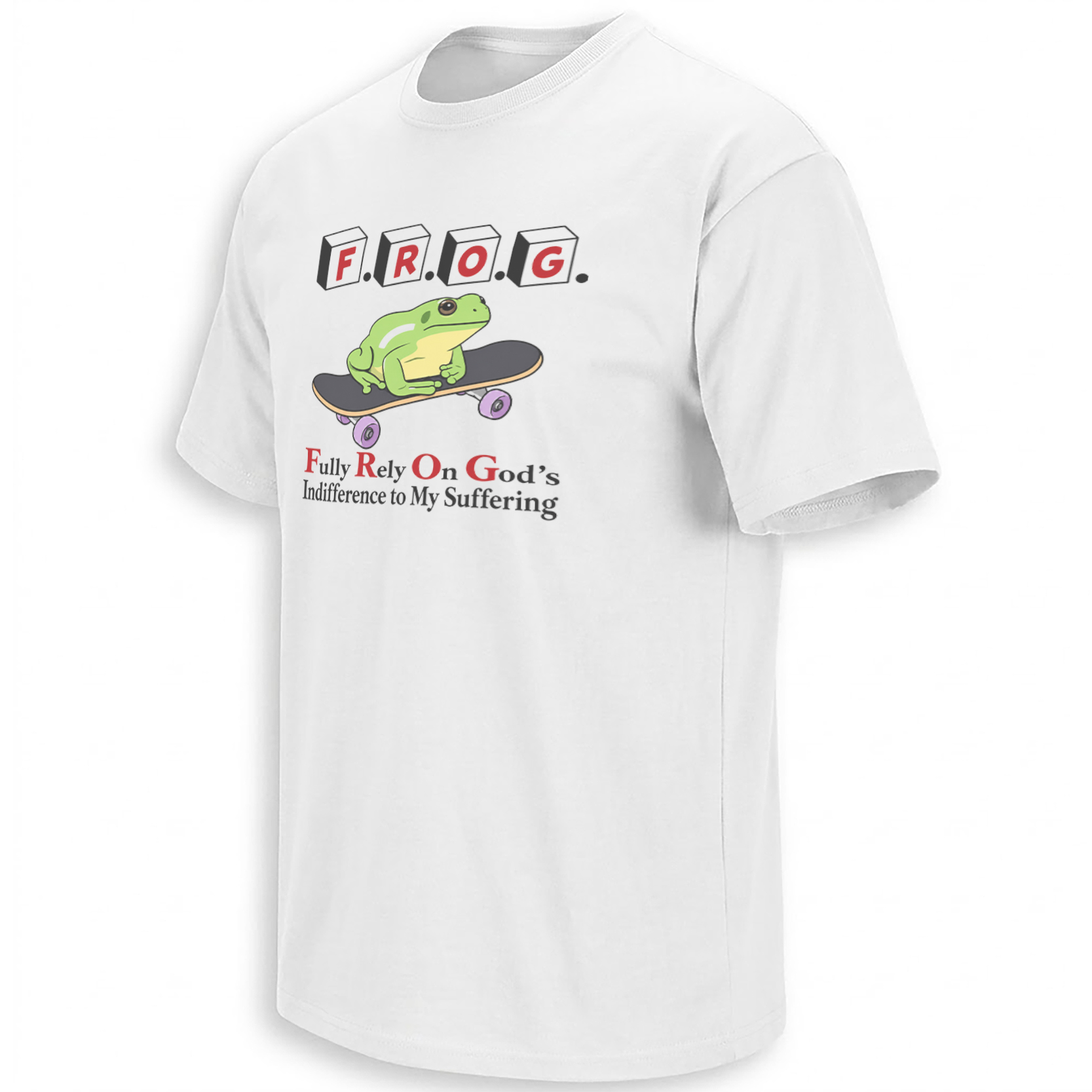
A friendly visual language carrying a deeply cynical sentence: a striking example of how irony changes the meaning of an otherwise familiar graphic.
View the illustrated piece →Why Cute Animals and Existential Humor Work Together
Internet humor often uses harmless imagery to soften or exaggerate uncomfortable ideas. A smiling animal can deliver a bleak sentence without the confrontational tone a realistic human figure might create.
The contrast gives readers two emotional reactions at once. The artwork is cute enough to invite attention, yet the caption is cynical enough to make the meaning surprising. That tension is part of why absurd animal imagery has become recognizable in contemporary online culture.
The F.R.O.G. composition also uses an older form of graphic humor. It asks viewers to decode an acronym, recognize the expected message and then discover how that message has been deliberately rewritten.
There is no verified evidence that a single November 2026 social post newly launched the trend. The better historical description is that this is an established illustration whose humor remains understandable across different internet communities.
What Makes the Joke Different From a Faith Slogan?
The difference is intention and tone. The original Christian acronym encourages reliance on God. The parody borrows that language to express the opposite emotional outlook, converting encouragement into absurd pessimism.
Some readers may interpret it as satire of religious merchandise. Others may simply read it as an expression of gallows humor, a cartoon about the feeling that life can be unpredictable and overwhelming.
The artwork’s strongest feature is that it never explains which interpretation the viewer must choose. It allows the cute frog and the full caption to create the contradiction on their own.
Frequently Asked Questions
What does F.R.O.G. traditionally mean?
F.R.O.G. traditionally stands for Fully Rely On God, a Christian inspirational acronym documented in popular merchandise during the 1990s.
What does the dark-humor F.R.O.G. meme mean?
It rewrites the reassuring acronym as Fully Rely On God’s Indifference to My Suffering, turning an uplifting message into absurd existential humor.
Who is credited with the skateboarding frog design?
An earlier published version of the composition is explicitly credited to illustrator Justin McGuire, also known as @Jmcgg.
Is the frog skateboard meme new in 2026?
No. The artwork and phrase appeared on apparel before 2026. There is no verified basis for describing it as a newly invented November 2026 meme.
Why does the frog ride a skateboard?
The skateboard adds a playful, carefree atmosphere that contrasts with the pessimistic sentence printed underneath the illustration.
Is this a traditional Christian encouragement design?
No. It is a parody of a traditional Christian acronym, using the familiar format to communicate a deliberately contradictory joke.
The F.R.O.G. skateboard graphic illustrates how a familiar acronym can acquire an entirely different meaning through a few extra words and one deceptively cheerful cartoon.
The F.R.O.G. skateboarding frog graphic turns the traditional Fully Rely On God acronym into Fully Rely On God’s Indifference to My Suffering. Explore the older faith-slogan history, the artwork’s credited source and the contrast between cute illustration and existential humor.