I’m Not Arguing. I’m Explaining Why I’m Right.
The Grinch has spent decades perfecting an irritated stare. Pair that expression with the internet’s favorite confidently contradictory comeback, and holiday sarcasm practically writes itself.
Every holiday gathering has its debates. The thermostat. The Christmas playlist. How early decorations should go up. Whether a certain relative actually knows the correct way to prepare dinner. Somewhere in that conversation is a person who insists they are not arguing at all.
They are, of course, simply explaining why they are right.
The line is an enduring piece of sarcastic internet humor because it exposes a contradiction everyone recognizes. The speaker claims to be calmly clarifying the facts while refusing to consider that anyone else might have a point. Put those words next to the Grinch’s narrowed eyes and spectacularly unimpressed expression, and the joke suddenly has a face.
The result is a holiday meme that does not require a new film release, celebrity argument or viral event to make sense. It depends on two established cultural elements: a famous Christmas grouch and a familiar joke about stubborn certainty.
Why the Grinch Is Such a Natural Face for Sarcasm
The Grinch entered popular culture through Dr. Seuss’s 1957 book How the Grinch Stole Christmas! From his home above Whoville, he resented the Christmas celebrations below, reacting to the Whos’ cheerful behavior with irritation rather than enthusiasm.
The 1966 animated television adaptation helped establish his now-famous green appearance and highly expressive face. Later screen versions, including the 2000 live-action film starring Jim Carrey, introduced the character’s theatrical frustration to new audiences.
The character works so effectively in reaction humor because his annoyance is legible without explanation. A frown, an eyebrow and a stare can communicate an entire imaginary conversation. His expression suggests that he has already decided the outcome before anyone else has finished speaking.
I’m not arguing.
I’m explaining why I’m right.

Where Did “I’m Not Arguing, I’m Explaining Why I’m Right” Come From?
The phrase circulates widely as a humorous saying, appearing in memes, captions, posters and graphic apparel. It is not a verified quotation from Dr. Seuss’s original Grinch book, the 1966 television special or the later films.
That distinction is worth making. A popular meme can become so strongly associated with a fictional character that readers begin to assume the character actually said the words. Here, the association comes from personality rather than an identifiable screenplay line.
Its structure is simple. The first part denies the existence of an argument. The second declares absolute certainty. The audience immediately recognizes that the speaker has supplied evidence of the very behavior they deny.
It is a joke about being stubborn, not a serious statement about who is correct. That makes it adaptable to countless everyday disagreements, from sports rivalries to the correct order for decorating a Christmas tree.
Three Reasons the Joke Works So Well
The Christmas Grouch Who Became a Reaction-Meme Character
The original Grinch story is ultimately about discovering that Christmas means something beyond material possessions and noisy celebrations. Its ending depends on a change of heart. But reaction memes often freeze a fictional character at one recognizable emotional moment rather than retelling the entire narrative.
For the Grinch, that moment is the unimpressed, irritated expression before his transformation. The internet can use it to communicate annoyance with a work meeting, frustration with holiday planning or a person’s absolute commitment to winning a minor disagreement.
There is a playful gap between the character’s literary redemption and the perpetually grumpy expression used in modern humor. The character learns a lesson in the original story; the meme deliberately keeps him in the mood before that lesson arrives.
A Design Built Around the Punchline
The I’M NOT ARGUING graphic avoids the usual visual furniture of Christmas apparel. There is no Santa hat, sleigh, decorated tree or snowy street. Instead, a black background creates a dramatic contrast with a bright green character portrait.
The Grinch’s head emerges above the lettering, with narrowed eyes, a small round nose, an irritated frown and the characteristic tuft of green hair. The image communicates displeasure while the typography supplies the explanation.
The wording is arranged with deliberate hierarchy. Green accents introduce the statement, “NOT” sits within an emphatic rectangular treatment, and the word “ARGUING” dominates in large white capitals. The smaller final line — “I’M EXPLAINING WHY I’M RIGHT” — completes the gag.
That layout encourages two readings. From a distance, the central word conveys confrontation. Up close, the smaller text reveals the ironic denial of that confrontation. The pairing makes the character and the line work as one visual joke.
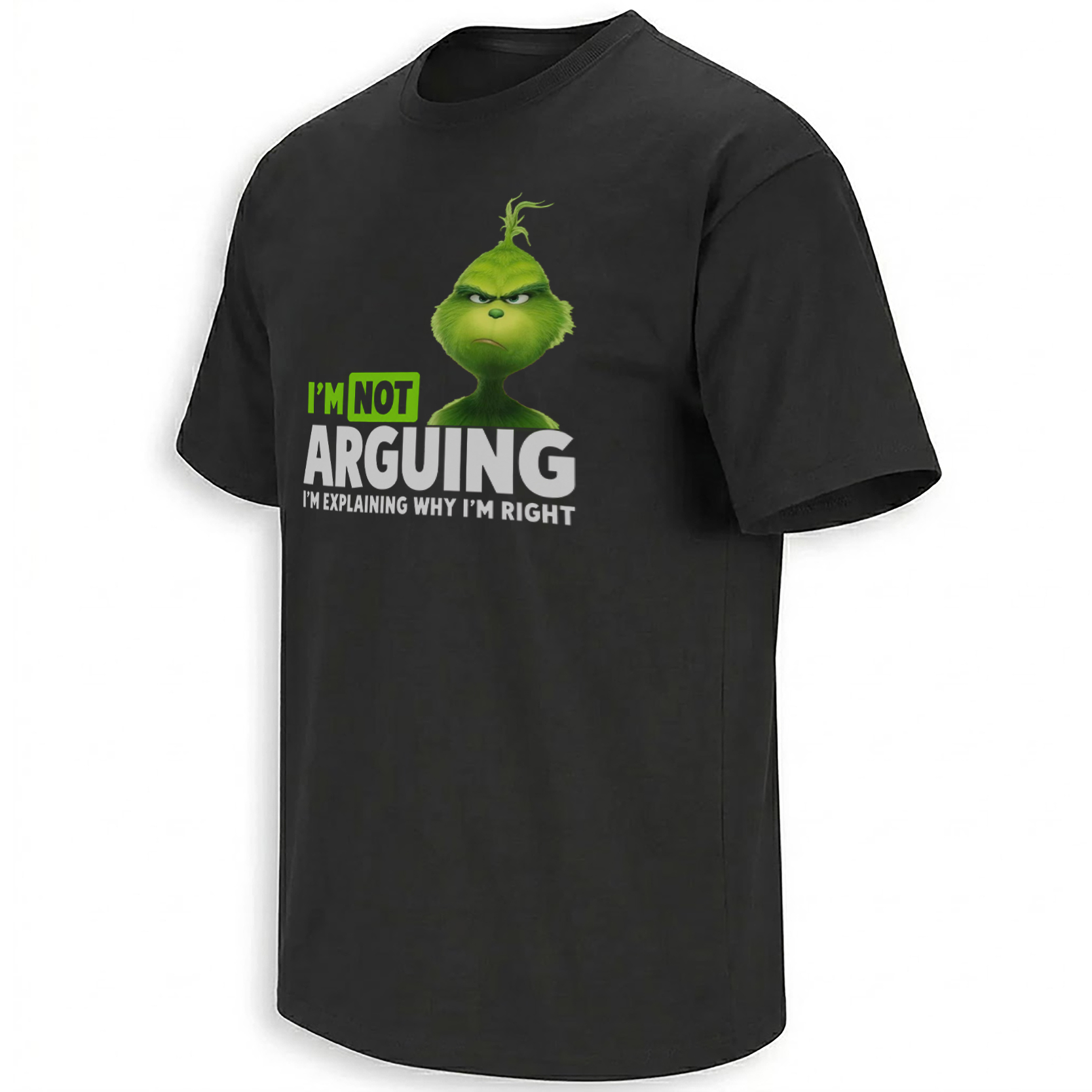
A character-driven sarcastic graphic using a black background, acid-green portrait and oversized lettering to bring an everyday argument joke into Christmas pop culture.
View the Grinch graphic →The image references the Grinch’s familiar appearance and personality. The slogan is a separately circulating humorous expression, not authenticated dialogue from the original books or films. The combination is a contemporary visual interpretation.
Why Sarcastic Christmas Humor Keeps Finding an Audience
Christmas storytelling often emphasizes warmth, generosity, family and reconciliation. Holiday comedy works by recognizing the less polished emotions that surround those ideals: exhaustion, scheduling conflicts, travel problems and disagreements about family traditions.
The Grinch occupies a useful place between those two moods. He belongs unmistakably to Christmas culture, but his most recognizable expression is not cheerful. That contrast allows a sarcastic quote to retain an immediate seasonal connection without requiring any explicit Christmas decorations.
The line also works outside December. It can be used as a reaction to workplace debates, everyday disagreements or conversations in which someone believes their interpretation is obviously correct. That broader cultural relevance explains why the meme is understandable even when the holiday season has ended.
From Dr. Seuss’s Original Story to the Modern Meme
Dr. Seuss’s original book appeared in 1957 with red-and-black illustrations. The subsequent animated and live-action versions established distinct visual interpretations of the character, but the central tension has remained recognizable: a deeply irritated outsider confronting a community whose enthusiasm he cannot understand.
Modern meme culture often borrows a familiar image and combines it with a phrase from an entirely different source. The meaning is created through juxtaposition rather than direct quotation. The Grinch’s angry face paired with “I’m not arguing” is an example of that approach.
Readers interested in the character’s official history can consult the original Grinch book information from Dr. Seuss and the 2000 film listing. Both provide source context for the character without suggesting that the meme quote originated there.
The Grinch and the Wider Christmas Graphic Archive
The Grinch collection brings together different interpretations of the character’s familiar personality, while the broader Christmas Collections archive includes seasonal graphics drawing on holiday traditions, television nostalgia and humor.
The I’m Not Arguing design belongs to the more sarcastic side of that archive. Rather than depicting Christmas celebration, it uses the cultural memory of a famous Christmas character to express a recognizable everyday attitude.
Frequently Asked Questions
Did the Grinch say “I’m Not Arguing, I’m Explaining Why I’m Right”?
There is no verified evidence that this exact phrase appears in the original Grinch book or its well-known screen adaptations. It is a popular humorous saying paired with the character.
What does the I’m Not Arguing meme mean?
It jokes about someone denying that they are arguing while insisting their opinion is correct, creating humor through contradiction.
Why is the Grinch used for sarcastic quotes?
His narrowed eyes, irritated expression and established Christmas-grouch personality make him immediately recognizable in reaction humor.
When was How the Grinch Stole Christmas first published?
Dr. Seuss first published the book in 1957, before the famous 1966 animated television adaptation and later film versions.
What is shown on the I’m Not Arguing Grinch graphic?
It features a bright green Grinch portrait on black, with bold white and green text reading “I’m Not Arguing, I’m Explaining Why I’m Right.”
Is the meme only about Christmas?
No. The Grinch provides a holiday connection, but the phrase can also describe ordinary arguments and stubborn everyday conversations throughout the year.
The joke does not need to prove who is right. It only needs a familiar expression and an unforgettable face. The I’m Not Arguing Grinch graphic combines both into a compact piece of sarcastic Christmas humor.
I’m Not Arguing, I’m Explaining Why I’m Right pairs the Grinch’s irritated green expression with a classic sarcastic quote, using bold white-and-green typography and black-background contrast.