Chicago Wants the North: Why the Bears Feel Like Kings in 2026
A four-game winning streak has put Chicago atop one of the NFL’s most competitive divisions. A Game of Thrones-inspired battle cry turns that unfinished fight into a declaration worthy of a northern kingdom.
The North has four contenders, and right now Chicago occupies the highest ground. The Bears enter their November bye at 7–2, a half-game ahead of Detroit and Minnesota, with Green Bay still close enough to make every remaining divisional meeting matter.
The standings tell only part of the story. On November 8, Chicago survived an extraordinary Sunday night against Tampa Bay, giving up a late lead before winning 27–24 on Cairo Santos’ 38-yard field goal as time expired. Quarterback Caleb Williams threw four interceptions, but he also delivered the crucial late pass to Colston Loveland that set up the winning kick.
Under head coach Ben Johnson, the Bears have won four consecutive games. They are leading the NFC North on November 12, not because every performance has been flawless, but because they have repeatedly found ways to survive difficult afternoons.
That is the real sporting context behind a bold fan declaration: THE KINGS OF THE NORTH. It sounds like a championship already celebrated. In reality, it is a challenge to three neighboring franchises that have no intention of surrendering the division.
One Last-Second Kick, and the North Looks Different
Chicago’s game against Tampa Bay was not a comfortable victory. The Bears entered the fourth quarter leading 24–13, only for the Buccaneers to tie the score at 24 with less than three minutes remaining. Williams then directed an eight-play, 49-yard drive, placing Santos in position for the decisive kick.
The game also highlighted the defense’s importance. Jaylon Johnson returned an interception 67 yards for a touchdown, while Cam Lewis added another takeaway. Those plays helped offset a difficult offensive night, giving Chicago a chance to win even when its quarterback struggled.
Johnson acknowledged after the game that the team had not played to its desired standard. The central achievement was finding a way to win. For fans, that resilience has its own appeal: a division leader being tested repeatedly, not simply cruising through a weak schedule.

What “The King in the North” Means in Game of Thrones
In Game of Thrones, the northern kingdom is bound to House Stark and the fortress of Winterfell. The title “King in the North” is associated with declarations of political loyalty and independence, especially the acclamation of Robb Stark and, later, Jon Snow.
The phrase works dramatically because it is not merely a description of geographical position. It is a statement about belonging, inherited rivalry and the willingness to defend a homeland. A room full of supporters recognizes a leader, but their declaration also invites conflict with other powers.
The NFL’s NFC North offers an obvious sporting parallel. Chicago, Detroit, Green Bay and Minnesota have decades of competing memories. There is no literal throne, but there is a division title, a playoff path and the bragging rights that survive long after an individual game.
Winter is coming to the NFC North. The Bears want more than a place at the table.
Four Football Houses, One Division
Chicago is at the top of the current table, but the other three teams remain formidable. Detroit and Minnesota both stand at 6–2, while Green Bay follows at 6–3. Every team is at least two games above .500, a historically rare concentration of winning records this far into the season.
The distinction between a present lead and a finished title matters. Chicago already lost divisional meetings to Minnesota and Green Bay earlier in the season, and its remaining schedule includes major opportunities to improve that record. The battle for the North is still being played.
The Design: A Bears Banner for an Imaginary Kingdom
The Kings of the North graphic uses remarkably few visual components. A roaring orange bear head dominates the bottom of the artwork, while the title sits above it in medieval-inspired lettering. The word NORTH receives the greatest emphasis, creating the effect of a heraldic declaration.
There are no swords, player portraits or actual championship trophies. The cultural reference comes from the lettering and slogan rather than a direct recreation of a television scene. Navy and orange keep the image unmistakably tied to Chicago Bears colors.
Instead of borrowing House Stark’s direwolf, the design introduces a more aggressive bear symbol. The animal becomes a fictional house emblem, and the NFL division becomes its imagined territory.
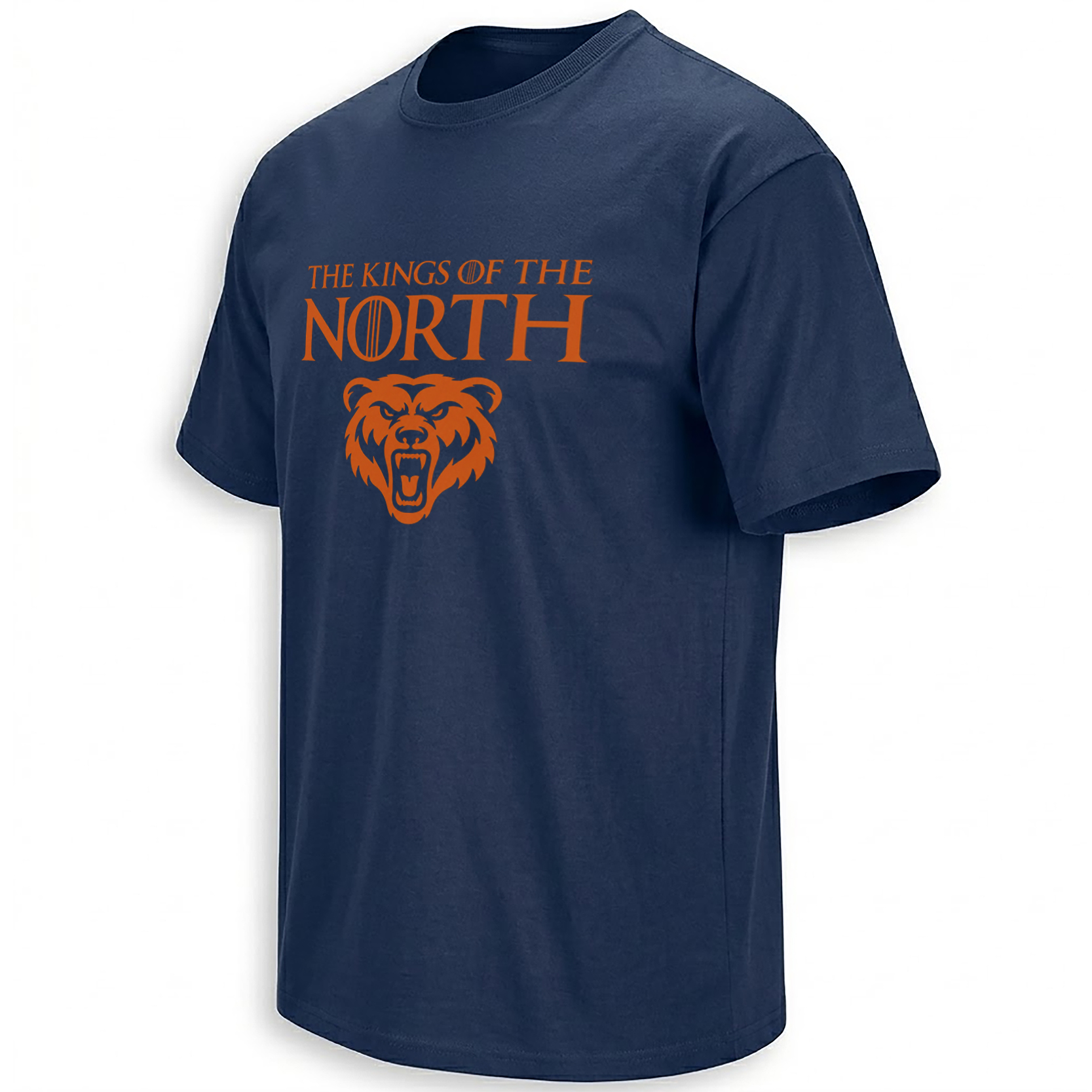
A navy-and-orange football emblem built around the NFC North rivalry and the unmistakable fantasy-television language of a northern kingdom.
View the Bears fantasy graphic →The Bears currently lead the NFC North at 7–2. They have not clinched the 2026 division championship. “Kings of the North” is a fan-facing metaphor and a Game of Thrones parody, not a verified championship designation or an official HBO collaboration.
Why Winter Makes the Metaphor Feel Natural
There is an additional cultural fit between Game of Thrones and the NFC North: winter. The television drama uses cold weather as a symbol of danger and uncertainty. For football teams in Chicago, Green Bay, Detroit and Minnesota, November and December are the months when division positioning becomes increasingly consequential.
Chicago’s next game comes after its bye, when it hosts New Orleans on November 22. Four days later, the Bears travel to Detroit for Thanksgiving. Those games are central to the next chapter of the race, especially the head-to-head opportunity against the Lions.
For fans, the image of a roaring bear beneath the words THE KINGS OF THE NORTH records confidence at a specific point in the season. Its meaning may change as the standings change, but that is part of what makes football graphics culturally interesting: they preserve what supporters believed when the story was still unfolding.
The Game and the Fan Conversation
The Bears’ official November 8 recap documents the unusual comeback-and-response sequence against Tampa Bay, while the team’s photo galleries preserve the scenes from Soldier Field. The strongest evidence of Chicago’s current position is the NFL standings rather than unverified social chatter.
For the original sporting context, readers can see the official Week 9 highlights and the Chicago Bears game report. These document the real result behind the contemporary fan slogan.
The wider Chicago Bears collection includes other images of the team’s evolving 2026 identity, while the NFL collection places this division rivalry within broader football culture. Designs involving the current quarterback can also be found through the Caleb Williams product search.
Frequently Asked Questions
Are the Chicago Bears leading the NFC North in 2026?
Yes. As of November 12, 2026, Chicago leads the division at 7–2, ahead of Detroit and Minnesota at 6–2 and Green Bay at 6–3.
Have the Bears won the 2026 NFC North title?
No. They lead the standings but have not clinched the division. The Kings of the North phrase is a fan declaration, not an official championship claim.
What is the Game of Thrones reference in Kings of the North?
It references the “King in the North” title associated with Robb Stark and Jon Snow, adapting the northern-kingdom idea to Chicago’s NFL division rivalry.
Who won the Bears versus Buccaneers game on November 8, 2026?
Chicago won 27–24 after Cairo Santos made a 38-yard field goal as time expired, extending the Bears’ winning streak to four games.
What does the orange bear symbolize in the design?
It represents Chicago’s team identity as a fictional heraldic emblem beneath the medieval-style Kings of the North typography.
Chicago’s 7–2 start has brought the Bears to the top of a demanding division. The Kings of the North design captures the confidence of that moment, while the remaining games will determine whether the football claim becomes reality.
The Kings of the North brings Chicago’s 2026 NFC North lead into Game of Thrones-inspired football imagery, combining medieval title lettering, a roaring orange bear and the rivalry-filled pursuit of division supremacy.