Harold Fannin Jr. Wins the Scepter
Two stiff arms. Thirty-seven yards after the catch. One overtime touchdown that Cleveland could not turn into a victory. Kyle Brandt saw enough to send the Week 9 Angry Runs scepter to Ohio.
With Cleveland trailing New Orleans 23–16 in overtime on November 8, 2026, Shedeur Sanders found Harold Fannin Jr. on a short pass. The Browns tight end caught the ball just two yards beyond the line of scrimmage. Thirty-seven yards later, he was in the end zone after delivering two forceful stiff arms to Saints defenders.
The play did not save the game. Cleveland failed on the ensuing two-point conversion and lost 23–22 at the Caesars Superdome. But the run was difficult to forget: an ordinary short reception had become a 39-yard touchdown through balance, strength and repeated refusal to be tackled.
Two days later, the highlight received a different kind of recognition. On November 10, Kyle Brandt selected Fannin as the Week 9 winner of the Angry Runs segment on NFL Network’s Good Morning Football. The symbolic Angry Runs scepter was heading to Cleveland.
Yards
the Catch
on the Play
The Overtime Play That Refused to End
The most revealing detail is where the play started. Sanders completed a short pass, leaving Fannin to create nearly all the yardage himself. Once the tight end turned upfield, the Saints had several opportunities to stop him.
The first defender encountered a stiff arm. Fannin kept his feet and accelerated. A second tackler came into range, and Fannin extended his arm again. What initially resembled a routine checkdown became a desperate defensive chase to the goal line.
The Browns’ official account emphasized the 39-yard touchdown in its immediate social coverage, while the NFL’s Angry Runs presentation focused on the violence and determination of the contact itself.
A Great Play Inside a Heartbreaking Loss
The final sequence made the highlight even more memorable. The Saints had taken a 23–16 lead on a touchdown pass to Juwan Johnson. Cleveland, rather than settling for a quiet overtime defeat, immediately threatened to answer.
Fannin’s touchdown reduced the deficit to one point. A successful two-point conversion would have given the Browns the lead, but the attempt failed. New Orleans escaped with the victory.
The contrast matters. Football highlight culture frequently treats a spectacular individual play as synonymous with a team-winning moment. This one was different. Fannin had produced an extraordinary run, but the scoreboard still belonged to the Saints.
The game belonged to New Orleans. The most violent run of Week 9 belonged to Harold Fannin Jr.
Editorial interpretationKyle Brandt Makes the Angry Runs Call
On November 10, Brandt revisited the touchdown on Good Morning Football. His reaction focused on Fannin’s determination through contact and the difficulty of stopping a runner who repeatedly maintained his balance after collision.
Angry Runs has developed its own visual tradition. The segment celebrates runners who punish tacklers, turn contact into additional yardage and make a highlight feel unusually physical. The scepter functions as the show’s recognizable symbol of victory.
Fannin’s performance was an obvious fit. His two stiff arms gave the segment clear images to replay. Rather than relying on speed alone, he used strength and leverage to extend the play after the catch.
Why the Scepter Means Something to Cleveland
Fannin’s recognition carries a hometown dimension. He grew up in Canton, Ohio, a city that occupies a foundational place in American professional football through the Pro Football Hall of Fame.
Now in his second NFL season, he has developed into a productive receiving tight end for Cleveland. Through nine games in 2026, he had 37 receptions for 453 yards and four touchdowns, along with 275 yards after the catch.
That final statistic helps explain why Angry Runs recognition is not an isolated novelty. Fannin has repeatedly created value after securing the football. The Saints touchdown was an extreme example of a characteristic already visible across his season.

From 39-Yard Run to Electric-Horror Artwork
The Harold Fannin Jr. Angry Runs shirt interprets the award through a visual language borrowed from supernatural horror posters and heavy-metal illustration.
Instead of presenting only a photograph of the touchdown, the graphic transforms Fannin into an exaggerated football character with a raised spiked scepter, blue lightning, monster heads and hands emerging from the ground.
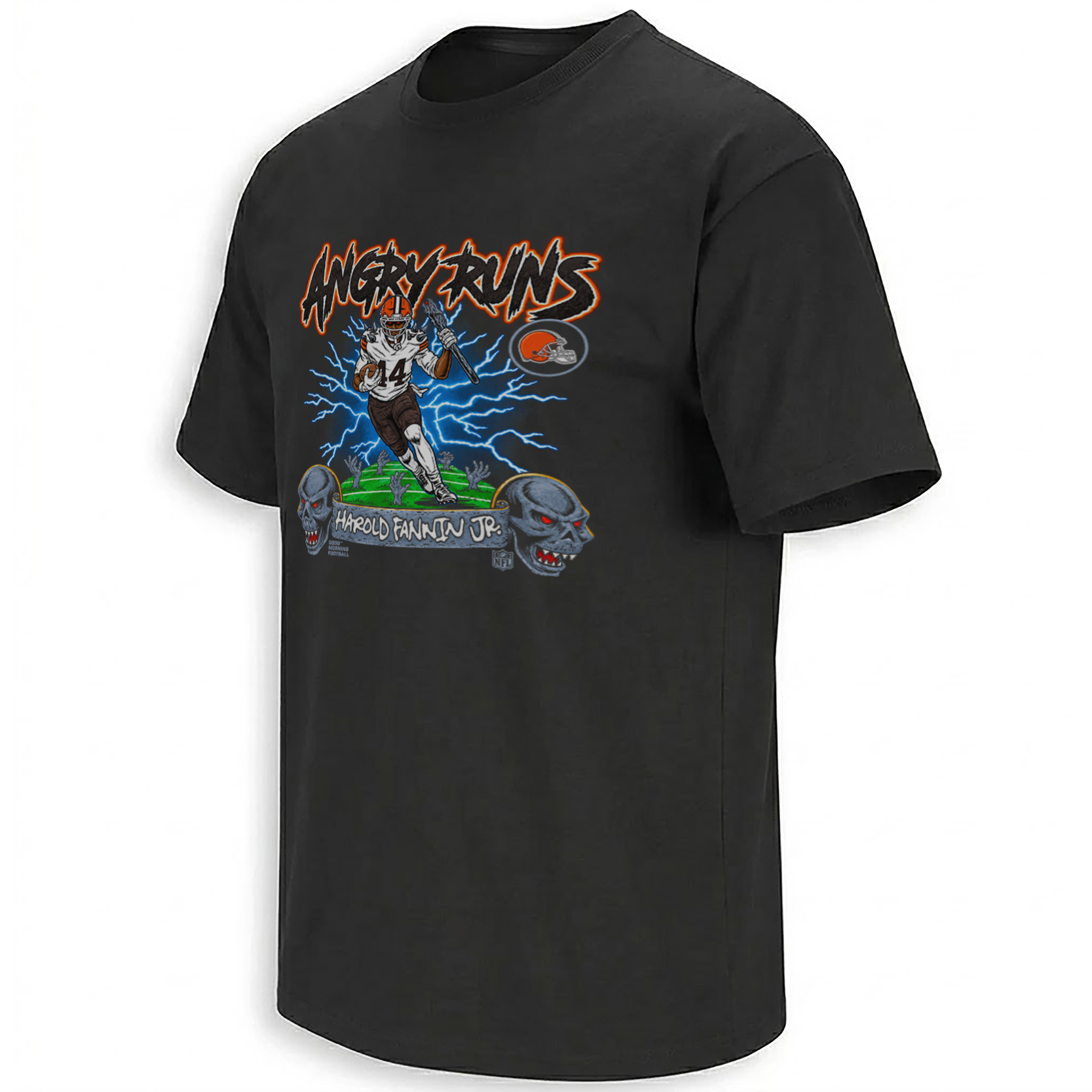
A horror-poster treatment of the two-stiff-arm touchdown and the scepter awarded on November 10, 2026.
View the Angry Runs graphic →The composition is intentionally theatrical. Jagged “ANGRY RUNS” lettering creates the sense of a storm or an approaching threat. Blue lightning explodes behind the player, while orange accents maintain the connection to Cleveland football.
The character’s pose converts the symbolic scepter into a literal weapon-like prop within the illustration. The monster faces and graveyard elements suggest that the runner is nearly impossible to bring down.
The artwork uses imaginative exaggeration rather than documentary realism. Fannin did not carry a scepter during the game, and the supernatural figures are not part of the highlight. They are visual metaphors for the physicality that earned the award.
Harold Fannin Jr. wears No. 44 for the Cleveland Browns. The illustrated player on this graphic appears to show No. 14. That discrepancy should be treated as an artwork detail, not a change in the player’s official jersey number.
Why Angry Runs Became a Football Meme Language
The appeal of the segment comes from an especially simple question: which player refused to be tackled in the most dramatic way? That is easy to debate, easy to clip and easy to turn into a visual reaction after the game.
Football fans already celebrate stiff arms, broken tackles and yards after contact. Angry Runs gives those moments a recognizable weekly ceremony. The scepter adds a physical symbol to the conversation, making the award feel like a character-defining achievement.
Fannin’s recognition also fits Cleveland’s preference for physical football identities. The Browns have a long tradition of celebrating toughness, and this particular play offered a striking modern example from a young receiving star.
The Highlight That Outlived the Score
The Browns entered their next week having dropped to 5–4. The loss to New Orleans remained the meaningful result for the standings. Yet Fannin’s play gave supporters an individual achievement to revisit.
Within the Cleveland Browns collection , graphics tied to player moments help preserve that layer of team culture. The wider NFL shirts collection connects the Browns story to similar highlights and fan references across the league.
Readers following the tight end’s development can explore additional Harold Fannin Jr. designs through the site’s internal product search.
Frequently Asked Questions
Who won Week 9 Angry Runs in 2026?
Cleveland Browns tight end Harold Fannin Jr. won the award, announced by Kyle Brandt on November 10, 2026.
What play earned Harold Fannin Jr. the scepter?
His 39-yard overtime touchdown against the New Orleans Saints on November 8, featuring two powerful stiff arms.
How many yards after the catch did Fannin gain?
He gained 37 yards after the catch on the touchdown reception.
Who threw Fannin’s overtime touchdown?
Cleveland quarterback Shedeur Sanders completed the short pass that Fannin turned into a 39-yard touchdown.
Did the Browns beat the Saints?
No. New Orleans won 23–22 in overtime after Cleveland failed on a two-point conversion attempt following Fannin’s touchdown.
What does the Angry Runs shirt design represent?
It portrays Fannin’s award-winning physical run through supernatural imagery, lightning, monster artwork and a raised Angry Runs scepter.
The Harold Fannin Jr. Angry Runs graphic turns one remarkable overtime play into a poster of Cleveland football physicality, preserving the moment that earned a young Browns tight end national recognition and an Angry Runs scepter.
Harold Fannin Jr. Angry Runs captures Cleveland’s Week 9 scepter winner through his 39-yard overtime touchdown, two stiff arms and a dramatic lightning-filled horror illustration inspired by the November 2026 Browns–Saints game.