
STATE CHAMPS.
THE HOLY WAR BELONGS TO UTAH.
A 28–20 win over BYU ended seven years without a Holy War victory for Utah. Four interceptions, four Devon Dampier touchdowns and one score turned a November rivalry into the defining Utah football image of the week.
On November 7, 2026, Rice-Eccles Stadium hosted a Holy War that already felt historic before kickoff. No. 3 Utah and No. 9 BYU entered as top-ten teams, bringing national stakes to a rivalry that rarely needs anything beyond the names on the jerseys. By the end of the afternoon, the scoreboard read Utah 28, BYU 20, and the Utes had their first win over the Cougars since 2019.
But the story was not simply that Utah won. The Utes had jumped ahead 14–0, surrendered 20 consecutive points and entered halftime trailing by six. What followed was the kind of second-half turnaround that gives rivalry results their staying power: an offensive recovery, a defensive shutout and four interceptions that repeatedly denied BYU a way back into the game.
Utah improved to 9–0 overall and 6–0 in Big 12 play. For supporters who had watched the Cougars win the previous three meetings, the outcome carried a second scoreboard that nobody needed to display: seven years of waiting had finally ended.
How Utah Took the Game Back
Quarterback Devon Dampier began with an emphatic statement, rushing for an early touchdown and connecting with Braden Pegan on a 46-yard scoring pass. BYU, however, refused to disappear. The Cougars produced their own explosive plays, including a 75-yard touchdown reception by Legend Glasker, and reached halftime holding a 20–14 advantage.
The second half changed the terms of the contest. James Chenault and Lance Holtzclaw helped build Utah’s comeback with interceptions. Dampier found Pegan for another touchdown as the Utes retook the lead, then ran for a further score in the fourth quarter to push it to 28–20.
And when BYU threatened again, the defense delivered the images that would define the finish. Trey Reynolds intercepted Bear Bachmeier near the goal line with 4:39 remaining. Nate Ritchie ended the Cougars’ final opportunity with another interception. The shutout after halftime was complete.
According to Utah’s official recap, Dampier accounted for four touchdowns while the defense recorded its highest single-game interception total since October 2022.
The Actual Images Behind 28–20
The most enduring visual from a rivalry victory is rarely a polished studio portrait. It is the tackle, the interception, the crowd or the exhausted celebration immediately after the final whistle. Utah’s official November 7 game gallery preserves that documentary side of the Holy War, with photographs captured during the same contest commemorated by the graphic.
Why “State Champs” Means Something Different in the Holy War
The phrase “State Champs” is not claiming that Utah received an NCAA state championship trophy. College football does not award a formal title to the winner of this rivalry. Instead, it captures a familiar piece of rivalry humor: when the two programs that dominate much of Utah’s college football conversation meet, the winner earns the right to talk about owning the state.
That distinction is central to the design’s appeal. A national ranking can change the next week. A conference race can continue into December. But the result of the Holy War stays with both fan bases until the next meeting. The words “State Champs” turn that temporary but deeply felt authority into a concise, instantly understandable declaration.
The scoreboard settled the game. “State Champs” is how the winning side gets to remember it.
Why the 2026 Victory Cut Deeper
Utah’s win broke a three-game losing streak against BYU and was its first victory in the series since 2019. It was also the first Holy War featuring two AP top-ten opponents, an unusually intense intersection of local identity and national football relevance.
For BYU, the loss was particularly frustrating because its first-half comeback had changed the atmosphere of the game. Bear Bachmeier threw for 272 yards, but his four interceptions became impossible to separate from the result. The Cougars found chances to score after halftime, yet left every one unfinished.
For Utah, the reverse was true. Morgan Scalley’s team demonstrated the resilience expected of an unbeaten program. The victory strengthened its position in the Big 12 standings and kept its College Football Playoff ambitions alive. The rivalry win became part of a larger undefeated-season narrative without losing its deeply local character.
How the State Champs Graphic Records the Moment
The Utah State Champs graphic treats the result like a vintage collegiate newspaper headline. Its arched distressed lettering puts “STATE CHAMPS” at the top, with the Utah drum-and-feather U emblem centered beneath it. “WE ARE UTAH” establishes the identity, and the date and final score—11/7/26 and 28–20—make the reference precise.
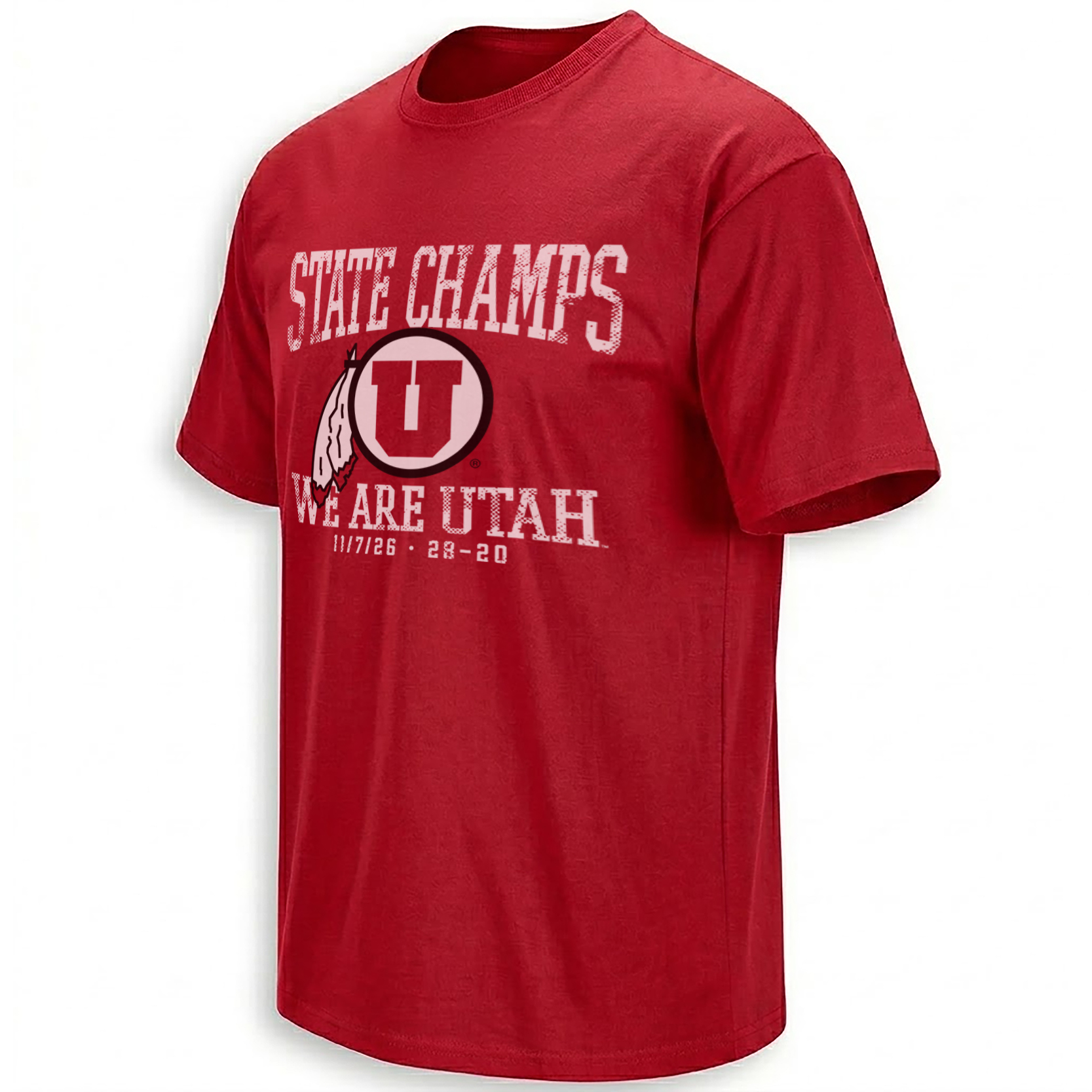
A rivalry headline in Utah red, tied to the score that ended the Utes’ wait for another win against BYU.
View the graphic →The worn typography provides a deliberately retro texture. The graphic could belong on the cover of a campus sports special or a commemorative poster outside Rice-Eccles Stadium. Rather than placing one player at the center, it represents the entire team and fan base.
Two Fan Bases, One Result That Will Be Remembered
The Holy War exists in the conversations that continue after every game: in family arguments, workplace banter, neighborhood allegiances and the annual comparison between Salt Lake City and Provo. Its meaning cannot be reduced to one Saturday’s rankings.
That is why the broader Utah Utes collection has a natural place in the story. Different graphics preserve different chapters of Utah football culture. The opposing BYU Cougars collection represents the other side of a rivalry that depends upon both schools, while the college sports collection connects these intensely local images to the wider language of campus sports fandom.
The 2026 edition will always have one unmistakable identifying feature: the eight-point margin that changed which side could claim the bragging rights.
Frequently Asked Questions
Who won the 2026 Utah vs. BYU Holy War?
Utah defeated BYU 28–20 on November 7, 2026, at Rice-Eccles Stadium in Salt Lake City.
Why does the Utah shirt say “State Champs”?
It is a playful declaration of in-state rivalry bragging rights after Utah beat BYU, rather than a claim to an official NCAA state championship.
When had Utah last beaten BYU before 2026?
Utah’s previous Holy War victory came in 2019. Its 2026 win ended three consecutive rivalry losses.
What did Devon Dampier do against BYU?
Dampier accounted for four touchdowns: two passing and two rushing, helping Utah overcome a 20–14 halftime deficit.
Why was the November 2026 Holy War historic?
It was the first Utah–BYU meeting with both programs ranked in the AP top ten, and the victory kept Utah undefeated at 9–0.
The final score remains the simplest way to tell the story: Utah 28, BYU 20. The State Champs design keeps that score beside the imagery and language the winning side wanted to remember.