I Smell Commies The Reagan Meme That Sounds Like the Cold War
Four words, a presidential portrait and a weathered 1980s sunset. The I Smell Commies graphic turns Ronald Reagan’s Cold War reputation into exaggerated retro humor — but the historical story behind the joke is more complicated than the slogan.
The joke is immediate: Ronald Reagan looks suspiciously into the distance, apparently detecting something the rest of us cannot. Behind him, a faded sunset carries the colors of an old American graphic tee. Above it all sits an exaggerated declaration: I SMELL COMMIES.
The phrase is contemporary political parody, not a verified quotation from the 40th president of the United States. Yet the reason it works is rooted in a documented political history.
Reagan served as president from 1981 to 1989, during the final decade of the Cold War. His administration frequently presented the geopolitical competition with the Soviet Union in explicitly ideological terms.
Decades later, that association remains recognizable enough to support visual satire, historical nostalgia and retro political merchandise.
The Cold War History Behind the Joke
To understand the graphic, it helps to revisit the political atmosphere of Reagan’s presidency.
When he entered office in January 1981, the United States and Soviet Union remained divided over military power, political systems, international influence and competing visions of the global order.
Reagan criticized Soviet communism in forceful terms and supported policies emphasizing American military strength and opposition to Soviet influence.
His administration’s approach also evolved. Later in the decade, negotiations with Soviet leader Mikhail Gorbachev contributed to landmark arms-control efforts.
The Cold War story therefore includes both confrontation and diplomacy — a distinction easily lost in the compressed language of political memes.
1983: The Speech That Defined Reagan’s Anti-Soviet Image
On March 8, 1983, Reagan addressed the National Association of Evangelicals in Orlando, Florida.
The speech became known as the Evil Empire address because of the president’s description of the Soviet system and its ideological conflict with the United States.
The U.S. State Department’s Office of the Historian identifies the address as a major example of the administration’s Cold War rhetoric.
Supporters viewed that language as moral clarity in confronting an authoritarian rival. Critics questioned whether such rhetoric might intensify tensions between nuclear powers.
These debates belonged to the political landscape of the early 1980s and remain part of the historical interpretation of Reagan’s presidency.
Ronald Reagan Beyond the Presidential Podium
Reagan’s public image was also shaped by appearances away from formal speeches. Photographs at Rancho del Cielo, his California ranch, frequently showed him in cowboy hats, sunglasses and casual outdoor clothing.
These images supplied a different cultural vocabulary from the official suit-and-tie presidential portrait. They became part of the visual shorthand associated with Reagan’s public persona.

The historical photograph does not depict the fictional phrase on the Ellie Shirt design. Instead, it documents the casual visual identity that helped make Reagan recognizable beyond formal politics.
Where Did I Smell Commies Come From?
The four-word slogan is best understood as a modern parody of Reagan’s anti-communist reputation.
No authenticated historical source examined for this article establishes I Smell Commies as a statement Reagan actually delivered.
Rather than quoting a particular speech, the artwork exaggerates the political image associated with him into a comic reaction: a president so sensitive to communist ideology that he can supposedly detect it by smell.
I Smell Commies is a parody slogan. Reagan’s documented Cold War statements include his 1983 Evil Empire rhetoric and the 1987 Brandenburg Gate address. The graphic should not be presented as an authentic presidential quotation.
Why the Retro Sunset Changes the Meaning
Visually, the design belongs to a familiar family of vintage American graphic shirts.
Its distressed bands of red, orange and green echo the faded sunset artwork associated with 1970s and 1980s leisurewear. The portrait supplies the recognizable historical subject, while the slogan introduces the political parody.
The retro styling is significant because it transforms a sharp ideological reference into something resembling an old novelty T-shirt.
The I Smell Commies Ronald Reagan Shirt uses that contrast as its central design strategy.
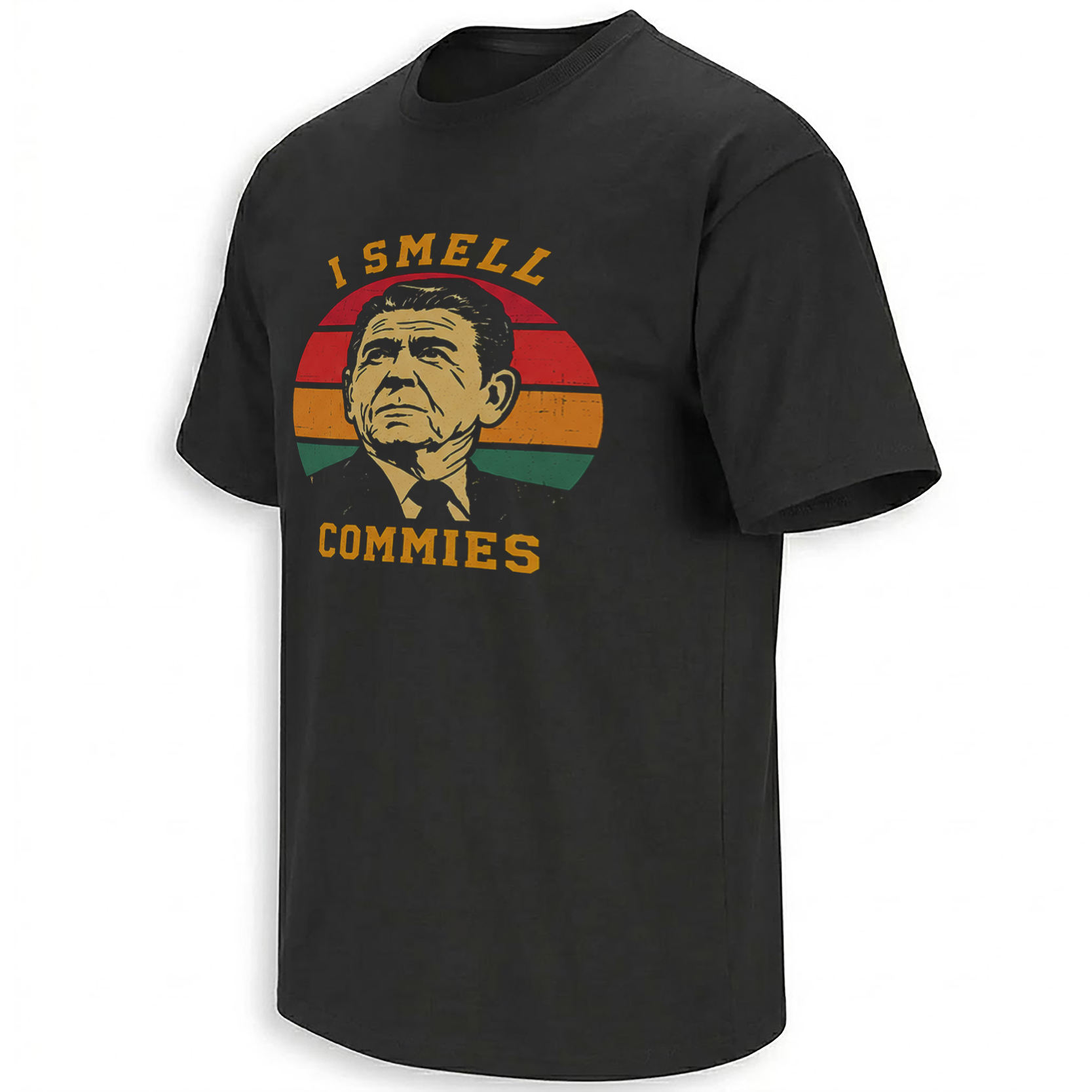
A vintage-style political parody pairing Reagan’s recognizable Cold War identity with distressed sunset lettering and exaggerated comic language.
View the retro parody design →The visual treatment also helps explain why a historical reference can circulate outside formal political debate.
For some viewers, the design may evoke nostalgia for Reagan-era conservatism. For others, the exaggerated wording may read as satire of Cold War suspicion itself.
The artwork leaves room for both readings because its central language is overtly theatrical rather than documentary.
1987: The Berlin Wall Speech and a Different Historical Image
On June 12, 1987, Reagan stood near the Brandenburg Gate in West Berlin and addressed Soviet leader Mikhail Gorbachev.
His speech included the now-famous appeal for the barrier dividing the city to be removed.
The remarks became one of the enduring public images of Reagan’s later presidency.
Unlike the invented wording on the retro shirt, the Berlin address survives in official transcripts, photographs and video recordings.
Original historical recording: Ronald Reagan Presidential Foundation — Tear Down This Wall, June 12, 1987 . Published on the Foundation’s official YouTube channel.
The speech illustrates the difference between historical language and modern political graphic humor.
Reagan’s actual remarks took place within a specific diplomatic and geopolitical setting. The I Smell Commies slogan removes that context to create a simplified, exaggerated cultural character.
Why Cold War Imagery Continues to Appear on Retro Shirts
Cold War visual culture offers immediately recognizable symbols: national flags, military imagery, television-era portraiture, political speeches and strong ideological slogans.
Retro graphics frequently reuse those references as nostalgia, satire or commentary on the public figures of the period.
That does not make every political parody a historical statement. Its meaning depends on the relationship between the original history and the modern reinterpretation.
In this design, the Reagan portrait establishes the historical association. The weathered sunset gives it an era-specific aesthetic. The deliberately exaggerated slogan delivers the joke.
Readers interested in other representations of historical political figures can explore Ellie Shirt’s verified Politics collection .
For other artwork featuring the former president, the Ronald Reagan product search provides a direct route to related designs.
Frequently Asked Questions
Did Ronald Reagan actually say I Smell Commies?
There is no authenticated evidence from the sources examined here establishing that Reagan said this phrase. It is best understood as modern political parody.
What historical events inspired the Reagan parody?
The design references Reagan’s Cold War reputation, including his 1983 Evil Empire speech and broader opposition to Soviet communism.
When was Ronald Reagan president?
Ronald Reagan served as the 40th president of the United States from 1981 to 1989.
What happened during Reagan’s 1987 Berlin speech?
On June 12, 1987, Reagan spoke at the Brandenburg Gate in West Berlin and urged Soviet leader Mikhail Gorbachev to remove the Berlin Wall.
Why does the I Smell Commies design use a retro sunset?
Its faded color bands reference vintage graphic T-shirt aesthetics, combining 1980s nostalgia with a modern satirical slogan.
The I Smell Commies Ronald Reagan design turns a recognizable Cold War political identity into a vintage-style illustration. Its slogan is parody; its historical references belong to the documented debates of the Reagan era.
I Smell Commies Ronald Reagan Shirt combines the former president’s Cold War image with distressed red, orange and green sunset graphics and a deliberately exaggerated modern political parody slogan.