I’m Not Clumsy. The Floor Hates Me.
The tables are bullies. The chairs are in on it. And the walls keep getting in the way. How a familiar joke about clumsiness turns everyday accidents into a full-blown household conspiracy.
There is a particular kind of person who can walk through an empty room and somehow emerge with a bruised knee. They catch their foot on the edge of the rug, discover the coffee table with their shin and collide with a doorway that has occupied exactly the same position for years. At some point, an explanation becomes necessary.
The easiest explanation is clumsiness. The funnier explanation is that the entire building has organized itself against them.
That is the world of the I’m Not Clumsy Shirt . The floor is hostile, the furniture is bullying the wearer and the walls are apparently moving just enough to cause trouble. Nobody actually believes the furniture is alive. The pleasure comes from pretending it is.
Why “The Floor Hates Me” Is Such a Good Excuse
The joke begins with a recognizable embarrassment. Tripping in front of somebody, bumping into a chair or knocking over a drink can make even a small mistake feel larger than it is.
Instead of offering a straightforward admission, the speaker responds with an impossible accusation. They have not misjudged the distance between their body and the table. The table has deliberately inserted itself into their path.
This is a classic example of personification: assigning human intentions or emotions to objects that do not possess them. The humor depends on that obvious impossibility.
It also offers a gentler alternative to becoming genuinely embarrassed. The person is laughing at their own awkward moment, but the story gives them a playful villain to blame.
Sometimes the Pavement Really Is the Problem
The funny thing about this joke is that its central premise is not always completely unreasonable. Uneven ground, raised paving stones and misplaced objects can create real obstacles.
A documented example appears in this photograph of a raised paving slab in Tottenham, London. Unlike the fictional enemy floor on the shirt, the physical obstacle is an actual trip hazard.

That real-world contrast helps explain the resilience of the saying. Everyone recognizes how a physical environment can occasionally work against them. The joke simply exaggerates that possibility until every object in the room seems to have a personal grudge.
How the Quote Escalates Into a Household Conspiracy
The full phrase unfolds like a series of increasingly unreasonable accusations. Each part broadens the alleged conspiracy.
“I’m not clumsy” rejects the most obvious explanation for the accident.
“The floor hates me” gives the ground a fictional personal motive.
“The tables and chairs are bullies” recruits the furniture into the imaginary conflict.
“The walls get in my way” makes the entire room responsible for the problem.
The escalation matters because the opening phrase alone could be a short one-line joke. The extra details create a story. By the end, the narrator is no longer simply clumsy; they are the innocent victim of a coordinated architectural attack.
The furniture isn’t moving. That’s what makes the accusation funny.
Where Did the “I’m Not Clumsy” Quote Originate?
Variations of the saying appear across online quote collections, novelty apparel and independent designs. Some mention only the floor; others add tables, chairs and walls. Different versions change the order and wording of the joke.
The quote does not have a verified original author or a clearly documented first social-media post. Marketplace listings demonstrate its circulation, but they do not establish who invented it.
For example, Redbubble’s collection of clumsiness quotes contains multiple differently worded versions of the floor-and-furniture joke. The same broader concept appears in independent TeePublic listings .
Those examples should be interpreted as evidence of an established humorous saying, not proof of one creator’s ownership or the exact date of the first version.
The specific author and first publication date remain unverified. The saying is best described as a circulating humorous quote, not as a confirmed celebrity catchphrase or a line from a named television show.
Why the Retro Typography Is the Entire Artwork
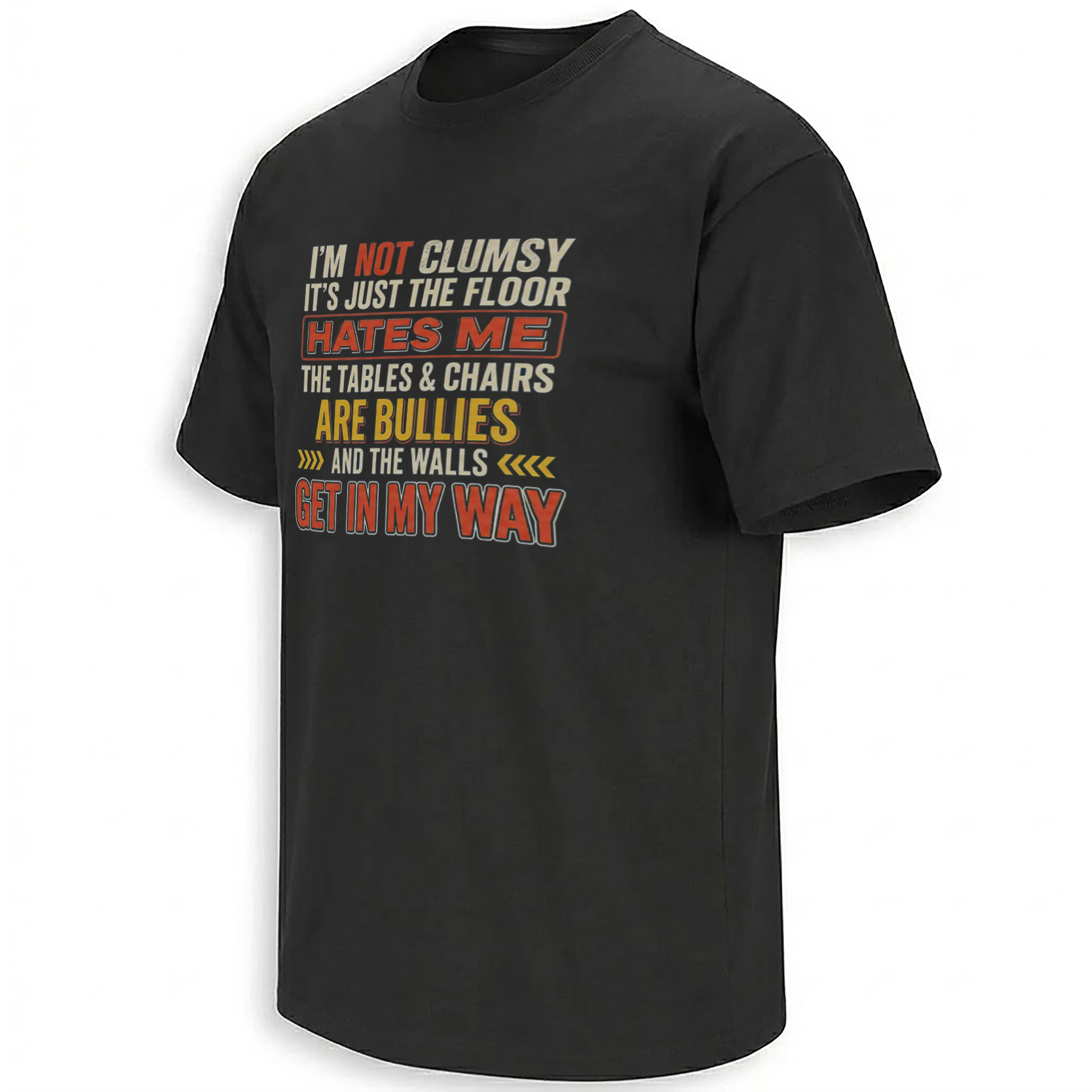
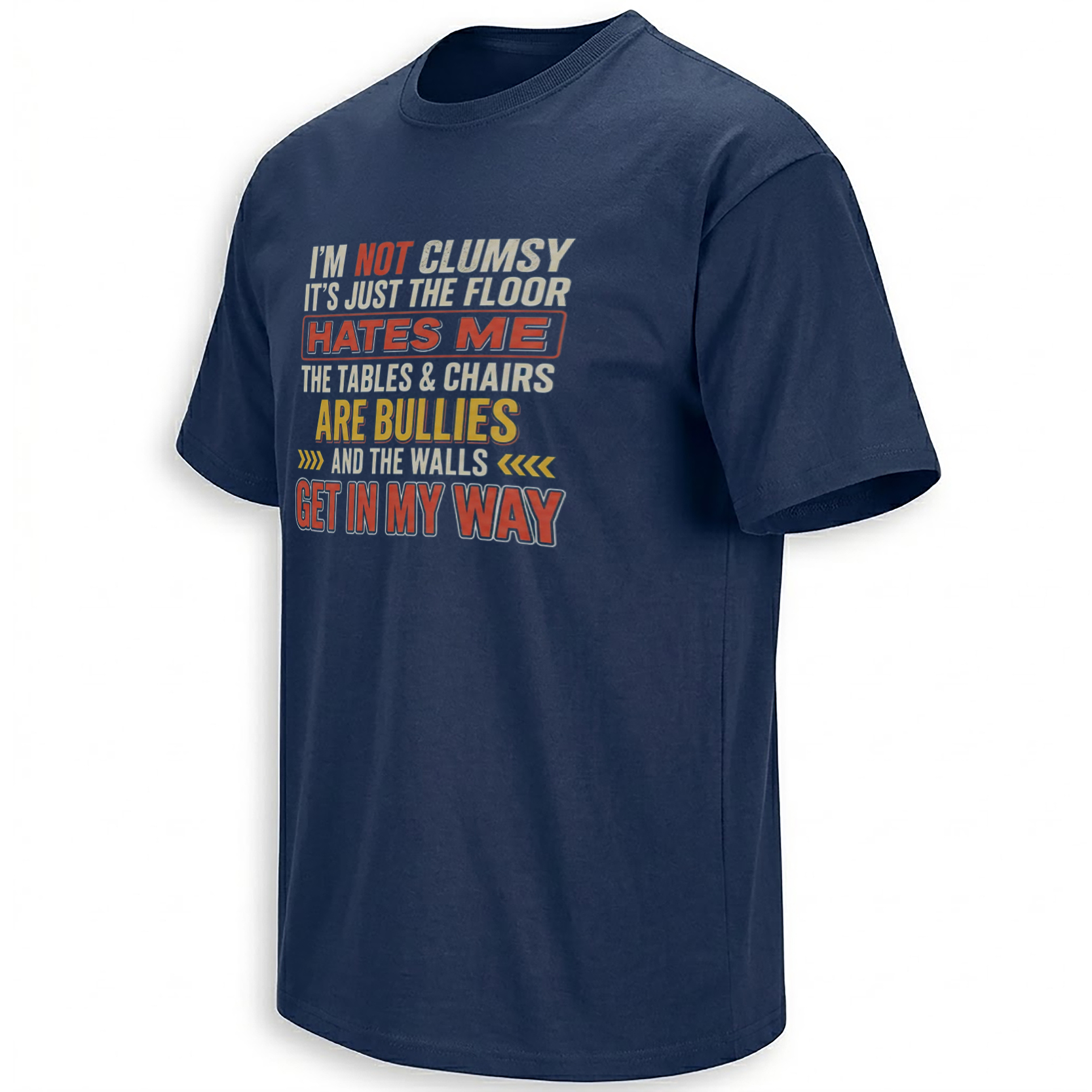
The Ellie Shirt design contains no illustrated character. It relies on the movement of words across a dark background.
Cream-colored italic letters introduce “I’M NOT CLUMSY,” with red used to emphasize the denial. The phrase “HATES ME” becomes an outlined red focal point, followed by mustard-yellow emphasis on the furniture’s supposed bullying.
Decorative arrows and chevrons help guide the eye toward the final accusation, “GET IN MY WAY.” The stacked arrangement produces the feeling of an old sports or advertising poster, but the subject is deliberately trivial.
That contrast makes the design visually effective. It treats an embarrassing little accident as if it deserves a dramatic headline, giving the joke a reading rhythm even without a picture.
Black and Navy: Two Versions of the Same Complaint
Both versions retain the identical cream, rust-red and mustard-yellow artwork. The shirt color changes the surrounding contrast rather than the central joke.
Why Self-Deprecating Humor Never Needs a Viral Moment
Some internet designs depend on a particular celebrity, event or video. This one works because it describes a recurring human experience.
A person who is usually coordinated can still have a clumsy day. Someone known for being accident-prone may find the exaggeration especially relatable. Either way, the audience does not need to know an original meme creator to understand the joke.
The humor also operates without targeting another person. Its fictional villains are household objects. That keeps the comic frustration focused on the speaker and their relationship with their surroundings.
Readers looking for more contemporary statement designs can browse the newest Ellie Shirt collection or explore the site’s clumsy-humor product search .
Frequently Asked Questions
What does “I’m Not Clumsy, the Floor Hates Me” mean?
It is a self-deprecating joke that blames a person’s awkward accidents on an imaginary grudge held by the floor.
Why does the quote say tables and chairs are bullies?
It gives ordinary furniture human intentions, exaggerating bumps and collisions into a fictional campaign of harassment.
Who originally said the I’m Not Clumsy quote?
No reliable evidence currently establishes the original author. Different versions circulate in online quote and merchandise collections.
Does the design feature an illustrated character?
No. It uses stacked retro-style lettering, outlined words and decorative arrows to tell the joke.
What are the two pictured shirt colors?
The artwork is presented in black and navy versions, both with cream, red-orange and mustard-yellow typography.
Why is this quote relatable?
Almost everyone has tripped, bumped into furniture or misjudged a doorway. The joke turns those familiar mishaps into an exaggerated excuse.
The I’m Not Clumsy graphic captures the best part of self-deprecating humor: admitting an awkward moment while insisting, with absolutely no evidence, that the entire room was responsible.
I’m Not Clumsy, The Floor Hates Me Shirt combines sarcastic humor about bullying tables, chairs and walls with bold retro lettering. Two dark colorways, black and navy, highlight the cream, red-orange and mustard-yellow design.