Wemby. Duncan. The Meaning of #21.
A black retro Tim Duncan portrait tee connects Victor Wembanyama’s present-day Spurs era with the superstar who built San Antonio’s championship foundation. The story behind the garment goes deeper than its 1990s lettering.
The first thing you notice is the number. A large, nostalgic 21 sits beside a faded portrait of Tim Duncan on a black shirt — a design that makes San Antonio basketball history visible before anyone says a word.
Victor Wembanyama has been associated with this retro Duncan look, an image that links two generational Spurs stars through something much simpler than a highlight reel. One is the player who helped establish the franchise’s modern championship identity. The other represents its future.
What is documented beyond doubt is Duncan’s legacy and Wembanyama’s place in the Spurs’ next era. The precise date and circumstances of Wembanyama’s photographed appearance in the shirt have not been independently verified, so the garment should not be treated as evidence of a specific game-day arrival or endorsement.
Why Tim Duncan’s Number 21 Means Everything in San Antonio
San Antonio selected Tim Duncan with the first overall pick in the 1997 NBA Draft. Over nineteen seasons, he became the defining player of the franchise’s greatest period.
Duncan won five NBA championships in 1999, 2003, 2005, 2007 and 2014. He earned two regular-season MVP awards and three Finals MVP awards, made fifteen All-Star teams and became synonymous with efficient, disciplined two-way basketball.
The Spurs retired his number 21 in December 2016. That distinction transformed the digits from a jersey identifier into a piece of the team’s permanent history.
Duncan enters the NBA as San Antonio’s first overall pick.
San Antonio captures its first NBA title with Duncan and David Robinson.
Duncan retires after nineteen seasons; the Spurs retire No. 21.
The 1990s Connection Isn’t Just an Aesthetic
The shirt’s “1990s” reference brings the viewer back to Duncan’s earliest NBA chapter. This was the period when he entered a team led by David Robinson and helped turn San Antonio into a champion.
In 1999, Duncan’s Spurs defeated the New York Knicks to win the organization’s first NBA championship. The season established the foundation for a dynasty that would keep finding ways to compete for more than a decade.
Black-and-white portraits, distressed ink and oversized numerals recall the visual culture of vintage basketball merchandise. They are especially effective here because Duncan’s image is so strongly associated with the beginnings of San Antonio’s title era.
Two Generations of Spurs Basketball

The connection between Duncan and Wembanyama is not merely based on their height or the position they play. Both entered the NBA as number-one draft picks carrying the expectations of a franchise with enormous ambitions.
Duncan inherited a team that had already established a strong organizational culture through Robinson. Wembanyama arrived in San Antonio in 2023, decades later, with a different skill set and a new generation of teammates.
The comparisons have intensified as Wembanyama has helped bring the Spurs back toward the top of the league. But it is important to resist claiming that the two men have identical careers. Duncan’s five championships are an established record; Wembanyama’s long-term legacy is still being written.
What the Retro Shirt Actually Shows
The 1990s #21 Shirt uses a monochrome treatment. Tim Duncan’s portrait is paired with a prominent number 21 and 1990s typography, all placed against a black background.
The contrast is deliberately minimal. There are no elaborate flames, trophy collages or oversized contemporary headlines. Its appeal comes from the balance of recognizable basketball history and worn-in vintage style.
That restraint also explains why the graphic works as a bridge between generations. Longtime Spurs fans recognize the historical reference immediately, while younger fans familiar with Wembanyama can explore the player whose retired number appears on the design.
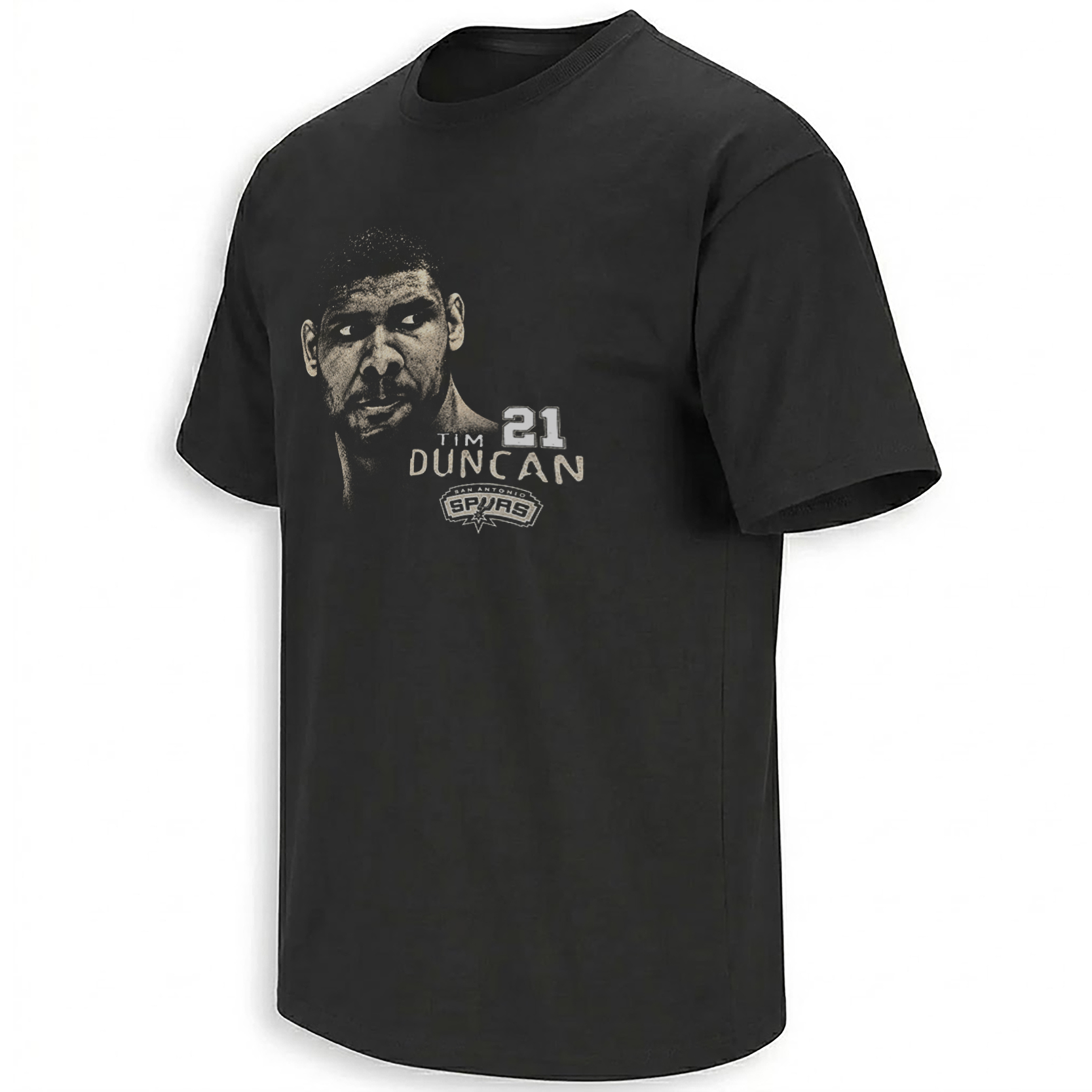
A black, distressed, monochrome graphic that celebrates the Spurs’ 1990s legacy and Duncan’s retired jersey number.
View the retro portrait design →Why Wembanyama and Duncan Belong in the Same Conversation
Both players changed the expectations surrounding the Spurs. Duncan offered stability, elite defense, efficient scoring and unmatched consistency over nineteen seasons. Wembanyama has brought unprecedented size, perimeter mobility, shot blocking and offensive versatility to modern San Antonio basketball.
The similarities make for compelling historical comparisons, but their differences are equally important. Duncan entered a franchise ready to contend, developed alongside Robinson and helped sustain a dynasty. Wembanyama is central to a newer project built in a different league and tactical environment.
Wearing or depicting a Duncan tribute does not mean either player’s achievements should be confused with those of the other. The most meaningful interpretation is one of franchise continuity — the past informing the present without determining the future.
Why Vintage NBA Shirts Have a Special Place in Fan Culture
Some basketball apparel celebrates a specific victory. Other designs celebrate the athlete whose presence changed the team over an entire era.
Duncan’s number belongs in the second category. It recalls championship banners, the 1999 Finals, the Robinson partnership and the methodical basketball that became synonymous with the Spurs.
A retro shirt can make that legacy accessible without trying to fit every achievement onto the garment. Sometimes the most recognizable symbol is simply the number that no future Spur will wear in an NBA game.
See the NBA’s Spurs retired numbers guide, the official 2016 Duncan retirement announcement and San Antonio’s No. 21 retirement announcement.
Browse EllieShirt’s Tim Duncan designs, Victor Wembanyama designs and San Antonio Spurs apparel.
Frequently Asked Questions
What does 1990s #21 mean on the shirt?
It references Tim Duncan’s No. 21 and the late-1990s beginning of his legendary career with San Antonio, including the 1999 NBA championship.
Did Victor Wembanyama wear a Tim Duncan tribute shirt?
The shirt is presented as the retro Duncan look associated with a photographed Wembanyama outfit. The exact time and circumstances of that appearance have not been independently verified.
How many NBA championships did Tim Duncan win?
He won five with San Antonio: 1999, 2003, 2005, 2007 and 2014.
Is Tim Duncan’s No. 21 retired?
Yes. The Spurs retired Duncan’s jersey number on December 18, 2016.
What style is the shirt?
It features a black base, distressed monochrome Tim Duncan portrait and 1990s-inspired No. 21 typography.