
Connor Hellebuyck Has Arrived. Welcome to Helle’s Gate.
Three Vezina Trophies, an Olympic gold medal and one enormous unanswered question: can New Jersey’s newest goaltender deliver the Stanley Cup that has eluded him?
On October 23, 2026, the New Jersey Devils changed the conversation around their season with one enormous move: acquiring Connor Hellebuyck from the Winnipeg Jets.
By the following afternoon, the decorated American goaltender was at Prudential Center in Newark, meeting his new teammates, speaking to reporters and explaining why he wanted the next phase of his career to begin in New Jersey.
For the Devils, the message was unmistakable. This was an investment in a team that believed its Stanley Cup window was already open.
For hockey’s visual culture, the trade also inspired an almost inevitable piece of wordplay: Helle’s Gate.
How the October 23 Trade Changed New Jersey’s Ambitions
Hellebuyck’s arrival followed a difficult departure from Winnipeg. After eleven NHL seasons with the Jets, he requested a trade and did not report to training camp for the 2026–27 campaign.
The Devils ultimately acquired him in a major transaction that sent Dawson Mercer, Nick Bjugstad, goaltender Nico Daws, prospect Alexander Command and two draft picks to Winnipeg.
The package demonstrated how seriously New Jersey valued the opportunity. Acquiring an established elite goaltender required sacrificing current roster pieces and future assets.
General manager Sunny Mehta saw the move as part of a broader pursuit of the franchise’s fourth Stanley Cup. The Devils already had talent led by Jack Hughes, Nico Hischier and Jesper Bratt. Hellebuyck added a proven veteran presence at a position that can determine an entire playoff series.
New Jersey didn’t trade for another promising piece. It traded for a goaltender with the résumé of a franchise cornerstone.
What Hellebuyck Said When He Arrived in Newark
During his October 24 introduction, Hellebuyck described the frustration of sitting out the beginning of the season and his excitement about returning to NHL competition.
He emphasized the Devils’ skill, habits and organizational commitment to winning. At 33, the goaltender’s career already included major individual awards, but the Stanley Cup remained the central unfinished objective.
The timing is important. As of October 27, Hellebuyck had not yet played a game for New Jersey. Coach Sheldon Keefe indicated that the team would assess his preparation before determining his debut.
That means the fascination surrounding him is still about possibility rather than a completed Devils achievement.

The Goaltending Legacy Hellebuyck Is Walking Into
New Jersey’s identity as a championship franchise has long been connected to the crease. Martin Brodeur helped define an era in which disciplined defensive hockey and elite goaltending became synonymous with the Devils.
The franchise won Stanley Cups in 1995, 2000 and 2003. Since the last of those championships, its supporters have watched several different versions of the organization attempt to return to that level.
Hellebuyck is not being brought to Newark to imitate Brodeur. Their careers and circumstances are different. But he enters a market where fans understand the value of a goaltender capable of controlling decisive games.
His own career includes three Vezina Trophy victories, the Hart Trophy as NHL MVP and Olympic gold with the United States in 2026.
Those achievements explain the scale of expectations. They also make the metaphor of a gate particularly appropriate: the Devils have acquired someone whose professional identity is built around denying opponents access to the net.
Why “Helle’s Gate” Works as New Jersey Hockey Language
The phrase operates on several levels. “Helle” comes directly from Hellebuyck’s surname. “Gate” suggests a barrier that attacking players must somehow find a way through.
At the same time, the wording evokes the Devils’ name and its established dark-red, black and infernal visual associations.
This creates an unusually natural piece of player-specific hockey wordplay. The surname, team branding and role on the ice reinforce each other without requiring a complicated explanation.
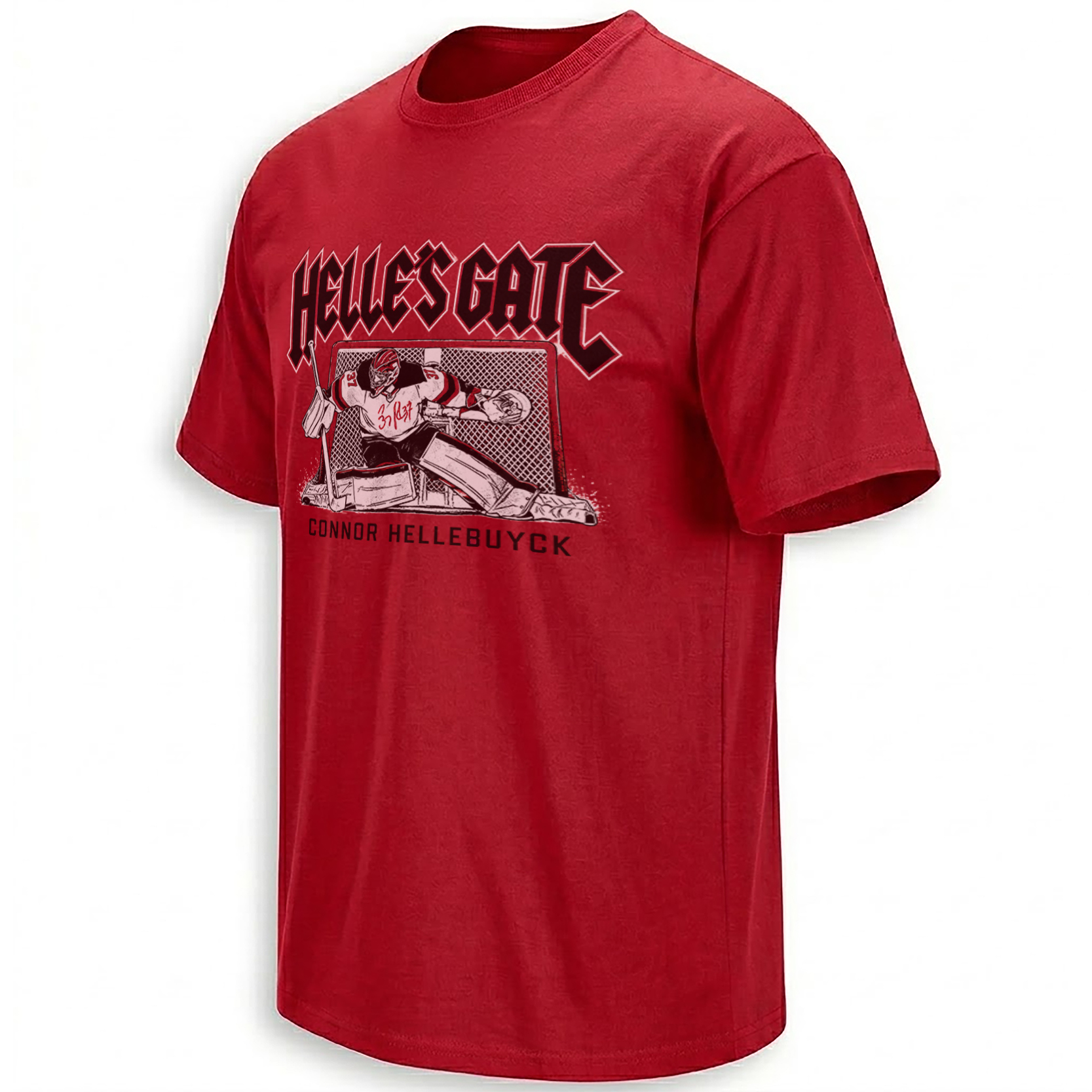
A dark hockey concept inspired by the Devils’ blockbuster acquisition and the intimidating idea of a world-class goaltender guarding New Jersey’s crease.
Explore the Helle’s Gate design →The idea is deliberately theatrical. It does not mean that opposing players will literally be unable to score, or that Hellebuyck has already delivered a record-setting shutout streak in New Jersey.
It captures the ambition behind the trade: to make scoring on the Devils significantly more difficult while giving the team’s attacking talent a stronger defensive foundation.
“Helle’s Gate” is a fan-inspired design concept associated with Hellebuyck’s October 2026 move, not a verified official team nickname or a claim about his as-yet-unplayed Devils debut.
A Complicated Winnipeg Exit, a New Beginning in New Jersey
Hellebuyck spent more than a decade with the Jets and became the franchise’s leader in several major goaltending categories. His departure therefore represents more than a routine trade.
It also came after a challenging 2025–26 campaign and an offseason disagreement that kept him away from Winnipeg at the start of the next season.
New Jersey is betting that the version of Hellebuyck who dominated during his best seasons can help push an already talented roster into genuine Cup contention.
For the player, the move offers a different environment and an immediate sense of purpose. For the Devils, it adds a major name to a team seeking its first championship since 2003.
From Trade News to Fan Culture
Some player graphics commemorate an achievement that has already happened. Others capture a shift in expectations the moment a major transaction is announced.
Helle’s Gate belongs to the second category. Its significance is tied to the first days of Hellebuyck’s New Jersey chapter, when his future impact was still unknown but the excitement surrounding his arrival was undeniable.
The New Jersey Devils collection places that moment within the franchise’s wider fan culture, while the NHL collection connects it to the league’s broader history of blockbuster trades and memorable player identities.
Readers following the goalie specifically can explore Connor Hellebuyck-related designs.
Frequently Asked Questions
When did Connor Hellebuyck join the New Jersey Devils?
The Devils acquired Hellebuyck from the Winnipeg Jets on October 23, 2026.
What does Helle’s Gate mean?
It is a fan-inspired play on Hellebuyck’s surname, the Devils’ identity and the idea of an elite goalie protecting the net like an imposing gate.
How many Vezina Trophies has Hellebuyck won?
He has won three Vezina Trophies, recognizing his performances in the 2019–20, 2023–24 and 2024–25 NHL seasons.
Has Hellebuyck already debuted for New Jersey?
As of October 27, 2026, New Jersey was still evaluating when he would make his Devils debut.
Why is the Helle’s Gate shirt connected to the Devils?
The graphic interprets Hellebuyck’s arrival through New Jersey’s dark hockey identity and the metaphor of a protected crease.
The Helle’s Gate graphic records the anticipation surrounding Connor Hellebuyck’s arrival, while the Devils archive follows the players and stories shaping Newark’s next hockey chapter.
Helle’s Gate Shirt celebrates Connor Hellebuyck’s October 2026 move to the New Jersey Devils. The goaltending-inspired wordplay connects his three-time Vezina-winning career, Devils identity and the anticipation surrounding New Jersey’s new No. 37.