Built on Bravery. Coal Never Quits. The Story Behind WVU’s Blackout.
West Virginia’s 2026 Coal Rush brought black uniforms, miners and generations of Mountain State history together in Morgantown. The scoreboard told one story. The celebration of the people behind the state’s coal heritage told another.
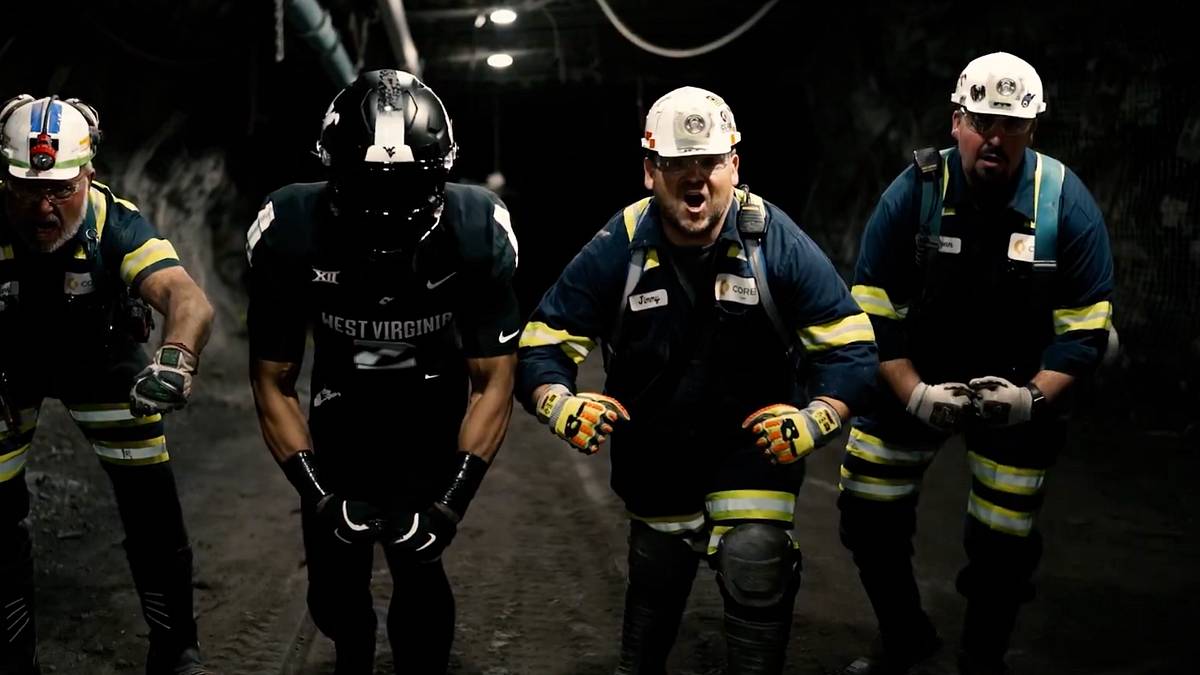
Before the Mountaineers kicked off against Arizona on October 10, 2026, West Virginia coal miners joined the Mountaineer Mantrip at Milan Puskar Stadium. Players wore black from helmet to cleats, with details inspired by the reflective equipment miners use underground. The occasion was called Coal Rush, but the people being recognized were far removed from a football box score.
West Virginia lost 52–31 to the Wildcats. The result was disappointing for a Mountaineers team that had opened the season 3–0 before falling into a three-game losing streak. Yet the university’s tribute was never dependent on a winning score. Coal Rush was created to recognize the courage, labor and communities associated with the state’s mining history.
Two slogans captured that purpose: “Built on Bravery” and “Coal Never Quits.” One had been part of the university’s coal-inspired identity since 2024. The other appeared prominently in WVU Football’s 2026 uniform reveal. Together, they connect modern college football imagery with a story rooted in the Mountain State.
What Is WVU’s Coal Rush, and Why Does It Honor West Virginia Miners?
Coal Rush began in 2024 when West Virginia University introduced black alternate football uniforms designed around the state’s coal-mining heritage. The first Coal Rush took place on October 12, 2024, against Iowa State, and included miner recognition, a special Mountaineer Mantrip and a stadium presentation built around the new uniform.
The design was unusually specific. Reflective lettering recalled the safety markings found on mining clothing. A coal-patterned texture on the uniform came from imagery of an actual sheared mine wall. The monochrome look acknowledged an industry deeply connected to West Virginia’s economic and family histories.
The ceremony also drew on an older football tradition. Since 2011, the Mountaineer Mantrip has brought the team along a route toward the stadium, taking its name from the transport used to carry miners underground. At the end of the route, players touch a piece of coal before entering.
For the inaugural Coal Rush, miners joined that procession. WVU’s photographic account documented the miners, the black uniforms, the tribute to mine rescue personnel and the crowd’s reaction. Those are the human details that explain why the event became an annual part of Mountaineer culture.
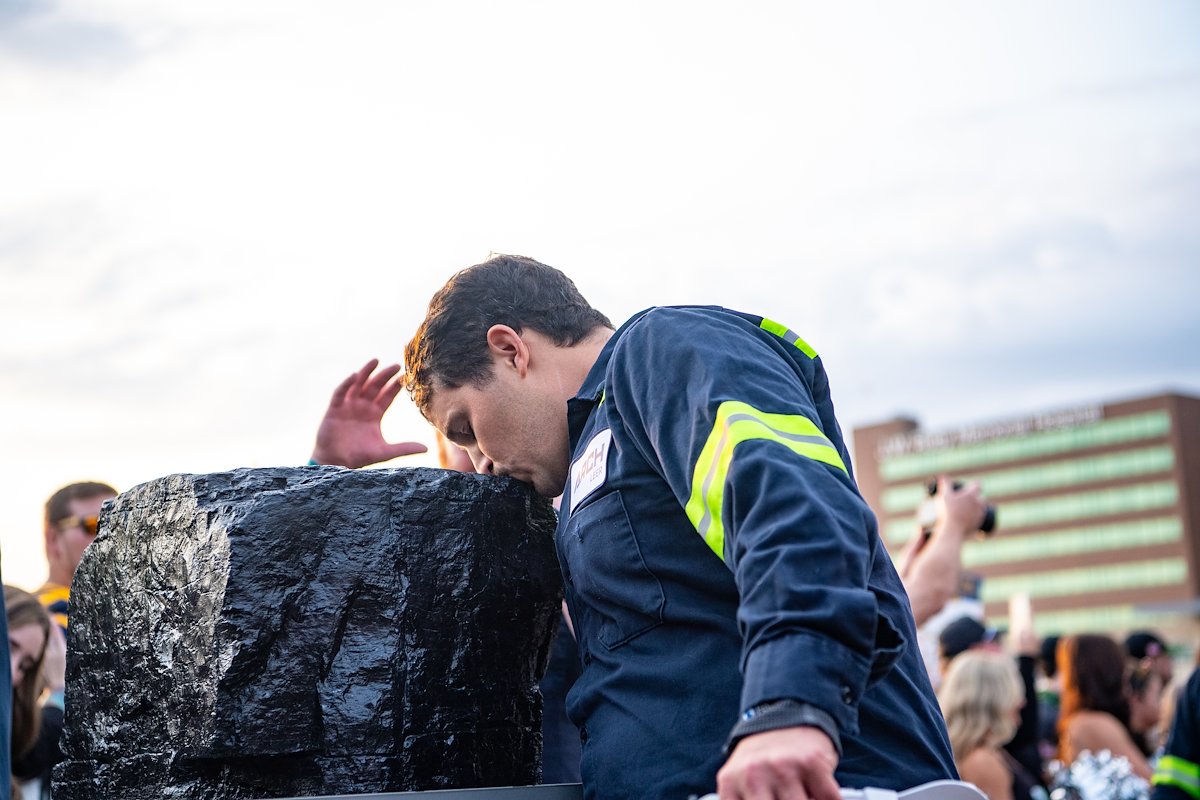
The meaning of Coal Rush was established before the final whistle: honor the people whose work helped shape West Virginia.
What Happened at the 2026 Coal Rush Game Against Arizona?
The tradition returned on October 10, 2026, when West Virginia hosted Arizona at Milan Puskar Stadium. Fans were encouraged to wear black, matching the team’s special uniforms. Coal miners from American Consolidated Natural Resources and Core Energy accompanied the Mountaineers onto the field, according to the West Virginia Coal Association.
The game itself was difficult. Arizona quarterback Noah Fifita passed for 341 yards as the Wildcats capitalized on explosive plays and WVU turnovers. West Virginia produced 522 yards of offense, including 141 rushing yards from Cam Cook, but could not overcome Arizona’s scoring efficiency.
The Coal Rush occasion nevertheless drew 50,121 spectators and made the miners’ tribute part of the day’s official coverage. The Coal Association published a statement on October 12 emphasizing the meaning of the uniforms and the decision to recognize the workers directly.
That distinction matters when interpreting the shirts. Neither “Built on Bravery” nor “Coal Never Quits” is a claim that WVU won the 2026 game. The slogans describe a heritage-based identity that existed before kickoff and remained meaningful afterward.
Why Does “Built on Bravery” Matter to West Virginia?
Mining has shaped West Virginia towns, employment, family relationships and community institutions for generations. Its history also includes difficult working conditions, industrial disasters and continuing questions about workers’ safety. Any meaningful tribute to the state’s miners must recognize the human cost and responsibility behind the word “bravery.”
WVU’s slogan frames courage as something associated with real people, not simply a metaphor for football toughness. The university developed a related merchandise collection alongside its black uniforms, using West Virginia geography, mining references and the Flying WV to connect its athletic identity with the wider state.
That approach helps explain why “Built on Bravery” works without a player’s name or a game score. It belongs to a story larger than one football season.
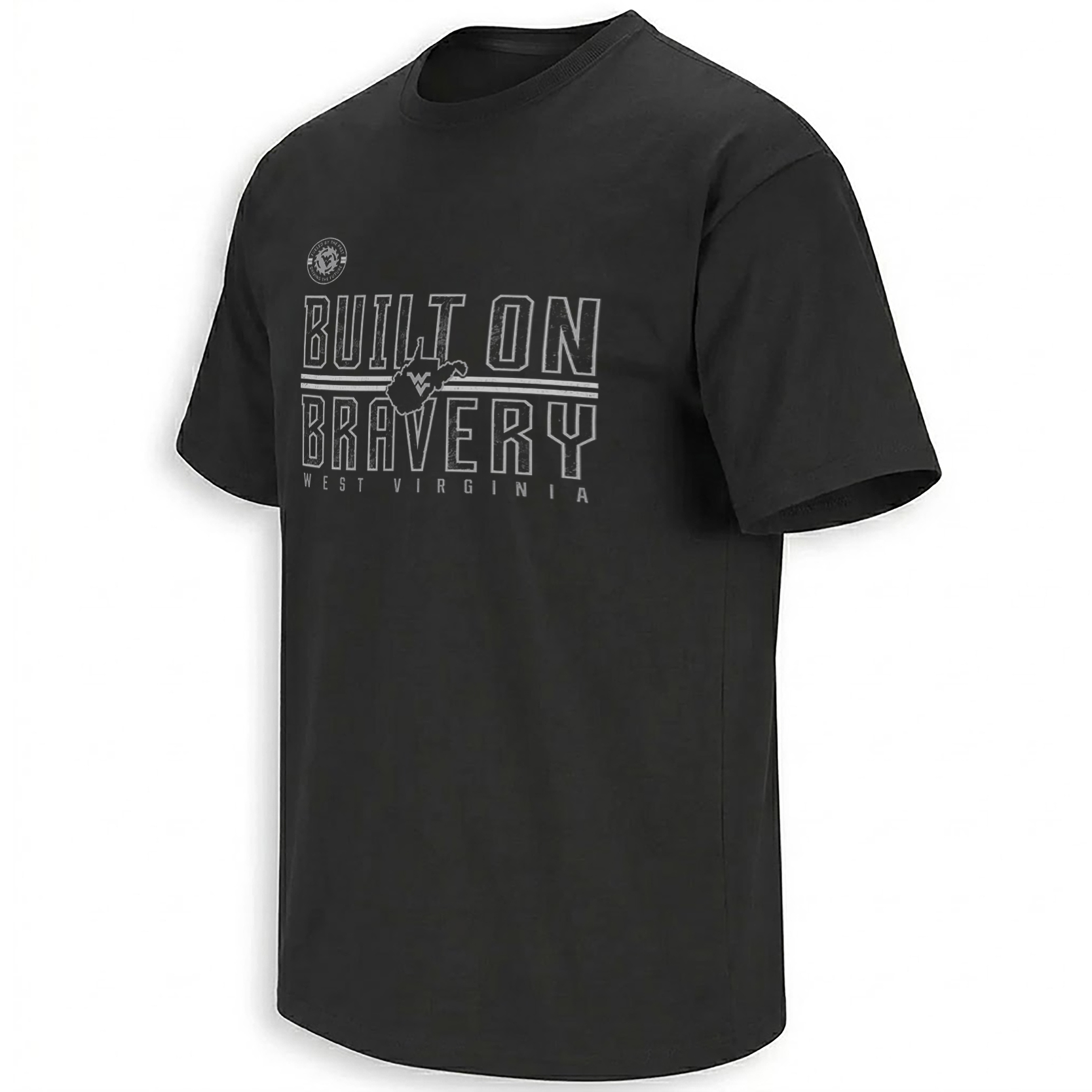
Distressed collegiate typography, the West Virginia state outline and a Flying WV-inspired emblem connect Mountain State geography with WVU’s coal-mining tribute.
View the state-outline design →This version places a West Virginia silhouette between two lines of oversized “BUILT ON BRAVERY” lettering. The Flying WV shape sits inside the map, making the connection between state and university immediately legible. A small circular mark and horizontal dividers reinforce the vintage collegiate layout.
The weathered gray-white print against black is restrained rather than celebratory. Its strongest feature is geographical: the state itself becomes the central symbol, expressing where the tradition began and whom it represents.
Why Did “Coal Never Quits” Become Part of the 2026 Uniform Story?
On October 8, 2026, the official West Virginia Football account released its uniform video for the Arizona game with the words “COAL NEVER QUITS.” The footage presented the team’s all-black combination — helmet, jersey and pants — in the same industrial visual language that has distinguished Coal Rush since its introduction.
The phrase uses a familiar sports idea, perseverance, but places it inside West Virginia’s mining identity. It suggests continuity and determination among communities whose experiences cannot be measured by a football record.
It is a symbolic slogan, not a literal statement about coal reserves, future employment or the energy industry. In the context of Coal Rush, its purpose is to recognize the people and traditions represented by the uniforms.
How Do the Two Built on Bravery Designs Tell Different Stories?
The second design uses the same central slogan but moves away from the state-map treatment. Large distressed block lettering dominates the composition, with “WEST VIRGINIA,” “MOUNTAINEERS” and “COAL NEVER QUITS” arranged within its broader typographic structure.
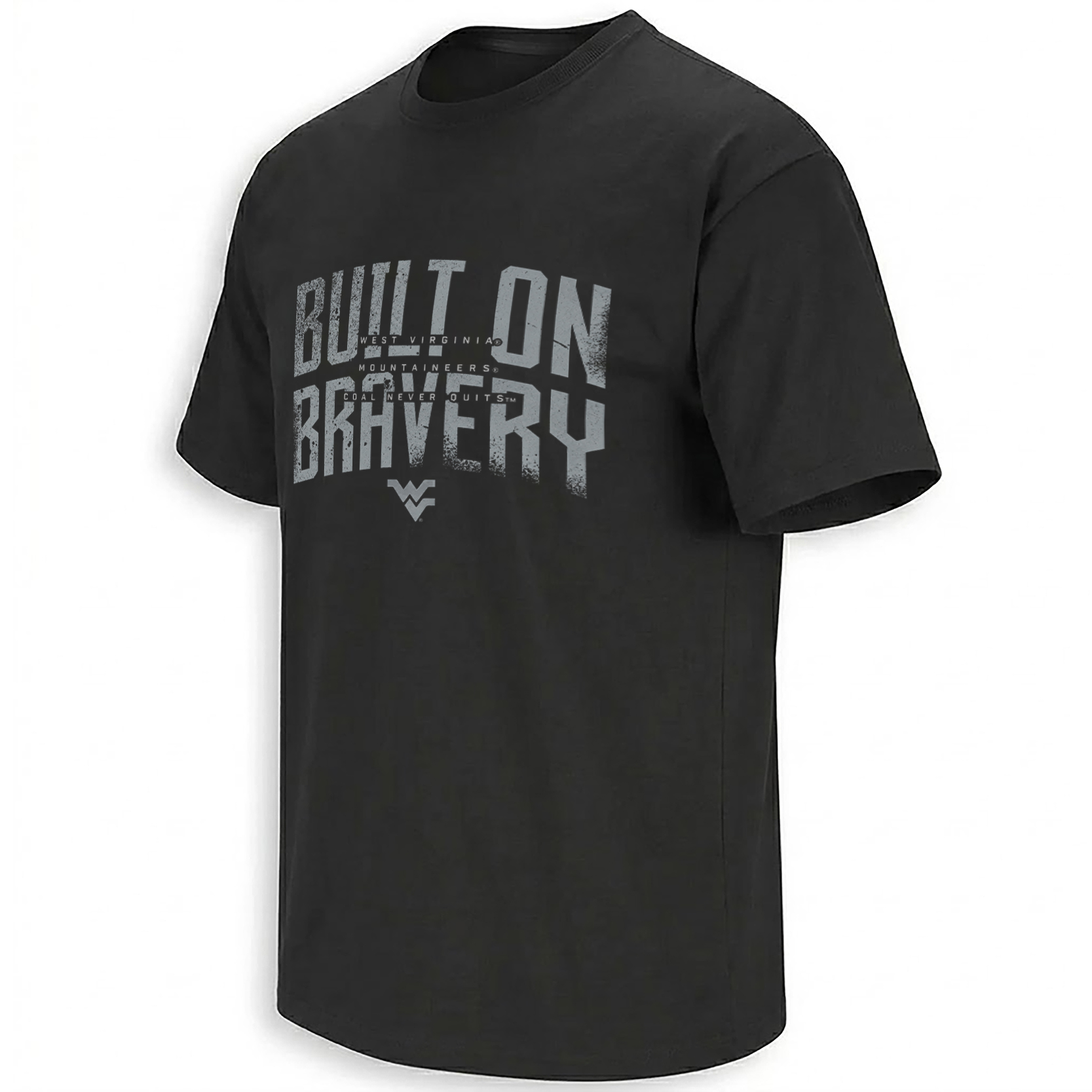
Oversized weathered typography, layered Mountaineers wording and a Flying WV emblem reinterpret the coal heritage slogan as a vintage football graphic.
Explore the typography design →This composition depends almost entirely on typography. The irregular gray printing suggests age and repeated use, recalling older university athletic graphics. The Flying WV anchors the design below the lettering, while the black background ties it visually to the Coal Rush uniform.
The two approaches therefore preserve different aspects of the same heritage. One emphasizes the state as a place; the other emphasizes an enduring message.
Focuses on West Virginia geography, the Flying WV and a direct connection between local identity and the Built on Bravery slogan.
Uses layered lettering and a stronger slogan-driven composition to recall old collegiate prints and the 2026 Coal Rush campaign.
Why Does Coal Rush Connect With Mountaineers Beyond Football?
The emotional reach of Coal Rush comes from its connection to West Virginia families and towns, including people whose relatives have worked in mining. WVU also maintains mining-related educational and safety programs, making the relationship more substantial than an annual alternate-uniform theme.
In 2026, the Coal Rush look had expanded beyond football into other WVU sports. Men’s basketball debuted its own coal-inspired uniforms earlier in the year, demonstrating how the visual identity had become a broader part of Mountaineer athletics.
That continuity gives the two graphics their relevance. They are connected to a university tradition, but the central meaning is about heritage rather than a temporary football ranking.
The wider West Virginia Mountaineers collection follows other visual expressions of WVU identity, including the traditions of Morgantown and the Mountain State. The broader NCAA collection connects Coal Rush to the distinctive histories and symbols surrounding college athletics.
Both designs are interpretations of WVU’s mining-heritage identity. Neither claims a 2026 championship, a victory against Arizona or a direct connection to an individual player. Their cultural meaning is rooted in the Built on Bravery initiative and the recurring Coal Rush tradition.
Frequently Asked Questions
What does Built on Bravery mean at West Virginia University?
Built on Bravery is a WVU identity introduced with its coal-inspired football uniforms in 2024, honoring the courage, labor and heritage of West Virginia miners.
What is the WVU Coal Rush football game?
Coal Rush is a West Virginia University football tradition featuring black alternate uniforms and activities recognizing the state’s coal-mining heritage. The inaugural event took place in October 2024.
What happened during the 2026 WVU Coal Rush?
WVU hosted Arizona at Milan Puskar Stadium on October 10, 2026. The Mountaineers wore black and honored miners during the event, while Arizona won the game 52–31.
What does Coal Never Quits mean?
Coal Never Quits is a slogan used in WVU’s Coal Rush identity to express persistence and pride in West Virginia’s mining communities. WVU Football included it in the October 8, 2026 uniform announcement.
Why are WVU Coal Rush uniforms black?
The black uniforms reference coal-mining environments and include elements inspired by miners’ protective clothing, including reflective markings and a coal-textured pattern.
What is the difference between the two Built on Bravery shirt designs?
The state-outline version places the Flying WV within a West Virginia silhouette, while the Coal Never Quits version emphasizes layered heritage slogans and distressed collegiate typography.
The Built on Bravery state-outline graphic and the Coal Never Quits interpretation document two different ways WVU football connects its visual identity with West Virginia’s mining history. The scoreboard changes every Saturday; the heritage is carried forward from generation to generation.
WVU Coal Rush 2026 brought West Virginia’s mining heritage into the football spotlight through black uniforms, miner recognition and the Built on Bravery identity. Two heritage-inspired designs use a state-shaped Flying WV emblem, distressed collegiate lettering and the Coal Never Quits slogan to preserve the tradition’s cultural meaning.