
Stand Guard. Cleveland Refused to Let October End.
Down two games, Cleveland needed three consecutive victories to keep its season alive. The Guardians delivered, turning an improbable 2026 ALDS comeback into a celebration that gave the words “Stand Guard” fresh meaning.
At Progressive Field on October 10, 2026, José Ramírez stood before an elated Cleveland crowd holding a flag that read “Stand Guard.” Supporters chanted his name, and the Guardians were headed to the American League Championship Series after defeating the Chicago White Sox 2–0 in the deciding fifth game of the ALDS.
The celebration would have been emotional in almost any season. This one carried another layer. Cleveland had lost the first two games of the series at home, leaving the team facing elimination on the road. Then came three consecutive wins, a transformation from near-certain disappointment into one of the most memorable postseason comebacks in franchise history.
By the time Ramírez raised the flag, the phrase seemed to describe everything the Guardians had survived: an unforgiving divisional rivalry, a difficult offensive start and the pressure of three games with no room for another defeat. The image connected Cleveland’s modern team identity with the kind of October memory that supporters carry long after a final out.
How Did the Guardians Come Back From 0–2 Against Chicago?
The series began with the White Sox winning Games 1 and 2 at Progressive Field. Their lineup and pitching staff left Cleveland with a brutal assignment: win twice at Rate Field in Chicago, then return home and finish the job. A single loss would have ended the Guardians’ season.
Game 3 provided the first response. Cleveland broke through for a 9–3 victory, with José Ramírez contributing a two-run triple, aggressive baserunning and an important defensive play. The offense that had struggled during the opening losses finally looked capable of carrying the team through October.
In Game 4, the Guardians won 9–5 to level the series. Ramírez homered again, and a six-run sixth inning changed the direction of the game. Cleveland had survived two elimination contests. The deciding Game 5 would return to Progressive Field, where the series had originally begun so badly.
Saturday’s finale was different from the two high-scoring wins in Chicago. Runs were scarce, and pitching controlled the evening. Ramírez supplied a fourth-inning two-run homer against Sean Burke, while Gavin Williams and the Cleveland bullpen shut out the White Sox. The team’s four pitchers combined for 21 strikeouts, a record in a nine-inning major-league game.
Three elimination games. Three Cleveland victories. One flag raised after the final out.
Editorial reflection on the 2026 ALDS comebackWhat Happened During the Stand Guard Flag Celebration?
The emotional center of the scene was not a trophy presentation. It was Ramírez holding the Stand Guard flag while fans at Progressive Field chanted his name. The moment followed the team’s Game 5 victory and was preserved in an official 21-second MLB video published on October 10.
That distinction matters because the phrase was already part of Cleveland’s baseball vocabulary. It was not created solely to celebrate the Game 5 win. Yet seeing the team’s most recognizable player carry those words after completing a historic comeback gave the familiar message a direct connection to the 2026 postseason.
Watch the verified José Ramírez Stand Guard flag celebration from the Cleveland Guardians’ MLB video archive. The clip shows the flag and the crowd’s response following Game 5.
Ramírez’s role in the scene added further meaning. The third baseman had continued playing through the effects of a wrist injury during a challenging season. His return to form across the final three ALDS games was essential to Cleveland’s comeback, but the flag represented an accomplishment larger than any one player.
Why Is “Stand Guard” Connected to Cleveland’s Identity?
The words reach beyond the baseball diamond. When the franchise adopted the Guardians name, it drew inspiration from the Guardians of Traffic sculptures that stand on the Hope Memorial Bridge near Progressive Field. The monumental sandstone figures, completed in the early twentieth century, became symbols of the city’s architecture, endurance and identity.
According to the team’s official explanation, the Guardians name is associated with loyalty, community and the determination to protect what Clevelanders value. The Hope Memorial Bridge itself provides a visual link between the city’s industrial history and the baseball franchise’s contemporary identity.

This connection helps explain why Stand Guard works as a rallying phrase rather than just a piece of promotional language. “Stand” suggests determination and collective presence. “Guard” echoes the franchise’s name and its relationship with Cleveland’s landmarks. Together, the words carry a sense of protecting something earned through history and sustained through adversity.
How Does the Stand Guard Design Reflect the 2026 Postseason?
The Stand Guard artwork uses Gothic-inspired typography on a vivid red shirt. A navy Cleveland C emblem sits above the central message, accompanied by four diamond-shaped accents. The words “Stand Guard” dominate the composition through large pale letters outlined and shadowed in navy.
The type resembles old blackletter signage and vintage baseball lettering, giving the message a heavier, more historical personality than a standard modern sports logo. A smaller postseason inscription anchors the graphic to October baseball without specifying a championship that the team has not won.
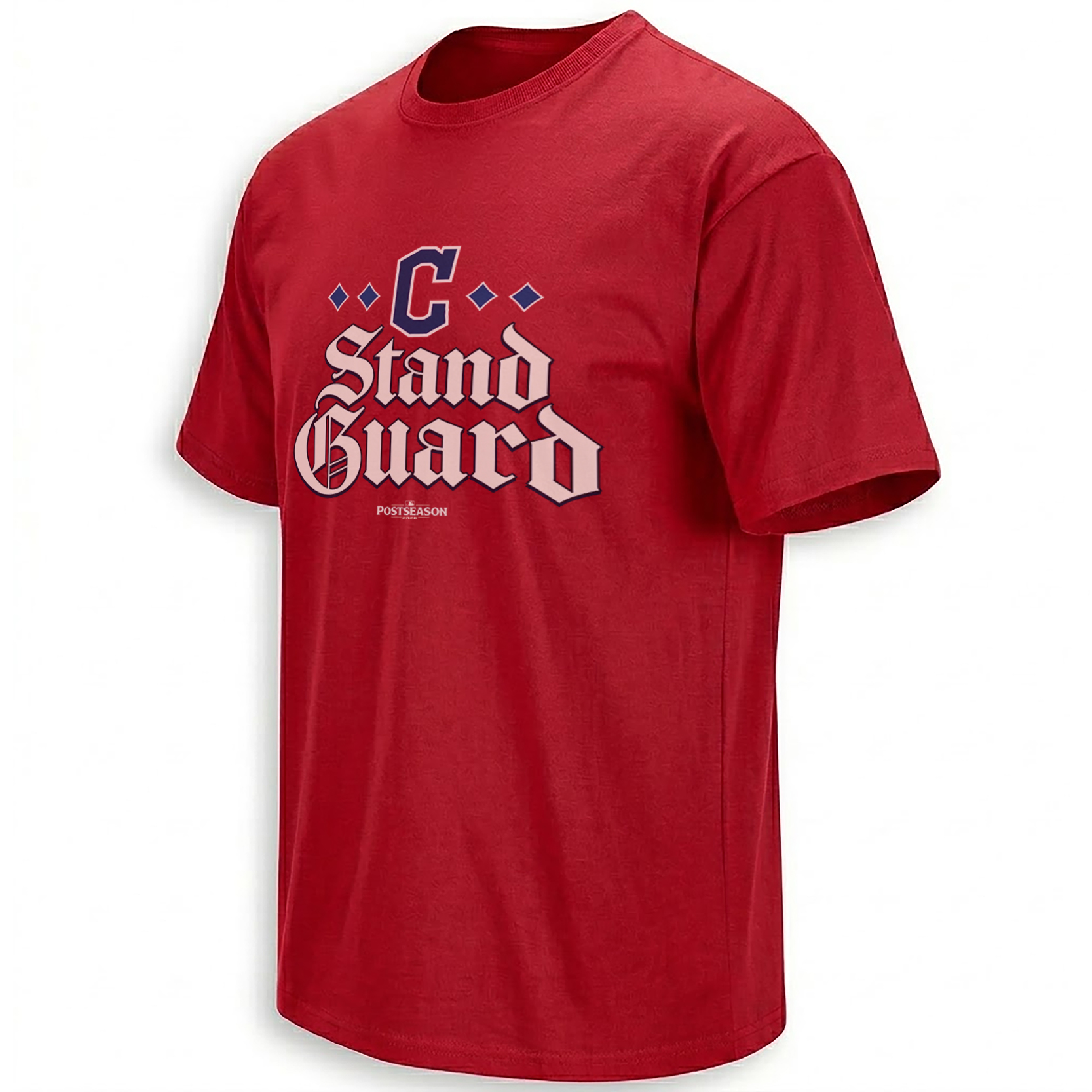
The lack of a player portrait makes this design distinct from a Ramírez-specific tribute. The red, navy and cream palette establishes the team connection, while the old-style lettering gives the slogan an authoritative feeling. Its meaning extends beyond the batter who delivered the decisive hit.
The design’s visual hierarchy is deliberate: Cleveland’s emblem first, the collective command second, and the postseason context below. It resembles a commemorative sports banner rather than a conventional player poster. That makes it especially well suited to an article about how a city identifies with its team during a period of adversity.
Why Does Cleveland’s Comeback Matter to the Fan Base?
Elimination games change the emotional rhythm of a postseason. Every at-bat might be the last meaningful opportunity of the year. A bullpen escape becomes an enormous moment, and a routine defensive play can carry the weight of an entire season. For Cleveland supporters, the three victories after falling behind 0–2 meant experiencing that pressure repeatedly.
The comeback also followed the Guardians’ late-season push to reclaim the American League Central title. In both cases, the team had to recover from a difficult position instead of simply protecting an early advantage. The October series gave that recurring theme its most concentrated expression.
There are limits to what can be inferred from fan reactions. Not every supporter interprets the 2026 season in the same way, and the excitement of one series does not guarantee success in the next. But the immediate response to Game 5 included celebrations of the team’s resilience, relief after the difficult first two games and admiration for the pitching staff and Ramírez.
What Awaits the Guardians Against the Tampa Bay Rays?
Cleveland’s next challenge is the American League Championship Series against Tampa Bay. Game 1 is scheduled for October 12 at Tropicana Field, with Game 2 following on October 13. The series then moves to Cleveland for Games 3 and 4 on October 15 and 16.
The Rays arrive after sweeping the New York Yankees, while Cleveland enters following a five-game series that required every available resource. That contrast makes pitching management, bullpen recovery and timely offense important storylines. The Guardians have earned a place in the ALCS, but the pennant remains undecided.
Within the Cleveland Guardians collection, the Stand Guard graphic belongs beside visual references to individual players, October comebacks and the modern club identity. The broader MLB collection places this moment among the rivalries and postseason stories shaping baseball in 2026.
The individual hero of the Game 5 celebration remains accessible through the José Ramírez design search, but this particular slogan centers on the team and the city whose name it carries.
Frequently Asked Questions
What does Stand Guard mean for the Cleveland Guardians?
Stand Guard expresses Cleveland’s baseball identity through ideas of loyalty, resilience and collective determination, connected to the Guardians name.
Did José Ramírez hold a Stand Guard flag in 2026?
Yes. MLB published footage of Ramírez holding the flag after Cleveland’s ALDS Game 5 victory on October 10, 2026.
How did the Guardians win the 2026 ALDS?
Cleveland lost the first two games against the Chicago White Sox, then won three straight to take the series 3–2.
What happened in Game 5 against Chicago?
José Ramírez hit a two-run home run and Cleveland’s pitching staff completed a shutout in a 2–0 victory.
Why is Cleveland named the Guardians?
The name draws inspiration from the Guardians of Traffic sculptures on the Hope Memorial Bridge near Progressive Field.
Who will Cleveland play in the 2026 ALCS?
The Guardians are scheduled to face the Tampa Bay Rays in a best-of-seven series beginning October 12.
Is the Stand Guard graphic a World Series championship design?
No. The design references Cleveland’s postseason identity and does not claim the team has won the 2026 World Series.
The most enduring October memories usually combine something extraordinary on the field with an image that captures how it felt. For Cleveland, the three-game comeback and the raised Stand Guard flag became connected parts of that story. The Stand Guard graphic interprets the words at the center of that celebration, while the next chapter awaits in the ALCS.
Stand Guard is a Cleveland Guardians 2026 postseason graphic inspired by the team’s dramatic ALDS comeback and José Ramírez’s flag celebration. Gothic-style lettering, a navy C emblem and bold red baseball colors connect the design with Cleveland’s city identity and October resilience.